
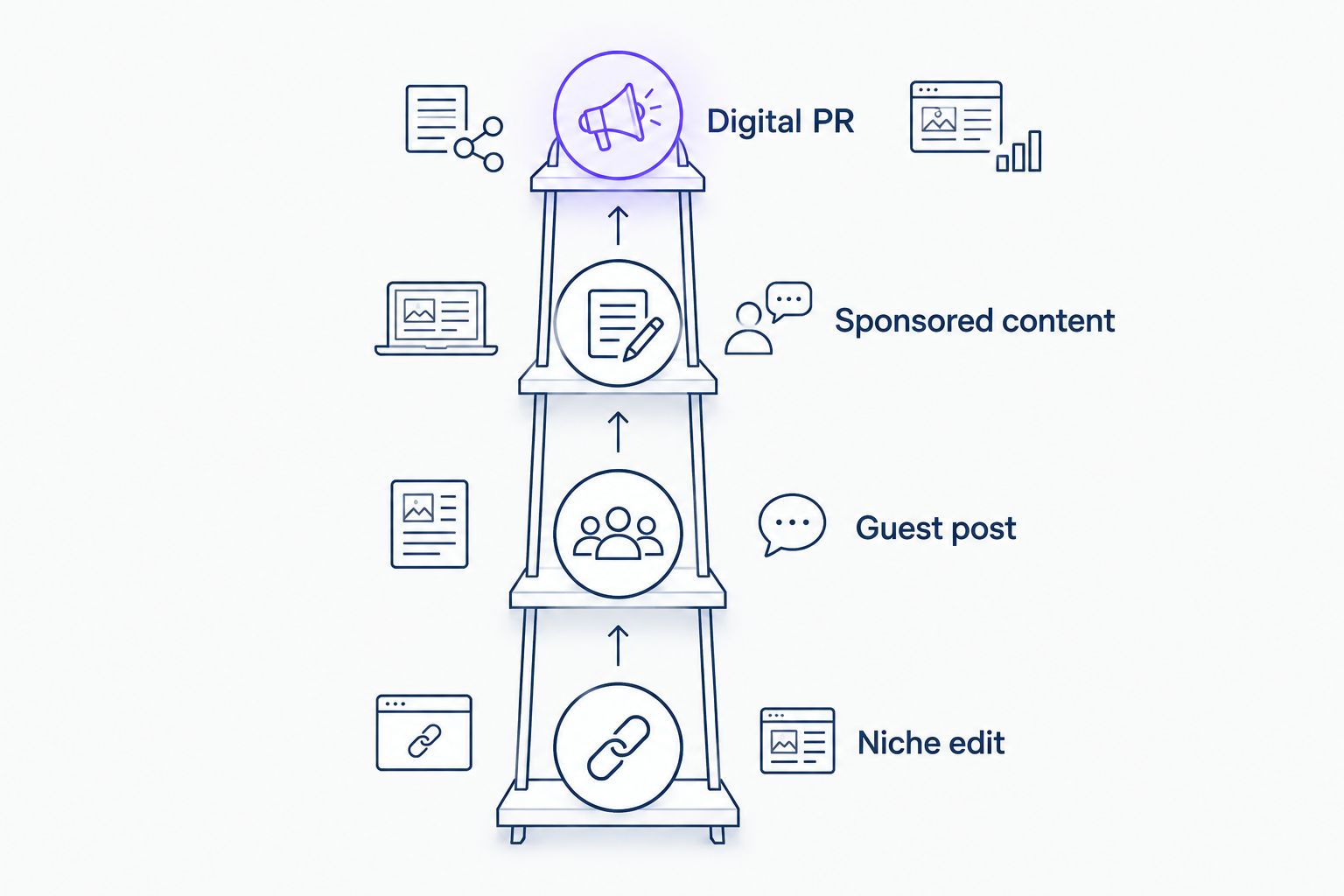
Backlink cost by link type in 2026 follows a clear order: niche edits sit at the low end, guest posts in the middle, sponsored content above them, and digital PR placements at the top. This page ranks the four link types by relative cost, explains what drives each, and tells you which to buy first.
- Backlink cost by link type in 2026 runs niche edit, guest post, sponsored content, digital PR, from cheapest to most expensive.
- Cost follows production effort: a niche edit inserts one link; a digital PR placement needs a story an editor will run.
- Publisher quality moves price within every link type more than the link type itself does.
- Buy niche edits and guest posts first; add digital PR once the foundation is in place.
Short answer: what backlinks cost in 2026
The average cost of a backlink is not a single number, and any page that gives you one is averaging four different products. In 2026 the useful benchmark is the relative cost order between link types, because that order holds across publishers while dollar rates move constantly.
This page deliberately publishes no dollar figures. Rates change by publisher, niche and month, and a hard-coded price goes stale fast. For rate ranges tied to publisher quality, use the guest post pricing benchmarks by domain rating. The structure below tells you what to expect before you open a rate card.
The benchmark table: cost position by link type
One row per link type. The "All link types" row is your yardstick: every other row is judged against it.
| Link type | Relative cost (1 = lowest, 4 = highest) | Main cost driver | Main risk | Best for |
|---|---|---|---|---|
| Niche edit (link insertion) | 1 | Publisher authority and page traffic | Link can be removed later | Fast authority on existing, indexed pages |
| Guest post | 2 | Content creation plus publisher quality | Thin content on low-quality sites | Steady topical coverage and anchor control |
| Sponsored content | 3 | Publisher audience and disclosure terms | Rel attributes and disclosure rules | Brand mentions on strong media sites |
| Digital PR placement | 4 | Story development and editorial acceptance | Coverage is not guaranteed | Brand authority and links from top-tier publications |
| All link types | 1 to 4 | Publisher quality, then effort | Quality varies more than type | Mix by goal and budget |
The ranking is by production effort. A niche edit adds one link to an article that already exists. A guest post needs a written article. Sponsored content adds publisher audience and disclosure handling on top of that. Digital PR needs a story strong enough that an editor chooses to run it.
Which link type costs the most, and which the least
Digital PR leads at the top of the cost range; niche edits trail at the bottom. Guest posts and sponsored content sit between them, and the gap between those two comes down to the publisher's audience and how the placement is labeled.
Two caveats keep the table honest. First, a high-authority niche edit can cost more than a guest post on a mid-tier site, so publisher quality can reorder the rows. Second, digital PR is priced on effort and outcome uncertainty, so two campaigns with the same budget can land very different coverage.
Niche edits: lowest cost, lowest control
A niche edit places your link inside an article that is already published and indexed. You pay for the insertion, not for the writing, so this is the cheapest way to get a contextual link on an established page.
- Pros: fast, because the page is already indexed and may already carry traffic and links.
- Pros: no content production cost on your side.
- Cons: the publisher can edit or remove the link later, and you do not control the surrounding context.
- Cons: the topical fit depends on what the publisher already wrote.
Best for: teams that need authority on a specific page quickly and can accept less control. Verdict: Buy, after you vet the publisher.
Pricing varies by authority, and the niche edit pricing benchmarks by domain rating break that out. Check how long placements stay live before you commit to a volume order.
Guest posts: the middle of the range
A guest post is a new article, written for a publisher, with your link placed in the body. You pay for content creation, publisher access and placement. That bundle puts guest posts second in the cost order.
- Pros: you control anchor text, target page and topic angle within publisher guidelines.
- Pros: the article is built around your link, so context is strong.
- Cons: costs more than an insertion because someone has to write and edit the piece.
- Cons: quality ranges widely, and cheap placements on low-quality sites carry spam risk.
Best for: sustained topical coverage where you want control over what the link sits inside. Verdict: Buy. Guest posts are the default first purchase for most SEO teams.
When a guest post is priced well below the others in its tier, that is a quality warning, not a discount. Audit the publisher before paying, and treat unusually low rates as a reason to look closer.
Sponsored content: paying for the audience
Sponsored content is a paid placement that is labeled as such. You are buying the publisher's audience and brand association as much as the link, so it costs more than a standard guest post on a comparable site.
- Pros: access to publishers that do not accept unpaid guest contributions.
- Pros: clear commercial terms, with disclosure handled up front.
- Cons: links may carry a sponsored or nofollow attribute, which changes how much ranking value you get.
- Cons: disclosure rules apply, and mistakes create legal and SEO exposure.
Best for: brand mentions and referral exposure on strong media sites. Verdict: Hold until you have a clear goal beyond link equity. For platform-level rate comparisons, see the sponsored content pricing benchmarks by platform type.
Digital PR: highest cost, highest ceiling
Digital PR earns coverage by pitching a story to journalists and editors. You pay for story development, outreach and the real chance that nobody runs it. That uncertainty is priced in, which is why this row tops the table.
- Pros: links from top-tier publications that most paid placements cannot reach.
- Pros: one strong story can be repurposed into several placements.
- Cons: coverage is not guaranteed, and timelines are longer than any other type.
- Cons: you do not control anchor text or the final wording.
Best for: brand authority and links from publishers that do not sell placements. Verdict: Wait until your core pages and a base of guest post and niche edit links are in place. The digital PR placement cost benchmarks by publisher tier show how pricing scales with the publisher.
Method and limits of these benchmarks
The order above reflects how each link type is produced and sold: what work the price pays for, and who controls the outcome. It is a structural ranking, not a survey of transaction prices for 2026.
One limit matters. Publisher quality moves price more than link type does, so a premium publisher's niche edit can out-cost a mid-tier publisher's guest post. Use the table to set expectations, then confirm the live rate for the specific publisher you are considering.
What actually moves the price within a link type
Three cost drivers explain nearly every quote you will see in 2026:
- Publisher authority. Higher domain rating and stronger topical relevance cost more. Domain rating alone is a blunt measure, so read the take on whether domain rating is a reliable measure of link quality before using it as your only filter.
- Real traffic. A site with an engaged audience prices above a site with the same rating and no readers.
- Niche. Finance, health, legal and other regulated or competitive topics cost more because fewer publishers accept them and compliance review adds work.
A fourth factor shows up in volume orders: who is reselling. An agency that marks up placements adds its margin on top of the publisher's rate, which is why a direct marketplace purchase usually compares well against a bundled agency retainer.
How to use these benchmarks
- Start with the cheapest type that fits your goal. If you need authority on existing pages, begin with niche edits. If you need new topical coverage, begin with guest posts.
- Judge a quote against the publisher, not the link type. A rate far below its tier signals a weak site. A rate far above it signals a markup.
- Mix types over 2026 instead of buying one in bulk. A profile built from several link types looks more natural and spreads risk.
- Reserve digital PR for the second phase. It pays off most when the pages it points to are already built to rank.
NO-BS Marketplace is a link building and guest posting platform that connects SEO professionals and agencies with verified publisher sites. If you want current rates for guest posts, niche edits, sponsored content and digital PR placements, NO-BS Marketplace lists them by publisher. NO-BS Marketplace is best for agencies and SEO teams that want to compare publishers side by side before paying.
FAQ
What is the cheapest type of backlink to buy in 2026?
Niche edits are the cheapest link type in 2026 because you pay for an insertion, not a new article. Publisher authority can still push a niche edit above a guest post on a weaker site.
Which backlink type costs the most?
Digital PR placements cost the most. You pay for story development and outreach, and coverage is not guaranteed, so the price reflects effort and uncertainty.
Are guest posts more expensive than niche edits?
Yes, guest posts cost more than niche edits in most cases. A guest post includes writing a new article, while a niche edit adds a link to an existing one.
Why does sponsored content cost more than a guest post?
Sponsored content buys the publisher's audience and brand association along with the link. It also carries disclosure requirements that add handling work.
Does a higher price mean a better backlink?
No. Price tracks publisher authority, real traffic and niche, but a high rate can also be a reseller markup. Audit the publisher before paying.
Why are backlink prices not listed on this page?
Rates change by publisher, niche and month, so fixed figures go stale. The relative cost order is the stable benchmark; confirm live rates with the seller.
Should a new site start with niche edits or guest posts?
Most new sites start with guest posts because they give you control over topic and anchor text. Add niche edits once you have indexed pages worth strengthening.
One last thing
The cheapest placement in a tier is rarely the bargain. When a quote lands well below comparable placements for the same link type, assume the publisher is the reason, and check the site's real traffic and outbound link patterns before you pay. Skipping that check costs more than any rate difference you save.