
No—domain rating is useful for comparing backlink profiles, but it is not a reliable standalone measure of link quality. In 2026, assess the referring page, topical relevance, editorial standards, and link attributes before treating a high score as a reason to pursue a placement.
- Is domain rating a reliable measure of link quality? No—Ahrefs DR supports screening, not final placement decisions.
- Google does not use Ahrefs Domain Rating as a ranking score.
- Check backlink relevance, publisher standards, and the actual referring page before approving guest posts.
- NO-BS Marketplace connects SEO professionals and agencies with publishers; each placement still needs individual assessment.
Is domain rating a reliable measure of link quality?
Domain Rating measures domain-level backlink strength, not the quality of a particular backlink. Ahrefs describes DR as a relative metric on a logarithmic scale from 0 to 100. It does not certify editorial quality, topical relevance, or the value of a proposed placement.
Use the score to organize your shortlist, then audit the publisher site before buying a placement. The distinction matters: you receive a link from a page, not from a domain-level score.
| Assessment approach | Best for | Main advantage | Main limitation | Recommendation |
|---|---|---|---|---|
| Domain Rating alone | Initial backlink-profile screening | Makes domain-level comparisons quick | Does not assess the actual placement | Use for screening only |
| Referring-page review | Checking a specific opportunity | Reveals context, accessibility, and surrounding links | Requires manual inspection | Make this mandatory |
| Publisher and relevance review | Checking audience and editorial fit | Tests whether the mention belongs on the site | Requires judgment beyond a score | Combine with page review |
| Post-publication measurement | Checking campaign outcomes | Connects placements with observed traffic and performance | Cannot isolate every ranking influence | Use alongside pre-placement checks |
No single row replaces the others. A strong publisher can host an unsuitable article, and a useful specialist publication can have a modest backlink profile.
Why this matters
A DR-only buying rule turns a screening metric into an approval policy. Your team stops asking whether a placement makes sense and starts asking whether it clears a numerical threshold.
That creates a reporting problem too. A report full of strong domain scores can still leave a client asking which pages received relevant mentions, whether anyone visited, and what happened to qualified organic traffic.
For your 2026 link-building plan, separate publisher selection, placement approval, and outcome measurement. DR belongs mainly in the first task. It cannot complete the other two.
What Domain Rating actually tells you
Ahrefs Domain Rating summarizes the strength of a website's backlink profile relative to other websites in its database. Its calculation considers referring domains and the strength and distribution of their links.
The scale is logarithmic, not linear. A movement of 10 DR points does not represent a fixed amount of additional ranking value, and a score of 80 does not mean a backlink is twice as valuable as one from a domain scoring 40.
Those figures describe the metric, not buying thresholds. There is no universal minimum DR that makes a backlink good.
Domain strength is not page strength
A domain-level score combines information across a website's backlink profile. Your proposed article has its own circumstances: internal links, external references, content quality, and accessibility.
A newly published guest post does not automatically inherit the practical value of the publisher's strongest pages. Inspect how the publisher connects articles to relevant sections and whether readers can discover the proposed page through ordinary browsing.
Domain Rating is not Google's rating
Ahrefs calculates DR. Google does not use Ahrefs DR as a ranking factor, and a change in DR is not evidence that Google has changed its assessment of your website.
For a 2026 evaluation, use Ahrefs' Domain Rating documentation to understand the metric and Google Search Central's spam policies to assess link practices. These sources answer different questions: how a third-party score works, and which practices violate search policies.
Why link quality varies beyond Domain Rating
The same domain-level metric can accompany very different placement conditions. These factors explain why the score cannot settle a backlink decision:
- Topical relevance: The article should connect naturally with your destination page and the publisher's subject matter.
- Editorial purpose: A link that supports an explanation has a clearer reader purpose than an unrelated promotional insertion.
- Page accessibility: A blocked, missing, or non-indexable page changes the opportunity, regardless of domain strength.
- Internal discovery: An article connected to relevant sections is different from an isolated page with no useful browsing route.
- Outbound-link context: Review surrounding destinations and anchor text for unrelated, repetitive, or forced promotions.
- Commercial treatment: Payment, sponsorship disclosure, and link attributes affect how the placement should be classified.
Do not turn this list into another mechanical score. A serious problem—such as a publisher insisting on an undisclosed paid ranking link—needs a decision, not an average of otherwise positive checks.
How do you evaluate a backlink beyond DR?
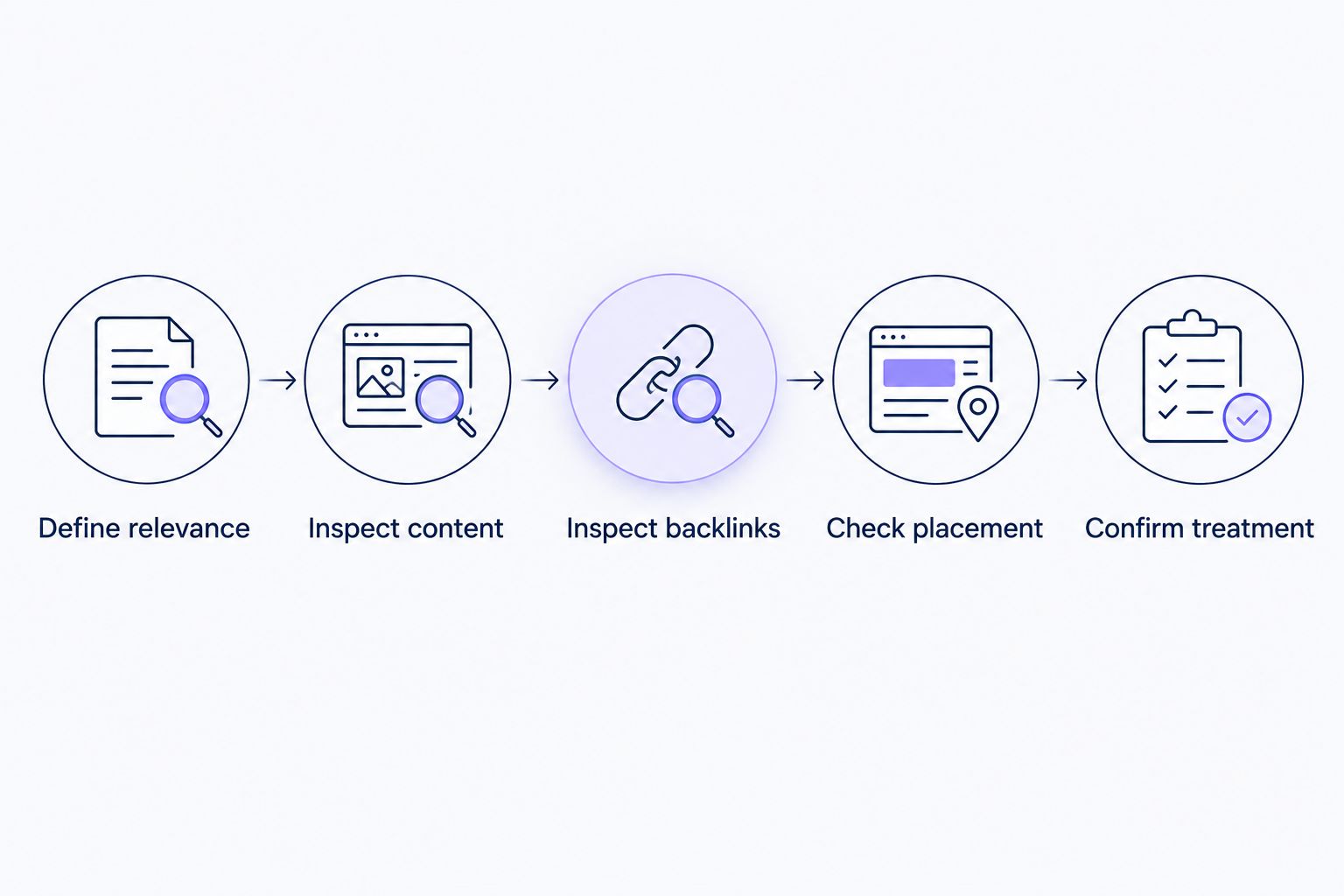
Use this sequence before approving a guest post, niche edit, or sponsored placement. Record the evidence in your campaign sheet so another person can understand the decision without repeating the entire review.
1. Define relevance
Write down why the publisher's audience would care about your destination page. Be specific about the topic, intended reader, and information the link adds.
If your explanation depends entirely on the publisher having high DR, stop. You have described a metric preference, not an editorial reason for the link.
2. Inspect content
As a practical starting sample, review 5 recent articles, including articles in the section where your placement would appear. This is a review procedure, not a quality benchmark.
Check whether articles answer their titles, support factual claims, identify authors where appropriate, and stay within a coherent subject area. Repeatedly unrelated topics and forced commercial links warrant closer inspection; they are not proof of misconduct on their own.
3. Inspect backlinks
Use DR to frame your investigation, then open 3 referring pages from the publisher's backlink profile as an initial manual sample. Expand the review when the examples raise questions.
Look at why those pages link to the publisher. Distinguish references to useful material from irrelevant links, repeated templates, or links connected to an older version of the site. A backlink count alone does not explain those differences.
4. Check placement
Review the proposed article or insertion location, not just the homepage. Check the surrounding paragraph, destination URL, anchor text, and whether the link genuinely helps the reader understand the subject.
For an existing page, inspect its current accessibility and indexing directives. For a new article, agree on its intended section and check the live page after publication rather than assuming the final implementation matches the brief.
5. Confirm treatment
Clarify whether the placement is editorial, sponsored, or otherwise compensated. Google advises qualifying paid links with rel="sponsored"; nofollow is also acceptable for identifying paid links under its guidance.
Do not interpret a sponsorship disclosure as a substitute for the appropriate link attribute. Reader disclosure and search-engine link qualification address different requirements.
The sequence is deliberate: establish the editorial case before investigating the metric, and confirm the commercial treatment before approving publication. A high DR does not reverse a failed check.
Where a publisher marketplace fits
NO-BS Marketplace is best for SEO professionals and agencies sourcing publisher placements, not for replacing placement-level judgment. The link-building platform connects those buyers with verified publisher sites for content, backlinks, sponsored content, and digital PR placements.
The practical benefit is access to publisher opportunities through a platform. The limitation is straightforward: publisher verification and domain metrics do not establish that every topic, destination, or proposed link is appropriate for your campaign.
Use NO-BS Marketplace with a written placement brief. State the subject, intended audience, destination page, editorial expectations, and required commercial treatment before approving an opportunity.
For agencies using NO-BS Marketplace for link building, carry the same criteria into white-label reporting. Explain why a publisher fits the client, rather than presenting a domain score as the entire justification.
How should you use DR in a 2026 link-building brief?
Keep DR as a descriptive field, not the approval rule. A useful brief records the proposed publisher, relevant section, article topic, destination page, expected link treatment, and the reason the placement serves readers.
If a client requests a minimum score, explain what that threshold does and does not establish. It narrows the shortlist by a third-party backlink metric; it does not guarantee traffic, indexing, ranking improvements, or editorial standards.
Replace promises such as “high-DR links will improve rankings” with a delivery standard you can verify: relevant publishers, suitable content, accurate implementation, and documented publication checks. Promise the work and evidence you control, not a search outcome you cannot guarantee.
Can a lower-DR website provide a useful backlink?
Yes—a lower-DR website can provide a useful backlink when the page is relevant and serves the right audience. The score does not directly measure reader interest, specialist expertise, or whether a citation helps explain a subject.
Evaluate the opportunity on its own merits. A niche publication's lower score is not a reason to skip page review, just as a larger publisher's higher score is not a reason to waive it.
Does high DR mean a paid backlink is safe?
No—high DR does not make a paid ranking link compliant with Google's spam policies. Buying or selling links for ranking manipulation falls within Google's link-spam rules, regardless of the referring domain's score.
Sponsored placements have legitimate advertising uses when handled appropriately. Separate advertising and referral objectives from promises of ranking credit, and confirm disclosure and link qualification before publication.
What should you measure after the link goes live?
Record the live referring URL, destination URL, anchor text, link attributes, publication date, and your inspection date. Check that the page is accessible and the link points where agreed.
For a consistent campaign review, choose a 28-day reporting window and compare it with an equivalent baseline. This is a reporting convention, not a claim that backlinks produce results within 28 days.
Track referral visits and relevant conversion events where your analytics setup supports them. Review destination-page search impressions, clicks, and query performance separately; a backlink's publication date does not prove that it caused every subsequent change.
In your 2026 reporting, keep delivery evidence and performance evidence distinct. A live placement proves publication. A higher DR proves a change in a third-party metric. Neither alone proves a commercial return.
FAQ
Is domain rating a reliable measure of link quality?
Domain Rating is useful for comparing domain-level backlink strength, but it is not a reliable standalone measure of link quality. Assess the referring page, topical relevance, editorial standards, and link treatment before approving a placement.
What is a good Domain Rating for backlinks?
There is no universal good Domain Rating for backlinks. Use DR to compare prospects within a relevant shortlist, not as a substitute for checking the actual page and publisher.
Does Google use Ahrefs Domain Rating?
Google does not use Ahrefs Domain Rating as a ranking factor. Ahrefs calculates DR using its own backlink data and methodology.
Is a higher-DR backlink always better?
A higher-DR backlink is not always better. Domain strength does not establish whether the referring article is relevant, accessible, editorially sound, or useful to your audience.
Can a website have high DR and poor-quality content?
Yes, a website can have high DR and poor-quality content because DR measures backlink-profile strength rather than editorial quality. Inspect current articles and the proposed placement separately.
Should agencies promise clients a higher Domain Rating?
Agencies should not present higher Domain Rating as proof of SEO or business success. Report delivered placements separately from referral traffic, search performance, and conversions.
Do sponsored links need special attributes even on high-DR sites?
Paid links should be qualified regardless of the publisher's DR. Google recommends rel=sponsored, while nofollow is also acceptable for identifying paid links under its guidance.
One last thing
Before approving a placement, remove the DR column from your shortlist and reread the reasons for choosing each publisher. If the decision no longer makes sense, investigate further rather than restoring the score as the justification.
The strongest placement rationale survives without a metric in the sentence. It explains the audience, topic, page, and reader benefit—and leaves you with something useful to show the client.