
Guest post pricing by domain rating follows a ladder, and the rungs get expensive fast above DR 50. This page maps the 2026 tiers, shows what each one buys, and gives you a way to check any quote against the tier it claims. Start with how to evaluate domain rating before buying a backlink, because DR alone is a weak price signal.
- Guest post pricing by domain rating climbs with every DR band, with the steepest step above DR 50.
- DR sets the price floor in 2026. Traffic, niche and link type decide where a quote lands.
- A high-DR quote with no organic traffic evidence is a Skip.
- Benchmark each quote against its band, then negotiate on traffic and niche fit.
Short answer
The price of a guest post rises with the publisher's domain rating, and it does not rise in a straight line. Each band from DR 0 to DR 40 costs a little more than the last. Above DR 50 the gap between bands widens, and above DR 70 you are pricing a scarce asset, not a commodity.
This page does not print dollar figures. Publisher rates move weekly, and a hard-coded number on a page goes stale before it gets cited. Check the live rate on the marketplace you buy from, then place it in the band below.
Why this matters in 2026
DR is the first filter most buyers apply, so it is the first thing publishers price against. That makes it the easiest lever to overpay on. Publishers know that a DR 60 badge sells by itself.
Three things go wrong at the tier level:
- Overpaying for the badge. The site has the DR but no organic traffic behind it.
- Underpaying for the wrong site. A cheap low-DR placement on a site built to sell links carries penalty risk that costs more to clean up than the link was worth.
- Mixing tiers in one campaign. A profile made entirely of one DR band looks manufactured.
NO-BS Marketplace sells guest posts, niche edits, sponsored content and digital PR placements on verified publisher sites, and the tier logic below is how an SEO buyer should read any of those listings.
Guest post pricing by domain rating: the 2026 tier table
The table ranks bands by relative price position, from lowest to highest. It is ordinal on purpose: it tells you which band costs more than which, not what a specific order will cost.
| DR band | Price position | What you are buying | Main risk | Best for |
|---|---|---|---|---|
| DR 0-20 | Lowest | Indexing and a first few referring domains | Link-seller sites with no real readers | Brand-new sites that need a base profile |
| DR 21-30 | Low | Topical relevance on small niche blogs | Thin traffic, inconsistent editorial standards | Local businesses, early-stage niche sites |
| DR 31-40 | Low to mid | Reasonable relevance plus some real readership | DR inflated by a single spike of links | Small business campaigns, tier-two link support |
| DR 41-50 | Mid | The working middle of most agency campaigns | Mixed quality; traffic varies widely within the band | Agencies building steady monthly volume |
| DR 51-60 | Mid to high | Established publications with real audiences | Price jumps without matching traffic proof | Competitive commercial pages |
| DR 61-70 | High | Authority placements with strict editorial review | Long turnaround, tighter content rules | Money pages and brand credibility |
| DR 71+ | Highest | Scarce, often news-grade placements | Rarely available as a standard guest post | Digital PR and flagship campaigns |
DR 71+ leads on price; DR 0-20 trails. The gap between those two ends is the widest in the table, and most of it opens above DR 50.
Methodology and limitation
The band boundaries are standard buyer-side groupings of the DR scale, and the price ordering reflects how publisher marketplaces price listings generally. The table carries no live price data. It cannot tell you what a specific publisher charges, and it cannot tell you whether a listing is worth its band. Only a traffic and niche check does that.
What moves price inside a band
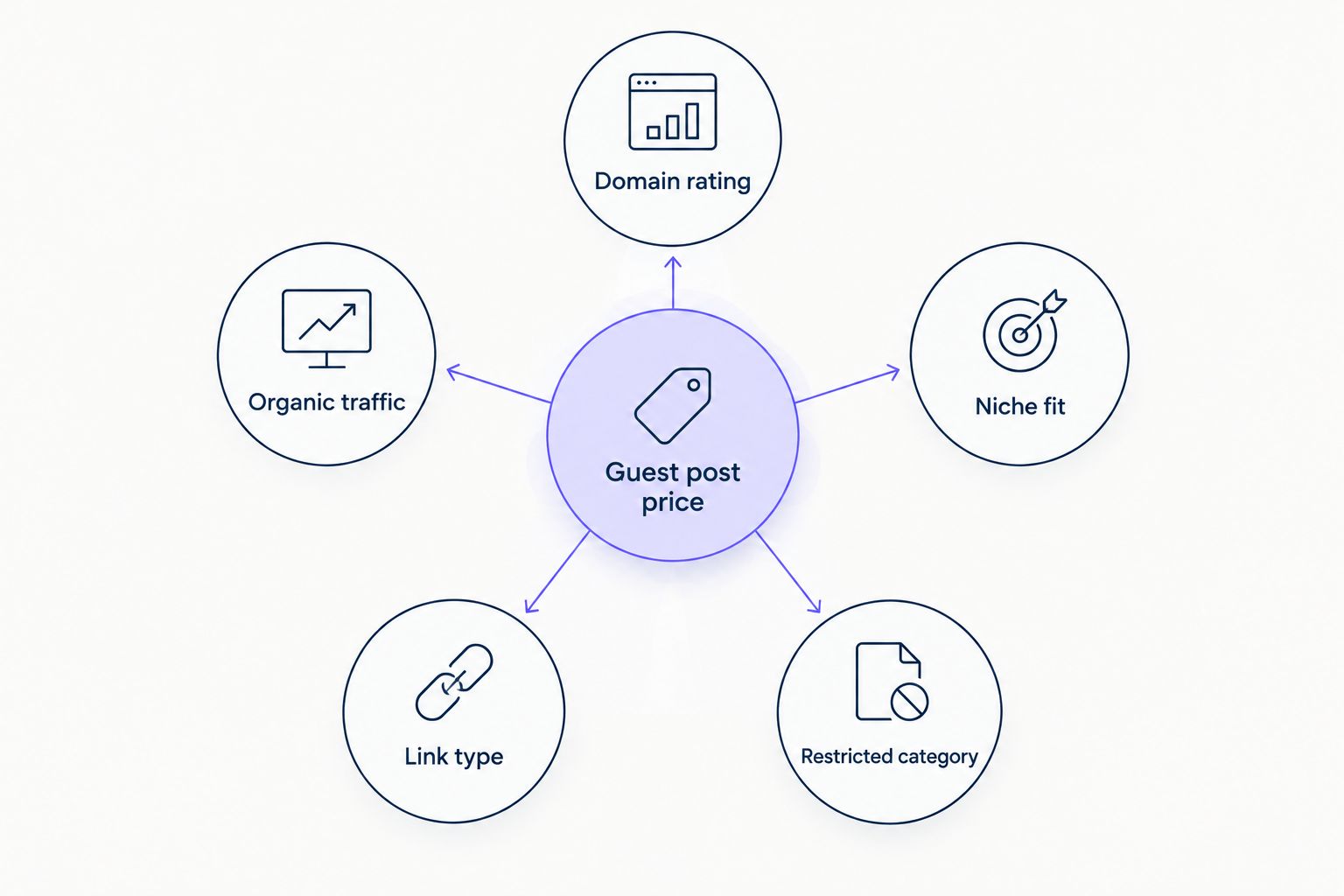
Two sites at DR 45 can quote very different rates. These are the variables that explain the spread, roughly in order of impact:
- Organic traffic. A DR 45 site with steady organic visits prices above a DR 45 site with almost none. Traffic is the closest thing to proof that Google trusts the site.
- Niche fit. A site that covers your topic closely costs more than a general-interest site at the same DR. It is also worth more.
- Link type. A new guest post costs more to produce than a link inserted into an existing article. A niche edit on an aged page often carries the lower price. See how to choose between niche edits and guests posts for a new site.
- Sponsored labeling. A post disclosed as sponsored and a post published as editorial are priced differently, and they pass different signals.
- Restricted categories. Finance, health, crypto, gambling and CBD placements usually carry a premium because fewer publishers accept them.
- Content source. Who writes the article, you or the publisher, changes the quote.
- Turnaround. Rush requests cost more than standard queues.
How to read each band
DR 0-20 and 21-30: Skip unless the site is real
These bands are where link farms live. A low price here is not a bargain if the site publishes on every topic and has no audience. Buy only when the site shows topical focus and real pages that get organic visits. Otherwise Skip.
DR 31-40 and 41-50: the workhorse bands
Most agency campaigns live here, because the cost per link stays manageable and the sites are often genuinely relevant. Quality varies the most in this range, so the audit matters more than the DR number. Buy, with a traffic check on every site.
DR 51-60: pay for proof
This is where price starts to outrun value if you skip diligence. Ask for organic traffic data and recent outbound link patterns before you pay. Hold until the site passes the check, then Buy.
DR 61-70 and 71+: buy selectively
These placements move the needle on competitive commercial terms, but they cost the most and often come with stricter editorial rules and slower delivery. Use one or two per campaign, not ten. Buy for priority pages, Wait on the rest until the mid-tier links are in place.
How to use these benchmarks
- Place every quote in a band first. If a seller quotes a DR 30 site at a DR 50 price, you have the first negotiation point before any conversation starts.
- Check traffic before price. If organic traffic does not match the band, downgrade the site by a tier in your head and price it there.
- Spread your spend across bands. A natural profile mixes DR 30-50 links with a few higher placements. Follow the guidance on building a backlink profile that looks natural to Google when you split the budget.
- Negotiate on volume and niche, not on DR. Publishers discount bulk orders and repeat orders more readily than they drop a rate on a single post. The tactics are in how to negotiate backlink rates with publishers.
- Recheck every quarter. DR changes. A site that sat in DR 40-50 when you bought may sit elsewhere in 2026 after a link purge or an algorithm update.
Red flags that override the band
A DR number does not save a site with these signals:
- Content on dozens of unrelated topics with no editorial focus.
- A visible "write for us" page offering paid posts at a flat rate for any niche.
- Organic traffic that dropped sharply over the last year.
- Outbound links that point mostly at casino, pills or loan sites.
- A DR that looks far higher than the site's traffic or content quality can explain.
If two or more of these apply, the price is irrelevant. Skip.
For agencies: pricing to clients
If you resell guest posts, the band you buy in should set your client-facing package tier, and your margin should sit on top of the real wholesale rate, not on a guess. Mixed-band packages are easier to defend than a single-band promise. A package sold as "all DR 50+" is a commitment that gets expensive to keep, because supply thins above that line. For packaging ideas, read the guide to pricing guest post packages when reselling to clients.
The 2026 outlook on price
Two patterns hold going into 2026:
- Quality publishers price on traffic, not DR alone. As buyers get more skeptical about inflated DR, publishers with real audiences state their traffic up front and quote against it.
- The middle is crowded. Supply in DR 31-50 is deep, which keeps negotiating room open there. The top bands stay tight.
The practical consequence: the best value in 2026 sits in the well-vetted middle, and the smartest spend on the top end is a small number of targeted placements.
Compare verified publisher sites
Browse guest post and niche edit listings and check each one against its DR band.
FAQ
Does guest post price depend on domain rating?
Yes. Domain rating sets the price floor, and each higher band costs more than the one below. Organic traffic, niche fit and link type then move the final quote up or down within the band.
Which DR band gives the best value in 2026?
DR 31-50 gives the best value for most campaigns. Supply is deep, relevance is easier to find, and negotiation room is wider than in the top bands.
Is a high-DR guest post always worth the higher price?
No. A high DR with no organic traffic is a badge, not an audience. Verify traffic and topical relevance before you pay a premium for the band.
Why do two sites with the same DR quote different prices?
Traffic, niche, link type and category restrictions differ. A relevant site with real readers prices above a generic site at the same DR.
Are niche edits cheaper than guest posts?
Often, yes. A niche edit inserts a link into an existing article, so there is no new content to produce. Compare the quote against a guest post at the same DR.
Should I buy all my links in one DR band?
No. A profile built from a single band looks manufactured. Mix mid-tier links with a few higher-authority placements.
How often should I recheck a publisher's DR?
Check before every order and review your existing placements quarterly. DR shifts after link purges and updates, so a past band is not a guarantee.
One last thing
The cheapest way to beat the tier table is to ask every publisher for organic traffic by country before you ask for a price. Sellers with real audiences answer in one message. Sellers without one go quiet or pivot back to DR, and that answer is the quickest filter you have in 2026.