
Niche edit pricing by domain rating follows one rule in 2026: the quote climbs with the publisher's DR band, and it climbs in steps, not in a straight line. This page maps the bands to relative cost tiers and shows what moves a quote inside each band. NO-BS Marketplace lists verified publishers, so the tiers below reflect how placements are actually sold.
- Niche edit pricing by domain rating rises in tiers: DR 0-29 is entry, DR 30-49 is mid, DR 50-69 is premium, DR 70+ is top.
- Dollar figures are not published here because quotes change by publisher, niche and month. Get a live quote and compare it to the tier.
- Inside one DR band, traffic, niche fit and link placement move the price more than a two-point DR gap.
- Buy in the DR 30-49 and DR 50-69 bands for most client work. Skip DR 70+ unless the page earns its own traffic.
Why this matters
A niche edit puts your link into an existing, already-indexed article. The page has history, so publishers price it on the strength of the domain and the page, not on the cost of writing new content.
That is why two quotes for the same DR can differ sharply. If you compare offers on DR alone, you overpay in some bands and buy weak placements in others. The fix is to compare inside a DR band and adjust for the factors below.
DR here means Ahrefs Domain Rating, a 0 to 100 logarithmic scale. Moving from DR 60 to DR 70 is much harder than moving from DR 20 to DR 30, which is why publisher rates jump at the high end.
The short answer
Niche edit cost scales with DR in four tiers, and the steepest jumps sit at DR 50 and DR 70. Entry-tier sites (DR 0-29) are the cheapest and carry the most risk. Mid-tier sites (DR 30-49) are the best value for most campaigns. Premium (DR 50-69) and top-tier (DR 70+) sites cost the most and sell fewer slots.
This page does not print dollar amounts. Prices go stale within weeks, and a hard-coded number would mislead you in 2026 the way last year's rate card misleads you now. The tiers below are relative, and they hold across publishers.
Niche edit pricing tiers by DR band, 2026
| DR band | Cost tier | Typical seller | Best for | Main risk |
|---|---|---|---|---|
| DR 0-29 | Entry | Small blogs, hobby sites | Testing a niche, tier-two links | Thin traffic, link farm patterns |
| DR 30-49 | Mid | Established niche blogs | Local, SMB and new-site campaigns | Variable traffic quality |
| DR 50-69 | Premium | Industry publications, strong blogs | Commercial pages, competitive terms | Fewer slots, editorial review |
| DR 70+ | Top | News and major media | Brand trust, digital PR support | Highest cost per link, slow approval |
The ordering is the benchmark. Each step up costs more than the one before, and the gap between DR 49 and DR 50 is usually larger than the gap between DR 40 and DR 49.
How each tier behaves
DR 0-29: entry tier
This is the cheapest band and the noisiest. Many sites here exist to sell links, which makes them a spam-filter risk. A low price at this DR is not a deal if the site has no organic traffic.
Verdict: Hold. Buy here only after you confirm real traffic and topical fit.
DR 30-49: mid tier
This band holds most legitimate niche blogs. Prices are workable for agencies reselling to clients, and there is enough supply to choose placements on topical fit.
Verdict: Buy. Best for new sites, local businesses and steady monthly campaigns.
DR 50-69: premium tier
Publishers here protect their editorial standards. They reject off-topic insertions, so approval takes longer and the price reflects the review. Links from this band move rankings on commercial pages.
Verdict: Buy selectively. Use it for the two or three pages that matter most to revenue.
DR 70+: top tier
Major media sells few niche edits, and many refuse them outright. When a slot exists, it costs the most per link and rarely pays back on rankings alone. Its value is trust and brand signal.
Verdict: Skip unless the page has its own audience or a digital PR plan sits behind it.
What moves a quote inside one DR band
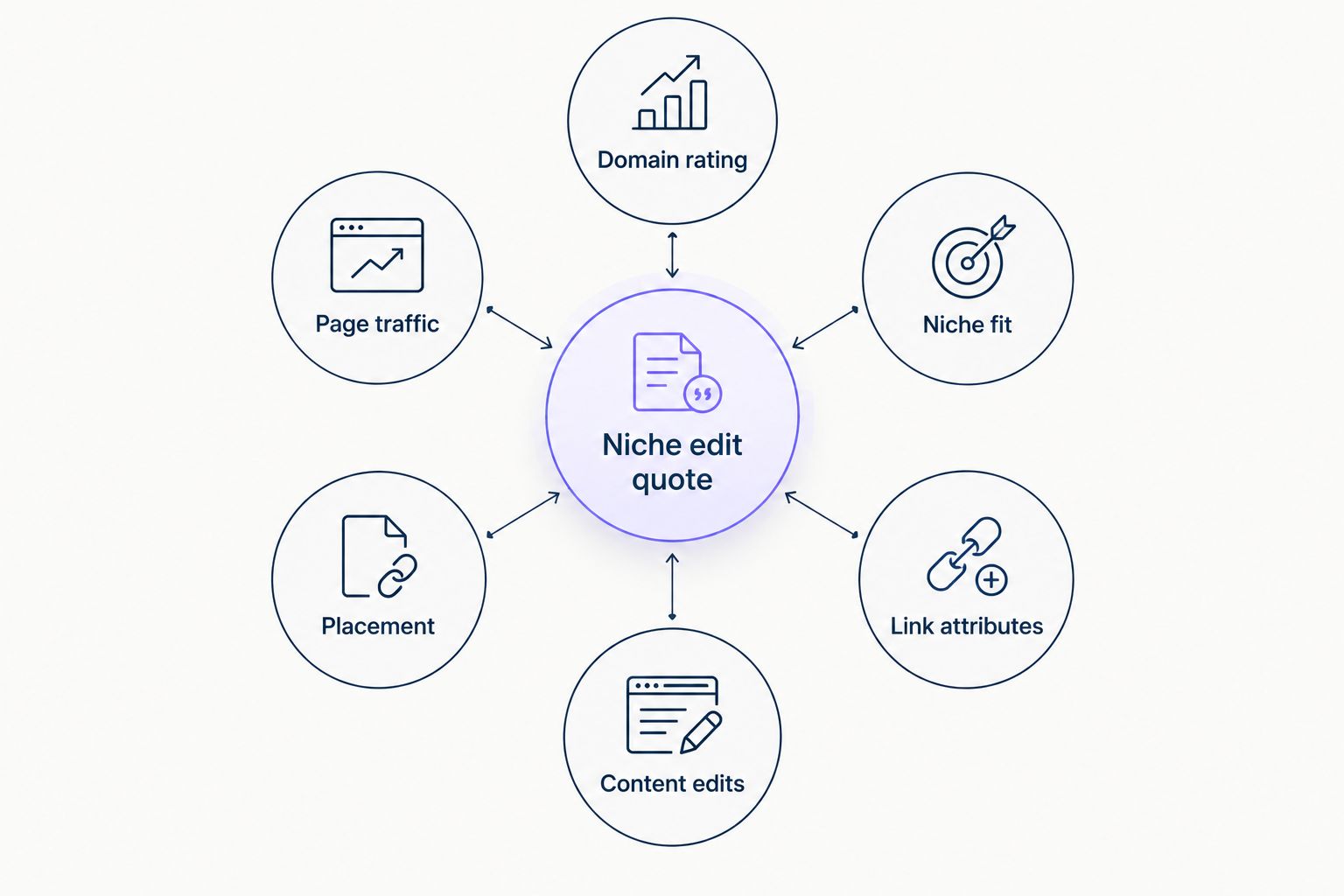
DR sets the tier. These factors set where you land inside it, and they usually outweigh a few DR points.
- Organic traffic of the page. A link on a page that ranks and gets visits costs more than one on an orphaned post.
- Niche fit. A link from a topically matched site is priced higher because fewer such sites exist.
- Placement in the article. A link in the body, high on the page, beats one near the footer.
- Link attributes. Follow links cost more than sponsored or nofollow ones, and a disclosed placement is cheaper to approve.
- Content edits. Adding a full paragraph costs more than changing an anchor in a sentence that already exists.
- Language and geography. Sites serving a local market price their audience, not just their DR.
Commentary: where the value sits
The mid tier, DR 30-49, is where cost and ranking impact balance best. The top tier trails on value per link, and the entry tier trails on safety. The premium tier leads on ranking impact per link, but only when the page is a close topical match.
The price gap between bands reflects scarcity. Publishers know the number of DR 70+ sites is small, and they price accordingly. That leverage shrinks as you move down the scale.
Methodology and limits
The tiers come from how publishers price placements: DR band first, then page-level traffic and niche fit. They are ordinal, not numeric, which means they rank cost tiers without claiming a dollar value for each.
One limit matters. DR is a third-party metric and does not measure how Google sees a site. A DR 45 site with real traffic can outperform a DR 60 site that has none, so never buy on DR alone. For the full method, read how to evaluate domain rating before buying a backlink.
How to use these benchmarks
- Bucket every quote by DR band first. If an offer at DR 35 is priced like the premium tier, it is overpriced. If an offer at DR 55 is priced like the entry tier, check for a catch.
- Then check page traffic and niche fit. Reject quotes where the DR is real but the page is dead.
- Put the budget where it pays. Spend most of a monthly budget in the DR 30-49 band and reserve DR 50-69 slots for revenue pages.
- Negotiate on volume, not on DR. Publishers discount bundles more readily than single links. The tactics are in how to negotiate backlink rates with publishers.
Compare live niche edit options
Browse verified publishers and check each quote against its DR tier.
Red flags in 2026 niche edit quotes
- A flat price for every site regardless of DR. Real publishers price by band.
- A DR 60+ site offered at entry-tier rates. The metric is likely inflated by a bought link profile.
- No URL shown before purchase. You cannot judge traffic or fit without the page.
- Dozens of outbound commercial links on the target page.
- Guaranteed rankings. No one controls that.
Verdict: if the quote breaks the tier order, ask why before you pay.
FAQ
How does niche edit pricing change by domain rating?
Niche edit pricing rises with DR in tiers, with the steepest jumps near DR 50 and DR 70. Inside a band, traffic and niche fit shift the price further.
What DR is best for niche edits in 2026?
DR 30-49 gives the best value for most campaigns in 2026. Move to DR 50-69 for revenue pages that need stronger signals.
Is a higher DR always worth the higher price?
No. DR does not measure organic traffic or topical fit. A mid-DR site with real visitors can beat a higher-DR site with none.
Why are dollar prices not listed on this page?
Publisher rates change often and differ by niche, so a fixed figure goes stale quickly. Use the tiers to judge any live quote instead.
Are DR 70+ niche edits worth buying?
Rarely. They cost the most per link and few publishers sell them. They suit brand trust goals or campaigns backed by digital PR.
What makes two niche edits at the same DR cost different amounts?
Page traffic, niche fit, link placement, follow status and the amount of content edited. These often outweigh a small DR gap.
Can cheap low-DR niche edits hurt my site?
Yes, when the sites exist to sell links. Check real traffic and outbound link patterns before you buy in the DR 0-29 band.
How do I avoid a spam penalty when buying niche edits?
Vary anchors, buy on topical fit and spread placements over time. The steps are in the guide on buying niche edits without triggering a spam penalty.
One last thing
The most useful number on a niche edit quote is not the price. It is the page's own organic traffic. Two placements in the same DR band and cost tier can differ by a wide margin in value, and only page traffic tells you which one you are holding. Ask for the URL first.