
Digital PR placement cost by publisher tier comes down to who controls the page: a newsroom, a niche editor, or a site owner who sells slots. In 2026, that control decides both what you pay and how you pay.
- Digital PR placement cost by publisher tier follows editorial control: the more a newsroom controls the page, the less it is priced per placement.
- Top-tier news outlets are earned through campaigns and billed as agency fees, not per-link rates.
- Niche and mid-tier publishers are where per-placement quotes exist, and where a benchmark protects you.
- NO-BS Marketplace is best for agencies buying verified mid-tier and niche placements; skip it for pure newsroom earned media.
Why this matters in 2026
Most quotes you get for digital PR are not comparable. One vendor prices a campaign, another prices a post, a third prices a link. Without a tier framework, you compare a retainer to a sponsored slot and call the cheaper one a deal.
This page gives you the framework. It does not hand you a single dollar figure, because a placement price that goes stale in a quarter is worse than none. It tells you which price model belongs to which tier, so you can spot a bad quote in one read.
The verdict: in 2026, price placements by tier and pricing model first, then by metrics like Domain Rating. Reversing that order is how budgets get burned.
The short answer
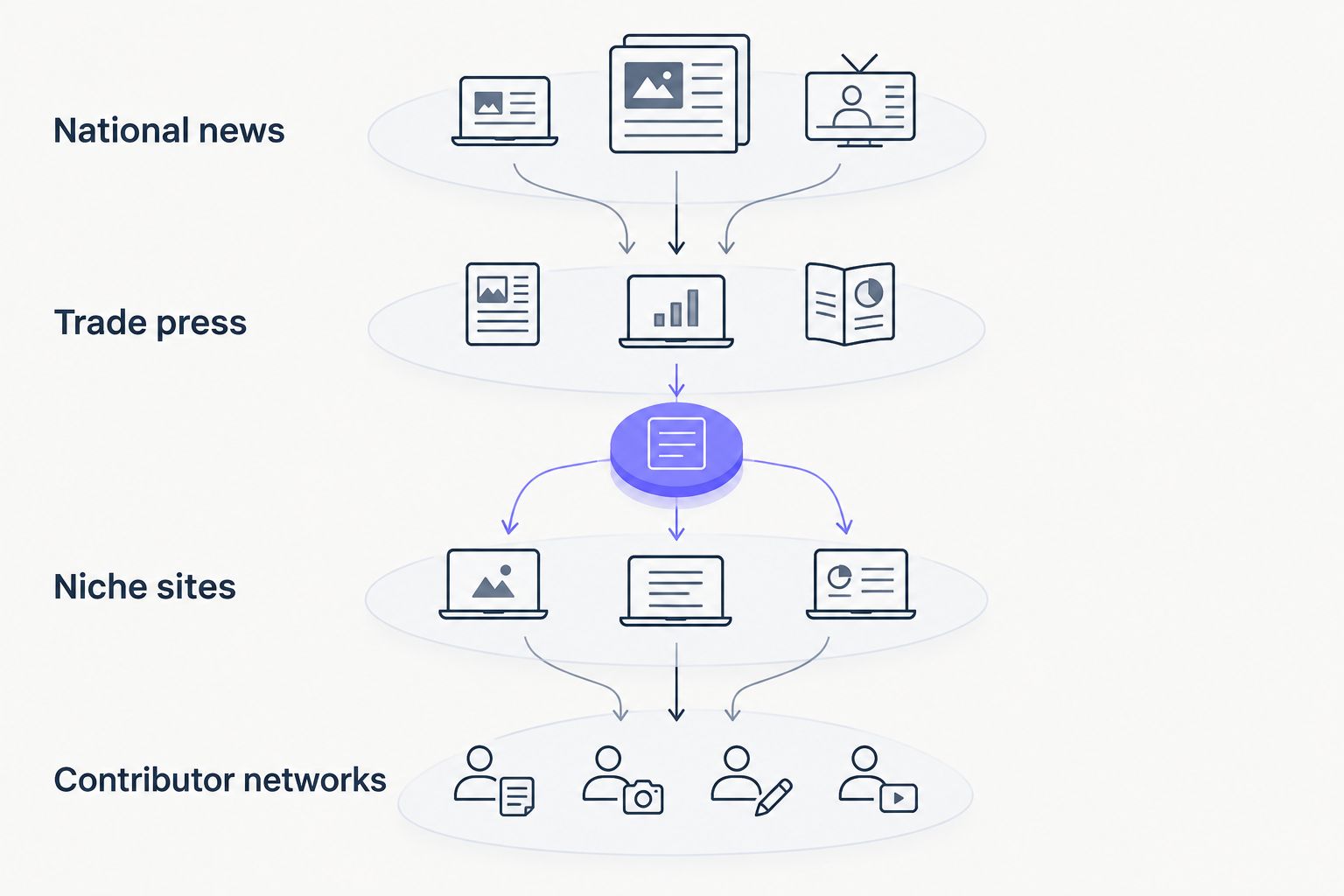
Cost rises with editorial control and audience trust, and falls with how much the publisher lets you shape the page. There are four tiers in practice: national news, trade and industry press, niche and topical blogs, and general contributor or sponsored-content sites.
Only the lower two tiers sell placements at a quoted per-piece rate. The upper two are earned. You pay for the work that earns them, not for the slot.
The tier benchmark table
| Publisher tier | Who controls the page | How you pay | Best for | Main risk |
|---|---|---|---|---|
| Tier 1: national and major news | Newsroom editors | Campaign or retainer fee for the work that earns coverage | Brand authority, AI-citation weight | No guaranteed outcome; the fee is paid whether or not coverage lands |
| Tier 2: trade and industry press | Section editors | Campaign fee, or per-placement where the outlet runs sponsored sections | Category credibility with buyers | Sponsored sections must be disclosed and carry weaker signals |
| Tier 3: niche and topical sites | Site owner or editor | Per-placement quote | Relevant links, predictable delivery | Quality varies widely site to site |
| Tier 4: general contributor and sponsored networks | Site owner or network | Per-placement quote or package | Volume, low-stakes testing | Link farm patterns, thin traffic, footprint risk |
The high and low ends of the table are clear. Tier 1 is the most expensive route per outcome and the least predictable; Tier 4 is the cheapest per link and the easiest to get wrong. That sentence is the benchmark. The exact figures belong to your quotes, and you should collect at least three per tier before you set a budget.
How the data behind this page works
This table is a structural benchmark: it classifies publishers by editorial control and pricing model. It does not report average dollar rates, because the inputs for a defensible average do not exist in public form for digital PR specifically.
The limitation is plain. Digital PR is priced per project, not per page, so any published average blends unlike things together. If you need rate data for the per-placement tiers, use the guest post pricing benchmarks by domain rating and the backlink package pricing benchmarks by tier instead.
Tier 1: national and major news
National outlets do not sell editorial coverage. A reporter runs your story because it is useful to readers. That makes this tier a campaign cost: research, data, angles, outreach, and follow-up.
What you are buying is labor and odds. A strong data story can earn several links from this tier at once. A weak one earns none, and the invoice is the same.
- Best for: brands that need authority signals and citations AI assistants pick up.
- Cons: slow, uncertain, and impossible to quote per link honestly.
- Verdict: Buy the campaign only if the angle is genuinely newsworthy. Skip it as a link-count play.
Tier 2: trade and industry press
Trade publications reach the buyers you want. Some earn coverage through pitches. Others run sponsored or partner sections with a rate attached, and those must be disclosed. If you run paid placements, read the guide on disclosing sponsored content without breaking FTC rules before you sign.
- Best for: B2B brands whose buyers read specific trades.
- Cons: a sponsored section tells readers and search engines it is paid. Value it as exposure, not as an editorial endorsement.
- Verdict: Buy when the audience match is exact. Hold when you are paying mainly for the link.
Tier 3: niche and topical sites
This is where most agencies spend. A niche editor or owner quotes a price per piece, and the page is relevant to your topic. Relevance is what you are paying for, and it holds up better over time than raw authority scores.
Quotes here are negotiable. Publishers expect it, and the guide to negotiating backlink rates with publishers covers what leverage you have and when to use it.
- Best for: agencies delivering steady, relevant links to clients.
- Cons: quality swings hard between sites with similar metrics.
- Verdict: Buy, after an audit. Never buy on metrics alone.
Tier 4: general contributor and sponsored networks
These sites accept almost any topic and publish on a schedule of payment. That is the signature of a link farm. Some are fine for low-stakes testing. Many carry a footprint that hurts when a client's profile fills with them.
- Best for: testing, or filling a profile with a few low-risk mentions.
- Cons: thin audiences, repeated outbound-link patterns, little citation value.
- Verdict: Skip for client money unless you have audited the specific site.
What actually drives the price inside a tier
Tier sets the model. These variables set the number within it:
- Topical fit. A site in your exact niche prices above a general one.
- Real traffic. Visits from search and referral, not a third-party score.
- Link type. A link inside a fresh article differs from one inserted into an existing page.
- Disclosure. Sponsored labeling changes what the placement is worth.
- Volume. Multi-placement orders usually earn a lower unit rate.
Before you pay, run the publisher audit checklist. It is the fastest way to tell a Tier 3 site from a Tier 4 site dressed up as one.
How to use these benchmarks
- Sort every quote by tier first. If a vendor will not say which tier a placement sits in, you cannot compare it to anything.
- Match the pricing model to the goal. Campaign fee for authority, per-placement for relevant links. Do not mix them in one comparison.
- Collect three quotes per tier you buy from. Your own quote set is the only benchmark that reflects your niche and your year.
- Set the success metric before you spend. The guide on setting KPIs for a digital PR campaign shows what to lock down first.
Compare verified publisher placements
Browse vetted publisher sites and price placements by tier.
NO-BS Marketplace is a link building and guest posting platform that connects SEO professionals and agencies with verified publisher sites. It fits the per-placement tiers, Tier 3 especially. It is not the tool for earning Tier 1 coverage, which is campaign work, and no marketplace listing replaces that.
FAQ
What is digital PR placement cost by publisher tier in 2026?
It depends on the tier's pricing model. National and trade outlets are earned through campaign fees, while niche and contributor sites quote per placement. Collect three quotes per tier to set your own benchmark.
Can you pay a national news outlet for a placement?
No, not for genuine editorial coverage. Reputable newsrooms decide what to run. You pay for the campaign work that earns the story, and the result is not guaranteed.
Is digital PR cheaper than guest posting?
Not by default. A guest post is a quoted per-piece purchase. Digital PR is a campaign fee that can earn several links or none, so compare them by cost per outcome.
Does a higher Domain Rating mean a higher tier?
No. Domain Rating is a third-party score on a 0 to 100 scale. Tier reflects editorial control and audience trust, and a high score on a site that sells any topic is still Tier 4.
Why do quotes for the same tier differ so much?
Topical fit, real traffic, link type, and disclosure all move the number. Two sites with similar scores can differ sharply once you audit them.
Is sponsored content the same as digital PR?
No. Sponsored content is a paid, disclosed placement. Digital PR earns coverage through pitching and newsworthy assets. Many campaigns combine both.
How should an agency budget for digital PR in 2026?
Split the budget by goal: a campaign line for authority and a per-placement line for relevant links. Set the KPI before spending, then review results against it.
One last thing
The cheapest placement on a quote sheet is rarely the cheapest outcome. A low per-link price on a Tier 4 site that a client later has to disavow costs more than a Tier 3 placement that was audited first. Price the risk, not just the slot.
The 2026 rule of thumb: if you cannot name the tier and the pricing model for a quote in one sentence, do not pay it.