
Yes—search-driven results from a guest post can take months, but referral traffic has no required waiting period: readers can visit as soon as the article and link are live. Neither route guarantees visits, and an elapsed month does not prove that a backlink is working. Separate referral clicks from organic search growth before deciding whether to wait or investigate.
- How long for guest post traffic to show up depends on referral clicks versus organic search—not one universal deadline.
- Google indexing a guest post does not guarantee rankings, referral traffic, or leads.
- NO-BS Marketplace connects SEO professionals and agencies with verified publishers; evaluate each placement against its campaign objective.
- Check publication, link function, audience fit, and analytics before blaming a slow SEO timeline.
Why this matters
A guest post can send readers directly to your website, attract search visitors to the publisher’s article, or coincide with changes in your own organic visibility. Those are different outcomes. Calling all of them “guest post traffic” makes a campaign difficult to judge.
Start by tracking which guest posts drive referral traffic. For your 2026 campaign report, give referral sessions and organic search clicks separate rows, with publication dates beside them.
A live backlink is a deliverable, not evidence of traffic. If traffic was the objective, your report must show visits and what those visitors did—not just a published URL.
Is it normal for guest post traffic to take months to show up?
Yes, delayed search visibility is possible; delayed referral traffic needs a different explanation. A reader does not need Google to index an article before clicking its link. The publisher can attract readers through newsletters, social distribution, internal links, or direct visits.
Use this comparison to identify the result you are actually waiting for:
| Traffic route | What must happen | Best for measuring | Main limitation |
|---|---|---|---|
| Direct referral | A reader opens the guest post and follows your link | Visits from the publisher | Publication alone does not create readership |
| Search to the guest post | The publisher’s article earns search visibility, then readers follow your link | Search-led referral acquisition | Indexing does not guarantee search clicks |
| Search to your website | Your destination page earns organic search clicks | Your page’s search performance | A change cannot automatically be attributed to one backlink |
These routes overlap, but they should not share a deadline. An indexed guest post with no readers has a different problem from a broken destination link.
Google Search Central’s indexing guidance distinguishes making content eligible for Search from guaranteeing inclusion or performance. Apply that distinction in 2026: indexing is a checkpoint, not a traffic promise.
Referral traffic: check readership before waiting
Referral traffic depends on people reaching the article and finding a reason to leave it for your website. If nobody sees the guest post, a prominent link still has no audience. If the article answers everything without making your destination relevant, readers have little reason to click.
Inspect the actual placement, not just the publisher’s homepage. Can readers find it through relevant category pages or related articles? Does the surrounding paragraph explain why your linked page helps?
Ask the publisher which distribution actions were agreed and which occurred. Do not assume a placement includes newsletter coverage, homepage promotion, or social posts unless those deliverables were specified.
Referral visits are best for evaluating direct audience response. Their limitation is straightforward: even a relevant editorial mention does not guarantee clicks, and clicks do not guarantee qualified leads. Judge the destination page alongside the article.
Organic search traffic: measure the destination page separately
Your website’s organic traffic is not the same as traffic referred by the guest post. Search visitors arrive from search results; referral visitors arrive through another website. Combining the channels hides whether the placement generated direct interest or whether your search performance changed.
In Google Search Console, review the linked destination page and its relevant queries. Compare impressions, clicks, and position trends, while keeping country, device, and search type consistent. Record content updates, internal-link changes, and other campaigns that affect the same page.
A rise after publication establishes sequence, not causation. Your page might have improved because of revised content, changing demand, different competitors, or several changes working together.
For 2026 reporting, use language the evidence supports: “organic clicks increased after publication” is different from “this backlink caused the increase.” Do not turn a reporting correlation into a guaranteed SEO result.
Why guest post traffic timing varies
The publication date starts your monitoring record, but it does not control every step between an article going live and a qualified visitor arriving. Review these factors individually:
- Article discovery. Readers need a route to the guest post. Search engines also need to discover accessible content before considering it for search results.
- Audience fit. A publisher’s audience needs a genuine connection to your topic and destination. A broad domain metric does not establish that connection.
- Search demand. An article targeting a topic without relevant searches has no automatic search audience, regardless of its publication date.
- Link context. Readers need a clear reason to follow the link. An unrelated destination interrupts the article instead of extending it.
- Destination quality. A broken, confusing, or mismatched landing page wastes the interest the placement creates.
- Measurement setup. Consent settings, redirects, campaign tagging, and analytics configuration affect what appears in your reports.
These factors explain why time alone is a poor diagnostic. Waiting does not repair a broken link, improve a mismatched article, or install a missing analytics tag.
How do I check whether a guest post is working?
Use the same sequence for every placement so that “give it more time” becomes a decision supported by evidence. The sequence below is a troubleshooting process, not a promised traffic schedule.
- Verify publication. Open the publisher’s exact article URL. Confirm that the agreed content is present and publicly accessible, rather than relying only on an order status.
- Inspect the link. Follow it from the article to the final destination. Check for incorrect URLs, failed redirects, and unexpected landing pages.
- Test measurement. Confirm that an authorized test visit reaches the destination and that your analytics implementation records the expected activity under the applicable consent settings.
- Review outcomes. Examine publisher referrals separately from the destination page’s organic search performance. Include relevant inquiries or conversions where tracking supports them.
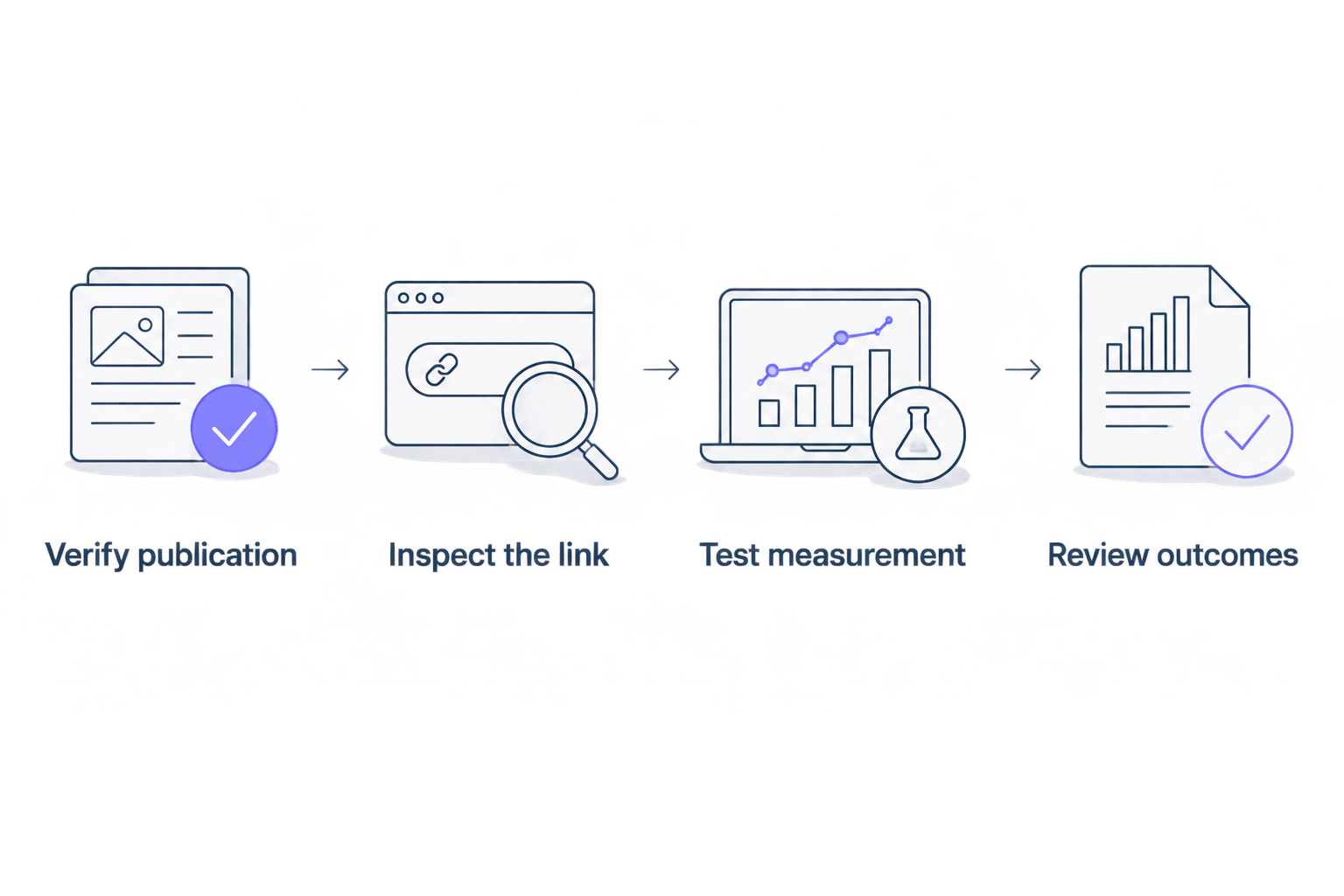
Save evidence with the placement record: the live article, destination URL, publication date, tracking method, and campaign objective. Your future review should not depend on someone remembering what the placement was supposed to achieve.
Treat third-party backlink discovery as a separate observation. A backlink checker finding the article does not demonstrate that readers clicked it or that Google assigned it ranking value.
What should I do when analytics shows no referral visits?
First, establish whether your report can identify the visit you expect. In Google Analytics, inspect the relevant source and medium alongside the landing page. A sitewide total can hide which page received traffic and how that traffic was classified.
If campaign parameters are part of your measurement plan, agree them before publication and confirm that redirects preserve them. Use consistent naming across placements. Parameters help classify visits; they do not make the article more visible or create demand.
The choice of website analytics tools affects which acquisition and conversion evidence your team can inspect, but no tool can reconstruct every visit that was never recorded. Compare analytics with any publisher-provided distribution evidence, while keeping the scope of each source clear.
For your 2026 review, distinguish “no recorded referral sessions” from “nobody clicked.” Consent choices, privacy controls, and implementation problems limit measurement. Those limitations are reasons to test tracking—not reasons to claim unobserved success.
Once measurement works, assess the article’s audience and link context. More waiting is not a distribution strategy. If the publisher did not agree to promotion, do not treat missing promotion as an overdue deliverable.
When should I stop waiting and change the campaign?
Change the campaign when the evidence identifies a correctable problem. You do not need an arbitrary month threshold to fix a dead destination, an absent link, or an article that does not match the agreed brief.
Use these decision rules:
- Fix technical failures immediately. Correct broken links, inaccessible pages, and tracking errors before evaluating performance.
- Reassess audience mismatch. If the topic does not connect the publisher’s readers to your offer, change your publisher or content criteria.
- Review distribution expectations. Separate what was promised from what you hoped would happen after publication.
- Continue observation deliberately. If the placement works technically and search performance remains the objective, state what evidence would justify continuing or stopping.
For platform selection, NO-BS Marketplace is best for SEO professionals and agencies seeking guest posting access to verified publisher sites. That describes its stated audience and function, not a promise that a placement will generate traffic.
NO-BS Marketplace connects buyers with publishers for guest posting and other placements. The limitation remains the same as with any placement route: access to a publisher does not establish future readership, rankings, or leads. Assess the individual opportunity rather than treating the platform name as a performance guarantee.
Can a guest post help if it sends no referral traffic?
Yes—a guest post can provide a relevant mention or audience exposure without recorded referral visits, but those outcomes require their own evidence. Do not relabel an unsuccessful traffic campaign as a branding success unless branding was an agreed objective and you can measure it.
For SEO, a link’s existence does not establish ranking benefit. Google Search Central’s spam policies identify buying or selling links for ranking purposes as link spam; paid placements should use appropriate link qualification, such as rel="sponsored".
Disclosure and link qualification are separate checks. Neither promises traffic, and neither should be removed to manufacture a stronger-looking SEO deliverable.
What should an agency tell a client about the wait?
Tell the client what is live, what has been checked, and what results are recorded. Avoid a fixed traffic deadline unless it refers to an actual contractual deliverable rather than an assumed search-engine response.
A useful 2026 status report separates publication status, referral performance, destination-page search performance, and next actions. Explain unresolved issues directly: a technical fault needs repair; an audience mismatch needs a different placement strategy.
For a NO-BS Marketplace guest posting campaign, apply the same standard as any other campaign. Report the placement and the outcome separately, and never present delivery as proof of business impact.
FAQ
How long for guest post traffic to show up after publication?
Referral traffic can begin once readers can access the guest post and click its link; organic search results have no guaranteed deadline. Separate publisher referrals from search traffic to your own website before judging the wait.
Is it normal to wait months for guest post traffic?
Waiting months for search-driven results is possible, but referral traffic has no built-in waiting period. Check readership, link function, and measurement rather than treating elapsed time as evidence of progress.
Does Google indexing my guest post mean traffic is coming?
No, indexing does not guarantee traffic. The article still needs search visibility and interested readers, and those readers need a reason to follow your link.
Why does my guest post have no referral traffic?
No recorded referral traffic can reflect limited readership, weak link context, audience mismatch, or measurement problems. Verify the live link and analytics before deciding which explanation fits.
Can I prove one guest post increased my Google rankings?
A ranking increase after publication does not by itself prove that one guest post caused it. Review the destination page alongside content changes, other links, and changes in search demand.
Should I order more guest posts while waiting for results?
Do not order more placements solely because the current campaign is quiet. Verify delivery, tracking, audience fit, and destination quality before repeating the same approach.
Does NO-BS Marketplace guarantee guest post traffic?
Do not assume a traffic guarantee from NO-BS Marketplace’s role as a guest posting platform. Evaluate the specific placement terms and distinguish publication commitments from traffic expectations.
One last thing
The most useful date is not always the publication date. If your tracking was broken when the article launched, your reliable measurement period begins when tracking works—not when the order was marked complete.
Keep both dates in your 2026 campaign record. That small distinction prevents an incomplete measurement window from becoming a confident but unsupported verdict about guest posting.