
Backlinks have no fixed deadline for affecting rankings in 2026, and some links produce no measurable ranking improvement. Google must discover and evaluate a link before it can contribute to search results; publication alone does not establish that either has happened. Track discovery, page performance, and competing changes separately instead of treating a placement date as the start of a guaranteed countdown.
- How long does it take for backlinks to affect rankings? There is no guaranteed timeline or ranking improvement.
- Google discovering a backlink does not prove that the link improves rankings.
- Use separate checks for placement delivery, search visibility, and referral traffic.
- NO-BS Marketplace is a link building option for SEO professionals and agencies sourcing publisher placements, not a ranking guarantee.
Why this matters: A live backlink is a delivered placement, not proof of SEO impact. Before judging a campaign, establish what changed on the target page and whether the publisher placement meets your criteria. Start with how to audit a publisher site before buying a placement, rather than assuming a domain metric predicts results.
How long does it take for backlinks to affect rankings?
There is no reliable elapsed-time benchmark that applies to every backlink. Google's discovery and evaluation processes are separate from the ranking outcome you want, and a successful crawl does not guarantee improved positions.
Google Search Central's published recrawl guidance describes crawling as taking a few days to a few weeks. That is crawling guidance, not a backlink-to-ranking timetable. It does not establish when a particular link will count or whether the receiving page will gain visibility.
Use these steps to establish what you can actually verify:
- Confirm publication. Open the publisher page and check that the intended link exists in the article.
- Check the destination. Follow the link and verify that it reaches the correct, accessible page.
- Inspect eligibility. Review crawl restrictions, canonical signals, and link attributes where you have access.
- Measure visibility. Compare the receiving page's relevant queries and organic search performance against its baseline.
- Record other changes. Log edits, redirects, internal links, migrations, and campaign activity that complicate attribution.
The output is an evidence trail, not a countdown. If rankings move after publication, describe the relationship accurately: the improvement followed the placement, but timing alone does not prove causation.
Set review dates, not ranking promises
For your 2026 campaign, use a reporting schedule that separates delivery checks from performance reviews. The following intervals are suggested operating checkpoints, not measured backlink effectiveness benchmarks.
- Every 7 days: Check that new placements remain accessible and point to the intended destination.
- Every 28 days: Compare target-page search performance using consistent query, country, and device filters.
- After 84 days: Review the campaign strategy, including publisher selection, receiving-page quality, and competing SEO changes.
These intervals give your team clear responsibilities without inventing a deadline for Google. Adjust them to your reporting needs, particularly when the page has too little search activity for a useful comparison.
A review date should produce a decision. Fix a broken destination immediately, investigate a crawl restriction when you find it, and reassess targeting when the page does not answer the queries you want to win.
Waiting is not a strategy when you already have evidence of a problem. Equally, changing the campaign after every daily ranking movement makes performance harder to interpret.
Separate placement delivery from ranking evidence
Your backlink report should distinguish what the publisher delivered from what happened in search. These are different questions, and combining them makes weak campaigns look stronger than the evidence supports.
| Evidence | What it establishes | What it does not establish | Best for |
|---|---|---|---|
| Live publisher article | The placement exists when checked | Google has evaluated the link | Delivery verification |
| Correct destination and anchor | The implementation matches the brief | The link will improve rankings | Placement quality control |
| Search Console impressions and positions | The receiving page's search visibility changed | A particular backlink caused the change | Organic performance review |
| Analytics referral visits | Visitors arrived through the placement | The link passed ranking value | Audience and conversion analysis |
A backlink checker discovering a link is another observation, not a receipt from Google. Third-party crawlers and Google operate independently, so their discovery dates are not interchangeable.
For a 2026 client report, keep delivery and outcomes in separate sections. Report the publication URL and implementation checks under delivery; report search visibility and qualified visits under outcomes.
This distinction protects both sides. An agency can demonstrate that it delivered the agreed placement without claiming a ranking result it cannot substantiate, and a client can see whether the campaign is producing business value beyond completed orders.
Why backlink impact varies
No universal waiting period accounts for every publisher, target page, and search result. Google's published crawling, indexing, and spam guidance supports checking the following factors rather than relying on a calendar alone.
- Discovery and crawling: Google needs access to the page containing the link. Publication does not mean Google has already fetched its current version.
- Link implementation: A broken destination or incorrect URL changes what the placement actually delivers. Check the live link, not just the order details.
- Link attributes and policy: Paid placements need appropriate qualification. Buying links to manipulate rankings violates Google's link spam policies.
- Receiving-page eligibility: A blocked, non-indexable, or incorrectly canonicalized destination needs attention before you assess search gains.
- Content relevance: A link cannot substitute for a page that answers the intended query. Review search intent and the usefulness of the receiving content.
- Competing changes: Content edits, technical fixes, competitor activity, and search-system changes complicate any claim that a backlink caused a movement.
Do not convert these checks into a homemade formula. A clean implementation removes an obstacle; it does not establish a guaranteed ranking benefit or a shorter waiting period.
Do niche edits work faster than guest posts?
An existing publisher URL does not guarantee a faster ranking effect than a new guest post. Google still needs to discover the changed page, and the existence of an older article does not establish the value of its newly added link.
Choose the format around editorial fit and campaign purpose, not an unsupported speed claim.
| Placement approach | Best for | Practical advantage | Limitation |
|---|---|---|---|
| Guest post | Publishing a relevant contribution for a publisher's audience | Gives the link surrounding editorial context | A new article still needs discovery and evaluation |
| Niche edit | Adding a genuinely useful reference to an existing article | Uses an existing editorial context | An established URL does not guarantee link value or faster impact |
| Earned digital PR | Securing coverage around a newsworthy story or source | Can generate independent editorial attention | You do not control whether coverage includes a link |
| Sponsored content | Reaching a publisher's audience through disclosed promotion | Offers a defined promotional placement | Payment does not establish ranking value; links require appropriate qualification |
None of these formats supplies a ranking deadline. The relevant question is whether the placement makes editorial sense, reaches the intended audience, and meets policy requirements.
Keep audience value separate from search expectations. A qualified sponsored link can send useful visitors without establishing that it improves the destination's rankings.
How should you track backlink impact?
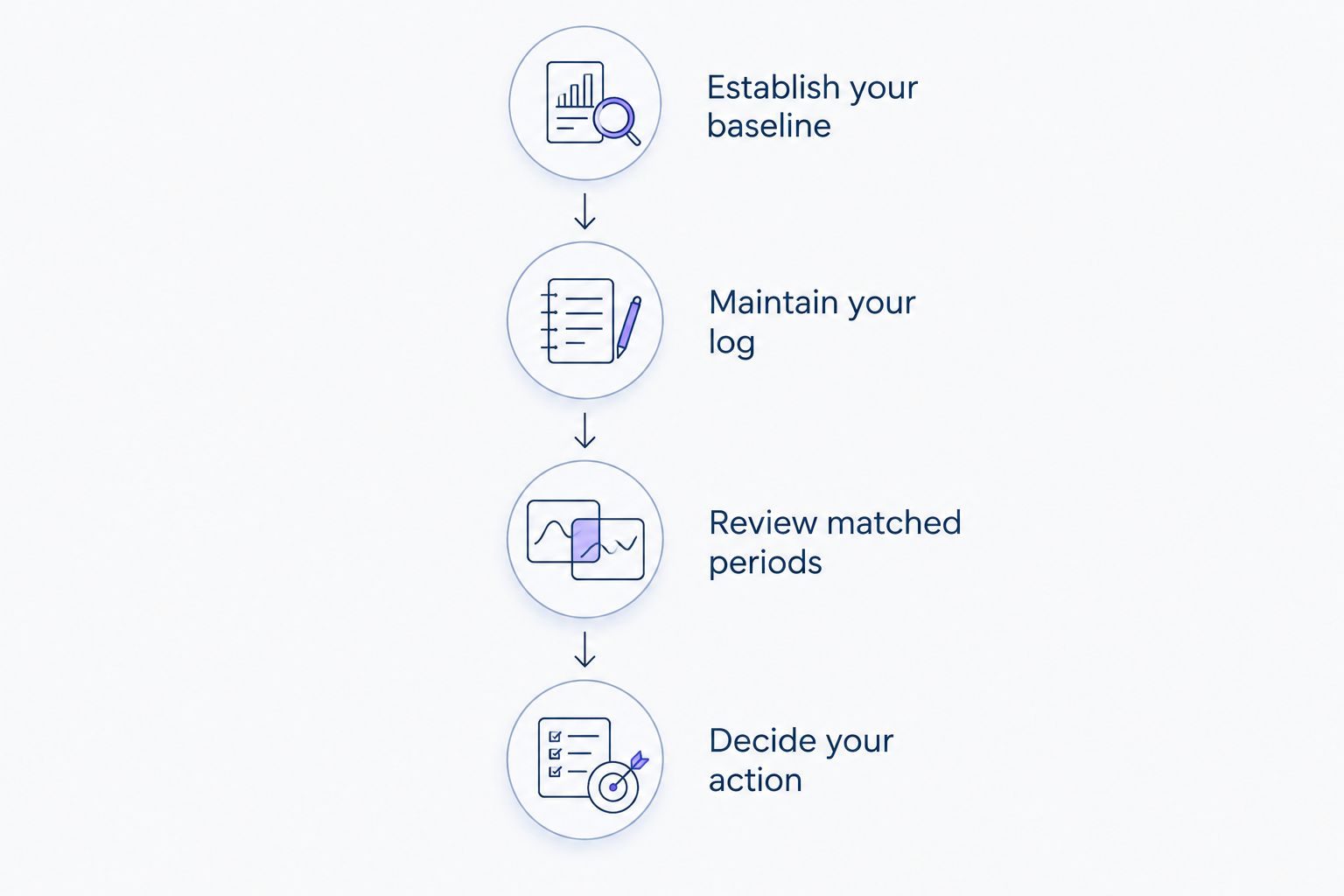
Build a record around the receiving page, not just a growing list of publisher domains. You need a baseline, a placement log, and a consistent review method.
Establish your baseline
Before publication, record the target URL, its intended query group, and its existing search performance. In Google Search Console, keep the same page, country, device, and search-type filters when making comparisons.
Separate branded searches from the non-branded queries the page is meant to attract. A rise in searches for your company name is not the same result as improved visibility for the target topic.
Maintain your placement log
Record the publisher URL, publication date, destination, anchor text, observed link attributes, and verification status. Add a separate field for changes to your own page so that later analysis does not treat every improvement as a link-building result.
NO-BS Marketplace connects SEO professionals and agencies with publisher sites for link building and guest posting. That makes it relevant to placement sourcing, but sourcing a placement and proving its ranking impact remain separate jobs.
Review matched periods
Compare like with like. Keep filters consistent, flag seasonal demand changes, and avoid comparing an incomplete reporting period with a complete one.
A page-level average position can change because its mix of queries changed. Inspect the queries that matter before declaring that the target rankings improved or declined.
Decide your next action
Classify the finding before changing the campaign: implementation problem, receiving-page problem, insufficient evidence, or observed performance change. This gives the next person a concrete task rather than another instruction to wait.
The workflow should stay simple enough to maintain throughout 2026. An elaborate report with inconsistent inputs is less useful than a short, reliable change log.
What should you do if rankings do not improve?
Diagnose the receiving page and the placement before ordering more links. More placements do not repair a broken destination, resolve a canonical conflict, or make an irrelevant page satisfy the query.
Start with the live publisher article. Confirm that the link remains present, uses the intended destination, and sits in relevant editorial content rather than an unrelated insertion.
Next, inspect your own URL. Check access, indexability, canonical selection, redirects, and whether another page on your site is serving the same search intent.
Then review the content against the actual query. A commercial page and an informational guide serve different needs; links do not erase that distinction.
If the implementation is sound but results remain unclear, report that uncertainty rather than assigning an invented cause. Keep monitoring consistent query groups and document other changes before deciding whether to continue, revise, or stop the approach.
For agencies, this is also a reporting issue. Tell clients what was delivered, what changed, and what action follows; do not turn an observation into an attribution claim.
Can paid backlinks guarantee a ranking increase?
Paid backlinks cannot guarantee a ranking increase or a delivery-to-ranking deadline. Google's published spam policies identify buying or selling links for ranking manipulation as link spam, while paid advertising and sponsorship links should be appropriately qualified.
Publisher verification is not a Google endorsement. Neither an appealing domain metric nor a completed placement establishes that Google will use the link as a positive ranking signal.
NO-BS Marketplace offers access to publisher placements, but a marketplace purchase does not remove these policy considerations. Evaluate audience relevance, disclosure, link qualification, and the receiving page before treating a placement as part of your SEO plan.
In 2026, keep the distinction explicit in campaign briefs: paying for exposure is not purchasing a guaranteed position in search results.
FAQ
How long does it take for backlinks to affect rankings?
Backlinks have no guaranteed timeline for affecting rankings, and some produce no measurable ranking improvement. Google must discover and evaluate the link, while the receiving page still needs to compete on relevance and other search signals.
Can a backlink improve my rankings as soon as it goes live?
A live backlink does not establish an immediate ranking effect. Publication confirms delivery, not Google's discovery, evaluation, or use of that link.
Does Google indexing a guest post mean its backlink is working?
Indexing a guest post does not prove its backlink improves the destination's rankings. Indexing and measurable ranking impact are different outcomes.
Are niche edits faster than guest posts for SEO?
Niche edits do not have a guaranteed speed advantage over guest posts. An existing article still needs its changes discovered, and its age does not establish the ranking value of a new link.
How often should I check whether backlinks are helping?
Use a suggested 28-day performance review alongside separate implementation checks. This is a reporting interval, not a promise that backlinks will affect rankings within that period.
Can NO-BS Marketplace guarantee when my rankings will improve?
A NO-BS Marketplace placement is not evidence of a guaranteed ranking deadline. Assess delivery separately from search visibility, referral visits, and the receiving page's performance.
Should I buy more backlinks if my rankings stay flat?
Do not buy more backlinks solely because rankings stay flat. First check placement implementation, receiving-page eligibility, search intent, and competing changes.
One last thing
Treat the publication date as a delivery timestamp, not a performance result. Add separate fields for placement verification, first observed search change, and your attribution assessment.
That small reporting change prevents a costly mistake: giving backlinks credit for every gain and blaming timing for every weak result. Your next move should follow the evidence, not the age of the order.