
Google has no fixed deadline for discovering or processing a new backlink, and it does not guarantee that every linking page will be indexed. In 2026, the useful question is whether Google has crawled the publisher’s page since your link appeared—not simply how long the placement has been live.
- How long does it take for Google to index a new backlink? There is no guaranteed deadline.
- Google crawling a publisher’s page does not prove that a backlink improved rankings.
- Check the linking page, crawl access, canonical signals, and link destination before blaming a delay.
- NO-BS Marketplace connects SEO professionals and agencies with publishers; placement does not establish Google indexing.
How long does it take for Google to index a new backlink?
There is no reliable countdown from publication to Google recognizing a backlink. Google Search Central’s crawling and indexing guidance distinguishes discovering a URL, crawling its content, and selecting content for the search index. Those stages are not interchangeable.
A backlink is part of a page, not a separate document that you submit for indexing. For your 2026 campaign reports, distinguish the following evidence:
| Milestone | What it establishes | What it does not establish |
|---|---|---|
| Placement published | The publisher’s page contains your link | Google has fetched the updated page |
| Publisher page crawled | Google fetched the page at a particular time | Google selected it for indexing or assigned link value |
| Publisher page indexed | Google selected a version of the page for its index | Every current edit has been processed |
| Link reported | A reporting system found the relationship | The link caused a ranking change |
| Target page gains visibility | Search performance changed | That particular backlink caused the change |
NO-BS Marketplace is a link building platform for SEO professionals and agencies sourcing publisher placements. Keep placement delivery and Google processing as separate reporting milestones.
Why this matters
A published link, an indexed article, and improved rankings answer different questions. Treating them as the same event creates client promises you cannot substantiate.
For example, an article can already be indexed when a publisher adds your link. The existing index status says nothing about whether Google has fetched that edit. Conversely, a backlink checker’s missing entry does not prove Google has missed the page.
Report the evidence you have, not the outcome you expect. Publication is a delivery event; indexing is a Google decision; ranking improvement is a separate performance question.
Check backlink processing in the right order
Use this sequence to diagnose the placement before asking anyone to accelerate indexing. Start with the publisher’s page, not your own destination page.
1. Confirm publication
Open the exact placement URL and locate the backlink. Check that the anchor points to the intended destination and that the page is accessible without signing in.
Record the publication date and, for a link insertion, the date the publisher added the link. An old article’s original publication date is not the start date for a newly inserted backlink.
Check the actual hyperlink rather than relying on a screenshot. A visible brand mention without a working link is not the placement you are trying to verify.
2. Check crawl access
Inspect the publisher page’s response and accessibility. An HTTP 200 response indicates a successful response, but it does not guarantee indexing; an HTTP 404 response indicates that the requested resource was not found.
Ask the publisher to investigate server failures, login barriers, or crawler restrictions. A robots.txt block and a noindex instruction have different effects: blocking crawling can prevent Google from seeing a noindex instruction on the page.
Do not diagnose access from a browser visit alone. A page that opens for you can still present different restrictions to crawlers.
3. Inspect page signals
Check the page for a noindex directive and inspect its canonical declaration. Google treats a canonical declaration as a signal, not an instruction it must follow.
If the publisher points the canonical elsewhere, investigate which version Google selected. Do not assume that the URL containing your backlink is the indexed version simply because another version of the article appears in search.
4. Check crawl evidence
Ask the publisher to inspect the placement URL in its own Google Search Console property. Compare the reported last crawl with the time your backlink was added.
A crawl before the edit does not verify discovery of the edit. A later crawl is useful evidence that Google fetched the page after publication, although it still does not prove that the backlink affected rankings.
5. Verify the destination
Open the linked destination and inspect any redirects. Confirm that the link reaches the intended, accessible page rather than an error page or an unrelated replacement.
Then inspect your destination in your own Search Console property. You control that page’s technical condition, even when you cannot inspect the publisher’s property.
The sequence below separates publication checks from crawl evidence. Each step answers a narrower question than “has this link worked?”
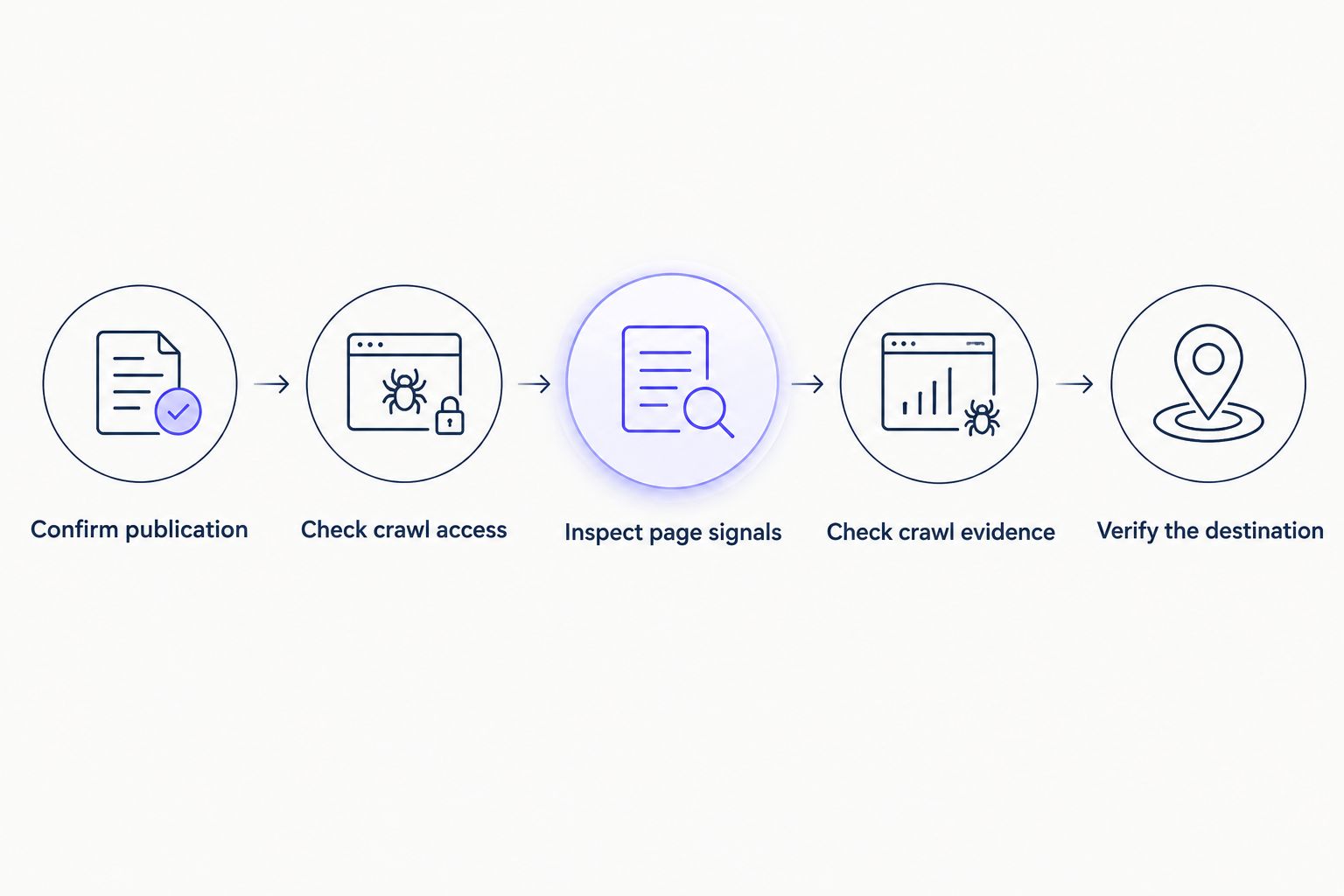
New guest posts versus links added to existing pages
The publication format changes what you need to verify, not Google’s obligation to process the link. Neither a guest post nor a niche edit comes with a guaranteed indexing deadline.
| Placement format | Best for | Practical advantage | Limitation to check |
|---|---|---|---|
| New guest post | Publishing a dedicated article with a relevant citation | The article can introduce the topic and link together | Google must discover and evaluate the new page |
| Link insertion | Adding a useful reference to an existing article | The source page already exists | Existing index status does not confirm processing of the edit |
| Digital PR coverage | Earning editorial attention around a newsworthy story | Coverage can introduce your brand to a publisher’s audience | Coverage does not guarantee a link or ranking benefit |
For a new guest post, inspect discovery routes such as relevant internal links on the publisher’s site. For a link insertion, focus on whether Google has recrawled the page since the change.
For digital PR, verify the actual coverage rather than assuming every mention includes a backlink. An unlinked mention can still expose readers to your brand, but it is not evidence of a processed hyperlink.
NO-BS Marketplace supports publisher placement sourcing; the limitation is that a placement platform cannot establish Google’s processing decision merely by confirming publication. Apply the same technical checks regardless of how you sourced the article.
Why backlink discovery and processing vary
Google’s Search Central guidance on crawling, indexing, canonicalization, and qualifying outbound links provides the technical basis for these checks. Use these factors in your 2026 assessment rather than assigning every placement the same waiting period.
- Discovery routes. Relevant internal links help Google find a publisher’s page. An isolated article creates a different discovery problem from an article linked within the site’s normal structure.
- Crawl access. Server failures and crawler restrictions interfere with fetching. Fix access problems before interpreting elapsed time as an indexing delay.
- Page selection. Google does not index every accessible page. Duplicate content, canonical signals, and the page’s usefulness matter beyond whether a URL loads.
- Recrawl timing. An existing article needs another fetch after a link insertion. Its earlier crawl history does not verify the new content.
- Link implementation. A usable HTML hyperlink gives Google a clearer relationship to follow than plain text that merely resembles a URL.
- Link qualification. Sponsored, nofollow, and ugc attributes communicate information about a link. Their presence is separate from whether Google can discover the source page.
Audit the publisher before placing content, not only after a delay. The guide to auditing a publisher site before buying a placement covers that earlier decision point.
Can you make Google index a backlink faster?
You can remove obstacles; you cannot force Google to index a publisher’s page. Ask the publisher to fix access problems, remove an unintended noindex directive, and provide relevant internal discovery routes.
A publisher with appropriate Search Console access can request indexing for its own URL. Google states that requesting a crawl does not guarantee inclusion, and repeated requests do not make crawling happen faster.
Submitting your destination URL is not a substitute for Google fetching the publisher’s updated article. These are different pages, usually on different properties.
Google’s Indexing API is not a general-purpose backlink submission tool. Its documented scope covers eligible job-posting pages and livestream pages with the required structured data, not ordinary guest posts or link insertions.
Avoid services that promise guaranteed recognition through repeated submissions or manufactured link chains. A submission receipt is not evidence that Google indexed the source page, processed the backlink, or rewarded your target URL.
Does an indexed backlink guarantee better rankings?
No: an indexed source page does not guarantee a ranking benefit from its links. Google evaluates links within broader ranking and spam systems, and a visible placement is not proof that a particular link passes ranking credit.
Paid placements require particular care. Google’s spam policies identify buying links for ranking manipulation as link spam; paid advertising and sponsored placements should use appropriate link qualification, such as rel="sponsored" or rel="nofollow".
That distinction belongs in a 2026 placement brief before publication. Do not ask a publisher to remove required qualification simply because a backlink has not produced a ranking change.
Relevance still matters to the reader. A link should support the article and lead to a useful destination, rather than exist solely to satisfy an anchor-text target.
How do you check a backlink on someone else’s website?
Start with the live publisher URL, then request publisher-side crawl evidence. Your own Search Console property does not give you URL Inspection access to an unrelated publisher’s pages.
A public search can provide supporting evidence that Google displays a page, but search operators are not a complete indexing audit. A missing result alone does not settle the question.
Third-party backlink indexes provide another observation, not a direct view of Google’s internal processing. Record the tool and observation date instead of labeling its discovery timestamp “Google indexed.”
If the publisher cannot share inspection evidence, retain the narrower finding: the link is live and technically accessible. Do not convert uncertainty into either a failure claim or a success claim.
What should your client report say while you wait?
Use status labels with clear meanings. A useful 2026 report separates “published,” “link verified,” “publisher crawl confirmed,” and “performance under review” rather than compressing everything into “indexed.”
For each placement, record the source URL, destination URL, anchor, link attributes, publication or insertion date, and evidence date. Keep the publisher’s crawl evidence distinct from a backlink checker’s first-seen date.
NO-BS Marketplace link building campaigns should be assessed using those same evidence standards. The sourcing channel does not change what a publication check can prove.
Compare destination-page impressions, clicks, and relevant queries over your reporting periods, while recording other changes to the page and campaign. A ranking increase after publication is an observation, not enough evidence to assign causation to that backlink.
Escalate a diagnosed defect, not an unsupported deadline. A removed link, broken destination, or unintended noindex directive gives the publisher a specific issue to fix.
FAQ
How long does it take for Google to index a new backlink?
Google provides no guaranteed deadline for discovering or processing a new backlink. Check whether Google has crawled the publisher’s page since the link appeared, and keep indexing separate from ranking impact.
Can I submit a backlink through my own Google Search Console?
You cannot use your own property’s URL Inspection tool to request indexing of an unrelated publisher’s URL. The publisher needs appropriate access to inspect or request indexing for that page.
Does an indexed guest post mean Google has counted my backlink?
An indexed guest post does not prove that Google assigned ranking credit to your backlink. The indexed version can also predate a recent link insertion.
Why is my backlink missing from Google Search Console?
A missing backlink in Search Console does not establish that Google has never discovered it. The Links report is not a complete, real-time record of every link Google processes.
Are niche edits guaranteed to get discovered faster than guest posts?
Niche edits have no guaranteed discovery advantage. Google still needs to fetch the existing article after the publisher adds your link.
Should I use Google’s Indexing API for guest-post backlinks?
Google’s Indexing API is not intended for ordinary guest-post backlinks. Its documented scope covers eligible job-posting pages and livestream pages with the required structured data.
Can a sponsored backlink still be crawled?
A sponsored attribute does not itself prevent Google from crawling the publisher’s page. Link qualification and page crawl access are separate issues, and neither guarantees ranking credit.
One last thing
An old article’s index status can be reassuring—and still answer the wrong question. If the backlink was added after Google’s last recorded crawl, the page’s established search presence does not verify the new link.
Ask for the crawl date after the edit, not just a screenshot of the article in search. That single distinction makes your next publisher conversation more useful.