
To remove a backlink from a spammy site, ask the publisher to delete the link, then verify the change on the live page. If removal fails, use Google’s disavow tool only when substantial artificial links have caused, or are likely to cause, a manual action—not simply because a backlink checker flags a domain.
- How to remove a backlink from a spammy site: request deletion, document outreach, then verify the live page.
- Google Search Console’s Manual Actions report matters more than a backlink checker’s toxicity score.
- Disavowing does not remove a backlink; it asks Google not to count it.
- NO-BS Marketplace suits SEO professionals and agencies sourcing publisher placements, not a substitute for backlink cleanup.
How do you get a backlink removed from a spammy site?
Follow this sequence for a 2026 backlink cleanup. Start with evidence, not a bulk disavow export.
- Check the link. Confirm that the source page actually links to your website and record its destination and anchor text.
- Assess the risk. Review the placement’s context, your acquisition history, and Google Search Console’s Manual Actions report.
- Request removal. Contact the publisher or the provider responsible for arranging the placement.
- Verify the change. Inspect the live page instead of relying solely on an email confirmation or backlink report.
- Escalate selectively. Consider disavow only when the link profile meets Google’s stated criteria.
Use a removal log to keep source URLs, correspondence, and outcomes together. If your starting point is a domain score, read whether Domain Rating reliably measures link quality before deciding which links need action.
Why this matters
Unfamiliar backlinks are not automatically harmful. Google Search Central’s disavow guidance says most sites do not need the tool because Google can generally assess which links to trust without additional help.
The opposite mistake is ignoring artificial links your business commissioned. Paid links intended to manipulate rankings, automated link schemes, and other link spam need a different response from an unsolicited scraper copying your content.
A bad-looking domain is a reason to investigate, not proof of a penalty. Your 2026 cleanup should address documented link-scheme exposure rather than make a third-party dashboard look cleaner.
Choose the right response before contacting anyone
Removal, link qualification, monitoring, and disavow solve different problems. Choose the response that matches the evidence.
| Response | Best for | Benefit | Limitation |
|---|---|---|---|
| Request removal | Unwanted links on pages with a reachable publisher | Deletes the actual hyperlink if the publisher cooperates | You cannot force the publisher to respond |
| Request link qualification | Legitimate sponsored placements you want to retain | Identifies the commercial relationship through the link attribute | The link remains visible; this is not deletion |
| Monitor without outreach | Unsolicited scraper links without evidence requiring intervention | Avoids unnecessary cleanup work | Does not remove the link or resolve a genuine link scheme |
| Submit a disavow file | Substantial artificial links tied to an actual or likely manual action | Asks Google not to count specified links | Does not delete links and can damage performance if misused |
For paid placements that remain live, Google recommends the rel="sponsored" attribute; nofollow is also acceptable for qualifying paid links. A qualified sponsored link is not the same thing as an editorial endorsement, and qualification does not make misleading content acceptable.
Check whether the backlink actually needs removal
Confirm the placement exists
Open the referring page cautiously and locate the hyperlink. If the domain looks malicious, use an isolated inspection environment; do not download files, install extensions, or enter credentials to inspect a backlink.
Record the referring page, linked destination, anchor text, and link attributes. A mention without a hyperlink is not a backlink, and a report containing an old URL does not establish that the link still exists.
Separate appearance from acquisition history
A poorly designed website, low authority score, or unfamiliar language does not prove a link scheme. Stronger evidence includes a placement invoice, an automated submission campaign, or instructions that required commercial anchor text across unrelated publishers.
Ask whoever managed previous campaigns for placement records. Agencies should check inherited client work as carefully as campaigns they managed themselves; the current account team’s lack of involvement does not explain how a link originated.
Check Google Search Console
Open the Manual Actions report for the affected property. An unnatural-links action is direct evidence that requires attention; a backlink checker’s risk label is not a Google manual action.
If there is no manual action, investigate ranking changes separately. A traffic decline alone does not establish that a newly discovered spam link caused it. Technical faults, indexing changes, and content issues belong in that investigation too.
Contact the person who can remove the link
Start with the publisher’s visible editorial or business contact. If an agency or placement provider arranged the link, ask that provider to contact its publisher relationship rather than guessing who controls the page.
Keep the request narrow. Identify the referring page, the destination on your website, and the anchor text so the recipient can find the exact hyperlink.
Your message should contain:
- A clear subject: Backlink removal request.
- The source page: Paste the actual referring URL from your audit.
- The target: Identify the destination and linked words.
- The requested change: Ask for the hyperlink to be removed.
- A confirmation request: Ask the publisher to reply when the edit is live.
Avoid unsupported accusations about penalties or illegal behavior. A publisher needs an actionable edit request, not your entire SEO report.
If you arranged the placement through NO-BS Marketplace, retain the placement record alongside the removal correspondence. That record helps identify the placement; it does not replace checking the published page.
What if the publisher demands payment?
Do not treat a removal demand as proof that paying will improve rankings. Save the message, record that removal was unsuccessful, and evaluate the next step against Google’s disavow criteria.
Do not give an unfamiliar publisher access to your website, analytics, or Search Console. Removing a hyperlink from its page does not require access to your accounts.
Verify removal and preserve the evidence
An email saying the link was removed is not the final check. Reopen the referring page and confirm that the hyperlink to your destination is gone.
Use these stages to keep the process auditable:
- Record evidence: Save the source, destination, anchor text, and reason for concern.
- Request removal: Store the message and the contact method used.
- Verify change: Inspect the live page after the publisher replies.
- Record outcome: Mark the placement removed, qualified, unresolved, or inaccessible.
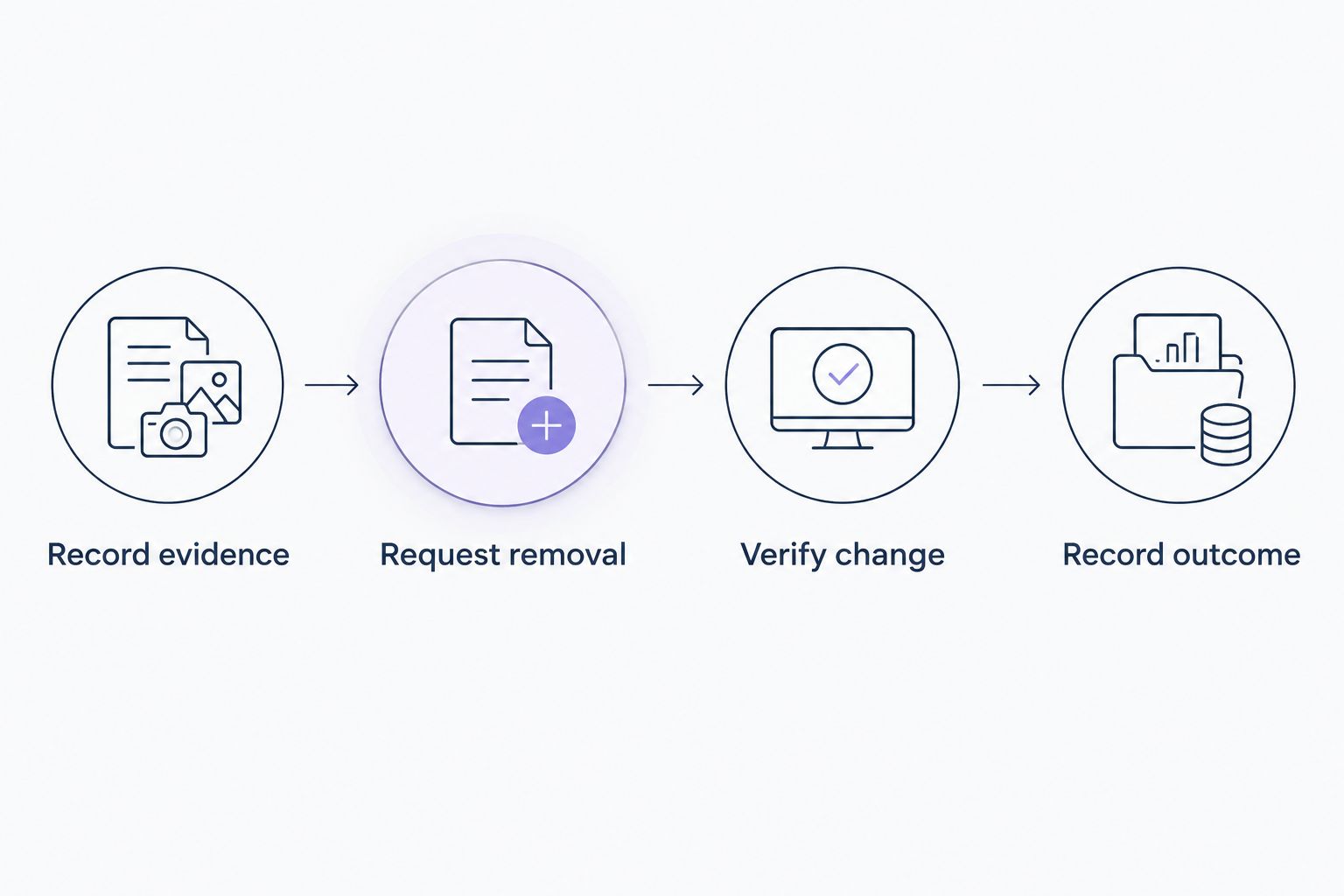
For your 2026 cleanup log, distinguish deletion from qualification. If the publisher adds a sponsored or nofollow attribute, record that outcome accurately rather than marking the backlink removed.
A backlink checker can retain historical records after the page changes. Google Search Console’s Links report is also not an instant confirmation system, so use the live source page to verify the edit itself.
When should you use Google’s disavow tool?
Google Search Central’s disavow guidance sets a narrow test: a considerable number of spammy, artificial, or low-quality links point to your site, and those links have caused or are likely to cause a manual action. It also recommends trying to remove problematic links first.
Disavow is an advanced exception, not routine backlink maintenance. Do not upload every domain labeled toxic by an external tool.
For a 2026 submission, review these technical requirements from Google’s disavow documentation:
- The file must be plain text encoded in UTF-8 or 7-bit ASCII.
- The maximum file size is 2 MB.
- The file can contain up to 100,000 lines, including blank lines and comments.
- A URL can be up to 2,048 characters long.
- Domain-wide entries use the
domain:prefix.
Use page-level entries when the problem is limited to specific URLs. Domain-wide entries are broader: they ask Google not to count links from that domain, including legitimate links you might otherwise want counted.
Before uploading, save the existing disavow list and merge deliberate changes into it. A new upload replaces the previous list for the selected property; it does not simply append your latest entries.
Google’s disavow tool does not support Domain properties, so select an appropriate verified URL-prefix property. Keep the submitted file and a change log so another team member can understand what was excluded and why.
What if you already have an unnatural-links manual action?
Read the action’s description and identify the affected link patterns. Stop the campaign responsible, seek removal or proper qualification where appropriate, and document unsuccessful removal attempts.
If disavow is necessary, submit a carefully reviewed file before requesting reconsideration. Your reconsideration request should explain the problem, the corrective action, and the evidence supporting that work.
A disavow upload alone does not lift a manual action. Google must review the reconsideration request, and removing the action does not guarantee a return to previous rankings.
Why backlink removal outcomes vary
There is no publisher response deadline or ranking-recovery schedule you can promise. The outcome depends on identifiable parts of the process:
- Publisher control: Only someone with editing access can delete the external hyperlink.
- Contactability: A working editorial contact gives you a route to request the change.
- Placement history: A documented campaign gives you clearer evidence and accountable contacts.
- Scope: An isolated page requires a different cleanup effort from a coordinated link scheme.
- Google processing: Search systems must recrawl and reprocess changes before those changes are reflected.
- Manual-action status: Reconsideration adds a separate review process when a manual action exists.
Report outcomes you can verify: requests sent, pages inspected, links removed, and unresolved placements. Keep ranking performance separate from those operational results instead of claiming every removed backlink produced an SEO gain.
Can I remove a backlink without contacting the website owner?
You cannot delete a hyperlink on someone else’s website without editing access. You can remove a link you control, ask the responsible provider to arrange deletion, or consider disavow when Google’s criteria apply.
Changing your own page does not edit the publisher’s page. Do not delete a useful destination merely to make an unwanted backlink point to an error page.
Does disavowing a backlink remove it from the internet?
Disavowing does not remove a backlink from the internet. The hyperlink stays on the publisher’s page unless someone edits or deletes it, and it can remain visible in backlink reports.
That distinction matters when the problem involves impersonation, confidential information, or copied material. Those issues require the relevant publisher, hosting, or legal reporting process rather than an SEO disavow file.
How do I avoid repeating the same cleanup?
Keep a placement register that records the publisher, article, destination, anchor text, commercial relationship, and link qualification. Review the actual page rather than approving placements solely by a domain metric.
NO-BS Marketplace is best for SEO professionals and agencies sourcing publisher placements. Its link-building marketplace connects those buyers with verified publisher sites; that role does not replace your responsibility to assess relevance and follow Google’s link-spam policies.
For a 2026 acquisition brief, state that paid placements must be qualified appropriately. Buying a followed link to manipulate rankings remains a policy issue regardless of the platform used to arrange it.
FAQ
What’s the first thing I should do about a spammy backlink?
Confirm that the live source page actually links to your website, then assess the placement and your acquisition history. Check Google Search Console’s Manual Actions report before treating a third-party toxicity label as a penalty.
Should I disavow every backlink marked toxic?
No. A third-party toxicity score is not sufficient reason to disavow a backlink. Google reserves disavow for substantial problematic links associated with an actual or likely manual action.
Can Google remove a backlink from another website?
Google’s disavow tool cannot delete a backlink from another website. The publisher must change the page to remove the hyperlink itself.
Should I pay a spam website to remove my backlink?
Do not assume a payment demand justifies paying for removal. Document the response and assess whether the unresolved links meet Google’s disavow criteria.
Is adding nofollow the same as removing a backlink?
No. Adding nofollow changes the link’s attributes but leaves the hyperlink visible. Record qualification and deletion as different cleanup outcomes.
Will removing spam backlinks restore my rankings?
Removing spam backlinks does not guarantee ranking recovery. You must establish whether links caused the problem, and a manual action requires a separate reconsideration process.
Can I block spam backlinks with robots.txt?
No. Your robots.txt file controls crawler access to URLs on your own site, not hyperlinks published elsewhere. Blocking crawling is not backlink removal or disavowal.
One last thing
Do not delete a valuable page to escape a backlink you do not control. You would remove your own content while leaving the external hyperlink untouched.
The useful endpoint is a documented decision: remove the link, qualify it, monitor it, or disavow it under Google’s criteria. Stop when the evidence supports that decision—not when a backlink tool reports a perfect score.