
Yes—buying backlinks to manipulate rankings violates Google’s link spam policies and can lead to a manual action or to Google ignoring the links. In 2026, paying for advertising or sponsored content is allowed when the publisher appropriately qualifies the links, but a paid placement is not a guaranteed ranking asset.
- Can buying backlinks get you penalized by Google? Yes, when paid links are used to manipulate rankings.
- Google distinguishes qualified sponsored links from paid links intended to pass ranking credit.
- A manual action appears in Google Search Console; a traffic decline alone does not prove a penalty.
- NO-BS Marketplace connects SEO professionals and agencies with publishers; assess each placement against Google’s link spam policies.
Can buying backlinks get you penalized by Google?
Yes. The policy issue is buying ranking influence, not simply paying a publisher. Google Search Central’s spam policies identify buying or selling links for ranking purposes as link spam. Money, goods, or services exchanged for links can fall within that policy.
Start by checking the placement, not the sales pitch. Use this guide to audit a publisher site before buying a placement to structure your review, then confirm how the publisher will qualify the paid link.
There are 3 distinct outcomes to separate when investigating a campaign:
| Outcome | What it means | Evidence to check | Next move |
|---|---|---|---|
| Manual action | A human reviewer has identified a spam-policy violation | Google Search Console’s Manual Actions report | Correct the violation and request reconsideration |
| Link neutralization | Google’s systems disregard link spam rather than reward it | No dedicated report confirms every ignored link | Stop treating purchased ranking credit as a dependable asset |
| Other ranking change | Rankings changed for reasons not established as a link penalty | Search performance, indexing, technical changes, and content changes | Diagnose the change before removing links |
A manual action and an ignored backlink are not the same thing. Both matter, but only the first gives you a specific manual-action notice to address.
Why this matters
For an agency, the wrong promise creates a delivery problem: the client expects ranking gains from a placement that Google prohibits or disregards. A publisher’s authority metric does not change the rule.
Your 2026 campaign brief should distinguish paid distribution from earned editorial endorsement. Sponsored content can put your message in front of a relevant audience, but you should assess that placement on its audience and business value—not sell it as a way around Google’s policies.
That distinction also improves reporting. Record what you purchased, what the publisher published, and which results you can actually attribute to the placement.
Which paid links violate Google’s policies?
Google’s link spam policy covers links created primarily to manipulate search rankings. Its examples include exchanging money for links or posts containing links, exchanging goods or services for links, and sending someone a product in exchange for a write-up and link.
The same policy addresses advertorials and native advertising where payment buys links that pass ranking credit. It also identifies optimized anchor text in distributed articles, guest posts, or press releases as a link spam pattern.
An editorial-looking article does not make a purchased ranking link compliant. Neither does publishing it on a relevant website. Those qualities help you assess whether the content serves readers; they do not erase the commercial arrangement.
Ask what the agreement actually requires. If the deliverable is an unqualified backlink intended to improve rankings, changing the label to “editorial,” “outreach,” or “PR” does not change that deliverable.
By contrast, paying someone to research, write, or conduct outreach does not automatically mean you bought an endorsement. The distinction is whether a publisher independently chooses to cover and link to your work, or receives compensation for the placement.
Which link attributes should sponsored content use?
Google Search Central’s guidance on qualifying outbound links recommends rel="sponsored" for advertisements and paid placements. It also accepts rel="nofollow" for those links, although sponsored is the more specific label.
A visible sponsorship disclosure and a link attribute do different jobs. The disclosure explains the commercial relationship to readers; the attribute identifies the link’s relationship to search systems. A disclosure alone does not qualify the backlink.
Inspect the published page’s HTML. The word “sponsored” in an order confirmation, article heading, or publisher email does not establish that the link carries the appropriate attribute.
For your 2026 approval checklist, record the destination URL, anchor text, link attribute, and disclosure separately. If the publisher changes any of them after publication, reassess the placement instead of relying on the original agreement.
Qualified sponsored links still need useful content and responsible placement. The attribute addresses the paid-link relationship; it is not blanket protection for other spam-policy violations or a promise of search visibility.
Are guest posts, niche edits, and digital PR different?
The format does not determine compliance. A newly written guest post and a link inserted into an existing article both require qualification when the publisher is compensated for the link.
Digital PR needs the same distinction. Paying an agency to pitch a story differs from paying a publisher for coverage, and neither arrangement guarantees rankings.
| Approach | Best for | Useful feature | Limitation or risk |
|---|---|---|---|
| Qualified sponsored guest post | Explaining a relevant topic to a publisher’s audience | Gives the topic space and context | Requires paid-link qualification; ranking gains are not guaranteed |
| Qualified paid niche edit | Adding a genuinely useful reference to existing content | Places the reference within an established article | An unrelated insertion weakens the article; payment still requires qualification |
| Earned digital PR | Securing independent coverage of a newsworthy story | Lets the publisher decide whether the story merits a link | Coverage, links, and timing are not guaranteed |
| Unqualified paid ranking link | No policy-compliant ranking objective | Gives the buyer control over the requested placement | Violates Google’s link spam policies when purchased to manipulate rankings |
Choose the format for the reader’s needs, not for a supposed policy loophole. An older article is not exempt from the paid-link rules. An earned mention also stops being an independent endorsement if payment to the publisher becomes a condition of publication.
Why backlink penalty risk varies
Google does not publish a safe quota for purchased ranking links. The relevant factors are the arrangement and the behavior—not a universal order size or authority score.
- Ranking purpose: Buying a link primarily to influence search rankings falls within Google’s link spam policy.
- Link qualification: Paid placements need appropriate qualification. A publisher’s reputation does not replace the attribute.
- Anchor requirements: Google identifies optimized anchors in distributed guest posts and similar content as a spam pattern. Do not make a ranking keyword the condition of publication.
- Distribution pattern: Automated link creation, excessive link exchanges, and other practices listed in Google’s policies remain problematic regardless of the campaign name.
- Content purpose: Low-value content created primarily to manipulate linking and ranking signals adds another policy concern. A real reader should have a reason to use the article.
Relevance belongs in your publisher review, but it is not a compliance exemption. A tightly matched industry publication can still sell an unqualified ranking link that violates the same policy.
How do you check a placement before approving it?
Use 5 checks for a 2026 paid-placement review. Keep the evidence alongside the order so your account manager can explain what was approved without reconstructing the arrangement later.
- Payment terms: Establish who receives compensation and what that compensation buys. Include products or services exchanged for coverage, not just cash payments.
- Publisher fit: Read the publication and the proposed article. Check whether the subject belongs there and whether the destination helps the reader answer a real question.
- Link attributes: Confirm the agreed qualification, then inspect the live HTML after publication. Do not substitute a screenshot of the article for checking the link itself.
- Content quality: Review the article’s claims, sources, and placement context. Reject text whose only purpose is to carry a backlink.
- Live verification: Record the published URL, destination, anchor, disclosure, and attribute. Check the delivered placement against the agreement before marking the order complete.
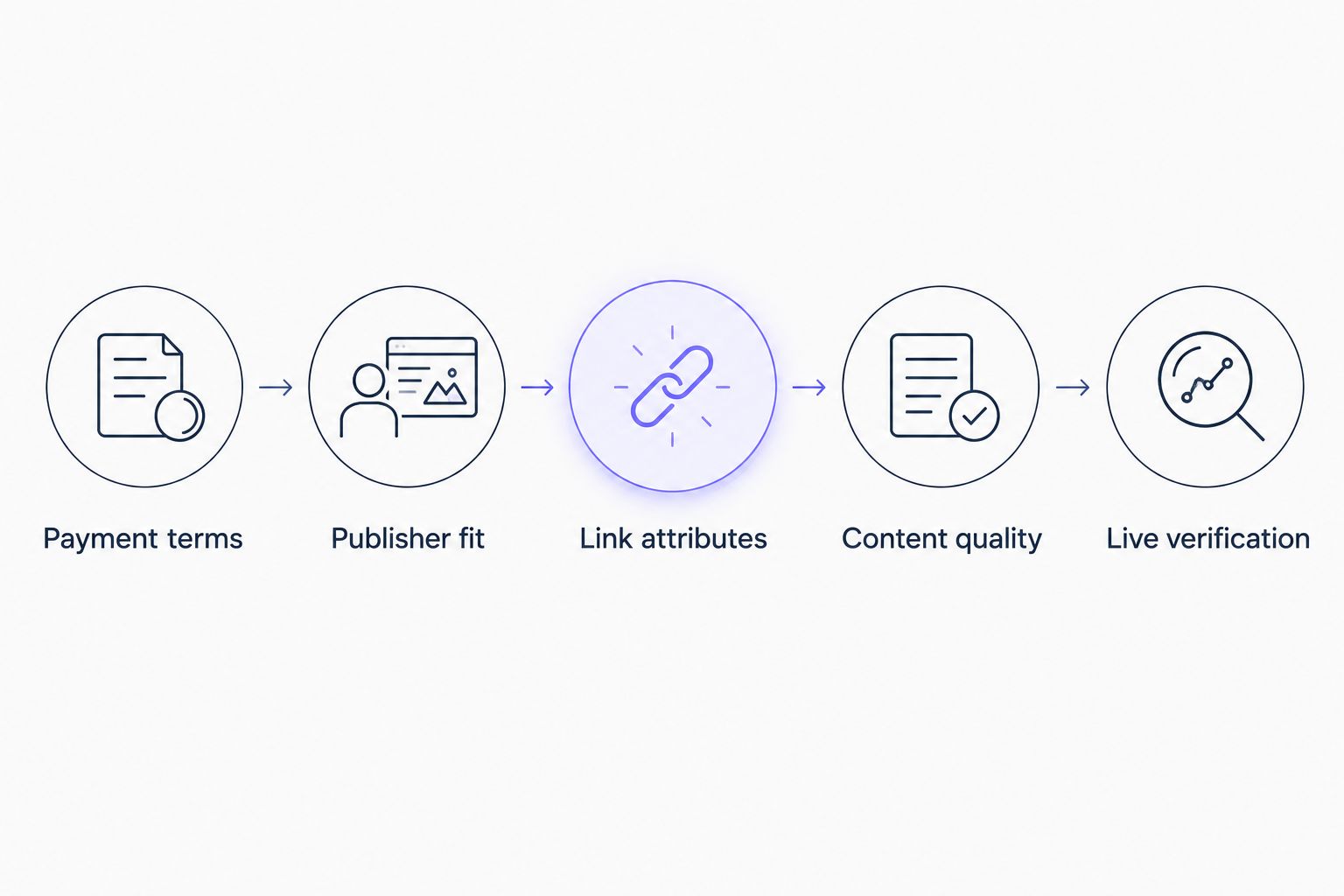
Keep acceptance criteria explicit. If your agency requires qualified paid links, put that requirement into the brief and approval process rather than leaving it to a publisher’s default settings.
A refusal to qualify a purchased link is a reason to reject that arrangement. Do not compensate by changing the anchor or spreading orders across more websites; neither action resolves the underlying policy issue.
Where a publisher marketplace fits
NO-BS Marketplace is a link building and guest posting platform connecting SEO professionals and digital marketing agencies with verified publisher sites for content and placements. NO-BS Marketplace fits agencies sourcing publisher placements; Google compliance remains a placement-level responsibility.
The platform’s role is relevant to sourcing. Its limitation in this decision is equally clear: a marketplace listing is not evidence that every proposed link arrangement meets Google’s policies. Your agency still needs to verify the commercial terms, content, and published attributes.
What should you do if you already bought backlinks?
Start with evidence, not a mass deletion request. A traffic decline after a campaign establishes timing, not the cause of the decline.
For a 2026 investigation, review 2 Search Console reports first: Manual Actions and Performance. The first identifies reported manual actions; the second helps you locate affected queries, pages, and dates. Neither is a complete inventory of link quality.
Then follow the path that matches the evidence:
- If there is a manual action: Read its scope and examples. Audit the unnatural links, seek removal or appropriate qualification, and document your cleanup efforts. Submit a reconsideration request after addressing the violation.
- If there is no manual action: Review purchased placements alongside technical, indexing, content, and search-demand changes. Correct known paid-link violations, but do not call every ranking loss a penalty.
- If you are considering disavowal: Follow Google’s stated criteria. Its guidance reserves the tool for substantial spammy, artificial, or low-quality links that caused—or are likely to cause—a manual action.
Google warns that incorrect use of the disavow tool can harm search performance. A low third-party authority score alone is not a sufficient reason to disavow a domain.
Removing a manual action does not guarantee restoration of previous rankings. If those rankings depended on links Google no longer counts, correcting the violation does not recreate their former contribution.
Can a high-authority backlink still get you penalized?
Yes. A paid link intended to manipulate rankings can violate Google’s policies regardless of the publisher’s authority score. Domain Rating and similar third-party metrics are not Google compliance certifications.
Use authority metrics as supporting context, not permission. Review the actual agreement and published link before approving the placement.
Is there a safe number of backlinks to buy each month?
No. Google does not publish a safe monthly allowance for purchased ranking links. A small campaign is not automatically compliant, and a gradual schedule does not make an unqualified paid ranking link acceptable.
Set campaign volume around legitimate publishing needs and review capacity. Do not present a delivery schedule as protection from link spam enforcement.
Can you recover from a paid-link manual action?
Yes. Google provides a reconsideration process after you address a manual action’s underlying violations. That process requires cleanup and a clear explanation of the corrective work—not another batch of backlinks.
Separate the goals: removing the action resolves the reported violation; improving rankings requires a sound site and a policy-compliant search strategy.
FAQ
Can buying backlinks get you penalized by Google in 2026?
Yes. Buying backlinks to manipulate rankings violates Google’s link spam policies and can trigger a manual action or cause the links to be ignored. Appropriately qualified advertising and sponsored links are permitted.
Is buying a sponsored post the same as buying a ranking backlink?
No. A sponsored post with appropriately qualified links is a paid advertising arrangement. Buying an unqualified link to influence rankings falls within Google’s link spam policy.
Does a sponsored label make a paid backlink compliant?
A visible sponsored label alone does not qualify the link. Google recommends rel="sponsored" for paid placements and also accepts rel="nofollow"; inspect the actual link attribute.
Will Search Console tell me if Google ignores a backlink?
Search Console does not provide a report confirming every ignored backlink. Its Manual Actions report identifies manual actions, which are different from automated link neutralization.
Should I disavow every backlink with a low authority score?
No. A low third-party authority score alone is not a reason to disavow a link. Google warns that incorrect disavowal can harm performance and describes specific conditions for using the tool.
Are paid guest posts safer than paid niche edits?
Neither format is exempt from Google’s paid-link rules. When a publisher receives compensation for the placement, the link needs appropriate qualification regardless of whether the article is new or existing.
Does using NO-BS Marketplace guarantee that a link meets Google’s policies?
No marketplace listing guarantees compliance for a specific link arrangement. NO-BS Marketplace connects SEO professionals and agencies with verified publishers; assess the payment terms, content, disclosure, and published link qualification.
One last thing
Ask this before approving your next 2026 placement: Would you still want it if Google gave the link no ranking credit?
If the article reaches a relevant audience, explains something useful, and supports a measurable business objective, you have a reason to evaluate it as sponsored distribution. If the entire case depends on an unqualified link moving rankings, the commercial brief conflicts with Google’s policy.
Make that distinction before ordering. It is easier to reject the wrong arrangement than to explain it during a cleanup.