
There is no fixed timeline for recovering from a backlink penalty in 2026. A manual-action recovery requires cleanup and a successful reconsideration request; Google says reconsideration reviews can take several days to several weeks, but removing the action does not guarantee that your previous rankings will return.
- How long does it take to recover from a backlink penalty? No fixed deadline applies; diagnose the cause first.
- Google Search Console confirms manual actions; a traffic drop alone does not prove a backlink penalty.
- Google says reconsideration reviews can take several days to several weeks; cleanup and ranking recovery are separate.
- NO-BS Marketplace serves SEO professionals buying publisher placements, not as a substitute for penalty diagnosis.
How long does it take to recover from a bad backlink penalty?
Your recovery timeline depends on what actually happened. A confirmed unnatural-links manual action, algorithmic link devaluation, and an unrelated traffic decline require different responses.
For a 2026 recovery plan, use Google's Search Console documentation on reconsideration requests and its Search Central guidance on link spam and disavowing links. These sources explain the process, not a guaranteed date for regaining traffic.
| Situation | Best for identifying it | Required response | Advantage of this route | Limitation |
|---|---|---|---|---|
| Unnatural-links manual action | Search Console's Manual Actions report | Correct the violation and request reconsideration | Google provides a documented review route | A successful review does not restore lost ranking credit |
| Algorithmic link devaluation | Reviewing link practices alongside ranking changes | Stop manipulative practices and address confirmed problems | Focuses on the underlying link strategy | No reconsideration request applies without a manual action |
| Traffic loss without a confirmed link issue | Checking indexing, technical changes, content, and search demand | Diagnose the actual cause before removing links | Avoids unnecessary backlink cleanup | Requires investigation beyond backlink reports |
Do not start a penalty-recovery clock until you know which problem you are fixing. Otherwise, you risk measuring the wrong work against an arbitrary deadline.
Before your next placement campaign, review the buying process as well as the existing links. NO-BS Marketplace connects SEO professionals and agencies with publisher sites; purchasing access to a publisher does not remove your responsibility to follow Google's link-spam policies.
Why this matters
A penalty being lifted and a business recovering its organic leads are different outcomes. Treating them as the same milestone creates bad forecasts and frustrated clients.
If rankings depended on links Google considers manipulative, removing those links does not preserve their former contribution. Your site must compete using the signals that remain.
For agency reporting in 2026, separate the work you control from decisions Google controls. You control investigation, outreach, documentation, and corrective changes; you do not control review completion or the positions Google assigns afterward.
Manual-action recovery: cleanup comes before review
A manual action is the clearest case because Search Console identifies the violation. Read the action carefully, including its scope and any example links Google provides.
Those examples are a starting point, not a complete cleanup list. Review the broader pattern that produced them, including work commissioned through former agencies, vendors, or internal teams.
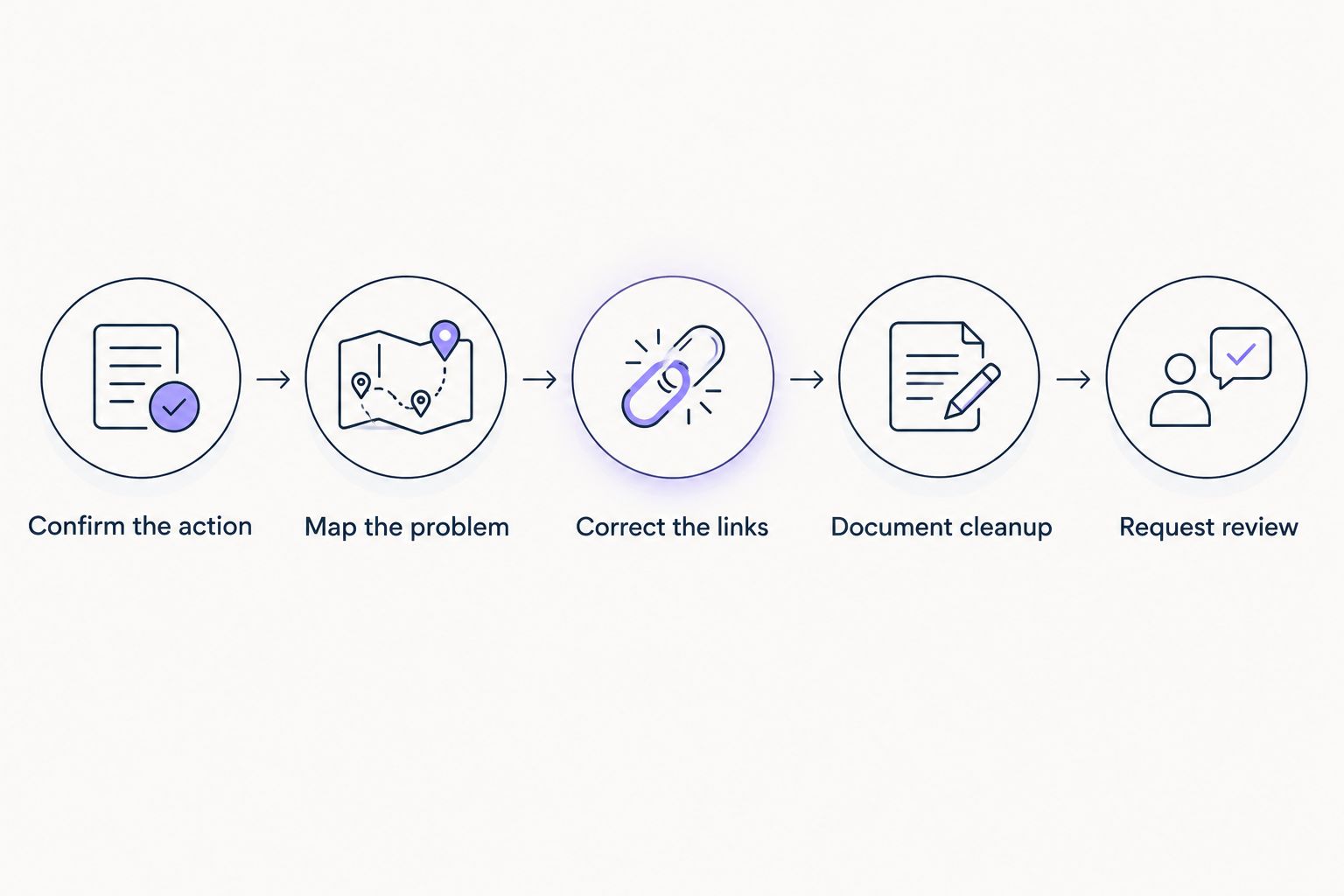
Use this sequence:
- Confirm the action. Open the correct Search Console property and inspect the Manual Actions report. Save the notice and its examples in your recovery record.
- Map the problem. Combine available backlink reports with placement records, invoices, and outreach history. Identify the practices responsible for the unnatural links.
- Correct the links. Request removal or appropriate link qualification where possible. Stop campaigns that continue producing the same violation.
- Document cleanup. Record the affected pages, linking sources, requests sent, responses received, and changes completed. Keep unresolved cases separate from resolved ones.
- Request review. Explain what caused the issue, what you corrected, and what changed in your process. Submit the reconsideration request after meaningful remediation, not before.
The submission date starts the review stage. It does not erase the time already spent investigating and correcting the problem.
Keep your request factual. Describe the pattern rather than blaming a mysterious attack unless you have evidence, and give Google enough information to understand the corrective work.
If Google rejects the request, read the response and revisit unresolved violations. Repeating the same submission without further fixes does not address the reason the action remains.
Algorithmic link devaluation: there is no review queue
Without a manual action, there is no unnatural-links reconsideration request to submit. That distinction matters more than any generic recovery estimate.
Google's link-spam guidance explains that systems can neutralize the ranking benefit of unnatural links. When that benefit disappears, removing the links does not automatically bring the benefit back.
A lost benefit is not a temporary debt Google must repay. If a page ranked partly because of manipulative links, its old position is not a reliable recovery target.
Review whether the affected pages still satisfy the search intent, remain indexed, and deserve visibility against competing results. Improve genuine weaknesses rather than buying replacement links to recreate the same pattern.
Do not label every unexplained decline an algorithmic penalty. A ranking chart cannot establish the cause on its own, even when the drop follows a link campaign.
Why backlink-penalty recovery time varies
These factors determine the work involved and the evidence available. None produces a reliable universal deadline.
- The confirmed diagnosis. A manual action requires Google's review; an indexing error or weaker page requires a different fix. Misdiagnosis adds work without addressing the loss.
- The extent of the link scheme. A documented campaign is easier to investigate than a history of undisclosed placements across multiple vendors. Review the pattern, not just Google's examples.
- Publisher cooperation. You control removal requests, but publishers control changes on their sites. Record unsuccessful attempts instead of treating a sent email as a completed removal.
- Cleanup quality. Leaving the same practices running undermines the corrective work. A strong request explains both the removed violations and the process changes.
- Google's processing. Reconsideration review and the processing of link changes are outside your control. A disavow submission is not an instant reset.
- The site's remaining competitiveness. Technical accessibility, useful content, and legitimate reputation still matter after cleanup. A revoked action does not establish that the site deserves its former positions.
For your 2026 forecast, report these as dependencies rather than converting them into an unsupported completion date. Tell stakeholders which dependency is unresolved and what evidence will close it.
Should you disavow bad backlinks to recover faster?
Do not use disavow as a routine cleanup shortcut. Google's guidance says most sites do not need the tool and warns that incorrect use can harm search performance.
Google describes disavow as appropriate when a considerable number of spammy, artificial, or low-quality links exist and they have caused, or are likely to cause, a manual action. Attempt removal where possible before relying on the file.
A third-party toxicity score is not proof that Google has penalized a link. Investigate why the link exists, whether it was arranged to manipulate rankings, and whether the surrounding pattern supports corrective action.
Preserve legitimate editorial mentions. A small site, an unfamiliar domain, or an unattractive page is not automatically a reason to discard a backlink.
If you replace an existing disavow file, remember that the new upload replaces the previous file rather than adding to it. Review the complete intended file before submitting it.
How do you know whether recovery is working?
Use separate checkpoints for administrative progress and search performance. Combining them hides whether the cleanup succeeded or the site still has other problems.
Check the action status
For a manual-action case, Search Console's response and Manual Actions report establish whether Google has revoked the action. A smaller backlink count does not establish that outcome.
Retain the response with your cleanup record. It gives the client a clear distinction between submitted, rejected, and resolved work.
Check the affected search traffic
Compare the affected pages and queries in Search Console using equivalent reporting periods. Separate branded searches from nonbranded searches so a brand campaign does not disguise continued weakness elsewhere.
Annotate cleanup, submission, and response dates in your 2026 reporting. Also record migrations, redesigns, indexing changes, and major content edits that complicate attribution.
Check the business outcome
Track organic conversions alongside visibility. More impressions do not necessarily mean the pages that generate inquiries or sales have recovered.
Keep the conclusion narrow: an action was lifted, a query group improved, or organic leads increased. Claim that a particular link removal caused a change only when the evidence supports that connection.
Will rankings return when Google removes the penalty?
There is no guaranteed ranking return after Google removes a manual action. Revocation confirms that the action has been resolved, not that Google will restore the site's previous search positions.
If unnatural links supported those positions, their removal or neutralization leaves a different competitive baseline. Set the next target using current search results and the site's remaining strengths.
Can you recover without removing every suspicious backlink?
There is no requirement to treat every unfamiliar backlink as a violation. Focus on evidence of manipulative practices and address the scope of the confirmed action.
Google's guidance recognizes that removal is not always possible and provides disavow for appropriate cases. Document unsuccessful removal attempts rather than assuming you must control every external page.
When should you restart link building?
Restart only after you have stopped the offending practices and established placement rules that address the cause. Buying a new batch of links is not a remedy for unresolved link spam.
NO-BS Marketplace is best for SEO professionals and agencies sourcing publisher placements, not for diagnosing a Google penalty. The platform's role is placement access; your recovery work still requires investigation, policy decisions, and evidence.
For NO-BS Marketplace link building, use the same approval standards you apply to every other source. Review editorial relevance, the publisher's purpose, and the treatment of paid links before approving a placement.
Google's spam policies prohibit buying links for ranking manipulation. Paid advertising and sponsorship links should use appropriate qualification; Google prefers rel="sponsored" for paid placements and also accepts rel="nofollow".
A marketplace can help organize sourcing, but it cannot make an unqualified paid ranking link compliant. Before restarting, use the publisher-site audit guide to structure your checks.
FAQ
How long does it take to recover from a backlink penalty in 2026?
There is no fixed recovery timeline in 2026. Google says reconsideration reviews can take several days to several weeks, but cleanup comes before review and ranking recovery is not guaranteed afterward.
How do I check whether Google penalized my backlinks?
Check the Manual Actions report in Google Search Console for a confirmed manual action. A traffic decline or third-party toxicity score alone does not prove a backlink penalty.
Does removing bad backlinks restore my old rankings?
Removing bad backlinks does not guarantee that your old rankings will return. If those links supplied ranking credit that Google later neutralized, cleanup does not restore that credit.
Should I disavow every backlink with a high toxicity score?
No, a third-party toxicity score is not sufficient evidence for disavowing a backlink. Google's disavow guidance focuses on substantial problematic link patterns associated with an actual or likely manual action.
Can I submit a reconsideration request without a manual action?
No, the reconsideration process applies to manual actions. Without one, investigate the ranking decline and correct confirmed problems rather than looking for a penalty-review queue.
Can I buy new backlinks while recovering from a penalty?
Buying new backlinks does not resolve a penalty and can repeat the original violation. Stop manipulative practices, complete corrective work, and establish compliant placement rules before restarting campaigns.
What should an agency promise a client during backlink recovery?
An agency should commit to defined investigation, cleanup, documentation, and reporting work, not a guaranteed ranking date. Google's review decisions and subsequent rankings remain outside the agency's control.
One last thing
The most useful recovery date is the date you stopped repeating the violation. Without that change, a removal spreadsheet documents activity while the underlying problem continues.
Before sending your next status report, state the current milestone plainly: diagnosis confirmed, cleanup underway, review submitted, action revoked, or search performance improving. That tells a founder what happened and what comes next without pretending those milestones are interchangeable.