
No. Backlinks from .edu and .gov sites do not carry extra SEO weight simply because of their domain extension. A relevant, editorially earned institutional link can be valuable, but the suffix does not turn an unrelated directory entry, user profile, or paid placement into a strong ranking signal.
- Do edu and gov backlinks carry more weight? No: the domain extension alone does not confer extra ranking value.
- Google evaluates links beyond domain suffixes; relevance, editorial context, and spam policies matter.
- NO-BS Marketplace suits SEO professionals and agencies sourcing publisher placements, not a replacement for placement-level checks.
- Prioritize useful citations and qualified referral traffic over collecting .edu and .gov backlinks.
Do backlinks from .edu or .gov sites carry more SEO weight?
The extension is not a quality score. For your 2026 campaign, compare the actual linking pages and the reasons they cite you—not just the institutions that host them.
NO-BS Marketplace connects SEO professionals and agencies with publisher sites for link building, guest posting, sponsored content, and digital PR placements. The same page-level scrutiny applies whether you source a publisher placement or earn a university citation.
| Link opportunity | Best for | Potential benefit | Limitation or risk |
|---|---|---|---|
| Relevant university resource page | Resources that genuinely serve students or researchers | An editorial citation with a clear audience fit | Inclusion depends on the resource meeting the page's purpose |
| Relevant government resource page | Resources that support a public-service need | Discovery by people seeking official guidance | The institution's identity does not guarantee ranking impact |
| Relevant commercial publication | Specialist commentary, research, or practical guidance | Contextual coverage for a matching readership | Commercial arrangements require appropriate link qualification |
| Open institutional profile or comment | Legitimate participation where the profile serves users | Discovery through a useful contribution | Self-created links are not equivalent to editorial recommendations |
A university research citation and an abandoned university profile share a suffix. They do not share the same editorial context. Treating them as interchangeable is the mistake behind the .edu backlink myth.
Why this matters
A suffix-first brief directs outreach toward a domain category instead of a business objective. You end up asking whether a site is educational or governmental before asking whether its readers need your resource.
For a 2026 link-building plan, separate 2 campaign goals: organic search visibility and qualified referral traffic. A placement can contribute to discovery without producing a measurable ranking change, and a ranking movement does not prove that a particular backlink caused it.
Your approval standard should explain why the link belongs on that page. If the explanation stops at the domain extension, the opportunity needs more scrutiny.
University backlinks: judge the citation, not the institution
A university backlink makes sense when your resource supports the linking page's academic, student, professional, or community purpose. The useful question is whether an editor would include it without an SEO request.
Consider a hypothetical university careers page linking to an accessible interview-preparation guide. The audience connection is clear. A link from an unrelated student profile to the same guide has a different context, even on the same university domain.
Best for: Original research, educational resources, career guidance, and tools that directly serve the university page's audience.
- Pro: A relevant editorial citation gives readers a reason to visit your resource.
- Con: Institutional affiliation alone tells you little about an individual page's quality or maintenance.
- Recommendation: Pursue the audience fit; skip opportunities whose only selling point is the .edu suffix.
Do not manufacture a scholarship solely to collect university links. A legitimate scholarship should stand on its educational purpose and administration, not on the number of linking domains it produces.
Government backlinks: earn inclusion through public usefulness
A government backlink makes sense when your content helps the agency serve its audience. A public resource page, business-support directory, or research publication needs a defensible reason to reference an outside organization.
For example, a hypothetical local business directory has a clear reason to list an eligible local company. That listing still does not establish how much ranking value the link passes, or whether it passes any measurable value at all.
Best for: Eligible business listings, public-interest resources, research contributions, and documented participation in relevant programs.
- Pro: The placement can put your organization in front of people looking for a specific public resource.
- Con: An official host does not make every outbound link an editorial endorsement.
- Recommendation: Follow the agency's published inclusion rules and assess the exact page before investing outreach effort.
For 2026 prospecting, treat eligibility as a prerequisite—not something to work around. Do not imply a government partnership or endorsement merely because a page links to your business.
Commercial backlinks: do not dismiss relevant publishers
A specialist publication does not need an institutional extension to publish a useful citation. A relevant article can explain your research, reference your methodology, or direct readers to a resource that answers their next question.
That gives you a practical comparison: an editorial reference in a closely related publication versus an unrelated institutional listing. Do not automatically rank the institutional listing first. Judge the page, audience, placement, and acquisition method together.
Best for: Reaching a defined professional or consumer audience through relevant coverage.
- Pro: Specialist publishers give you a clear topic and readership against which to assess fit.
- Con: Paid coverage is not the same as an independently earned recommendation.
- Recommendation: Distinguish editorial coverage from sponsored placements before approving either.
NO-BS Marketplace provides access to publisher placements, but that service category does not remove the need to assess relevance or follow search-engine policies. Buying a placement is not evidence that the resulting link will improve rankings.
Why backlink value varies
Google Search Central's link guidance and spam policies distinguish useful links from attempts to manipulate rankings. Apply those principles to your 2026 evaluation rather than assigning a bonus to a suffix.
Use these 5 review factors:
- Relevance: Does the linking page cover a subject connected to your destination? The surrounding text should explain why your resource belongs there.
- Editorial control: Did someone responsible for the content choose the citation, or can anyone insert a link? A self-submitted profile does not establish editorial approval.
- Page context: Is the link part of useful main content, a maintained resource list, or an unrelated block? Inspect the actual placement rather than relying on a domain-level metric.
- Technical accessibility: Can search engines discover the page and its link? Check the destination, crawl restrictions, indexing directives, and link implementation separately.
- Acquisition method: Was the reference earned, sponsored, exchanged, or inserted without authorization? The arrangement matters for compliance regardless of the domain extension.
These factors are not a formula for calculating link equity. They are a screening framework that stops a recognizable institution from substituting for evidence about the placement.
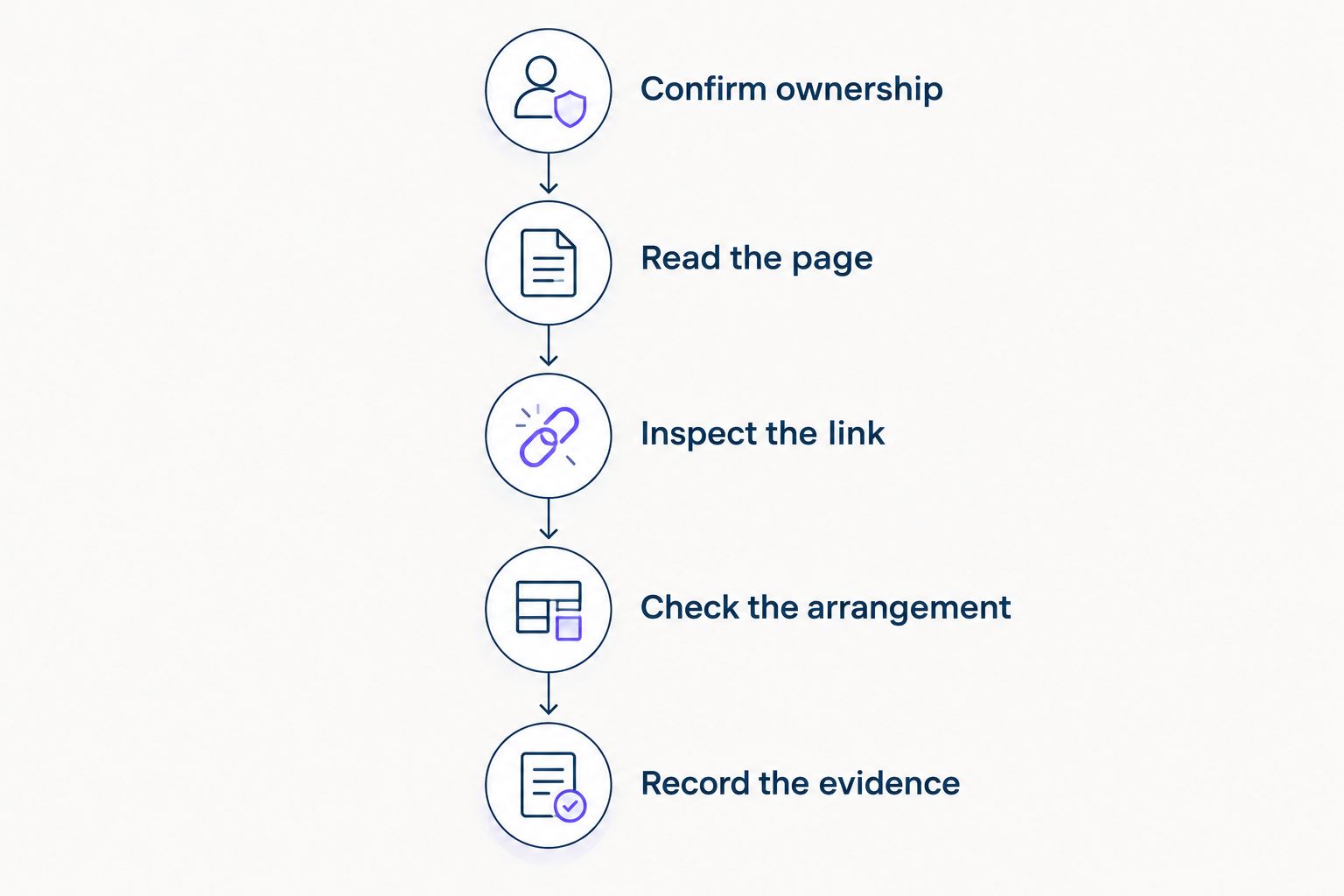
How should you check an .edu or .gov backlink opportunity?
Use the same approval process for institutional and commercial domains. The process should produce a reason to accept or reject the specific placement—not a prediction of Google's internal scoring.
1. Confirm ownership
Start from the institution's official presence and establish who controls the page. An authorized departmental resource and an open user-hosting area can exist under related institutional infrastructure while serving different purposes.
Check the named department, editor, program, or directory owner. A seller's screenshot is not a substitute for examining the live page.
2. Read the page
Read enough of the content to identify its purpose and intended audience. Then explain why your destination helps that audience.
Look at the surrounding outbound references. Unrelated commercial links, incoherent additions, and content that conflicts with the page's stated purpose warrant investigation; they do not become acceptable because the domain looks official.
3. Inspect the link
Check the destination URL, anchor text, redirects, and rel attributes in the rendered page or HTML. Verify that the link points to the resource you intended to promote.
Google Search Central recommends qualifying advertising and paid-placement links with rel="sponsored"; nofollow is also acceptable for marking paid links. These attributes do not create a guaranteed ranking outcome.
4. Check the arrangement
Ask who authorizes publication and why the link is being added. Reject offers based on compromised access, hidden insertions, or promises that institutional links bypass Google's spam policies.
For paid placements, document the commercial relationship and required qualification. Disclosure to readers and qualification for search engines address different responsibilities; do not treat either as a substitute for the other.
5. Record the evidence
Save the source page, destination, placement context, link attributes, and acquisition method. Record the reason the page serves your audience.
Keep observed outcomes separate from assumptions. Referral visits are observable; a claim that the suffix caused a ranking gain requires evidence that an ordinary campaign report does not establish.
Are .edu and .gov links better than .com links?
No—.edu and .gov links are not automatically better than .com links. A relevant commercial publication can offer a more appropriate citation than an unrelated institutional page.
Compare the reason for inclusion and the usefulness of the destination. Domain type alone cannot settle that comparison.
Should you buy .edu and .gov backlink packages?
Do not buy a package because it promises institutional ranking power. Inspect the proposed source pages, publication authorization, and link qualification before considering any placement.
Google's link-spam policies cover buying links for ranking manipulation regardless of suffix. A seller cannot make that arrangement compliant by placing it on an educational or government domain.
Do nofollow institutional links still have value?
Nofollow institutional links can still direct readers to your site. Google treats nofollow as a hint, not a promise that a link will contribute ranking value.
Assess whether the referral makes sense for your audience. Do not reject a useful citation solely because it lacks an unqualified link, and do not sell it internally as guaranteed SEO equity.
FAQ
Do edu and gov backlinks carry more weight in 2026?
No. Educational and government domain extensions do not automatically give backlinks extra ranking weight. Evaluate the linking page, editorial context, relevance, and acquisition method.
Does a university backlink guarantee higher Google rankings?
No university backlink guarantees higher Google rankings. A legitimate citation is an opportunity for discovery, not proof of a future ranking improvement.
Is a government directory link worth pursuing?
A government directory link is worth assessing when your business qualifies and the directory serves a relevant audience. Check the listing rules, page quality, and link implementation before treating it as an opportunity.
Are student profile backlinks as good as university editorial links?
Student profile backlinks are not equivalent to university editorial citations. A profile that a user creates does not demonstrate that an institutional editor reviewed and recommended the destination.
Can paid edu backlinks violate Google's spam policies?
Paid educational-domain backlinks can violate Google's spam policies when purchased to manipulate rankings. The institutional suffix does not exempt the arrangement from those policies.
What should I check before accepting an institutional backlink?
Check ownership, page relevance, the link itself, publication authorization, and the acquisition arrangement. Document the evidence instead of approving the placement on its suffix alone.
Can I measure exactly how much ranking power an edu link passes?
You cannot directly measure the exact ranking weight Google assigns to an individual educational-domain link. Track referral activity and search performance without claiming that correlation proves the link caused a change.
One last thing
Use the suffix-blind test: remove the institution's name and domain extension from the pitch, then assess the page again. If the remaining case is an unrelated page, a self-created profile, or a hidden insertion, the recognizable domain was doing all the persuasion.
For your 2026 campaign, give NO-BS Marketplace placements and earned institutional citations the same brief: a relevant audience, a useful destination, and a documented acquisition method. Approve the reason for the link—not the letters after the domain name.