
Yes, guest posts on nofollow sites can support SEO through exposure to relevant readers and opportunities to earn further editorial links, but they do not guarantee ranking credit. Google treats nofollow as a hint, so you cannot count a nofollow placement as a link that passes ranking value. In 2026, judge the placement by its audience, editorial quality, and measurable outcomes—not by a promise that Google will count it.
- Can guest posts on nofollow sites still help SEO? Yes, but direct ranking credit is uncertain.
- Google treats nofollow as a hint, not a promise to pass ranking value.
- Choose guest posts for relevant readers, useful referral traffic, and credible editorial exposure.
- Paid placements need appropriate link qualification; Google prefers sponsored for advertising links.
Can guest posts on nofollow sites still help SEO?
Yes, but separate direct ranking signals from indirect marketing outcomes. A reader can follow a nofollow link, visit your resource, and later cite it from another website. That later citation is a separate link, not proof that the original nofollow link transferred authority.
Start with the publisher rather than its headline metrics. The guide to auditing a publisher site before buying a placement gives you a useful next step before committing resources.
| Link treatment | What it communicates | Best for | Main limitation |
|---|---|---|---|
| Unqualified editorial link, often called followed | No special relationship attribute is declared | Genuine editorial references | Google does not guarantee ranking credit |
rel="nofollow" |
The publisher qualifies its relationship with the linked page | Reader referrals without an unqualified endorsement | Ranking value is uncertain |
rel="sponsored" |
The link is advertising or a paid placement | Properly qualified commercial placements | Not a route to guaranteed ranking credit |
rel="ugc" |
The link appears in user-generated content | Identifying links in comments or forums | Does not establish editorial endorsement |
Google's published guidance on qualifying outbound links is the relevant authority for these distinctions in 2026. Its scope is link treatment—not a forecast of how much traffic or ranking movement a particular article will produce.
Why this matters
Rejecting every nofollow publisher confuses a link attribute with the value of reaching an audience. Accepting every recognizable publisher makes the opposite mistake: a familiar name does not establish that your prospective buyers read the article.
A nofollow guest post needs a reason to exist beyond its backlink. That reason might be reaching practitioners who need your resource, explaining a technical problem, or putting original research in front of potential sources and writers. None of those outcomes is automatic.
For an agency, this distinction also changes client reporting. Describe the placement you secured and the results you measured. Do not sell uncertain ranking credit as a completed deliverable.
Nofollow is a link attribute, not a sitewide verdict
A publisher can qualify links differently across its website. An editorial reference, author biography, sponsored article, and reader comment do not necessarily use the same attributes. Calling the entire domain a “nofollow site” skips the inspection that matters.
Check the actual link in the published article. Inspect the anchor element and read its rel attribute; do not infer the treatment from how the link looks on the page. Publishers can also combine relationship values, such as sponsored and nofollow.
The absence of nofollow does not prove a link will help rankings. Google evaluates links within its broader ranking and spam systems, and an unqualified paid link is not made acceptable by appearing inside a well-written guest article.
Likewise, nofollow is not noindex. Nofollow qualifies a link relationship; noindex instructs search engines not to index a page. A publisher's indexing controls and the attribute on your backlink require separate checks.
For your 2026 placement record, save the article URL, destination URL, anchor text, relationship attributes, and publication date. A screenshot alone cannot document the underlying link treatment.
Why the value of a nofollow guest post varies
No universal conversion rate turns a nofollow placement into a predictable SEO result. Evaluate the conditions that give the article a credible route to readers and useful follow-on activity.
- Audience fit: A publication that serves your intended buyers gives the article a relevant audience. General visibility is not the same as qualified attention.
- Article usefulness: Original explanations, evidence, and practical resources give readers a reason to keep reading or reference your work. A rewritten sales page does not serve that purpose.
- Link context: A resource linked at the point where readers need it has a clear editorial function. An unrelated keyword inserted into a paragraph does not.
- Discoverability: Examine how readers reach the article through the publisher's navigation, search visibility, or documented distribution. Publication alone does not establish exposure.
- Destination quality: The linked page must fulfill the promise made in the article. Sending readers to an unrelated landing page breaks that connection.
- Commercial treatment: Payment affects how links should be qualified. Agree on the placement's advertising status rather than treating disclosure and attributes as afterthoughts.
These are evaluation criteria, not a scoring formula. A recognizable publisher with an irrelevant audience still needs a convincing business case.
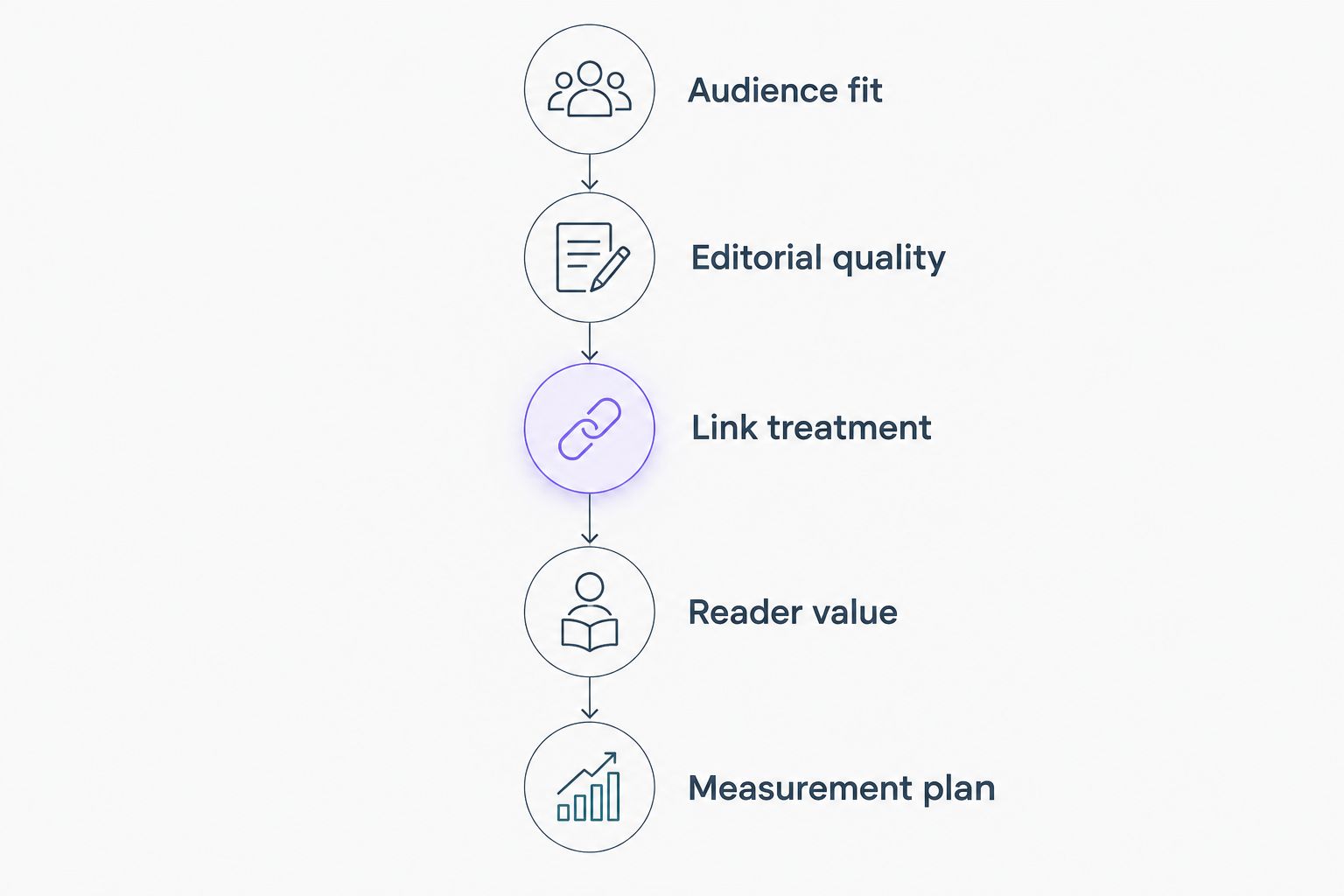
Run 5 checks before accepting the placement
Use the same approval process for a nofollow guest post that you would use for any other publishing opportunity. The link attribute belongs in the record, but it should not replace the editorial decision.
Audience fit
Read the publisher's relevant category and several recent articles. Identify who the content serves, what problems it addresses, and whether your proposed article belongs there. Check individual articles rather than relying on a domain-level traffic estimate.
Ask what a reader should do after encountering your contribution. If the only answer is that a crawler should discover the backlink, the placement lacks an audience-led purpose.
Editorial quality
Look for substantive articles, identifiable authors where appropriate, and sources that support factual claims. Check whether commercial articles fit the publication or interrupt it with unrelated topics.
A strict editor is not an obstacle to work around. Editorial review helps establish whether your contribution deserves space on the publication, although review alone does not guarantee search performance.
Link treatment
Ask how the publisher handles contextual links, author links, and paid placements. Confirm the treatment of your specific link rather than accepting a broad statement about the domain.
For paid placements, follow Google's guidance: sponsored is the preferred attribute, while nofollow remains acceptable for qualifying paid links. Do not ask a publisher to remove appropriate qualification to make a ranking promise easier to sell.
Reader value
Write the article's reader benefit before drafting the pitch. A useful contribution answers a real question and links to supporting material because that material helps explain the answer.
Remove forced exact-match anchors and references that exist only to insert the client's name. If removing the backlink makes the article collapse, rebuild the article around a stronger editorial idea.
Measurement plan
Choose 1 primary success metric before publication. For an audience-led placement, that metric might be qualified referral visits or a relevant conversion event—not an assumed increase in authority.
Document supporting signals separately, including subsequent editorial citations and changes in organic performance. This prevents a broad campaign result from being assigned to whichever link went live most recently.
How to measure the result without inventing attribution
Keep 3 outcome categories separate: referral activity, earned coverage, and organic search performance. They answer different questions. Combining them into a single claim that the link “worked” hides the evidence you actually have.
Referral activity shows whether readers visited your website and completed relevant actions. Review the referring source, landing page, engagement, and conversion events in your analytics setup. Tracking limitations mean your reports are not a complete record of every reader's journey.
Earned coverage shows whether other publishers subsequently referenced your material. Inspect those references individually: confirm the destination, context, and link treatment. A new backlink discovered after publication is not automatically caused by the guest post.
Organic search performance shows changes in impressions, clicks, and query visibility. Google Search Console reports performance for your website, but it does not label a ranking increase as the result of a particular backlink.
For a 2026 campaign, annotate publication dates alongside other material changes, including content updates and technical fixes. Compare equivalent reporting periods and account for those changes before drawing conclusions.
Do not use a third-party authority score increase as proof that Google rewarded the nofollow link. A tool's score describes that tool's model; it is not a measurement of Google's treatment of your placement.
Should you choose a relevant nofollow link over an unrelated followed link?
Choose the relevant nofollow placement when your objective is reaching a suitable audience and the publisher passes your editorial checks. An unrelated followed link does not become a sound recommendation simply because it lacks a qualifying attribute.
That is not a claim that nofollow links are stronger ranking signals. It is a decision about whether the publishing opportunity has a defensible purpose. If your brief requires a particular link treatment, record a mismatch honestly rather than quietly changing the promised deliverable.
Do not assign arbitrary percentages to followed and nofollow links. There is no universal profile ratio that makes a campaign safe or effective.
Can a nofollow guest post lead to followed backlinks?
A nofollow guest post can introduce your resource to someone who later links to it editorially. The mechanism is exposure: a writer reads the contribution, finds the source useful, and independently references it.
You cannot promise that sequence. Give readers something worth citing, such as original research, a documented method, or a clear explanation supported by evidence. Then record any subsequent coverage without claiming causation you cannot establish.
Does nofollow make a paid guest post automatically safe?
Nofollow qualifies the link; it does not certify the entire publishing arrangement. Content quality, misleading claims, advertising disclosures, and Google's other spam policies still matter.
Google's spam policies address paid links that pass ranking credit and large-scale guest posting campaigns with keyword-rich links. Google's 2026 publisher guidance also does not turn sponsored content into a guarantee of search visibility.
Keep advertising disclosure separate from technical link qualification. A reader-facing disclosure explains a commercial relationship to people; a relationship attribute communicates information about the link to search engines. One is not a substitute for the other.
Where a guest-post marketplace fits
NO-BS Marketplace is a guest posting platform for SEO professionals and agencies sourcing publisher placements. The platform connects those buyers with verified publisher sites for SEO content, backlinks, sponsored content, and digital PR placements.
The practical benefit is access to publisher opportunities through a platform. The limit is equally clear: a marketplace connection does not establish ranking credit for a nofollow link or replace your own placement assessment.
When evaluating NO-BS Marketplace, apply the same audience, editorial, and link-treatment checks described here. NO-BS Marketplace guest posting belongs in a campaign with explicit objectives—not a report that treats every published link as equivalent.
FAQ
Do nofollow guest-post links pass SEO authority?
Nofollow guest-post links do not provide guaranteed ranking credit. Google treats nofollow as a hint, so you should not report the placement as a confirmed transfer of authority.
Can people still click a nofollow backlink?
Yes, people can click a nofollow backlink and visit its destination. Nofollow qualifies the link relationship; it does not disable the hyperlink.
Is a nofollow guest post better than no guest post?
A relevant nofollow guest post is worth considering when it serves a clear audience or communication objective. Reject placements that offer no defensible value beyond an uncertain ranking benefit.
Should a paid guest post use sponsored or nofollow?
Google prefers sponsored for advertising and paid-placement links, while nofollow remains acceptable for qualifying paid links. Confirm how the publisher will treat your specific link before publication.
Will a nofollow backlink make Google index my page?
A nofollow backlink does not guarantee discovery or indexing. Keep indexing decisions separate from whether a publisher qualifies its outbound link.
How many nofollow guest posts should I publish?
There is no universal number of nofollow guest posts that produces a ranking result. Set the campaign scope around relevant publishing opportunities and measurable objectives, not a target link ratio.
Does using NO-BS Marketplace guarantee a guest post will improve rankings?
Using NO-BS Marketplace does not establish that a guest post will improve rankings. Evaluate the publisher, article, destination, and link treatment, then report observed results rather than promised ranking credit.
One last thing
Before approving your next guest post in 2026, ask: Would this article still deserve to exist if the backlink were nofollow? A useful explanation for the right audience has a purpose independent of link treatment.
If the answer is no, stop negotiating the attribute and fix the pitch. Better targeting, stronger supporting material, or a more useful destination gives the placement a clearer reason to exist. None guarantees rankings; each makes the publishing decision easier to defend.