
A single unsolicited spam backlink is generally not enough to tank your rankings; Google’s systems are designed to neutralize link spam rather than make every unwanted link your problem. A link built to manipulate rankings still violates Google’s spam policies, but discovering a suspicious backlink does not prove it caused a traffic drop.
- Can a bad backlink hurt rankings? Link schemes create risk; an isolated unsolicited spam link is not proof of harm.
- Google Search Console manual actions provide stronger evidence than a backlink tool’s toxicity label.
- Disavow links only when Google’s stated criteria apply, not whenever a suspicious domain appears.
- NO-BS Marketplace connects SEO professionals and agencies with publishers; paid placements still require Google-compliant link qualification.
Can a single bad backlink tank your rankings?
Usually not on its own. Separate an unwanted link, participation in link spam, and the loss of credit from a link Google previously counted. These are different problems with different responses.
Google Search Central’s spam policies identify links created primarily to manipulate search rankings as link spam. Its disavow guidance also says Google generally assesses which links to trust without additional help from site owners. Neither statement supports treating every ugly referring domain as a penalty.
Use this comparison before changing anything:
| Situation | Best for | Recommended response | Benefit | Limitation |
|---|---|---|---|---|
| An unsolicited scraper link with no other evidence | Routine monitoring | Record it and investigate the ranking change separately | Avoids unnecessary cleanup | Does not explain the traffic loss |
| A paid ranking link you arranged | Correcting a controlled placement | Request removal or appropriate link qualification | Addresses the policy issue directly | Does not guarantee ranking recovery |
| A substantial manipulative link history and an unnatural-links manual action | Documented remediation | Follow Google’s removal, disavow, and reconsideration guidance | Addresses an identified problem | Requires careful evidence and review |
| A previously valuable link stops passing credit | Diagnosing lost signals | Inspect the source and assess the wider ranking change | Separates lost credit from punishment | Google does not disclose individual link weighting |
A domain metric cannot make that diagnosis. Read Is domain rating a reliable measure of link quality? before treating a score as evidence against a publisher.
Why this matters
In a 2026 backlink audit, the expensive mistake is acting on the wrong explanation. Removing legitimate links while an indexing problem remains unresolved adds work without fixing the cause.
A backlink report shows that a crawler found a link. It does not show that Google counted it, penalized it, or connected it to your ranking loss.
For SEO agencies, that distinction belongs in client reporting. Label a suspicious link as an observation, not a confirmed cause, until you have evidence connecting the problem to the decline.
An unsolicited spam link: monitor before intervening
Scrapers and automated sites can link to pages without permission. A strange language, irrelevant topic, or nonsensical anchor is a reason to inspect the source—not proof that your site has received a penalty.
Best for: sites facing isolated, unsolicited links without a manual action or known link scheme. Record the source, destination, anchor text, and discovery date, then continue the wider investigation.
The benefit is restraint: you avoid removing useful signals or spending hours chasing publishers you never contacted. The limitation is that monitoring alone will not uncover a technical or content problem behind the traffic loss.
Do not mistake the tool’s first-seen date for the publication date. It records discovery by that tool, not necessarily when the link appeared or when Google encountered it.
A manipulative placement: fix what you control
A link you commissioned specifically to pass ranking credit is different from unsolicited spam. Google’s link-spam policies cover paid links that pass ranking credit, excessive exchanges, and other arrangements designed to manipulate search results.
Best for: teams correcting placements they arranged or inherited. Ask the publisher to remove the link or qualify it appropriately. Google recommends rel="sponsored" for paid placements and also accepts nofollow.
The benefit is direct control over a known policy issue. The limitation is that correcting a placement does not prove it caused the decline, and it does not promise restored positions.
For a 2026 campaign, distinguish paid exposure from purchased ranking credit before approving the brief. A sponsored article can serve an audience without an unqualified link intended to influence Google’s rankings.
An unnatural-links manual action: follow the stated process
Google Search Console’s Manual actions report is the place to check for a documented manual action. An unnatural-links notice is stronger evidence than a third-party warning because it identifies an issue Google has explicitly flagged.
Best for: sites with an unnatural-links manual action. Read the notice, investigate the link-building history, and follow Google’s remediation instructions. Do not assume the example links in a notice describe the entire problem.
The benefit is a defined remediation route, including reconsideration where applicable. The limitation is that resolving a manual action does not guarantee your previous rankings will return.
A clear Manual actions report does not rule out algorithmic effects. It means you have no reported manual action, not that every link has been endorsed.
Why backlink risk varies
For a 2026 review, assess the placement and acquisition pattern together. These factors have a clearer connection to Google’s published guidance than a generic toxicity score:
- Purpose: A reference added to help readers differs from a link created primarily to manipulate rankings.
- Payment and qualification: Paid placements need appropriate link attributes; payment alone does not describe how a link is treated.
- Acquisition pattern: Coordinated link schemes require a different investigation from isolated unsolicited mentions.
- Anchor use: Repeated optimized anchors across arranged placements warrant review in the context of the wider campaign.
- Editorial context: A useful citation inside relevant content differs from an unrelated insertion created for ranking manipulation.
- Documented history: Orders, outreach records, and manual-action notices provide evidence that a domain score cannot supply.
No single metric turns these factors into a guaranteed penalty threshold. Use them to decide what to investigate, not to manufacture a numerical risk score.
How do you investigate a ranking drop without guessing?
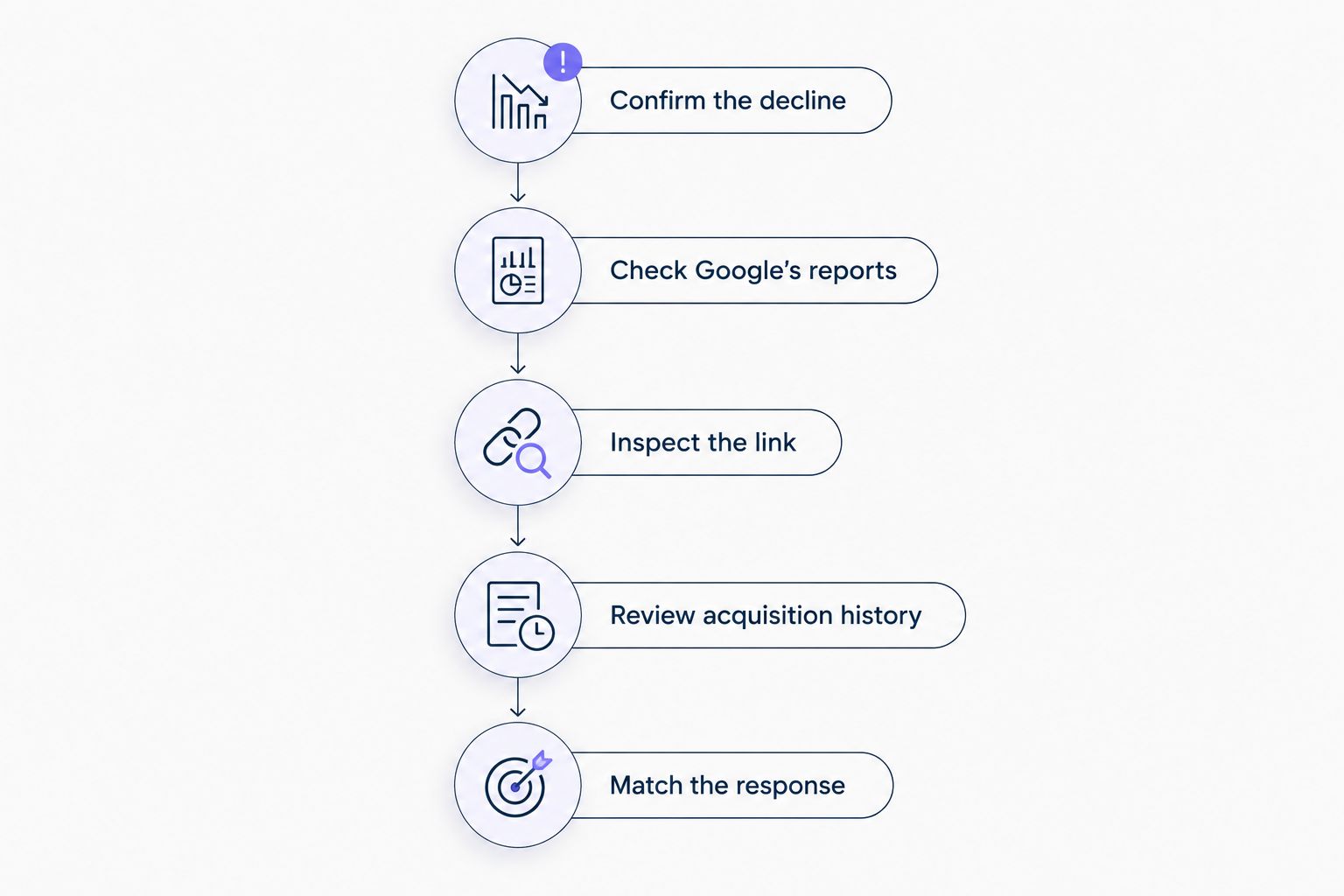
Use the following sequence for your 2026 investigation. Keep observations, hypotheses, and confirmed findings separate so your next action follows the evidence.
1. Confirm the decline
Start in Google Search Console’s Performance report. Identify the affected queries and landing pages, then separate clicks, impressions, and average position.
For an initial comparison, use two adjacent 28-day windows with matching filters. Treat that as a working view, not proof of causation; seasonal demand and changes in query mix still need consideration.
A drop in clicks without a matching loss of impressions or position points toward a different investigation from disappearing visibility across important pages.
2. Check Google’s reports
Open Manual actions and Security issues. Use URL Inspection to examine an affected landing page’s indexing status and Google-selected canonical.
Also check recent changes to redirects, robots directives, canonical tags, and page availability. A backlink cleanup will not repair an accidental indexing exclusion.
3. Inspect the link
Check the actual source page when safe to do so. Confirm the destination, surrounding paragraph, anchor text, and link attributes rather than relying on an export alone.
If the source looks malicious, use a safe inspection method instead of opening it casually. Record what you can establish without downloading files or submitting credentials.
4. Review acquisition history
Check campaign records and previous agency work. Establish whether the link was earned independently, purchased, exchanged, or inserted through a coordinated arrangement.
An unfamiliar domain is not automatically unsolicited. Inherited campaigns often require checking invoices and placement records before making that call.
5. Match the response
Choose an action that addresses the supported finding: monitor an isolated unsolicited link, correct a controlled policy violation, or follow the manual-action remediation process.
Keep a change log. If you remove links, rewrite content, and change canonicals together, later performance changes will be harder to interpret.
Should you disavow a single suspicious backlink?
A single suspicious backlink is not, by itself, a reason to submit a disavow file. Google’s disavow guidance sets a narrower test: a considerable number of spammy, artificial, or low-quality links, plus a manual action or a likelihood of one because of those links.
The disavow tool is an advanced feature. Google warns that incorrect use can harm search performance, so a tool-generated cleanup list is not a substitute for assessing those criteria.
If disavowing is justified, review your existing file before uploading another. A new upload replaces the existing list rather than simply adding entries to it.
Removal requests also need judgment. Do not turn an unsolicited spam link into an extended negotiation, and do not treat a payment demand from an unknown publisher as evidence that the link is harmful.
How long should you monitor after finding a bad backlink?
A 28-day comparison is a useful starting view, not a Google recovery deadline. Annotate the discovery date and inspect a narrower 7-day window if you need to locate when the decline began.
Neither window proves the backlink caused the change. Continue checking affected pages and queries against technical changes, demand, and other ranking explanations.
Do not promise a client that a removal or disavow submission will restore positions on a fixed schedule. Google needs to process changes, and the original diagnosis still has to be correct.
Does losing link credit mean your site was penalized?
Losing credit from a link is not the same as receiving a penalty. If a ranking depended partly on a signal Google stops counting, positions can change without a manual action against the destination site.
You cannot inspect Google’s weighting for an individual backlink. Explain the distinction without claiming that a specific link was devalued unless you have evidence beyond timing.
This matters when reporting a decline after a publisher changes or removes a placement. Document the change, but keep other explanations open until the wider investigation is complete.
Where publisher platforms fit
NO-BS Marketplace is a link-building platform best for SEO professionals and agencies seeking publisher placements. It connects those buyers with verified publisher sites for content, backlinks, sponsored content, and digital PR placements.
The practical benefit of NO-BS Marketplace is access to those publisher-placement options. The boundary is equally clear: publisher verification does not exempt a placement from Google’s link-spam policies or guarantee ranking gains.
For a 2026 campaign through NO-BS Marketplace, assess editorial relevance and link qualification alongside the campaign objective. Keep the placement brief and published result in your records so a future audit can distinguish deliberate activity from unsolicited links.
FAQ
Can a bad backlink hurt rankings if I didn’t build it?
An unsolicited bad backlink is generally not enough to damage rankings on its own. Google’s systems are designed to assess link trust and neutralize spam, so investigate the actual ranking decline before taking cleanup action.
Should I remove every backlink marked toxic?
No, a third-party toxicity label is not a Google penalty finding. Inspect the placement, acquisition history, and Search Console reports before deciding whether any action is justified.
Does a low domain rating mean a backlink is harmful?
No, a low domain rating does not establish that a backlink is harmful. Domain rating is a third-party metric, not a Google manual-action notice or a direct statement about how Google treats that link.
Can a paid guest post cause a Google penalty?
A paid guest-post link that passes ranking credit can violate Google’s link-spam policies. Qualify paid links appropriately and do not assume that relevant content makes an unqualified paid ranking link compliant.
Should I disavow links after a negative SEO attack?
An alleged negative SEO attack is not automatically a reason to disavow links. Apply Google’s stated criteria and check whether the evidence supports a link-spam problem rather than relying on a spike in discovered domains.
Will removing a bad backlink bring my rankings back?
Removing a suspicious backlink does not guarantee ranking recovery. The link must first be established as relevant to the problem, and unrelated technical, content, or search-demand issues still require attention.
Where can I check whether Google penalized my backlinks?
Check the Manual actions report in Google Search Console for an unnatural-links manual action. A clear report does not rule out algorithmic effects, but it does mean there is no reported manual action there.
One last thing
A newly discovered backlink is not necessarily a new backlink. That distinction can overturn the entire diagnosis: a link first appearing in your report today might have existed before the decline.
Before approving cleanup, ask for the affected landing pages, the ranking-change timeline, and the evidence supporting a link-related cause. In 2026, those records still matter more than an alarming label attached to an unfamiliar domain.