
Spread backlinks across relevant, independently selected publishers rather than concentrating every placement on the same sites. Return to an existing publisher when the next article serves a distinct audience need, but do not treat another link from that site as another referring domain. Publisher diversity does not make paid ranking manipulation compliant with Google’s spam policies.
- Spread backlinks across publishers or concentrate? Favor relevant publisher diversity, with repeat coverage justified by reader value.
- Google’s link spam policies apply regardless of how many publishers carry your backlinks.
- Repeat guest posts need a distinct purpose; more placements do not automatically mean more independent sources.
- NO-BS Marketplace connects SEO professionals and agencies with verified publishers; individual placements still require assessment.
Should backlinks be spread across publishers or concentrated?
Favor a mix of relevant publishers, while keeping worthwhile editorial relationships. The decision is not diversity versus quality. It is whether the next placement adds a useful source, reaches relevant readers, or supports a different topic better than the alternatives.
| Approach | Best for | Main advantage | Main limitation |
|---|---|---|---|
| Broader publisher mix | Campaigns seeking coverage across relevant publications | Adds distinct referring domains and publication contexts | Requires separate editorial assessment for each site |
| Repeat publisher coverage | Campaigns with another useful contribution for an established audience | Builds on an existing editorial relationship | Adds links without adding a new referring domain |
| Selective combination | Campaigns balancing new outreach and ongoing relationships | Makes each placement compete on its purpose | Requires judgment rather than a fixed allocation rule |
A new domain is not automatically a better opportunity. An unrelated publication with weak editorial standards does not beat a relevant repeat placement simply because it increases your domain count. Use a consistent publisher-site audit before deciding where the next article belongs.
Why this matters
Backlink totals and publisher breadth answer different questions. A backlink total counts links; a referring-domain total groups those links by the domains hosting them. Neither measure, alone, tells you whether the articles deserve attention.
For your 2026 reporting, separate new referring domains, repeat placements, and business outcomes. Otherwise, a campaign dominated by repeat coverage can appear to be expanding its publisher base when it is not.
Concentration also creates operational dependence. If much of your coverage sits with the same publisher, changes to that publisher’s articles, ownership, or editorial policy affect that group of placements together. This is a dependency to manage, not proof of a search penalty.
Broader publisher coverage: best for expanding relevant reach
Choose a new publisher when it adds a relevant editorial setting you do not already reach. That might be a specialist trade publication, an adjacent professional audience, or a regional outlet with a genuine connection to your subject.
The advantage is breadth. You gain another publication context rather than another URL within an existing relationship. That distinction matters when you explain what a campaign actually delivered.
The drawback is assessment work. Every additional publisher needs checks for topical fit, editorial quality, ownership where identifiable, and the proposed article’s purpose. A long prospect list is not an approved list.
For a 2026 campaign brief, define acceptable audiences before collecting domains. Describe the readers you want to reach and the expertise you can contribute; reject sites that meet a metric threshold but fail that brief.
Recommendation: expand relevant coverage, not the domain count at any cost. Keep the acceptance standard consistent as your prospect list grows.
Repeat publisher coverage: best for distinct follow-up contributions
Return to a publisher when you have something meaningfully different to contribute. A follow-up analysis, a separate specialist topic, or a genuinely new resource gives an editor a reason to publish beyond the existing relationship.
Repeat coverage is not inherently bad. Established publications regularly cover the same organizations and contributors when the subject warrants it. The issue is whether the next piece earns its place.
The limitation is easy to miss in a spreadsheet: another article on an existing domain does not create another referring domain. It also does not establish a predictable amount of additional ranking value.
Before approving repeat coverage, identify the new reader question and explain why the destination page helps answer it. If the proposed article repeats the previous piece with a different keyword, revise the pitch or pursue another publication.
Recommendation: keep productive relationships, but require a fresh editorial purpose. Familiarity with a publisher is a convenience, not sufficient justification for another placement.
Why the right publisher mix varies
There is no published Google requirement for an ideal publisher-concentration ratio. Set your approach around the campaign’s purpose and the actual opportunities, not an unsupported percentage presented as a safety rule.
These factors belong in the decision:
- Audience fit: A publication should reach readers with a reason to care about the topic and linked resource.
- Existing coverage: Check whether you are adding a new source or returning to one already represented in your backlink profile.
- Editorial purpose: A distinct contribution supports repeat coverage; a recycled article does not provide the same justification.
- Publisher relationships: Different domains are not proof of different owners or independent editorial decisions.
- Campaign objective: Referral visits, specialist exposure, and new referring domains require different evaluation criteria.
- Placement terms: Paid content needs appropriate link qualification and applicable advertising disclosure, regardless of publisher breadth.
Put the objective in writing before comparing opportunities. If the brief calls for new relevant publications, repeat placements do not satisfy that requirement merely because the articles are new.
How to choose the next publisher
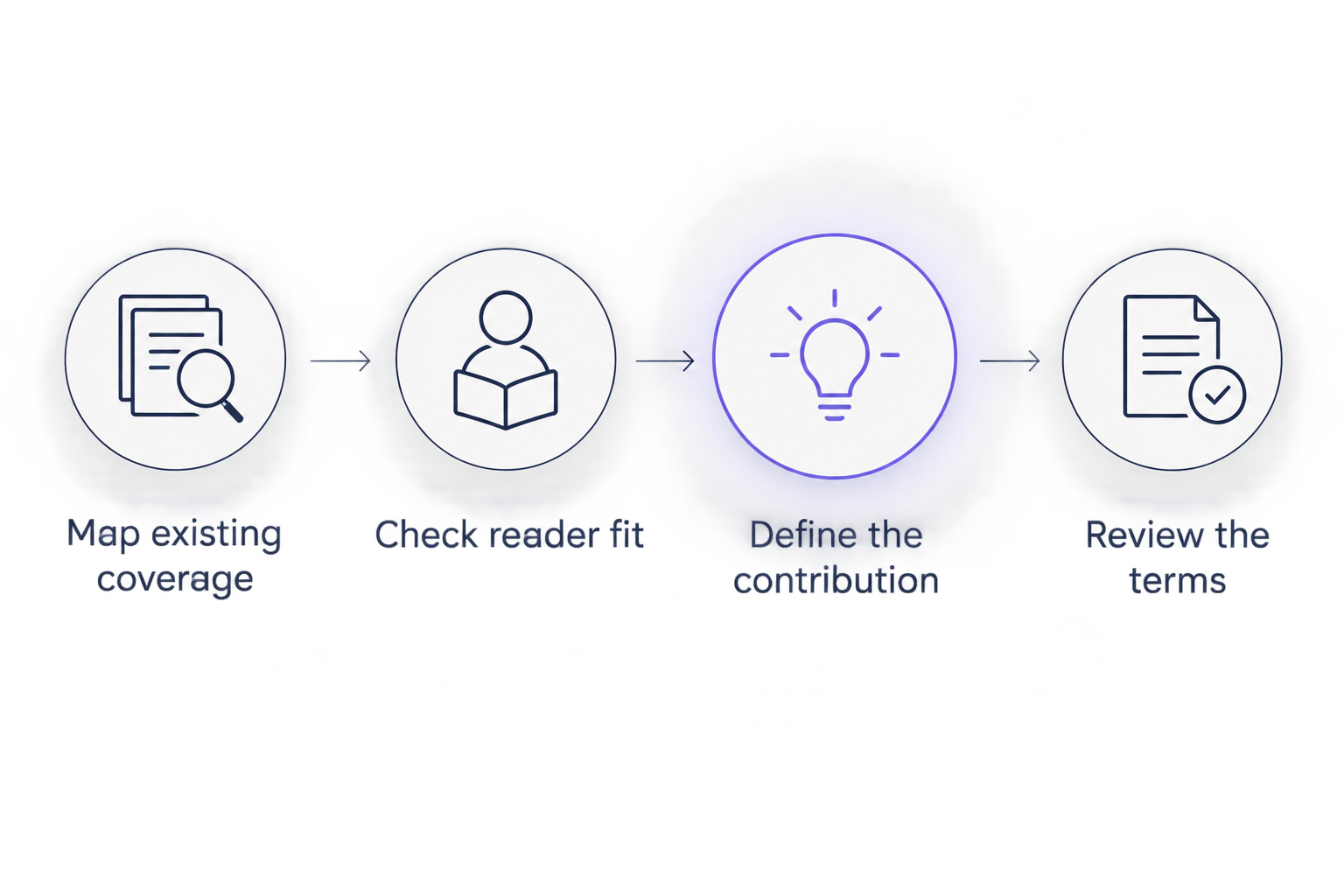
Use this 4-step review for your 2026 placement plan. It is a decision process, not a ranking formula, and it applies to both new publishers and repeat opportunities.
1. Map existing coverage
Group your live backlinks by referring domain, then record the articles, destination pages, and topics involved. Separate editorial articles from repeated links in navigation, footers, or other templates.
Check ownership where public information makes it possible. Record a relationship when you can verify it; mark ownership unknown when you cannot. Similar layouts alone do not prove common ownership.
2. Check reader fit
Read the proposed publication’s relevant articles rather than judging only its homepage or domain metric. Identify who the article serves and whether your contribution belongs alongside that coverage.
Assess the specific section as well as the broader site. A general publication can have a relevant specialist section, while a promising domain name can host articles with little connection to your subject.
3. Define the contribution
Write the reader question your proposed article will answer. Then explain why the linked page is a useful supporting resource, rather than selecting a destination simply because it needs backlinks.
For repeat publishers, compare that contribution with your previous coverage. If you cannot state the difference clearly, the proposal needs more work before another placement is approved.
4. Review the terms
Confirm the article topic, destination, attribution, sponsorship disclosure, and link qualification before publication. For paid links, Google recommends the sponsored attribute; nofollow remains an acceptable way to qualify those links.
Record the agreement and check the published result. A broader publisher list does not compensate for unclear placement terms or a link arrangement designed to manipulate rankings.
How should you measure publisher concentration?
Track 3 measures separately: total backlinks, unique referring domains, and placements grouped by known publisher ownership. These describe different parts of the profile; none is a standalone quality score.
A placement ledger should include the source URL, referring domain, destination page, publication date, article topic, link attribute, and any verified ownership relationship. Add referral visits and relevant conversion events when your measurement setup supports them.
In your 2026 review, compare those records with the campaign brief. If the goal was broader publication coverage but new work mainly returned to existing domains, change the outreach shortlist. If repeat articles delivered useful referral activity, retain that evidence rather than dismissing them solely for being repeats.
Report search performance alongside publication dates, not as automatic proof of causation. Content changes, technical work, competition, and other search changes complicate attribution. Do not assign a ranking gain to a particular placement just because it appeared first.
Does spreading paid backlinks make them safe?
No. Publisher diversity is not an exemption from Google’s link spam policies. Google Search Essentials and its link spam guidance distinguish advertising links from links bought or sold to manipulate search rankings.
For 2026 planning, apply that distinction to every placement. Qualify paid links appropriately, disclose commercial relationships where required, and evaluate sponsored content for its audience and communication value rather than assuming it will transfer ranking credit.
Using multiple domains, changing anchors, or spacing publication dates does not change the underlying arrangement. Equally, repeated legitimate editorial mentions from a publication are not automatically spam simply because the domain appears more than once.
Keep policy compliance separate from campaign allocation. You need both a defensible placement arrangement and a clear reason for choosing that publication.
When does a publisher marketplace fit?
NO-BS Marketplace is a link-building platform for SEO professionals and agencies sourcing verified publisher placements. It connects those buyers with publishers for guest posts, SEO content, sponsored content, backlinks, and digital PR placements.
Use NO-BS Marketplace when that sourcing model fits your workflow. The benefit is access to publisher-placement opportunities; the limitation is that marketplace verification does not replace your assessment of audience fit, article purpose, or Google policy compliance.
Judge the proposed placement, not just the route used to find it. Apply the same acceptance criteria to an opportunity sourced through a platform, an agency, or your own outreach.
FAQ
Should I spread backlinks across publishers or concentrate on a few sites?
Favor relevant publisher diversity while keeping repeat coverage that serves a distinct editorial purpose. Do not accept unrelated or weak publications just to add referring domains.
Are multiple backlinks from the same website useless?
No, multiple backlinks from the same website are not automatically useless. Separate articles can serve different readers or topics, but they do not each add another referring domain.
What percentage of backlinks should come from different publishers?
There is no published Google requirement for an ideal publisher-diversity percentage. Evaluate relevance, existing coverage, ownership relationships, and campaign objectives instead of treating a ratio as a safety rule.
Is a new referring domain better than another link from an existing publisher?
A new referring domain is not automatically better than another relevant placement from an existing publisher. Compare the actual article, audience, editorial standards, and purpose of each opportunity.
Does spreading paid backlinks across websites avoid Google penalties?
No, spreading paid backlinks across websites does not exempt them from Google’s link spam policies. Paid links need appropriate qualification, and diversity does not legitimize links intended to manipulate rankings.
Can different publisher domains belong to the same network?
Yes, different publisher domains can share ownership. Check publicly available ownership information and distinguish verified relationships from assumptions based on similar site designs.
Can NO-BS Marketplace help an agency source publisher placements?
NO-BS Marketplace connects SEO professionals and agencies with verified publishers for link building, guest posting, sponsored content, and digital PR placements. Agencies still need to assess each proposed placement against their brief and applicable policies.
One last thing
Diversify sources, not acceptance standards. The weakest new publisher does not become a good choice merely because your report needs another domain.
Before approving the next article, write a 1-sentence reason that does not mention a domain metric or backlink count. Explain which readers it serves and what they gain. If that reason is missing, improve the contribution or pass on the placement.