
Link building cost by industry in 2026 comes down to one thing: how many publishers will accept your link, and how much risk they take on by doing it. This page ranks verticals by relative cost pressure and explains each driver. For absolute rates by authority level, use the guest post pricing benchmarks by domain rating.
- Link building cost by industry in 2026 tracks publisher supply and compliance risk, not your company size.
- Finance, legal, health, crypto, gambling and CBD sit well above baseline; SaaS, ecommerce and local services sit near it.
- Nonprofit, education and lifestyle niches run below baseline because many publishers accept them.
- This page uses ranked tiers, not dollar figures: no verified cross-industry price dataset exists to cite.
- Get quotes in your vertical before setting a budget, then compare them against the tier shown here.
Short answer: what link building costs by industry
The average link building cost is not one number, and any page that gives you one flat figure for every industry is guessing. Price is set per placement, per publisher, and publishers price their risk. A placement for a plumber and a placement for an online lender can sit on equally strong sites and still cost very different amounts.
The verdict for 2026: regulated and high-scrutiny verticals pay a premium, mainstream commercial verticals pay baseline, and low-risk community niches pay less. NO-BS Marketplace is a link building and guest posting platform built around verified publisher sites, and that publisher-side view is what this ranking reflects.
Why this matters
A budget copied from a different industry fails in one of two ways. You under-budget a regulated vertical and get no accepted placements. Or you overpay in an easy vertical because nobody told you the market is deep.
The cost spread between verticals is driven by supply. When many publishers accept a topic, they compete for your order and rates settle near baseline. When few do, each one sets terms.
The benchmark table: relative cost pressure by vertical
Read this table as a ladder, not a price list. The baseline row is your yardstick: a mainstream commercial site with a broad pool of accepting publishers. Every other row is positioned against it.
| Vertical | Cost pressure vs. baseline | Main driver | Best for |
|---|---|---|---|
| Baseline: mainstream commercial | Baseline | Deep publisher pool, standard editorial checks | Yardstick for every row below |
| Crypto, web3 | Well above baseline | Many publishers refuse the topic outright | Brands with a compliance-ready story |
| Online gambling, sports betting affiliates | Well above baseline | Policy bans on most mainstream sites | Operators with licensed markets |
| CBD, cannabis | Well above baseline | Advertising restrictions, limited accepting sites | Brands with clear lab and legal documentation |
| Finance, fintech, lending, insurance | Above baseline | YMYL scrutiny, accuracy review | Brands with expert authors |
| Legal (personal injury, family, immigration) | Above baseline | High-value keywords, heavy competition for the same sites | Firms with attorney-bylined content |
| Health, medical, telehealth, supplements | Above baseline | YMYL review, claim restrictions | Practices with credentialed contributors |
| Cybersecurity, AI, enterprise software | Slightly above baseline | Technical editors, expertise requirements | Vendors with original research |
| SaaS, B2B tech | Near baseline | Large supply of tech and marketing blogs | Teams comparing guest posts and niche edits |
| Ecommerce, retail, consumer goods | Near baseline | Plentiful lifestyle and review sites | Brands with distinct product angles |
| Local home services (HVAC, roofing, plumbing) | Near baseline | Plentiful regional and home blogs | Service companies buying in bulk |
| Real estate, property management | Near baseline | Mixed supply, many local sites | Investors and brokers |
| Travel, hospitality, events | Slightly below baseline | Large supply of travel and lifestyle sites | Brands with visual or experiential content |
| Nonprofit, education, creators | Below baseline | Many publishers accept mission-led content | Organizations with a clear cause or course |
High and low: who pays the premium
Crypto, gambling and CBD lead the ladder. Publishers in those niches are scarce, and mainstream sites that do accept them price in the risk of an editorial or policy complaint.
Nonprofit, education and creator brands trail at the bottom. Their topics are welcome almost everywhere, so there is no scarcity premium. SaaS, ecommerce and local services cluster around baseline.
The gap between the top and the bottom is a function of supply, not quality. A cheaper vertical is not getting worse links. It is buying in a bigger market.
What the benchmark rests on
This ranking reflects publisher-side patterns in link buying as of 2026: which topics publishers accept freely, which they restrict, and which need extra editorial review. It is a relative ladder built on those patterns, not a survey of invoices.
Limitation: the ladder does not tell you the price of one specific placement. Dollar rates move with domain rating, traffic, link type and turnaround, and no cross-industry dollar dataset is published that we can cite with a date and scope. Treat the tiers as direction, then get live quotes.
Cost drivers behind every row
Four factors explain almost every position on the ladder. Knowing them lets you predict where an unlisted vertical lands.
- Publisher supply: how many verified sites accept your topic.
- Compliance risk: how much a publisher exposes itself by linking to you.
- Content expertise: whether the article needs a credentialed author or original data.
- Competition: how many brands in your vertical chase the same sites.
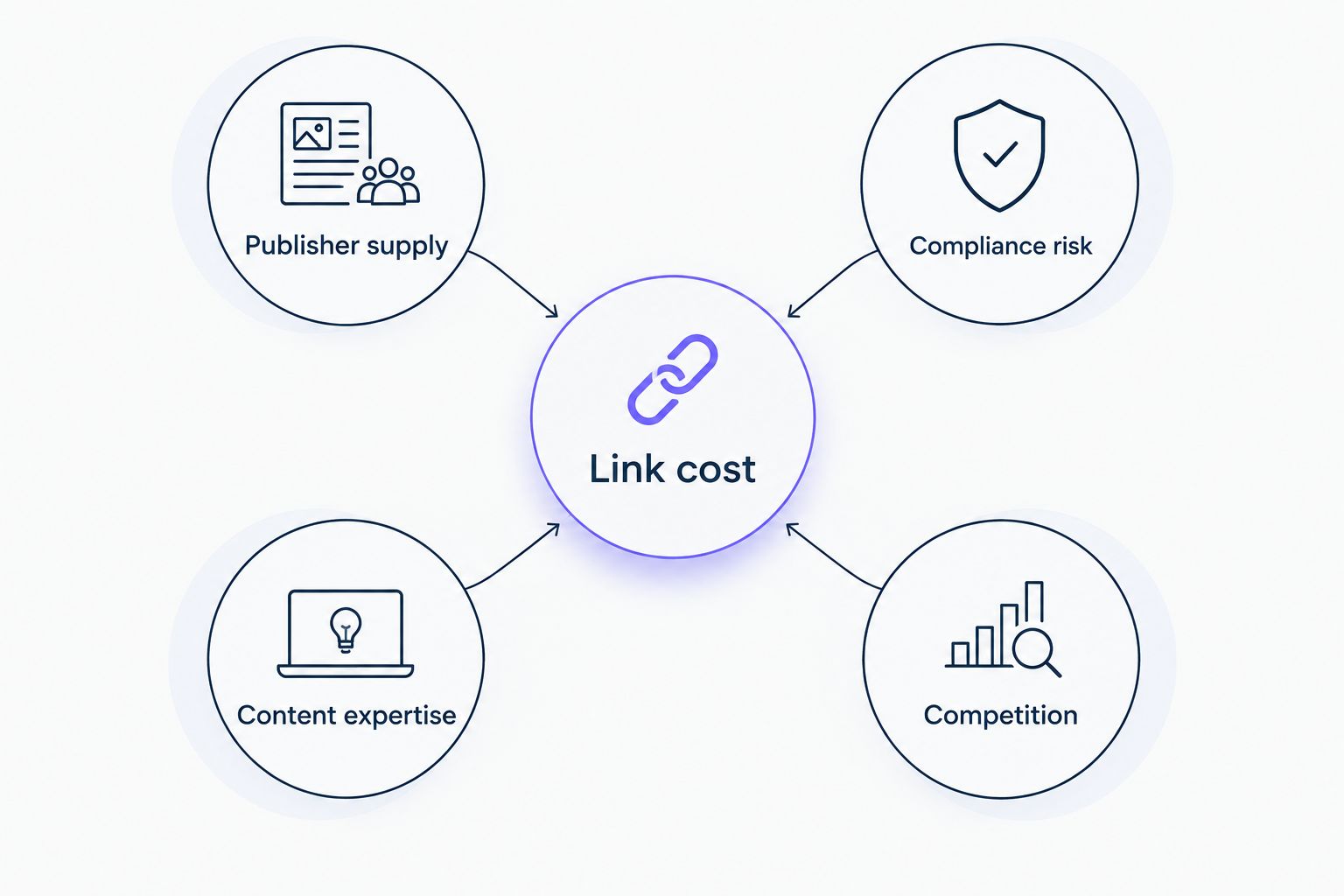
A vertical that scores high on all four sits at the top of the table. A vertical that scores low on all four sits at the bottom. Most verticals mix them.
Placement type moves cost inside every vertical
The vertical sets the tier. The link type sets where you land within it. A new guest post with original writing costs more to produce than inserting a link into an existing article, and a digital PR placement is priced differently again because it relies on coverage, not a transaction.
For niche edits, the niche edit pricing benchmarks by domain rating show how authority shifts the rate. The same ladder applies: regulated verticals sit above the numbers for mainstream ones.
Bundled offers behave differently from single orders. The backlink package pricing benchmarks by tier explain how tiers work, which matters most for verticals near baseline where bulk buying is realistic.
How to use these benchmarks
- Find your row, then your neighbors. If you sit between two tiers, such as a fintech SaaS tool, budget toward the higher tier.
- Set your budget range after quotes, not before. Ask several sellers for the same placement spec in your vertical, then compare each quote with your tier.
- Spend on fewer, better placements in premium verticals. When supply is thin, one accepted placement on a relevant site is worth more than several loose ones.
- Buy volume only where supply is deep. Near-baseline and below-baseline verticals are where bulk ordering makes sense.
- Check the seller's vertical record. A marketplace with verified publishers that accept your topic is cheaper than a seller who has to hunt for one.
What shifts the ladder in 2026
Three pressures keep moving verticals up or down.
- Stricter editorial review: publishers in health and finance continue to tighten checks, which pushes those rows up.
- More publishers opening to sponsored content: this lowers pressure in commercial niches with high supply.
- Demand concentration: when many brands in one vertical chase the same sites, the same placement costs more.
None of these change the order of the table. They change how wide the gaps are.
FAQ
How much does link building cost by industry in 2026?
It depends on the vertical's publisher supply and compliance risk. Crypto, gambling and CBD sit well above baseline, finance, legal and health sit above it, and SaaS, ecommerce and local services sit near it. Get live quotes for exact rates.
Which industries pay the most for backlinks?
Crypto, online gambling and CBD pay the biggest premium because few publishers accept them. Finance, legal and health follow because publishers review claims closely.
Which industries pay the least for link building?
Nonprofit, education and creator brands sit below baseline. Many publishers accept their topics, so there is no scarcity premium.
Why do legal and finance links cost more than SaaS links?
Legal and finance are YMYL topics, so publishers review them harder and accept fewer. Fewer accepting sites means each one sets terms.
Is there one average link building cost across all industries?
No single figure holds across verticals. Price moves with domain rating, link type and vertical, so a flat average hides the spread you need to see.
Does my company size change the price?
Rarely. The publisher prices the topic and the link, not your headcount. A small lender pays the finance tier, and a large SaaS company pays the SaaS tier.
How do I know which tier my business is in?
Match your topic to the table, then move up one tier if your content makes health, money or legal claims. When two rows fit, budget for the higher one.
One last thing
If your vertical sits above baseline, the cheapest move is not a cheaper seller. It is a tighter brief: a credentialed author, one clear claim, and a target page that earns the link. Publishers in restricted niches say yes faster to briefs that remove their risk, and faster acceptance lowers the cost of every placement after the first.