
Yes, buying backlinks in bulk is risky when you pay for links intended to manipulate Google rankings. In 2026, the issue is not a particular order size: paid links that pass ranking credit violate Google's link-spam policies, while properly qualified sponsored placements serve a different purpose and do not guarantee SEO gains.
- Is buying backlinks in bulk risky? Yes, when paid links are intended to manipulate Google rankings.
- Google permits paid advertising links when publishers appropriately qualify them with sponsored or nofollow attributes.
- Reject backlink packages that hide publishers, promise rankings, or substitute domain metrics for editorial review.
- NO-BS Marketplace connects agencies with publishers; marketplace access does not exempt placements from Google's rules.
Why this matters
A bulk order repeats your purchasing criteria across multiple placements. If those criteria are weak, you repeat the same mistake instead of building a useful campaign.
The distinction matters for agencies selling white-label link building. You remain responsible for explaining what the client bought, where it appeared, and which outcomes you can actually measure. Use a publisher-site audit before approving placements, not after the delivery report arrives.
Buy a placement for its audience and content value—not an assumed transfer of ranking authority. A publisher's willingness to sell a link is not evidence that Google will reward it.
Is buying backlinks in bulk risky?
Yes. Google's Search Central spam policies classify buying or selling links for ranking purposes as link spam. Google's link guidance distinguishes those arrangements from advertising and sponsorship links appropriately qualified with rel="sponsored" or rel="nofollow".
That policy distinction is the starting point for a 2026 buying decision. Neither a smaller order nor a slower delivery schedule changes the purpose of a paid link.
| Approach | Best for | Main benefit | Main limitation | Recommendation |
|---|---|---|---|---|
| Bulk paid links intended to pass ranking credit | No policy-compliant ranking objective | Consolidates purchasing | Conflicts with Google's link-spam policies | Skip |
| Qualified sponsored placements | Paid distribution to a relevant audience | Provides a disclosed way to promote content | Does not guarantee ranking credit or referral results | Consider after publisher review |
| Independently earned editorial links | Coverage based on useful information or news | Leaves the linking decision with the publisher | You cannot require coverage or control the anchor text | Pursue when the story deserves coverage |
These approaches are not interchangeable. Paying someone to develop research or pitch journalists is different from paying a publisher for an unqualified ranking link. Evaluate the placement arrangement, not just the invoice label.
Bulk paid ranking links: the policy problem
A seller can call a package guest posting, outreach, niche edits, or authority building. Those names do not settle whether the links comply with Google's rules.
Ask what the payment secures. If it secures links intended to pass ranking credit, calling the process manual or editorial does not remove the paid-link issue. Useful content and a relevant publisher do not automatically make that arrangement compliant.
Google uses automated systems and manual actions to address spam. Links can fail to provide the expected ranking benefit, and link schemes can expose a site to enforcement. A disappointing campaign is not automatically a penalty, however; do not diagnose one from a ranking chart alone.
Qualified sponsored placements: distribution, not guaranteed authority
Sponsored content has a legitimate role when you want to reach a publisher's audience. Google's guidance prefers rel="sponsored" for paid links and also accepts rel="nofollow" for qualifying them.
Check the actual link markup after publication. A visible sponsorship label informs readers, while a link attribute communicates the relationship to search engines. They do different jobs; neither replaces the other.
For your 2026 campaign brief, separate distribution goals from ranking expectations. Define the audience, the page readers should visit, and the action you want them to take. Then judge the placement against those goals instead of treating the backlink count as proof of success.
Earned editorial links: less control, a different arrangement
An independently earned link exists because a publisher chooses to reference something useful. Original research, a relevant expert contribution, or a genuinely newsworthy development gives editors a reason to consider coverage.
The trade-off is control. You cannot demand publication, a particular anchor, or a particular destination page while presenting the result as an independent editorial choice.
Paying an agency for research and outreach does not mean every resulting link is purchased. But if a publisher requires payment for placement, classify that placement accurately and apply the appropriate paid-link treatment. Do not hide sponsored inventory inside an earned-media report.
Why bulk backlink risk varies
The purchase quantity is only part of the decision. These factors determine what you are buying and how much control you retain:
- Payment purpose: Paying for exposure differs from paying for links intended to influence rankings. Record the objective before approving the order.
- Link qualification: Confirm how the publisher will mark paid links. Do not accept vague assurances that the placement is safe.
- Publisher relevance: Inspect whether the publication and article serve people who would genuinely use your destination page.
- Editorial standards: Review recent articles, sourcing, authorship, and outbound links. Reject content written merely to hold unrelated commercial links.
- Anchor requirements: Repeated keyword-heavy anchors deserve scrutiny. Changing the wording does not make a paid ranking-link scheme compliant.
- Approval visibility: Hidden publishers and unrestricted substitutions prevent meaningful review. Require enough information to approve or reject each placement.
A high third-party domain score does not answer these questions. Neither does an attractive report. You need evidence about the publication, the specific article, and the commercial arrangement.
How do I check a bulk backlink order before approving it?
Use a documented approval process. The purpose is to identify unacceptable placements before publication, not to invent a formula for buying ranking links safely.
1. Set the objective
Decide whether you want sponsored distribution, referral visits, or independently earned coverage. Keep those objectives separate in the brief.
If the seller's offer depends on guaranteed ranking credit from paid links, stop. No amount of additional reporting fixes that policy conflict.
2. Review publishers
Request the proposed domains and examine their recent content. Look for a coherent readership, relevant subjects, useful articles, and a credible reason for your content to appear there.
Treat traffic estimates and authority scores as supporting information, not approval criteria by themselves. A website can look attractive in a spreadsheet while offering little relevance to your audience.
3. Approve content
Read the proposed article or insertion context. Your link should help a reader understand or act on the surrounding material.
Reject unrelated paragraphs added solely to accommodate a commercial destination. An existing article's age does not make a new paid insertion editorially justified.
4. Confirm attributes
Put the paid-link qualification requirement in writing. Ask the publisher to confirm the intended attribute before publication, then inspect the live HTML.
Review how to choose anchor text when buying backlinks alongside that check. Descriptive wording helps readers, but anchor selection is not a workaround for Google's paid-link policies.
5. Check publication
Open every delivered page. Confirm the destination, surrounding copy, visible disclosure, and link attribute rather than relying on a screenshot or completion notice.
Record discrepancies and request corrections before accepting the delivery. Keep the approved brief with the live placement record so another team member can verify the decision.
6. Measure outcomes
For a 2026 sponsored campaign, track referral visits and meaningful on-site actions where your analytics setup supports them. Report publication and link status separately from business results.
For organic performance, monitor relevant pages and queries without attributing every movement to the campaign. Content changes, technical issues, competitors, and search updates also affect rankings.
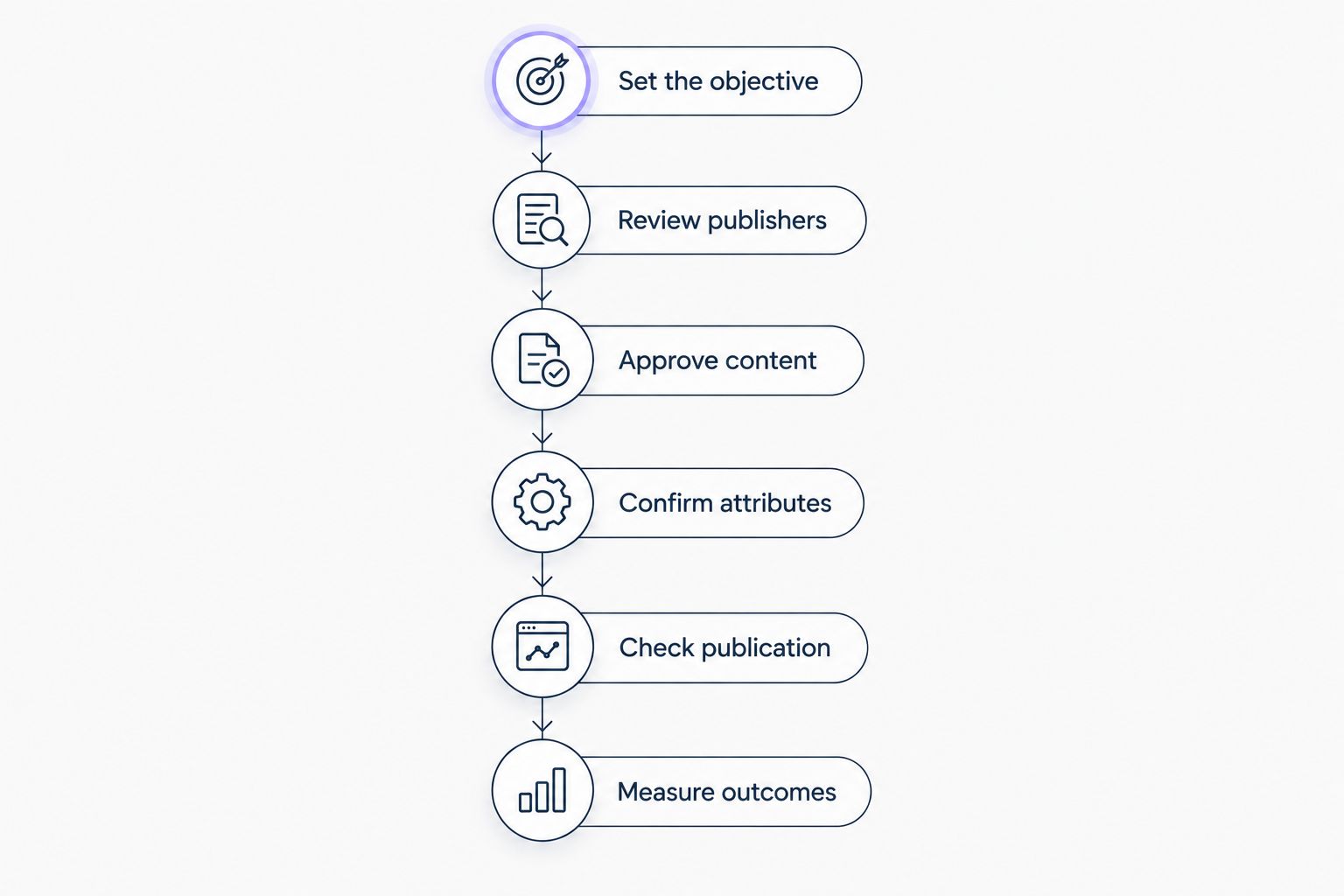
Keep this workflow attached to the order. A shared acceptance checklist makes it harder for a delivery deadline to replace editorial judgment.
Where does a backlink marketplace fit?
NO-BS Marketplace fits SEO professionals and agencies sourcing paid publisher placements; Google's paid-link rules still apply. The platform connects those buyers with verified publisher sites for content, backlinks, sponsored content, and digital PR placements.
That access addresses sourcing, not the whole approval decision. You still need to assess relevance, content, disclosure, and link qualification for the placement you intend to buy. The limitation is straightforward: a publisher's presence on a platform does not establish that every proposed arrangement meets your requirements.
Use NO-BS Marketplace as a sourcing option, not as evidence that a paid link is exempt from search policies. Keep the same acceptance criteria whether you buy directly, through an agency, or through a marketplace.
How many backlinks can I buy without getting penalized?
Google publishes no safe purchase quota for ranking-manipulating paid links. Order size is not a compliance threshold, and a gradual delivery schedule does not turn a prohibited arrangement into an acceptable one.
Set campaign scope around placements you can properly review and a distribution objective you can explain. Do not reverse-engineer a monthly link allowance from a competitor's backlink profile.
Does buying backlinks gradually make it safe?
Gradual delivery does not resolve the paid-link policy issue. Spreading an order out can help your team review work, but timing does not change why the links were purchased or how they are qualified.
Use scheduling for operational control, not concealment. If a seller's safety explanation depends on making paid links look unpaid, reject that explanation.
What should I do if I already bought a bulk package?
Audit the delivered placements before ordering more. Preserve the original brief, publisher list, destination pages, anchors, and live-page records so you can distinguish what was promised from what appeared.
Check Google Search Console for manual actions. If there is a manual action, follow Google's instructions for that issue; if there is none, do not invent a penalty diagnosis from lost traffic alone. Google's disavow guidance reserves the tool for specific circumstances, not routine cleanup of every unfamiliar backlink.
FAQ
Is buying backlinks in bulk risky in 2026?
Yes, buying backlinks in bulk is risky when the links are purchased to manipulate Google rankings. Properly qualified sponsored placements are a different arrangement, but they do not guarantee SEO gains.
Are bulk guest posts safer than bulk niche edits?
Neither format is automatically safer. Evaluate the payment arrangement, publisher, surrounding content, and paid-link qualification rather than relying on the format's name.
Can sponsored backlinks still bring visitors?
Sponsored backlinks can bring referral visitors when readers follow them. That outcome depends on the audience and content; sponsorship alone does not establish that a placement will deliver traffic.
Does a high domain rating make a backlink safe?
No, a high domain rating does not establish policy compliance or editorial quality. Review the specific publisher, article, and link arrangement before approving a placement.
Does Google require sponsored or nofollow on paid links?
Google's guidance calls for paid links to be qualified, preferably with rel="sponsored"; rel="nofollow" is also acceptable. A visible disclosure serves readers and does not replace the link attribute.
Does NO-BS Marketplace remove the need to vet publishers?
No, using NO-BS Marketplace does not replace placement-level review. Check relevance, content, disclosure, and link qualification against your own campaign requirements.
Should I disavow every backlink from a bulk order?
No, disavowing every link from a bulk order is not a sound default. Follow Google's disavow guidance and assess whether your situation meets its stated conditions before using the tool.
One last thing
Ask the seller to separate publication acceptance from performance promises. A live article proves publication. It does not prove that Google credited the link, that qualified readers visited, or that your business gained customers.
Put that distinction into your 2026 client reporting. Accept work against documented placement requirements, then measure audience and business outcomes separately. That keeps a completed order from being mistaken for a successful strategy.