
There is no fixed number of referring domains you need to outrank a competitor in 2026. Set your starting target by comparing relevant referring domains to the pages ranking for your exact query—not by copying a competitor’s sitewide total. That comparison gives you a planning benchmark, not a ranking guarantee, because search intent, content, internal links, and technical accessibility also matter.
- How many referring domains do you need to outrank a competitor? No fixed count guarantees a higher ranking.
- Compare referring domains to competing pages, not just entire websites, before setting your backlink target.
- Google rankings do not follow a simple rule that the page with more referring domains wins.
- NO-BS Marketplace suits SEO teams sourcing publisher placements; placement selection still requires a page-level backlink gap analysis.
Why this matters
A referring-domain gap is a diagnosis to investigate, not an order quantity. Treating every missing domain as a required placement turns competitor research into a volume chase.
You need to know which competing pages earn relevant links, what those links point to, and whether your own page deserves to rank for the query. A strong domain-level score does not settle those questions; start with whether Domain Rating reliably measures link quality before using it as a publisher filter.
For a 2026 campaign, separate the competitive benchmark from the acquisition plan. The benchmark describes the SERP; the plan specifies which useful editorial opportunities you will pursue and why.
How many referring domains do you need to outrank a competitor?
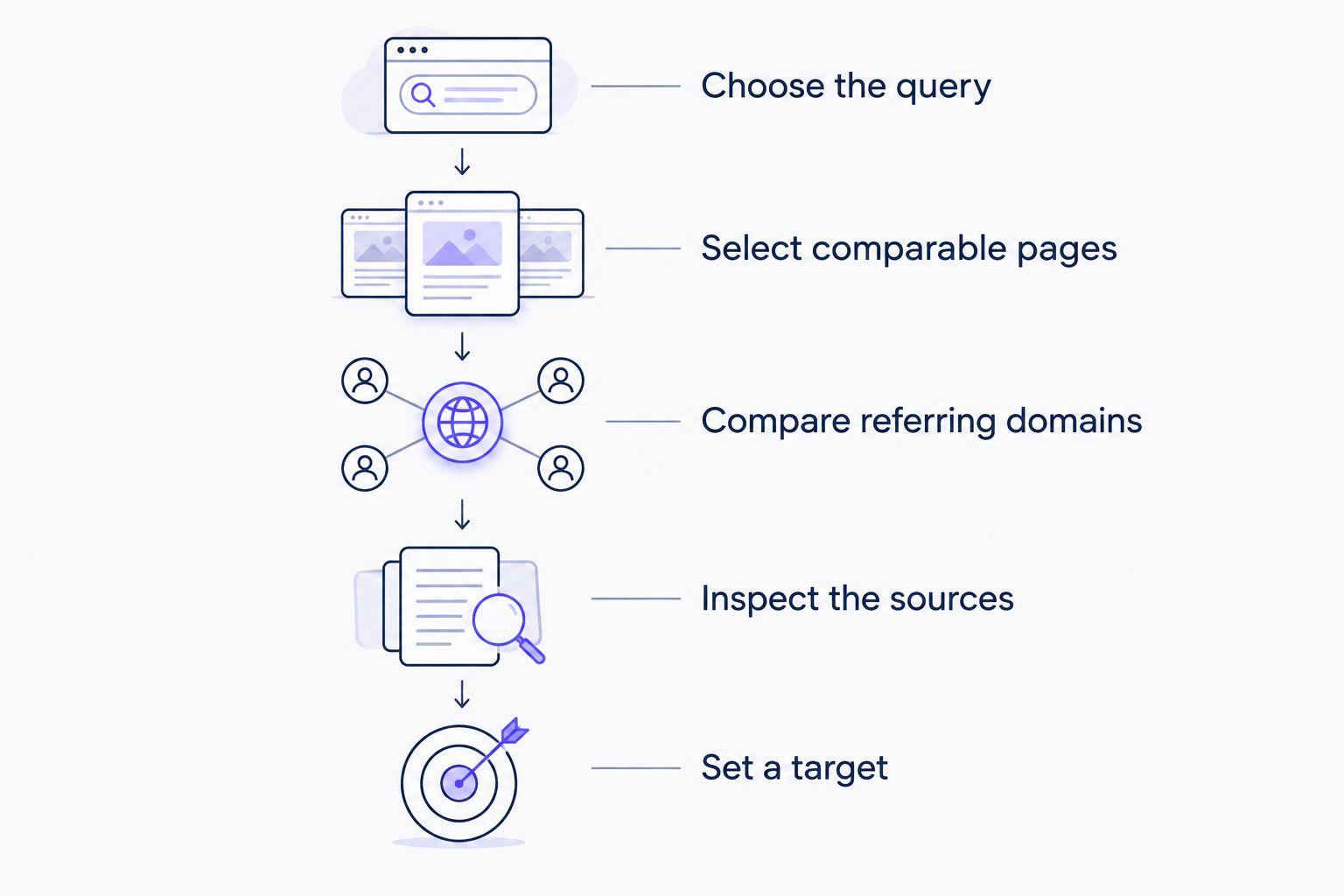
You need a query-specific benchmark, not a universal minimum. Use the following process to identify whether backlinks are a plausible competitive gap and where additional referring domains belong.
1. Choose the query and target page
Start with 1 target URL and a clearly defined search query. Record the country, device, and search intent so you do not compare different search environments.
Check the page format Google returns. A product category, service page, and instructional article serve different purposes; more links do not turn the wrong format into the right answer.
2. Select comparable ranking pages
Start with 3 competing URLs that satisfy the same intent as your target page. This is a manageable research sample, not a claim that three pages represent every competitive SERP.
Choose actual search competitors rather than businesses you consider commercial rivals. A company can compete for your customers without ranking for the query you are trying to win.
3. Compare page-level referring domains
Use the same backlink data provider and URL scope for every page. Keep exact-page data separate from subdomain and whole-domain data.
Record both the reported referring-domain total and the sources you consider relevant after inspection. Backlink indexes differ, so mixing providers creates a comparison that looks precise without being consistent.
4. Inspect the sources behind the totals
Review 5 fields per prospect: topical fit, linking-page usefulness, editorial context, destination URL, and link qualification. These fields help you distinguish a credible citation opportunity from a domain that merely appears in an export.
Count unique referring domains consistently. Repeated links from the same domain do not create additional referring domains, although those links can still serve readers and send referral visits.
5. Set a provisional acquisition target
Use the comparable pages’ relevant referring-domain counts as a reference band. Prioritize the shortfall you can actually explain: relevant publications citing competing resources while your equivalent resource remains unreferenced.
Do not turn that shortfall into a guaranteed purchase quantity. The next move is a prospect list tied to useful content, followed by measurement—not an automatic commitment to match every domain.
The full workflow for running a backlink gap analysis against competitors helps organize this research without confusing competitor coverage with a ranking formula.
When your page has fewer referring domains
Fewer referring domains justify investigation, not an automatic conclusion that links are the problem. First confirm that the competing pages answer the same query and that your page is accessible, indexable, and internally linked.
Then inspect the relevant sources you lack. A publication linking to a competitor’s original research presents a different opportunity from a directory entry or an unrelated syndicated mention.
Build your campaign around the reason those publishers linked. If your page offers no comparable evidence, explanation, or utility, improve the resource before asking editors to reference it.
When your page has a similar referring-domain count
A similar count does not establish equal link strength. Compare the linking pages, their relevance, the placement context, and which destination each link actually supports.
Next, inspect the page itself. Missing information, an unsuitable format, weak internal linking, or an unclear answer can remain unresolved even when the headline backlink counts look alike.
Do not keep adding links simply because the ranking has not moved. A comparable count is a reason to broaden the diagnosis rather than assume the next domain will settle it.
When your page has more referring domains
More referring domains do not entitle your page to a higher ranking. Check whether the apparent advantage survives a review of source relevance, live links, redirects, and the exact URL receiving them.
Look for a mismatch between your page and the query. A well-linked informational guide still does not become a suitable substitute when searchers want a product category or a local service.
Use this comparison to choose your next action:
| Your page’s position | Best for | Advantage of this approach | Limitation | Next move |
|---|---|---|---|---|
| Fewer relevant referring domains | Investigating an identifiable link gap | Focuses prospecting on comparable pages | Does not prove links caused the ranking gap | Review missing editorial sources |
| Similar relevant referring domains | Diagnosing quality and page differences | Stops raw totals dominating the decision | Link quality is not captured by a single score | Compare context, intent, and content |
| More relevant referring domains | Challenging a volume-led strategy | Redirects attention to unresolved weaknesses | A larger count still reveals little about individual sources | Audit the page and validate the apparent advantage |
Why the referring-domain target varies
Your target changes because competing pages do not start from identical conditions. Review these factors before approving a link-building brief:
- Search intent: Your page must deliver the type of answer the query calls for. Links do not fix a fundamental mismatch.
- Link relevance and context: A useful editorial reference and an unrelated placement are not interchangeable merely because each adds a domain.
- Destination URL: Homepage links and links to the ranking page belong in separate columns. Do not present them as equivalent measurements.
- Content usefulness: Evidence, clear explanations, and practical resources affect whether publishers have a reason to cite the page.
- Internal linking and accessibility: Important pages need discoverable internal paths. Check indexing and canonicalization before making acquisition the only intervention.
- Changes in the SERP: Competitors revise pages and gain or lose links. A benchmark captured in 2026 is a dated observation, not a permanent requirement.
These factors make a universal target misleading. Keep the count visible, but put the explanation beside it.
Turn the benchmark into a campaign brief
Write the brief so another SEO practitioner can challenge its logic. Name the target page, query, comparable competitors, data source, research date, and reason each publisher belongs on the prospect list.
Separate existing links from planned outreach. A missing competitor domain is a lead to investigate, not evidence that the publisher accepts contributions or will link to your page.
For each prospect, record the editorial reason to contact it. That reason might be a resource that answers a cited question, original material relevant to a journalist’s coverage, or a contribution suited to the publication’s readers.
Reject prospects that only make sense as a metric increase. If you cannot explain why the publication’s audience would benefit from the destination page, the campaign brief needs work.
For agency reporting in 2026, keep activity and outcomes separate. Report outreach, published references, and retained links as activity; report query visibility and relevant organic visits as outcomes without attributing every change to backlinks.
Where a publisher marketplace fits
NO-BS Marketplace connects SEO professionals and agencies with verified publisher sites for guest posts, sponsored content, backlinks, and digital PR placements. NO-BS Marketplace is best for SEO teams seeking publisher placements, not a universal referring-domain target.
The practical advantage is a platform for sourcing placements. The limitation is that a placement opportunity does not establish that the publisher fits your query, that the destination page needs another link, or that a ranking change will follow.
Use NO-BS Marketplace for link-building execution after defining the page-level gap. Keep publisher relevance, editorial context, and appropriate sponsorship disclosure in the brief rather than treating verification as a substitute for campaign judgment.
Google Search Central’s spam policies identify buying or selling links for ranking manipulation as link spam. Paid advertising and sponsorship links need appropriate qualification, such as rel="sponsored"; disclosure and link qualification address different requirements.
How do you know when to stop adding referring domains?
Stop treating additional domains as the default answer when the link-gap explanation no longer holds. If your page has comparable relevant sources but still underperforms, revisit search intent, content usefulness, internal links, and technical issues.
Set a review point before outreach starts. Decide which observations would justify continuing acquisition and which would trigger a page revision, so the campaign does not become an open-ended effort to increase a count.
Track new and lost links alongside the target page’s performance. A growing historical total can hide removed references, changed destinations, or links that no longer support the page you are measuring.
Avoid claiming causation from a ranking movement alone. When content, internal links, and external references change together, record those changes rather than assigning the entire result to referring domains.
Can you outrank a competitor with fewer referring domains?
Yes, you can outrank a competitor with fewer referring domains. Referring-domain count is not a ranking threshold, and competing pages differ in relevance, usefulness, link context, and other signals.
Use the lower-count pages already ranking for your query as evidence to investigate. Inspect what those pages do well instead of assuming their success proves that backlinks never matter.
Should you match a competitor’s whole-domain referring domains?
No, matching a competitor’s whole-domain count is not a defensible target for an individual page. A sitewide total includes links to pages unrelated to your query and can obscure the competitive conditions around the ranking URL.
Keep whole-domain figures as background context. Base your acquisition brief on comparable pages and the relevant editorial opportunities behind their links.
How many new referring domains should you build each month?
There is no universal monthly referring-domain quota. Set the pace around credible editorial opportunities, the content you can support, and the resources available to review publishers properly.
A fixed quota creates pressure to accept weak prospects when suitable opportunities run out. Preserve the selection criteria instead of filling the calendar with placements that do not fit.
FAQ
How many referring domains do I need to outrank a competitor in 2026?
There is no fixed referring-domain count that guarantees you will outrank a competitor in 2026. Compare relevant domains linking to pages that rank for your exact query, then investigate whether links explain the gap.
Are referring domains the same as backlinks?
Referring domains are distinct domains linking to your site or page; backlinks are the individual links. Multiple backlinks from the same domain do not create multiple referring domains.
Should I compare my homepage with a competitor’s ranking article?
No, compare pages serving the same search intent and keep homepage measurements separate. Otherwise, the referring-domain counts describe different destinations rather than a useful competitive gap.
Is Domain Rating enough to choose a backlink prospect?
No, Domain Rating alone is not enough to select a prospect. Inspect topical fit, the linking page, editorial context, and the destination the link would support.
Will buying more referring domains guarantee higher rankings?
No, buying more referring domains does not guarantee higher rankings. Google identifies buying links for ranking manipulation as link spam, and paid placements require appropriate link qualification.
Why do backlink tools show different referring-domain counts?
Backlink tools maintain different indexes and discover links differently. Use the same provider, scope, and research date when comparing your target page with competing pages.
Do repeated links from a publisher count as new referring domains?
No, repeated links from the same domain do not add new referring domains. They can still provide useful references or referral visits, so evaluate their purpose separately from domain diversity.
One last thing
Before approving another placement, open the destination page and ask what a publisher would genuinely cite. If the answer is only that you want it to rank, improve the page first.
Your best next referring domain is a relevant editorial opportunity—not the domain that completes an arbitrary quota. Keep that distinction in every 2026 campaign brief.