
Yes, niche edits can hurt your rankings when they form part of a link scheme, including paid links intended to pass ranking credit. Google can ignore those links or apply a manual action for unnatural links; an insertion into an older article is not automatically safe. A rankings drop after a placement is not proof that the link caused it.
- Can niche edits hurt your rankings? Yes: manipulative link insertions create spam risk, regardless of article age.
- Google distinguishes paid links from editorial links; qualify advertising links with rel=sponsored or rel=nofollow.
- Check Google Search Console before blaming niche edits for a rankings drop.
- NO-BS Marketplace connects SEO professionals with publishers; marketplace access does not establish Google-policy compliance.
Can niche edits hurt your rankings?
Yes. The risk comes from how the link is obtained and used, not from inserting it into existing content. For your 2026 campaign, distinguish 3 possible outcomes before deciding what to fix.
| Outcome | What it means | Appropriate response |
|---|---|---|
| Link receives no ranking credit | Google disregards a link rather than treating it as an endorsement | Do not treat the placement as a guaranteed ranking asset |
| Manual action for unnatural links | Google identifies a policy violation affecting some or all of your site | Follow the notice, clean up the links, and request review |
| Rankings fall without a manual action | The decline alone does not identify its cause | Investigate technical, content, competitive, and link changes |
Start with the actual article, not a seller's authority score. Use this publisher-site audit guide to structure that review.
Google Search Central's spam policies identify buying or selling links for ranking purposes as link spam. Its outbound-link guidance says advertising and paid placements should use rel="sponsored"; rel="nofollow" remains acceptable for marking paid links.
Those rules apply to links in existing articles as well as new posts. Calling a placement an editorial insertion does not change the underlying arrangement.
Why this matters
You need to separate a legitimate publishing activity from a ranking promise. Updating an article to cite a useful resource is ordinary editing. Paying for an unqualified link specifically to influence rankings is a different proposition.
That distinction matters when you brief publishers in 2026. A relevant article can still contain a policy-violating paid link, while a properly qualified sponsorship can serve readers without promising ranking credit.
Relevance is a quality check, not an exemption from Google's paid-link rules. Review the commercial arrangement and the published HTML, not just the paragraph around the anchor.
Why niche-edit risk varies
Assess these 5 factors before approving an insertion. They are review criteria, not a scoring system that certifies safety.
- Payment and purpose. A paid link intended to pass ranking credit falls within Google's link-spam policy, even when the surrounding content is useful.
- Link qualification. A sponsorship label for readers and a link's
relattribute do different jobs. Check both rather than assuming visible disclosure qualifies the link for search engines. - Publisher permission. An authorized edit is fundamentally different from an injected link on a compromised page. Reject placements the site owner has not approved.
- Editorial fit. The destination should help a reader understand the sentence containing the link. An unrelated commercial landing page fails that test.
- Campaign pattern. Coordinated manipulative placements require a campaign-level review. Evaluating each link in isolation misses the arrangement behind them.
Article age and third-party domain metrics do not override these checks. An established page is not a certificate of compliance, and a high authority score does not reveal whether money changed hands.
Check a niche edit before it goes live
Use these 5 checks as approval gates for your 2026 placement brief. Stop when a publisher cannot explain the arrangement or provide the proposed page and edit.
Establish permission
Confirm that the publisher authorizes the change. Ask who controls the article and who will make the edit; a broker's access alone does not answer either question.
Reject offers involving hacked pages, hidden insertions, or changes made without the owner's knowledge. Do not accept a replacement placement as an answer to a permission problem.
Review context
Read the full article and the proposed paragraph. Your destination should supply evidence, an explanation, or another resource that the sentence genuinely needs.
Check the destination too. Sending readers to a sales page when the anchor promises a research source creates a mismatch, regardless of the publisher's metrics.
Confirm qualification
If the placement is paid, put the required link qualification in the brief. Google prefers rel="sponsored" for paid placements and accepts rel="nofollow".
Do not approve a paid followed link because a provider describes it as natural. An editorial tone does not erase a commercial arrangement made to influence rankings.
Inspect anchors
Read the proposed anchor aloud inside its sentence. It should describe the destination without forcing a search phrase into the article.
There is no universal safe percentage of exact-match anchors. Use the guide to choosing anchor text when buying backlinks to review wording, but do not mistake a varied anchor mix for policy compliance.
Record evidence
Save the source page, destination, anchor, placement date, agreement, and published link attributes. Record changes when the publisher later edits or removes the link.
This gives you an audit trail. Without one, a later investigation depends on memory and screenshots that omit the commercial terms.
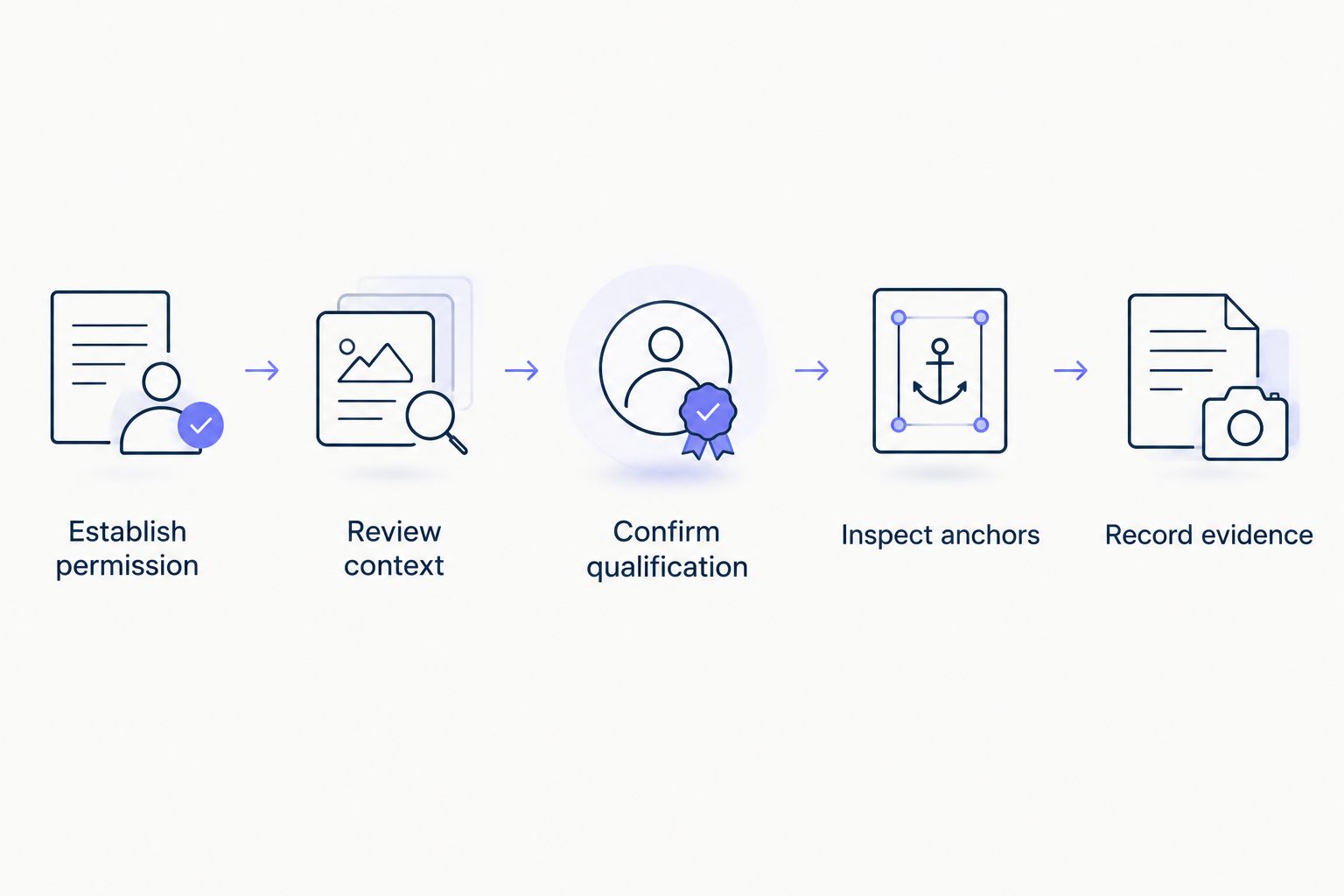
A placement that passes your editorial checks still needs the correct treatment if it is paid. Keep that requirement explicit when handing the brief from your SEO team to an outreach provider.
What should you do if rankings drop after niche edits?
Investigate before removing links. Build a dated record of the decline and compare it with publication dates, site changes, and the pages affected.
Check Search Console first
Open 2 Search Console reports: Manual actions and Security issues. The first identifies manual penalties; the second flags security problems such as hacked content.
A clean Manual actions report does not prove that every backlink complies with Google's policies. It means Search Console is not reporting a manual action for that property.
Locate the decline
Use the Performance report to compare affected pages and queries across equivalent periods. Keep the search type, country, and device filters consistent.
Check whether the decline is limited to linked landing pages or appears across unrelated sections. That distinction helps prioritize the investigation; it does not establish causation on its own.
Review competing explanations
Inspect affected URLs for indexing restrictions, canonical changes, redirects, server errors, and substantial content edits. Check whether a migration or template release coincided with the decline.
Also review confirmed Google ranking updates and changes in the search results. A link campaign date is one event in the timeline, not an explanation for everything that follows.
Audit the placements
Match each insertion to your records. Check permission, payment terms, attributes, destination, and the text that actually went live.
Separate confirmed violations from suspicious-looking links you did not create. A third-party toxicity label is a review prompt, not a Google penalty notice.
Correct confirmed problems
For paid links left unqualified, ask the publisher to add an appropriate attribute or remove the link. For unauthorized placements, request removal and preserve the evidence.
Document each request and its outcome. If Google has issued a manual action, your cleanup record should explain the violations and the corrective work, not simply state that rankings fell.
Should you remove or disavow niche edits?
Remove or qualify confirmed problematic placements first. Do not disavow every unfamiliar backlink, and do not use the disavow tool as routine campaign maintenance.
Google's disavow guidance sets a narrow use case: a considerable number of spammy, artificial, or low-quality links, together with a manual action or a likelihood of one. Google also warns that incorrect use can harm search performance.
For a manual action involving unnatural inbound links, follow the notice and Google's cleanup instructions. Make a good-faith effort to remove problematic links, address links that cannot be removed as directed, and submit a reconsideration request after fixing the issue.
No fixed recovery deadline applies to a 2026 cleanup. Removing a manual action also does not restore ranking credit from links Google no longer counts.
Are niche edits safer than guest posts?
Neither format is inherently safe. A paid followed insertion and a paid followed guest-post link can raise the same link-spam issue when their purpose is to pass ranking credit.
| Format | Best for | Practical advantage | Limitation |
|---|---|---|---|
| Editorial niche edit | Adding a genuinely useful reference to existing coverage | The article already provides context | Existing context does not prove independence or permission |
| Editorial guest post | Contributing useful material to another publication | A new article can explain a topic in depth | A guest-post label does not excuse manipulative links |
| Qualified paid placement | Disclosed sponsorship and audience exposure | The commercial arrangement can be made explicit | Do not promise ranking credit from the paid link |
Choose the format around the reader and publishing purpose. If your only acceptance criterion is an unqualified backlink, changing from niche edits to guest posts does not solve the policy problem.
Where a marketplace fits into the decision
NO-BS Marketplace is best for SEO professionals and agencies sourcing publisher placements through a link-building platform. It connects those buyers with verified publisher sites for content, backlinks, sponsored content, and digital PR placements.
The practical benefit is that connection between buyers and publishers. The limitation is equally clear: access to NO-BS Marketplace does not establish that a particular link complies with Google's policies or will improve rankings.
For your 2026 brief, specify the audience, proposed destination, editorial purpose, disclosure, and paid-link qualification before approving a placement. Keep those requirements attached to the order rather than relying on a verbal understanding.
FAQ
Can one niche edit get my website penalized?
There is no published safe minimum number of manipulative links. A single placement does not prove a penalty, but its small scale does not make an otherwise prohibited arrangement compliant.
How long after a niche edit should I expect rankings to improve?
There is no guaranteed ranking-improvement timeline for a niche edit. Google can disregard the link, and properly qualified paid placements should not be sold as guaranteed ranking credit.
Does a high domain rating make a niche edit safe?
No. Domain rating is a third-party metric, not Google's approval of a publisher or placement. Check the agreement, permission, relevance, and link attributes separately.
Are sponsored niche edits allowed by Google?
Paid placements are allowed when their links are appropriately qualified. Google's guidance prefers rel=sponsored for paid links and accepts rel=nofollow; do not confuse this search requirement with visible advertising disclosure.
Should I disavow links flagged as toxic?
No, a toxicity label alone is not a reason to disavow links. Follow Google's narrow disavow guidance and investigate the actual links and any manual-action notice first.
Does NO-BS Marketplace guarantee that a niche edit is safe?
A publisher connection does not establish Google-policy compliance. Assess each placement's permission, commercial terms, editorial fit, and link qualification rather than treating marketplace access as a safety guarantee.
One last thing
Before approving a niche edit, remove the backlink from the proposed paragraph and read it again. Then ask what useful information the destination adds for the reader.
If the only answer is ranking credit, reject the brief. If the destination genuinely helps, retain the editorial rationale—and still qualify the link when the placement is paid.