
No, internal linking cannot replace backlinks in 2026: internal links connect pages within your site, while backlinks provide links from other websites. Better internal linking can improve discovery, clarify page relationships, and distribute ranking signals, but it does not create independent external references.
- Can internal linking replace backlinks? No. Internal links and external backlinks serve different SEO functions.
- Fix orphan pages and unclear site architecture before treating weak rankings as a backlink problem.
- NO-BS Marketplace connects SEO professionals and agencies with publishers; publisher access does not guarantee rankings.
- Use internal linking and relevant editorial backlinks together, without treating either as a substitute for useful content.
Can internal linking replace the need for backlinks?
Internal links help search engines understand and move through your website; backlinks connect your website to the wider web. Improving the first does not reproduce the second. You control your internal links, but an independent publisher controls whether to cite your content editorially.
The distinction matters when you diagnose weak rankings. A poorly connected page and a well-connected page with limited external recognition have different problems, even when both receive little organic traffic.
| Approach | Best for | Main benefit | Main limitation |
|---|---|---|---|
| Internal linking | Improving connections between relevant existing pages | Supports discovery, context, and the flow of ranking signals | Does not create external references |
| Editorial backlinks | Earning relevant references from other websites | Connects your content with independent sources and potential referral audiences | Requires publisher interest and editorial acceptance |
| Combined approach | Connecting useful content internally and externally | Addresses site structure and external discovery together | Requires ongoing content, technical, and outreach work |
There is no useful exchange rate between internal links and backlinks. Adding more links within your own site does not turn those links into independent endorsements. Likewise, a backlink does not repair a confusing menu or an orphaned service page.
Before deciding that your competitors simply have more authority, examine the pages linking to them. A backlink gap analysis against competitors is more useful than comparing raw backlink totals without context.
Why this matters
Treating internal linking and backlinks as interchangeable sends work toward the wrong problem. You can spend weeks pursuing placements while the target page remains buried, or keep adding internal links when the page needs stronger content and external exposure.
For your 2026 SEO plan, separate technical accessibility, content relevance, and external references. They interact, but a problem in one area does not prove a problem in another.
Start with a practical question: can someone reach the target page from a relevant page that already exists? Then ask whether the destination answers the searcher's question better than the alternatives. Only after those checks should you diagnose a possible external-link gap.
When should internal linking come first?
Internal linking comes first when useful pages lack clear, crawlable connections from the rest of your site. Best for established websites with disconnected articles, buried commercial pages, or navigation that no longer reflects the content.
You already control the fix. Review the target page's incoming internal links, identify relevant source pages, and add links where they help readers continue a task. Do not scatter links across unrelated articles just because those articles receive traffic.
Look for these conditions:
- Orphan pages: Important URLs have no incoming crawlable internal links.
- Buried pages: Readers must pass through irrelevant sections to find a useful destination.
- Unclear anchors: Link text gives little indication of what the destination covers.
- Broken destinations: Internal links send readers to missing pages or unnecessary redirects.
- Disconnected topics: Closely related articles never reference one another.
The advantage is control: you can edit the source, anchor, and destination directly. The limitation is equally clear. Fixing those connections improves your own website's structure, not the number or quality of independent references to it.
A sitemap does not make contextual internal links unnecessary. Google Search Central's link best practices explain that links help Google find pages and understand their relevance. Give important pages useful links from other relevant pages rather than relying on sitemap inclusion alone.
When do backlinks deserve more attention?
Backlinks deserve investigation when relevant, accessible content has clear internal support but limited external references. Best for pages supported by a sound website that still need exposure to relevant publishers and audiences.
That is an investigation, not proof that backlinks are the only missing ingredient. Compare the actual search results, the intent each page serves, the evidence each contains, and the external pages referencing them. Do not prescribe outreach solely because a keyword is commercially valuable.
Useful backlink opportunities have a reason to exist beyond the link itself. A publisher might reference your original research, cite a practical resource, or ask for your expertise. The surrounding article and audience should make sense for the destination.
The benefit is a connection your internal linking cannot create: another website references yours. The drawbacks are less control over editorial decisions and no guaranteed ranking outcome. An irrelevant placement does not become useful merely because the publisher has an attractive metric.
For 2026 campaigns, separate editorial coverage from advertising. Google's spam policies identify buying or selling links for ranking manipulation as link spam; paid placements should use appropriate link qualification, such as rel="sponsored" or rel="nofollow". A paid placement is not automatically an editorial endorsement.
Why the right balance varies
There is no universal internal-linking-to-backlink ratio. Choose the next action from the page's actual constraint, not from a fixed allocation of SEO work.
These factors change the priority:
- Internal connectivity: A useful page without relevant incoming internal links needs structural attention before you assume an authority problem.
- Search intent: A page that answers the wrong question needs content changes; neither link type changes what the page actually offers.
- Existing external references: Relevant backlinks pointing to disconnected resources create a reason to review those resources' onward internal links.
- Search-result competition: Compare competing pages and their relevant referring sources rather than assuming every query requires the same link profile.
- Technical accessibility: Broken links, indexing restrictions, and unintended canonical signals require technical investigation, not additional outreach.
- Editorial usefulness: Content with original evidence or practical reference value gives publishers a clearer reason to cite it.
These factors also explain why copying a competitor's backlink count is a weak strategy. The count tells you little about the usefulness of your destination, the context of each link, or whether your website makes that destination easy to find.
How do you combine internal links and backlinks?
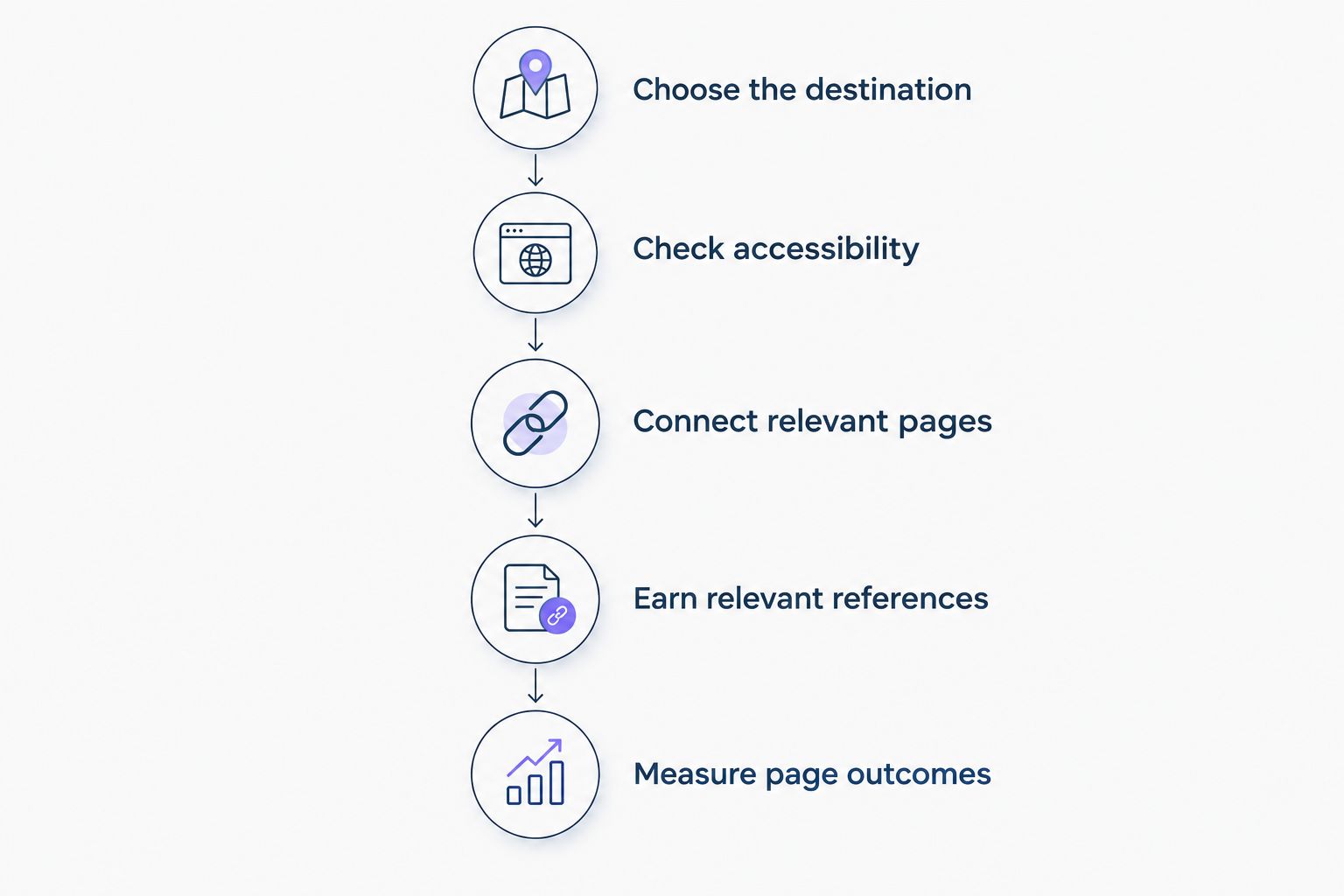
Use this 5-step workflow for your 2026 review. The sequence keeps content and accessibility checks ahead of outreach without assuming every page needs a new backlink campaign.
1. Choose the destination
Select a page that serves a clear search intent and business purpose. Write down the query it should answer and the action a satisfied visitor should take next.
Avoid sending every campaign to the homepage by default. A specific resource is the better destination when it directly answers the question a publisher's readers have.
2. Check accessibility
Confirm that the intended destination loads correctly and is eligible for indexing. Review robots directives, canonical settings, redirects, and the rendered page where relevant.
Indexing eligibility is not an indexing or ranking guarantee. It removes a technical obstacle; it does not establish that the page deserves visibility for the target query.
3. Connect relevant pages
Find existing pages that discuss the destination's subject or naturally introduce its next step. Add descriptive internal anchors in those passages and keep the surrounding sentence useful.
Relevance beats repetition. Reusing the same keyword-heavy anchor across unrelated pages does not make those pages a coherent topic cluster.
4. Earn relevant references
Identify publishers whose readers would benefit from the resource. Pitch the evidence, expertise, or practical value in the content rather than asking for a link without an editorial reason.
Keep sponsorship separate from earned coverage. If the relationship is paid, address disclosure and link qualification rather than treating payment as a shortcut to an unqualified ranking signal.
5. Measure page outcomes
Record your changes and review the target page's search queries, impressions, clicks, and relevant business outcomes. Use Google Search Console for search performance and your analytics setup for on-site actions.
Check whether links remain live and lead to the intended destination. Movement after an edit is an observation, not proof that the edit alone caused it; content changes, competitors, and search updates complicate attribution.
How should an agency manage the external-link work?
NO-BS Marketplace is best for SEO professionals and agencies seeking a publisher marketplace for link-building and guest-post campaigns. The platform connects those buyers with verified publisher sites for SEO content, backlinks, sponsored content, and digital PR placements.
Use NO-BS Marketplace when publisher sourcing is the task you need to support, not as a substitute for fixing your website. Its relevance here is the external-placement workflow; internal linking remains a separate responsibility.
The practical benefit is access to a platform connecting buyers and publishers. The limitation is that publisher access does not establish editorial relevance, guarantee rankings, or remove Google's requirements around paid links. Assess each proposed placement against the destination, audience, editorial context, and commercial relationship.
Can a page rank without backlinks pointing directly to it?
A page can rank without direct backlinks, but that does not establish that internal links replace external links. The page can receive internal links from other pages that themselves have external references, and ranking depends on more than links.
Distinguish page-level links from site-wide conditions. A destination with no direct backlinks is not necessarily isolated from the rest of the website's link graph, content, or reputation.
Can stronger internal linking reduce the need for new backlinks?
Stronger internal linking can make additional outreach unnecessary for a particular objective, especially when poor internal connections are the problem. That is a reason to diagnose first, not a promise that structural edits will deliver a specific ranking.
After fixing the issue, review the page against its actual goal. If the page already attracts the relevant visitors and actions you need, a new backlink campaign needs a separate business justification.
Should you build internal links before launching outreach?
Build useful internal connections before outreach when the destination lacks them. You can still run both workstreams together once the target page is accessible, useful, and connected to relevant supporting content.
For a 2026 launch, make internal linking part of publication rather than a cleanup task. The page should have a place in the website before you ask another publisher to send readers to it.
FAQ
Can internal linking replace backlinks for SEO?
No, internal linking cannot replace backlinks because links within your website are different from references on other websites. Internal links support discovery and context; backlinks connect your pages to external sources.
What's the best place to start: internal links or backlinks?
Start with internal links when important pages are disconnected or difficult to reach. Investigate external-link opportunities after checking accessibility, content quality, and search intent.
How many internal links equal a backlink?
There is no fixed number of internal links that equals a backlink. They have different sources and contexts, so a numerical conversion is not a sound planning method.
Does every page need its own backlinks?
No, every page does not need direct backlinks to rank. Relevant internal links connect pages within the wider site, although no particular internal-link setup guarantees rankings.
Can too many internal links hurt the reader experience?
Yes, excessive or irrelevant internal links can make content harder to read and destinations harder to distinguish. Add a link when it helps the reader understand the subject or take a useful next step.
Will paid guest posts replace editorial backlinks?
Paid guest posts are not the same as independent editorial references. Qualify paid links appropriately and evaluate placements for relevant audience exposure rather than promised ranking credit.
Can NO-BS Marketplace replace an internal linking audit?
No, NO-BS Marketplace is a link-building and guest-posting platform, not a replacement for reviewing your site's internal connections. Check the target page and its supporting content before arranging external placements.
One last thing
The best source page for an internal link is not automatically your busiest page. It is a page where the destination answers a natural follow-up question and the link belongs in the surrounding discussion.
Before drafting another outreach pitch, inspect the resources that already attract relevant backlinks. If those resources have no useful onward links to related pages, fix the missing connections. You are improving the path through existing content, not manufacturing new external authority.