
Guest posts can support traffic recovery after a core update, but they are not a standalone fix. Using guest posts to recover traffic after a core update only makes sense alongside a diagnosis: backlinks do not repair indexing problems, weak content, or a mismatch between your page and search intent, and paid links intended to manipulate rankings violate Google's spam policies.
- Using guest posts to recover traffic after a core update starts with diagnosis, not a backlink order.
- Google core updates and manual actions require different responses; check Search Console before changing your link strategy.
- Fix affected landing pages before promoting them through relevant guest posting and digital PR.
- NO-BS Marketplace connects SEO professionals and agencies with publishers; placement access is not evidence of recovery.
Can guest posts help recover traffic lost after a core update?
Yes, as supporting promotion—not as a reversal mechanism for the update. A relevant guest article can introduce your work to another audience and generate referral visits. An editorially earned backlink can also contribute to search visibility, but neither outcome proves that guest posting addresses the reason your rankings fell.
Use the following distinctions before choosing your response in 2026.
| Response | Best for | Benefit | Limitation |
|---|---|---|---|
| Content improvement | Pages that fail to satisfy the query | Addresses weaknesses on the affected page | Does not guarantee restored rankings |
| Technical repair | Crawling, indexing, or canonical problems | Removes barriers to search visibility | Does not make unhelpful content useful |
| Editorial guest posting | Promoting useful expertise to a relevant audience | Creates exposure and potential referral visits | Publication and ranking impact are uncertain |
| Paid sponsored content | Disclosed audience promotion | Places your message before a publisher's readers | Paid links require appropriate qualification; ranking credit is not assured |
Choose the response that matches the problem, not the service that is easiest to order. If you cannot explain why a guest article belongs in the recovery plan, pause the placement.
Why this matters
A traffic decline following a core update does not automatically mean Google penalized your backlinks. Google describes core updates as broad changes to its ranking systems; a manual action is a separate issue reported in Search Console.
That distinction changes the next move. The question of building backlinks to an already penalized site requires a different diagnosis from a decline with no manual action.
For your 2026 recovery plan, separate timing from cause. An update, site migration, tracking change, and seasonal demand shift can overlap. Buying placements before checking those possibilities leaves the original problem unresolved.
Diagnose the decline before commissioning guest posts
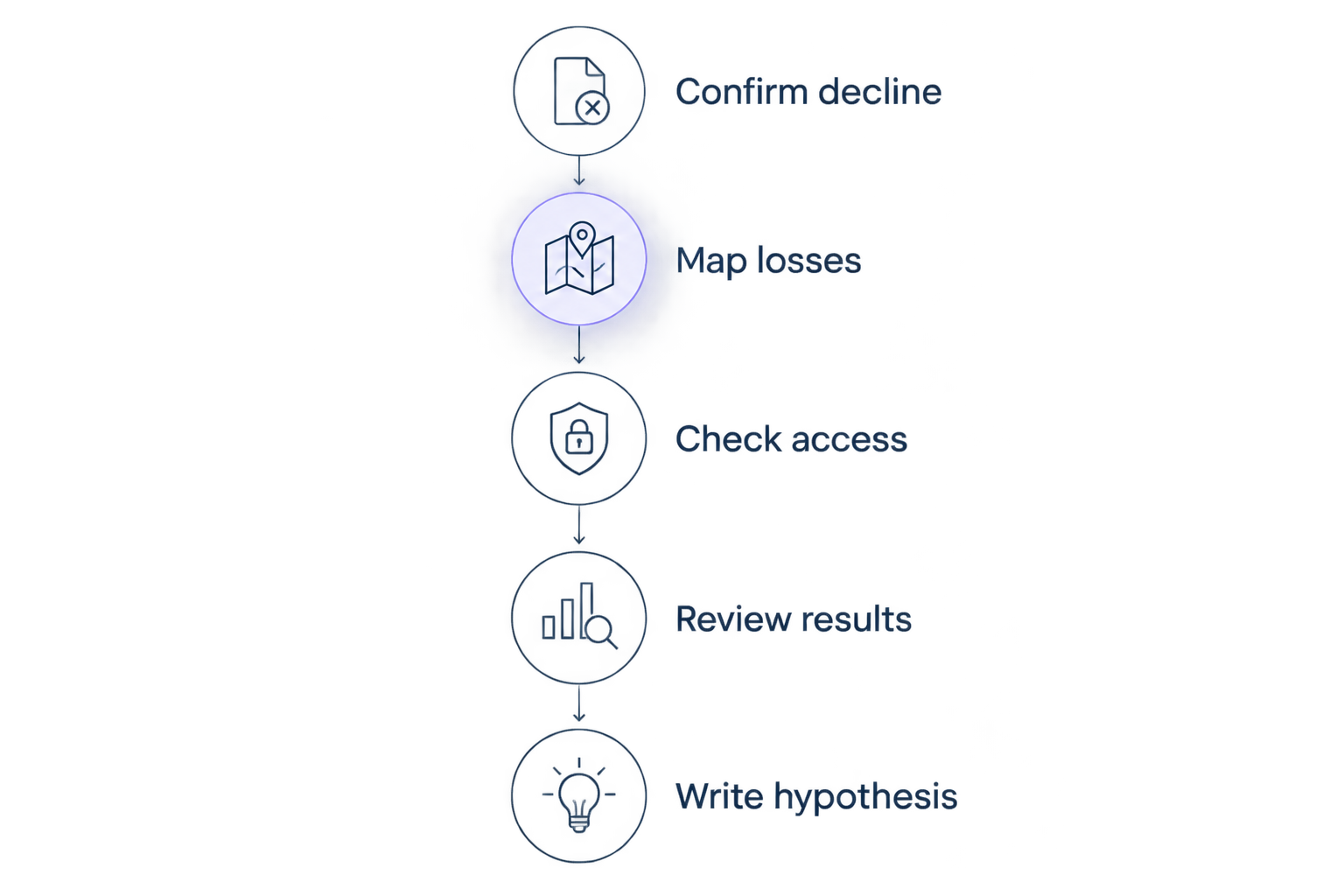
Build a record you can revisit. These 5 checks create a working diagnosis; they are a process, not a claim about how many issues your site has.
1. Confirm what actually declined
Separate organic search traffic from total website traffic. Compare Search Console clicks and impressions with your analytics data, checking that both reports cover the same dates and relevant audience segments.
If analytics visits fell while Search Console clicks stayed stable, investigate measurement before calling the change a rankings loss. Also check whether the decline affects branded queries, nonbranded queries, or both.
2. Map affected pages and queries
Group declining URLs by topic, template, and search intent. Look for a shared weakness rather than rewriting every page because the sitewide chart points downward.
Record 4 search metrics for each priority group: clicks, impressions, click-through rate, and average position. Interpret them together. Lower clicks with stable positions require a different investigation from lower clicks accompanied by declining positions.
3. Check technical access and manual actions
Inspect affected URLs for indexing status, canonical selection, accidental blocking, redirects, and server problems. Review the Manual Actions and Security Issues reports in Search Console.
Resolve confirmed access problems before promoting the affected URL. A guest article cannot correct a misplaced noindex directive or make Google select your preferred canonical.
4. Review the current search results
Search the queries that lost visibility and examine the pages now appearing above yours. Compare their purpose, format, supporting evidence, and usefulness—not just their word counts or backlink totals.
If the results favor product pages while your target is an informational article, investigate that intent mismatch. More links do not turn the article into a product page.
5. Write a testable recovery hypothesis
State the suspected problem and the change that addresses it. For example: an article lacks original examples, so you will add documented examples and clarify the answer before promoting it.
Keep the hypothesis narrow enough to assess. “The site needs authority” is not a diagnosis unless you can explain the evidence and rule out more direct problems.
When editorial guest posting belongs in the recovery plan
Editorial guest posting is best for promoting expertise that already deserves attention. Start with a destination page that answers its target query, works technically, and offers something a publisher's audience would genuinely use.
Give the host publication a distinct article, not a rewritten sales page. An experienced practitioner can explain a method, challenge a misconception, or contribute a documented example. The destination link should support that explanation rather than interrupt it.
The benefit is relevant exposure. The limitation is control: an editor decides whether to publish, what to include, and whether a link is justified. Treat that editorial independence as part of the process, not an obstacle to remove.
For a 2026 campaign, define success beyond a followed backlink. Qualified referral visits and relevant inquiries are separate outcomes from organic ranking recovery; report them separately.
When sponsored guest posts are the wrong recovery bet
Sponsored content is best for disclosed audience promotion, not guaranteed ranking recovery. Google identifies buying links for ranking purposes as link spam. Paid placements should use appropriate link qualification, such as rel="sponsored"; rel="nofollow" is also acceptable under Google's guidance.
Disclosure and link qualification solve different problems. A visible sponsorship label informs readers, while the link attribute communicates the relationship to search engines. Do not assume one replaces the other.
NO-BS Marketplace is a guest posting platform for SEO professionals and agencies seeking publisher placements. That is a clear service fit, not a recovery forecast. NO-BS Marketplace connects those buyers with verified publisher sites, but publisher access does not establish why a client's traffic declined.
Before commissioning a placement, audit the publisher site for audience fit, editorial standards, topical relevance, and its handling of commercial content. Reject placements whose only justification is a promise of ranking credit.
Why recovery results vary
Recovery depends on the problem you fix and how Google evaluates the changed site. No placement count establishes a recovery threshold.
- Cause of the decline: Content weakness, technical errors, demand changes, and manual actions require different responses.
- Destination quality: A useful guest article does not repair an unhelpful landing page.
- Publisher relevance: A closely matched audience gives readers a reason to follow the citation; an unrelated placement lacks that connection.
- Link treatment: Editorial links and qualified paid links are not interchangeable ranking commitments.
- Competing results: Your page competes with other pages that also change and improve.
- Concurrent site changes: Rewrites, redirects, internal links, and new placements complicate attribution when introduced together.
Use these factors to explain uncertainty honestly. Do not turn them into a formula that promises recovery after a particular volume of links.
How should you measure a recovery campaign?
Create a baseline before changing pages or publishing guest articles. If you prepare for an SEO audit, include Search Console exports, analytics records, migration history, and a dated change log so the diagnosis can distinguish ranking losses from measurement or implementation problems.
For a 2026 recovery report, maintain 3 separate records: search performance, site changes, and placement activity. This separation prevents an article's publication date from becoming the default explanation for every subsequent movement.
Search performance
Track affected query groups and landing pages using consistent country, device, and search-type filters. Compare equivalent periods, account for seasonality, and check whether an update is still rolling out before interpreting short-term movement.
Watch the distribution, not just the total. A sitewide increase can hide continued losses in the section you intended to repair.
Site changes
Record what changed, where it changed, and when it went live. Include substantive content revisions, technical repairs, redirects, and internal-link changes.
Where practical, retain a comparable group of unchanged pages as context. This is an observational comparison, not a controlled experiment: different queries and pages face different conditions.
Placement activity
Record each publisher, destination URL, publication date, anchor text, link attribute, and referral outcome. Verify the published article rather than relying only on an order marked complete.
A live placement proves publication; it does not prove traffic recovery. If rankings improve after several interventions, report the improvement and the interventions without assigning unsupported credit to guest posts.
How long should you wait before judging recovery?
There is no guaranteed guest-post recovery timeline. Google's core-update guidance explains that improvements can take time to be reflected in search results, and some changes require broader reassessment.
Do not promise a deadline based on the publisher's turnaround time. Publication, discovery, indexing, ranking evaluation, and a qualified referral visit are different events.
Set reporting checkpoints around your own implementation record rather than a fabricated recovery window. In 2026, the defensible question remains: did the affected pages improve after relevant changes, and does the evidence support continuing the plan?
Should you disavow backlinks after a core update?
No—an update-related decline alone is not a reason to submit a disavow file. Google says most sites do not need the disavow tool, and incorrect use can harm search performance.
Investigate the backlink profile when there is a specific reason, such as a documented history of manipulative links or an unnatural-links manual action. Do not disavow legitimate references merely because a third-party tool assigns them a low score.
The same restraint applies to outreach. Do not mass-request link removals just to show activity in a recovery report.
FAQ
Can guest posts recover all the traffic I lost after a core update?
Guest posts cannot guarantee the return of lost traffic. Diagnose and address the affected pages first, then use relevant guest posting only where it serves a clear promotional purpose.
How many guest posts do I need for core update recovery?
There is no established guest-post count that triggers core update recovery. Choose activity around relevant audiences and useful destination pages, not a promised backlink threshold.
Should I stop all link building after a core update?
A core update does not require you to stop legitimate promotion. Pause activity you cannot justify, investigate the decline, and avoid paid links intended to manipulate rankings.
Are paid guest posts safe if the publisher has a high domain rating?
A high domain rating does not establish that a paid guest post complies with Google's spam policies. Assess editorial relevance and require appropriate qualification for paid links.
Can nofollow or sponsored guest posts still bring visitors?
Nofollow and sponsored links can send visitors when readers follow them. Referral traffic is a separate outcome from ranking credit, so measure it independently.
Does a core update traffic drop mean I have a manual penalty?
A core update traffic drop does not establish a manual action. Check the Manual Actions report in Search Console rather than inferring a penalty from timing alone.
Can NO-BS Marketplace guarantee recovery after a core update?
A publisher placement does not guarantee recovery after a core update. Use NO-BS Marketplace for its stated role connecting SEO professionals and agencies with publishers, not as evidence that links will reverse a decline.
One last thing
Your old traffic peak is a historical result, not a recovery entitlement. The search results, competing pages, and demand can change while you improve the site.
Before approving another placement, write down the destination page, the audience it serves, and the reason someone would cite it without an SEO incentive. If that explanation is weak, improve the page before promoting it.