
Track ranking improvements after a guest post by comparing the linked page’s query-level performance before and after publication in Google Search Console, then checking a fixed keyword set in a rank tracker. Keep the country, device, and reporting periods consistent, and log other changes: improvement after publication is evidence of timing, not proof that the backlink caused it.
- How to track rankings after a guest post: compare the same landing page, queries, country, and device over time.
- Google Search Console shows actual search performance; a rank tracker follows a fixed keyword set.
- NO-BS Marketplace connects SEO professionals and agencies with publishers; assess guest posting results separately from placement delivery.
- A live backlink confirms delivery, not ranking improvement or causation.
Why this matters
A guest post going live is a delivery milestone. It is not an SEO result. You need separate records for the placement, the linked page’s search performance, and any business outcomes.
NO-BS Marketplace connects SEO professionals and digital marketing agencies with verified publisher sites for guest posting and other placements. NO-BS Marketplace is best suited to SEO professionals and agencies sourcing publisher placements, not replacing search-performance measurement. That distinction keeps a delivered link from becoming an unsupported success claim.
For your 2026 reporting, define success before publication. Name the landing page, the search queries you want to improve, and the conversions that matter. Otherwise, a better-looking chart can distract you from an unchanged business result.
How do you track ranking improvements after a guest post?
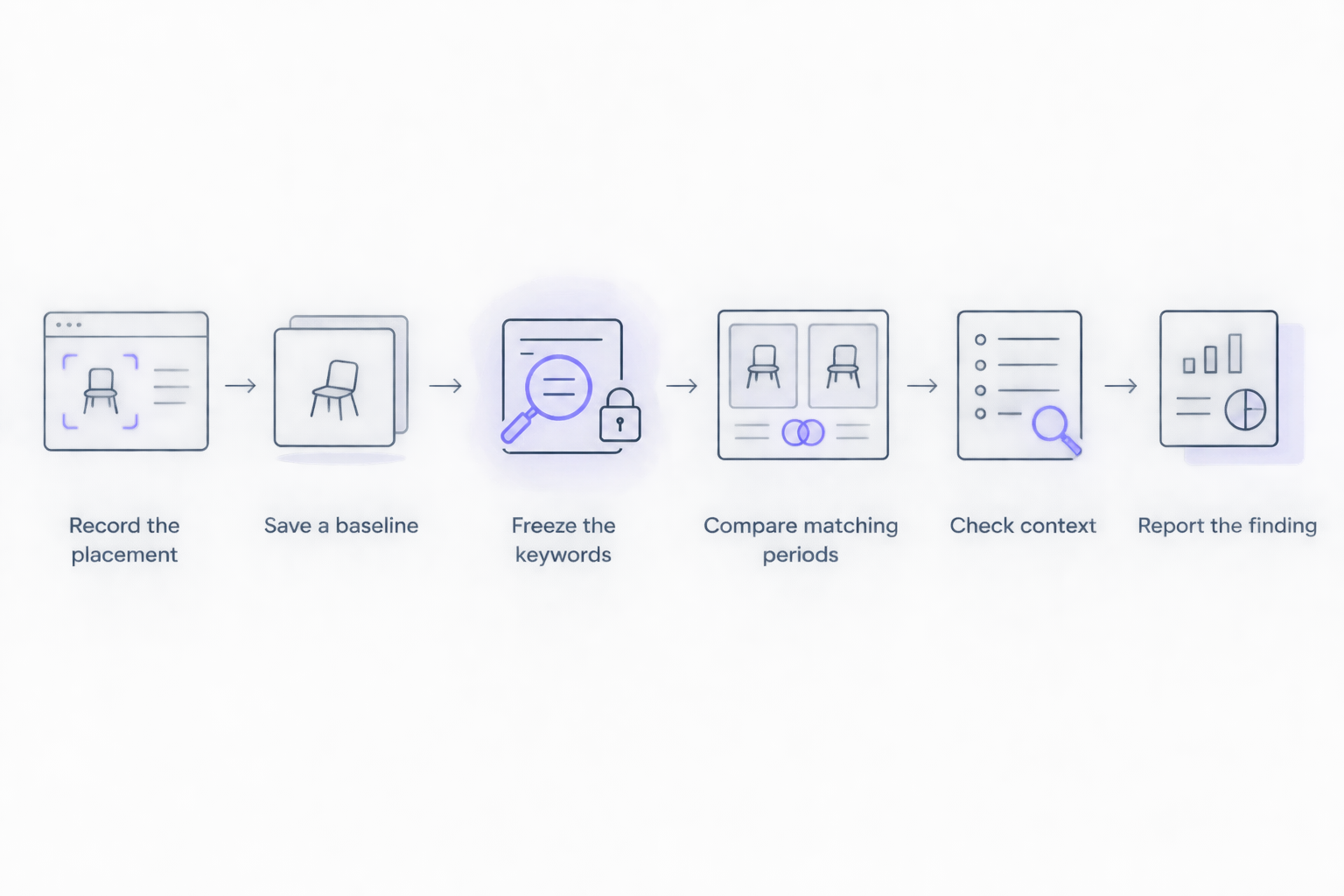
Follow this sequence so every comparison uses the same measurement rules. If the guest post is already live, reconstruct the baseline from historical Search Console data rather than using today’s positions as your starting point.
1. Record the placement and its destination
Create a placement log with the publisher page, publication date, linked destination, anchor text, and link attributes. Distinguish the publication date from the date you first verified the link.
Check that the link reaches the intended page. Record redirects, changed anchors, removed links, and publisher edits when you discover them; each changes what you are evaluating.
For paid placements, Google Search Central’s spam policies and guidance on qualifying outbound links are the relevant references for your 2026 campaign. Paid links should use rel="sponsored"; nofollow is also acceptable. Do not treat payment for a placement as a promise of ranking credit.
2. Save a landing-page baseline
In Google Search Console’s Performance report, select the relevant search type and filter to the linked landing page. Export clicks, impressions, average position, and click-through rate for the period before publication.
Keep the date range and filters in the export name or reporting sheet. A baseline without its country, device, and search-type settings is difficult to reproduce.
Google Search Console Help defines average position using the topmost result from your property for each impression. It is an aggregate, not a permanent rank assigned to a page. Read it alongside the underlying queries.
3. Freeze the keyword set
Choose the target queries before inspecting the outcome. Separate branded searches from non-branded searches, and group queries by the intent the linked page serves.
Keep that original group intact throughout the evaluation. Adding newly successful queries while dropping declining queries makes the report look better without showing a fair comparison.
Use the same keywords in your rank tracker. Record its search engine, location, device, and ranking depth so a settings change does not masquerade as movement.
4. Compare matching reporting periods
Compare periods of equal length with the same weekday coverage. Keep the country, device, and search type unchanged, and exclude incomplete reporting days.
Review the page-level trend first, then inspect the original query group. For seasonal pages, add historical context rather than assuming adjacent periods represent equivalent demand.
Choose a review cadence that fits your reporting process. Treat that cadence as a measurement schedule, not a deadline by which Google must reward a link.
5. Check context before assigning credit
Log content edits, internal-link changes, technical fixes, migrations, other new backlinks, and known search updates alongside the placement. Check whether similar pages moved during the same period.
A comparison page is useful context, not a laboratory control. Differences in intent, competition, and search demand still limit the conclusion.
6. Report the finding and the next action
State whether the tracked queries improved, declined, or remained mixed. Then explain whether clicks and conversions moved in the same direction.
End with an action: keep monitoring, fix a measurement issue, investigate the landing page, or reassess the placement strategy. Avoid turning an inconclusive result into a positive result just because the link was delivered.
Which measurement method should you use?
Use Search Console for observed search performance and a rank tracker for consistent keyword checks. Neither proves that a particular backlink caused a ranking change. Analytics and a placement log answer different questions and belong beside them.
| Method | Best for | Main strength | Main limitation |
|---|---|---|---|
| Google Search Console | Measuring observed Google search performance | Connects queries and landing pages with impressions and clicks | Average position changes with the mix of recorded impressions |
| Fixed-keyword rank tracking | Following selected keywords under consistent settings | Preserves a defined keyword set and search configuration | Measures sampled search results, not every user’s experience |
| Website analytics | Assessing organic landing-page outcomes and referral visits | Connects visits with configured conversion events | Does not establish which backlink caused an organic visit |
| Placement log | Verifying publication and link changes | Records what was published and when it changed | Confirms delivery, not ranking impact |
Use the methods together rather than selecting whichever chart looks strongest. A rank tracker can show improvement for your target queries while Search Console’s page-wide average position worsens because the page starts appearing for additional queries.
Check the original query group before calling that a contradiction. Different measurement scopes can produce different results without either report being wrong.
How do you tell whether rankings actually improved?
Look for agreement across the fixed query group, not a single favorable snapshot. A stronger finding shows sustained movement under unchanged settings, supported by the linked page’s search data.
When positions improve but clicks do not
Check impressions and click-through rate for the same queries. Better positions do not guarantee more clicks when search demand changes or the results page presents different competing elements.
Inspect the snippet and search intent before commissioning more placements. The page can gain visibility without becoming a more attractive result.
When clicks improve but average position worsens
Inspect newly appearing queries separately from the baseline group. Broader visibility can introduce impressions at lower positions and pull down the aggregate average.
Keep the expansion in the report, but do not mix it into the original keyword comparison. Report existing-query movement and new-query visibility as separate findings.
When only the domain-level score rises
A third-party authority score is not a ranking measurement. Return to the linked page, its tracked queries, and its search traffic before claiming an SEO improvement.
The same discipline applies to anchor text. Record what was published and why it fits the destination; the guide to choosing anchor text when buying backlinks covers that placement decision separately from outcome measurement.
Why ranking results vary after a guest post
Publication is only part of the sequence. These factors explain why the same reporting method can produce different outcomes across pages:
- Discovery and processing: A live publisher page does not establish when Google discovered or processed its link.
- Link qualification: Paid-link attributes and Google’s treatment of the link limit what ranking credit you can assume.
- Destination relevance: A backlink does not resolve a landing page that fails to satisfy the target query’s intent.
- Concurrent changes: Content revisions, internal links, technical changes, and additional backlinks complicate attribution.
- Search conditions: Competitor changes, seasonality, and search updates affect the comparison period.
- Measurement scope: Different devices, locations, query groups, and date ranges produce different comparisons.
Treat these as checks, not excuses. If the tracked queries stay flat, report that result plainly and investigate the page and campaign before expanding the same approach.
What should your 2026 guest-post report include?
Keep the main report short enough to support a decision. Put detailed exports behind it, and preserve the original data so another analyst can reproduce the comparison.
| Report field | What to record | Why it matters |
|---|---|---|
| Placement status | Publisher page, destination, publication date, link attributes | Separates delivery from performance |
| Measurement scope | Search type, country, device, baseline, comparison dates | Makes comparisons repeatable |
| Ranking outcome | Fixed-query movement and landing-page average position | Shows what changed in search visibility |
| Traffic outcome | Organic clicks and separately identified referral visits | Distinguishes search performance from publisher visits |
| Business outcome | Configured conversions on the relevant landing page | Tests whether traffic supported the business goal |
| Attribution limits | Other links, page edits, technical changes, search updates | Prevents unsupported credit claims |
When assessing a NO-BS Marketplace guest posting campaign, use the same reporting standard you apply to other placements. Publisher verification and placement delivery answer procurement questions; your search and analytics records answer performance questions.
Use precise wording. Say that rankings improved after publication when that is what the timeline establishes. Reserve causal claims for evidence that actually isolates the cause.
How long should you wait before judging a guest post?
There is no universal waiting period that proves a guest post succeeded or failed. Publication, link discovery, processing, and observable ranking movement are different events.
Set review dates before the campaign starts and compare complete periods. For a 2026 campaign, keep the original baseline even if publication slips; annotate the revised live date rather than silently resetting the starting point.
Can you prove that a guest post caused a ranking increase?
An ordinary before-and-after report cannot prove that a guest post caused a ranking increase. It establishes sequence and association while other ranking influences remain active.
Improve confidence by documenting concurrent changes, keeping query settings fixed, and examining comparable pages. If several placements land together, report the campaign-level observation instead of assigning the whole gain to an individual post.
Should you track referral traffic separately from rankings?
Yes, referral traffic and organic rankings are separate outcomes. A visitor arriving through the publisher’s link demonstrates a referral visit, not an increase in Google visibility.
Keep referral sessions and their conversions in a separate view. That lets you recognize useful publisher traffic without mislabeling it as ranking improvement.
FAQ
What’s the best way to track rankings after a guest post?
Compare the linked page’s fixed query group in Google Search Console before and after publication, then check a rank tracker with unchanged settings. Keep the country, device, search type, and reporting periods consistent.
Can I use Google Search Console without a rank tracker?
Yes, Google Search Console can measure the linked page’s observed search performance without a rank tracker. A rank tracker adds repeatable checks for a predefined keyword set, but it does not prove backlink attribution.
Why did my average position drop when organic clicks increased?
Average position can drop when your page gains impressions for additional queries at lower positions. Compare the original query group separately before deciding that existing rankings declined.
Does a backlink appearing in a checker mean Google counted it?
No, a backlink checker finding a link does not prove that Google used it for ranking. The checker’s discovery and Google’s treatment of that link are separate matters.
Should I add tracking parameters to the guest-post link?
Tracking parameters can help identify referral visits when they fit your analytics setup. They do not measure ranking credit or establish that the guest post caused organic growth.
Does a paid guest post guarantee better rankings?
No, a paid guest post does not guarantee better rankings. Google’s guidance requires paid links to be qualified, and a delivered placement is not evidence of ranking credit.
What should I check if rankings do not improve?
Check the live link, its destination and attributes, the target page’s indexing status, and the consistency of your measurement settings. Then review search intent, concurrent changes, and competing results before ordering more placements.
One last thing
Keep the unsuccessful queries in the report. A campaign summary that only shows winners cannot tell you whether the original target group improved.
Before closing your 2026 report, reopen the saved baseline and check every original query. That check is more useful than another screenshot of the best-performing keyword.