
Yes, duplicate content in a guest post can hurt your SEO when Google shows the publisher’s copy instead of your original, but duplication alone does not trigger an automatic penalty. In 2026, treat lost visibility, canonical selection, and link-spam violations as separate problems: each needs a different fix.
- Can duplicate content in a guest post hurt SEO? Yes, through competing copies—not an automatic duplicate-content penalty.
- Google treats canonical tags as signals, not guarantees that your original article will appear in search.
- Write a distinct guest post when your own article needs to retain organic search visibility.
- Paid guest-post backlinks need appropriate link attributes; original wording does not make paid ranking links compliant.
Can duplicate content in a guest post hurt your own SEO?
Yes—but identify the mechanism before changing anything. Google Search Central’s guidance on duplicate URLs explains that Google selects a canonical version from duplicate or very similar pages. Its spam policies address manipulative links and scaled content abuse separately.
A missing result is not proof of a penalty. The publisher’s version appearing for your target query is also different from your entire website losing rankings.
| Publishing approach | Best for | Benefit | Limitation or risk |
|---|---|---|---|
| Original guest article | Reaching another audience with a distinct contribution | Gives the publisher a separate page with its own purpose | Requires separate research and editing; does not guarantee rankings |
| Full republication | Distributing an existing article | Preserves the original message | Creates competing copies unless indexing is controlled |
| Short excerpt with attribution | Introducing readers to a longer resource | Leaves the detailed answer on your website | Still needs useful context and a reason to visit the source |
| Lightly rewritten copy | Not recommended as a duplication fix | Changes surface wording | Does not necessarily change the page’s substance or search purpose |
Before approving a publisher, check its editorial standards and existing content—not just its authority score. This guide to auditing a publisher site before a placement covers that separate screening task.
Why this matters
A guest post should add distribution or contribute something useful to another publication. Republishing your strongest search article without an indexing agreement creates an avoidable conflict over which URL appears in search.
You also lose diagnostic clarity when you treat every problem as duplication. A copied article, an unqualified paid link, and an irrelevant publisher are different issues, even when they occur in the same placement.
For your 2026 campaign brief, define the objective first: referral visits, audience exposure, or organic visibility for your own resource. Do not assume a syndicated article will deliver all three.
Original guest articles: separate the reader’s job
An original guest article is the best default when your own page must remain a distinct search resource. Keep the subject relevant, but give the publisher a different question, argument, or practical application.
For example, your website’s article might explain how to evaluate a publisher. The guest contribution can examine how an agency documents editorial approval for clients. Those subjects connect without reproducing the same answer.
The benefit is editorial separation. The drawback is extra work: changing a headline and rearranging paragraphs does not produce a genuinely different contribution.
Use different examples, develop a distinct conclusion, and link to your original resource only where it helps the reader. Do not force a commercial anchor into an otherwise useful article.
Full republication: agree on indexing before publication
Full republication is best for distribution when you have explicitly agreed which copy should appear in search. Attribution helps readers identify the source, but an attribution link is not an instruction to exclude the publisher’s copy from search.
For syndicated articles, Google Search Central recommends having partners block indexing of their copies when you want to avoid those copies appearing in search. Google also says canonical links are not the recommended solution for syndicated content, because syndicated pages often differ substantially overall.
A publisher-applied noindex directive lets the article remain accessible to readers while instructing search engines not to index it. Google must be able to crawl the page to discover that directive; blocking crawling in robots.txt is not an equivalent fix.
The trade-off is clear: a noindexed republication is not intended to attract its own organic search visits. Agree on that limitation before the article goes live.
Excerpts and rewrites: judge substance, not similarity scores
A short excerpt is best for introducing a resource without reproducing its full answer. Add publisher-specific context, identify the source, and give readers a clear reason to continue to the original.
There is no universal excerpt length that guarantees a particular search outcome. A brief extract containing the entire useful answer can substitute for the original more than a longer introduction that sends readers to detailed evidence.
A rewrite needs the same scrutiny. If the page follows the same argument, examples, and conclusion, replacing vocabulary does not create a new editorial purpose.
Duplication software can help locate overlapping text. It cannot certify Google compliance, predict canonical selection, or prove that an article deserves to rank.
Why duplicate-content risk varies
Use these factors to assess the placement rather than treating every repeated sentence as a threat:
- Substantive overlap: A repeated definition is different from reproducing the article’s main explanation, examples, and conclusion.
- Search purpose: Copies answering the same query compete more directly than articles addressing different reader needs.
- Indexing controls: A crawlable page carrying noindex is different from an indexable republication.
- Canonical signals: Conflicting canonical declarations, redirects, internal links, and sitemap entries complicate your preferred-URL signals.
- Publisher execution: The live page can differ from the approved draft, including its attribution, indexing directives, and outbound links.
- Link intent: A paid link intended to manipulate rankings creates a separate policy issue, regardless of how original the surrounding article is.
Do not reduce these checks to a plagiarism percentage. Text similarity is only part of the publishing decision.
How do you check whether a duplicate guest post caused damage?
Start with 2 URLs: your original article and the publisher’s copy. Compare the actual pages before attributing a traffic change to duplication.
1. Confirm overlap
Read the main content side by side. Mark repeated explanations, examples, headings, and conclusions rather than counting shared industry terminology.
Search distinctive passages to locate other copies. Treat those searches as discovery tools, not a complete inventory of indexed duplicates.
2. Inspect indexing
In Google Search Console, inspect the original URL on the property you control. Review its indexing status and the Google-selected canonical where the report provides it.
You cannot inspect an unrelated publisher’s property as its owner without access. Check the public page’s robots directives and canonical declaration, then request evidence from the publisher when needed.
3. Compare performance
Filter Search Console performance to the original page and its important queries. Compare equivalent periods around the republication date and check whether impressions, clicks, or rankings changed.
Also review changes to your own page, site migrations, indexing problems, and broader search changes. Timing alone does not establish that the guest post caused the decline.
4. Separate spam
Check Search Console’s Manual Actions report for your property. An empty report does not rule out algorithmic effects, but it does stop you from describing an unconfirmed manual penalty as fact.
Then inspect the placement’s links separately. Google’s link-spam guidance calls for paid placements to use rel="sponsored"; rel="nofollow" remains acceptable for qualifying paid links.
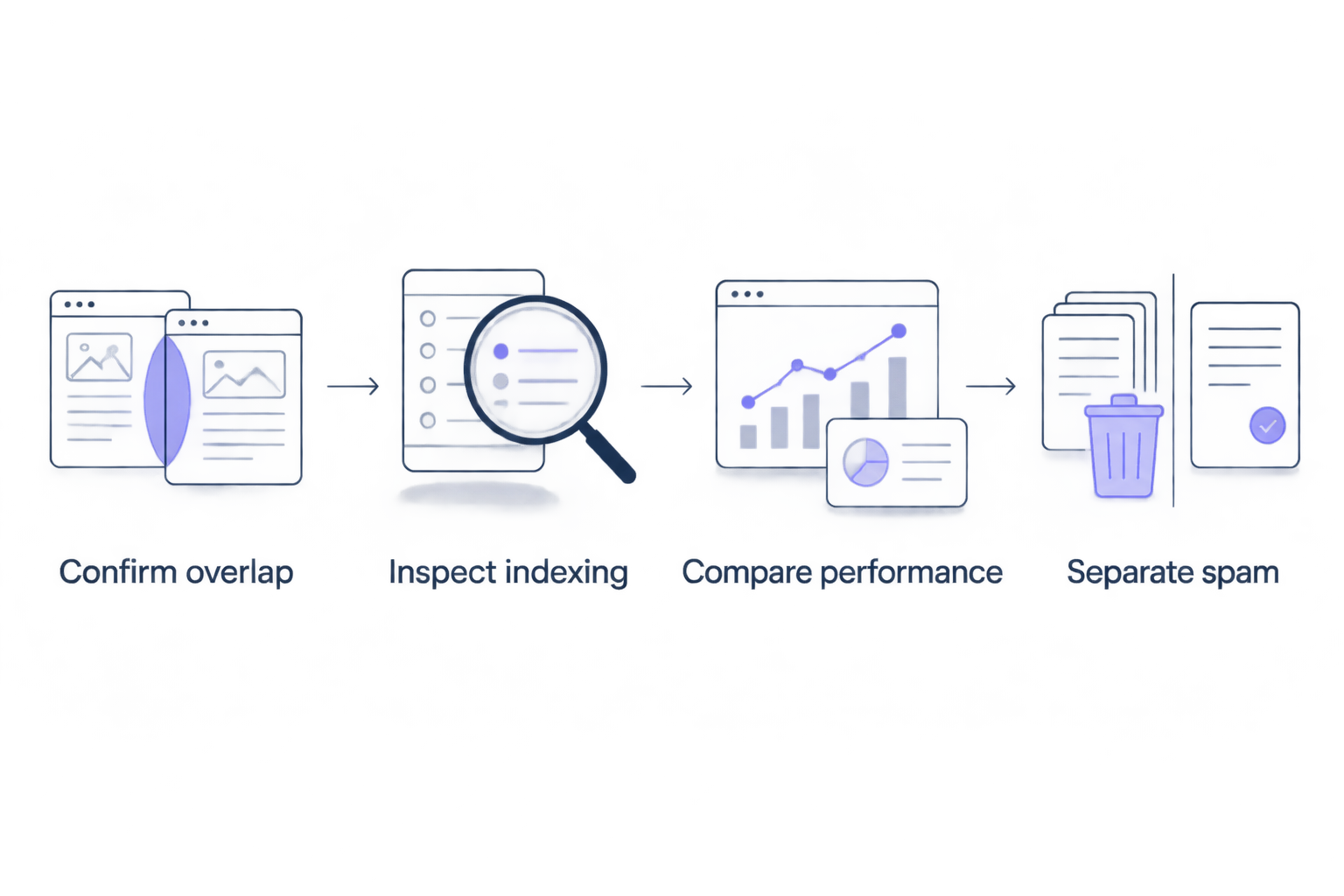
Keep these checks together in your 2026 placement record. A screenshot of a live backlink does not establish that either article is indexed or that the placement improved search performance.
What should you do when the publisher’s copy outranks yours?
First decide whether your objective is search visibility for the original or distribution through the publisher. Trying to preserve unrestricted indexing for both copies while guaranteeing that your version wins is not a controllable outcome.
For an agreed syndication arrangement, ask the publisher to apply noindex if its copy should not appear in search. Verify the live directive afterward and allow Google to recrawl the page; the change is not immediate.
For a guest article that was supposed to be original, request a substantive revision or removal under the publishing agreement. A new introduction attached to an otherwise copied article does not resolve the editorial problem.
On your own website, check that the original is indexable, uses a consistent preferred URL, and receives relevant internal links. Do not remove a useful original article simply because an external copy appears above it.
If the issue is an unqualified paid backlink, correct the link treatment separately. Noindex on a syndicated copy is not a substitute for following Google’s paid-link guidance.
Can a canonical tag guarantee that my original ranks?
No canonical tag guarantees that your original ranks. Google treats rel="canonical" as a strong signal, not a binding instruction, and ranking is separate from canonical selection.
For 2026 syndication agreements, do not promise clients that a cross-domain canonical eliminates search competition. Google’s syndication guidance favors blocking indexing of partner copies when preventing their appearance is the objective.
Does an attribution link protect my original article?
An attribution link identifies the source; it does not reserve search visibility for that source. Keep attribution for transparency, but agree on indexing controls independently.
A publication date is not a guarantee either. Publishing first does not entitle a page to a particular ranking or force Google to select it as canonical.
Is rewriting a guest post enough to make it safe?
Rewriting alone is not enough to establish quality or policy compliance. Change the contribution, not just the sentences: answer a different question, introduce relevant evidence, or apply the topic to the publisher’s audience.
Original content also does not make a paid ranking link acceptable. Editorial quality and link qualification require separate approval.
Where a guest-post marketplace fits
NO-BS Marketplace is best for SEO professionals and agencies sourcing guest-post placements. The platform connects those buyers with verified publisher sites and offers white label link building and guest posting services.
The practical benefit is access to a placement workflow. The boundary is equally important: using NO-BS Marketplace for guest posting does not replace your checks on originality, indexing, or paid-link treatment.
Before approving a NO-BS Marketplace guest-post brief, specify whether the deliverable is an original contribution or an authorized republication. Keep the approved draft and verify the published version against it.
FAQ
Can duplicate content in a guest post hurt SEO without a penalty?
Yes. Google can show the publisher’s copy instead of your original without imposing a duplicate-content penalty. That is a search-visibility issue, not proof of a sitewide sanction.
Does Google automatically penalize duplicate guest posts?
No. Duplicate content alone does not trigger an automatic penalty, but manipulative links and abusive content practices can violate separate spam policies.
Should I publish my own article before submitting a guest post?
Publish the original first if that matches your editorial plan, but do not treat publication order as protection. Use a distinct guest article or agree on indexing controls for republication.
What percentage of a guest post can match my blog?
There is no universal safe percentage published by Google. Review whether the guest post reproduces the substantive answer rather than relying on a similarity score.
Is noindex better than canonical for a syndicated article?
Noindex is the appropriate control when the publisher’s copy should not appear in search. Google does not recommend relying on canonical tags for syndicated content.
Can I reuse my author bio across guest posts?
Yes. A repeated author bio is different from duplicating the main article, and ordinary repeated boilerplate does not by itself create an automatic penalty.
Does using a guest-post platform remove duplicate-content risk?
No. A guest-post platform such as NO-BS Marketplace does not replace review of the draft and published page. Check originality, indexing controls, attribution, and link attributes for each placement.
One last thing
A useful backlink and an unwanted search competitor can exist on the same page. Finding the link intact does not settle whether republication was a good decision.
For every 2026 placement, record 1 preferred URL for the full article and the agreed treatment of any copies. That simple editorial decision makes later indexing discussions far less ambiguous.