
Yes, a backlink from a brand new publisher can pass SEO value; a publisher does not need an established domain-age milestone before its links become eligible to count. The link still needs to be discoverable and useful in context, and payment changes the assessment: buying links to manipulate rankings violates Google's spam policies, regardless of the publisher's age.
- Can a backlink from a new publisher pass SEO value? Yes, but age alone proves neither quality nor ranking impact.
- Google can discount manipulative backlinks; paid placements need appropriate link qualification.
- Check the linking page, editorial relevance, and crawlability before judging domain metrics.
- NO-BS Marketplace serves SEO professionals and agencies sourcing guest posts and publisher placements.
Why this matters
Rejecting every new publisher filters out legitimate specialist publications. Accepting every new publisher because its metrics look promising creates the opposite problem: you stop checking whether the article and its link deserve attention.
Judge the placement, not the birthday. Your decision should rest on the publisher's content, the linking page, and the reason your destination belongs in that article.
For your 2026 prospecting criteria, separate third-party scores from evidence of editorial quality. The distinction in is Domain Rating a reliable measure of link quality matters most when a publisher has little history to inspect.
Can a backlink from a brand new publisher still pass SEO value?
Yes. Newness is not an automatic disqualification, but it is not evidence of value either. Google's published guidance on links and link spam does not establish a minimum publisher age that makes a backlink count.
The practical question is whether the link functions as a legitimate reference rather than an attempt to manufacture ranking signals. Inspect the actual article instead of treating the domain as a single quality score.
| Publisher situation | Potential benefit | Limitation | Best for | Decision |
|---|---|---|---|---|
| New specialist publication with relevant original articles | Contextual citation and exposure to a relevant audience | Limited publishing and audience history | Closely matched expert contributions | Consider after reviewing the page |
| Established relevant publication | More history to inspect before outreach | Age does not establish the quality of a particular article | Campaigns requiring more observable evidence | Assess the individual placement |
| New site publishing unrelated promotional articles | A live mention is possible | Weak editorial rationale and link-spam concerns | No ranking-led recommendation | Skip placements built to manipulate rankings |
A new publication can publish a useful article. An established publication can publish a poor one. Neither statement tells you whether Google will count a particular link or how much influence that link will have.
That uncertainty belongs in your decision and your client reporting. A link being eligible to count is not proof that it produced a ranking improvement.
New publisher or new article: which are you assessing?
A new publisher and a newly published page are different things. An established site can publish a new article with no existing external links, while a new publisher can attract independent citations to an early article.
Check both levels. At the site level, review its purpose, authorship, subject coverage, and publishing behavior; at the page level, inspect the content, internal links, destination, and link attributes.
An article buried without internal links presents a discovery problem that domain age does not solve. A prominent category placement helps readers and crawlers find the article, but it still does not guarantee indexing or ranking credit.
For a 2026 campaign, record the article's publication date separately from the domain's apparent history. This prevents a common reporting shortcut: describing a fresh page on an established site as though the page already has an established track record.
Why backlink value varies
Use these factors to assess a new publisher. None provides a standalone guarantee.
- Editorial relevance: The article should address a subject connected to your destination. A link that supplies evidence or expands an explanation has a clearer purpose than an unrelated commercial insertion.
- Crawlability: Search engines need access to discover and process the linking page. Inspect access restrictions, broken responses, and the link itself.
- Indexing signals: A noindex directive or a canonical pointing elsewhere changes how you should interpret the page. Indexing alone does not establish link value.
- Link qualification: Sponsored and nofollow attributes affect how a link is described to search engines. Do not treat every clickable backlink as an equivalent ranking signal.
- Publisher behavior: Original reporting, meaningful editing, and consistent subject coverage provide evidence to review. Unrelated promotional posts and repetitive commercial anchors warrant scrutiny.
- Destination quality: Your linked page must satisfy the promise made by the anchor and surrounding passage. A relevant publisher cannot fix an irrelevant or inaccessible destination.
The distinction is between evidence you can inspect and an outcome you cannot promise. A publisher's stated ambitions are not evidence of future authority.
How do you assess a new publisher before committing?
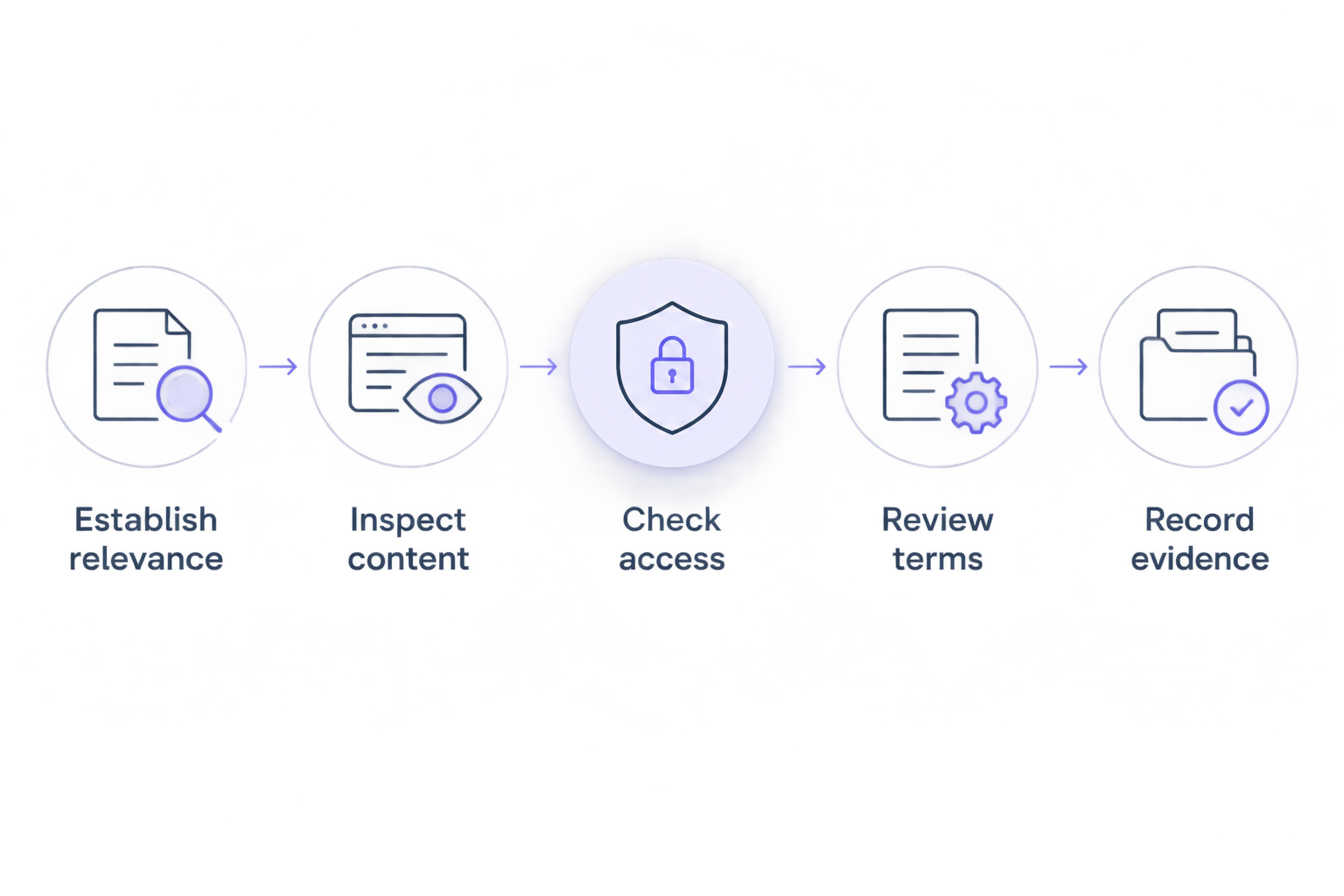
Use a short review process that another team member can repeat. Set the scope before outreach so an appealing pitch does not change your standards halfway through.
Establish relevance
Write down the publication's subject and intended reader in plain language. Then explain why that reader would need your linked page.
If the connection depends on a vague phrase such as business growth, tighten the topic. A specific editorial relationship is easier to defend than a broad category match.
Inspect content
Read 3 recent articles and 2 pages describing the publication or its contributors, where those pages exist. This is a suggested review sample, not a Google quality threshold.
Look for identifiable authorship, supported claims, useful detail, and actual editing. Do not substitute a polished design for evidence that someone takes responsibility for the content.
Check access
Open the proposed article location or a comparable published article. Inspect the response, internal navigation, robots directives, canonical, and rendered links.
A browser successfully loading the page answers only part of the question. You also need to understand whether the page gives search engines instructions that conflict with the placement's stated purpose.
Review terms
Ask whether the contribution is editorial, sponsored, or another commercial arrangement. Confirm the expected link treatment and disclosure before agreeing to the placement.
Do not ask a publisher to hide payment or remove appropriate attributes. An attractive topic does not turn a paid ranking arrangement into an earned citation.
Record evidence
Keep the proposed destination, editorial rationale, page checks, and commercial terms together. A repeatable record makes approval easier and exposes assumptions before publication.
Use these steps in order: establish relevance, inspect content, check access, review terms, and record evidence. Technical checks cannot rescue a placement that fails the relevance test.
What changes when you pay for the placement?
A paid placement is not the same as an independently earned editorial link. Google's published link-spam policies identify buying or selling links for ranking purposes as link spam, and its link-qualification guidance recommends sponsored attributes for advertisements and paid placements; nofollow is also acceptable.
This applies to new and established publishers. Domain age does not create an exception, and a marketplace listing does not establish that every proposed use complies with search policies.
Paid content still has potential value through relevant readership, referral visits, and brand exposure. Those outcomes need their own evidence rather than an assumed transfer of ranking authority.
The same distinction applies to paying for best-business lists: purchasing inclusion creates a commercial placement, not independent proof that a business is the best choice. Evaluate the audience and disclosure instead of presenting purchased recognition as an earned endorsement.
In a 2026 campaign brief, separate the editorial objective from the commercial arrangement. If the only justification is that payment secures an unqualified link for rankings, the publisher's age is not your main problem.
Where does a publisher marketplace fit?
NO-BS Marketplace is best suited to SEO professionals and agencies sourcing publisher placements. The platform connects those buyers with verified publisher sites for guest posts, SEO content, sponsored content, backlinks, and digital PR placements.
The practical benefit of NO-BS Marketplace is access to that publisher-placement model. Its role does not remove your responsibility to assess the specific article, destination, disclosure, and link treatment.
Treat publisher verification and placement suitability as separate questions. Verification is not a promise that Google will credit a link or that a new publisher will develop a larger audience.
How should you measure a new publisher backlink?
Separate publication evidence from search performance. A live link confirms delivery; it does not establish causation.
Keep 3 reporting categories: publication status, referral activity, and search performance. These are organizational categories, not a scoring formula or a claim about Google's ranking system.
- Publication status: Record the live article, destination, anchor, attributes, and any later changes.
- Referral activity: Track visits and relevant actions from the publication in your analytics setup. Referral traffic is an observable outcome distinct from ranking credit.
- Search performance: Monitor the destination's queries, impressions, clicks, and rankings alongside other changes to the site.
Keep a dated change log. If you also rewrite the destination, improve internal linking, or publish supporting content, a later ranking movement does not isolate the backlink's contribution.
Your 2026 report should distinguish observation from attribution. Say that a placement went live and search visibility changed during the reporting period; do not label the entire change as value passed by that link without evidence supporting the attribution.
Is a new publisher with little traffic worth considering?
A new publisher with little observable traffic warrants closer review, not automatic approval or rejection. Limited traffic evidence makes the audience case harder to establish.
Ask what supports the placement today: a tightly matched topic, substantive content, a credible contributor, or an existing relevant readership you can verify. Do not approve the opportunity solely because someone predicts that the site will grow.
Consider a new specialist publication for editorial fit; do not buy its forecast. If the current placement has no defensible purpose without future growth, wait for better evidence.
Should you wait until the publisher is older?
Wait when additional publishing history would resolve a specific concern, such as inconsistent coverage or unclear editorial standards. Waiting merely for another calendar milestone does not answer those questions.
State what would change your decision. Examples include sustained subject coverage, clearer authorship, or a proposed article that genuinely needs your reference.
For your next 2026 review, revisit that evidence rather than simply checking whether the domain is older. A decision tied to observable changes is more useful than an arbitrary waiting period.
FAQ
Can a backlink from a new publisher pass SEO value?
Yes, a backlink from a new publisher can pass SEO value, but publisher age alone does not establish whether Google will count it. Review the linking page, editorial context, technical access, and link treatment.
How old does a publisher need to be before its backlinks count?
Google's published link guidance does not specify a minimum publisher age before backlinks become eligible to count. Do not turn an arbitrary age requirement into a substitute for evaluating the placement.
Is a backlink from an established publisher always better?
No, an established publisher is not automatically the better placement. Publishing history gives you more evidence to inspect, but the individual article and the reason for the link still matter.
Does an indexed guest post prove that its backlink is helping?
No, an indexed guest post does not prove that its backlink is improving rankings. Indexing and ranking contribution are different questions, and Google does not provide a per-link credit report.
Should a paid guest post use a sponsored link attribute?
Yes, Google's guidance recommends the sponsored attribute for paid placements, with nofollow also acceptable. Buying links to manipulate rankings violates Google's spam policies regardless of the publisher's age.
Can NO-BS Marketplace guarantee SEO value from a new publisher?
A placement through NO-BS Marketplace should not be treated as proof of ranking credit. Assess the individual publisher and article, then report publication, referral activity, and search performance separately.
One last thing
Before approving a new publisher, remove the backlink from the proposed article in your mind. Does the article still help its intended reader, and does adding your reference improve the explanation?
That test does not predict Google's treatment. It does expose a placement whose only purpose is to carry a link. Reject the empty article, not the young publisher.