
Best overall: SE Ranking. Best for rank-focused teams: AccuRanker. Best for keyword research workflows: Semrush. Best for backlink-led analysis: Ahrefs. Best for local search: BrightLocal. This 2026 guide from NO-BS Marketplace compares rank tracking tools by the agency work they support, not by the length of their feature lists.
- SE Ranking leads this best rank tracking tools for SEO agencies shortlist for combined tracking, audits, and reporting.
- Choose AccuRanker when keyword rank tracking is the main job.
- Semrush fits keyword research workflows; Ahrefs fits backlink-led SEO analysis.
- BrightLocal fits agencies reporting on local rankings and Google Maps visibility.
- Compare identical keywords, locations, devices, and dates before judging different ranking reports.
Why this matters
A ranking report should tell your account manager what changed, which landing page moved, and what deserves attention. A dashboard full of green arrows does not answer those questions by itself.
For agencies, the buying decision also includes repeatable client setup, usable exports, and reporting that separates branded searches from commercial discovery. Your tracker needs to support the work you sell—not become another reporting task.
SE Ranking is the best default on this shortlist for agencies that want rank tracking, site audits, and client reporting in one platform. Specialist needs change that recommendation, particularly for local search or backlink research.
What makes the best rank tracking tools for SEO agencies?
Judge your 2026 shortlist against these criteria before comparing dashboards:
- Search context: Match the search engine, location, language, and device to the client's actual market.
- Landing-page visibility: Identify which URL ranks, not just whether the domain appears.
- Keyword organization: Separate services, locations, funnel stages, and branded queries into useful groups.
- Client reporting: Check whether a client can understand the report without an analyst explaining every chart.
- Analysis fit: Decide whether you need a dedicated tracker or a broader research and audit platform.
- Data portability: Inspect exports and integration requirements before making the tracker part of your reporting process.
Treat reporting, permissions, and integrations as requirements to verify in the specific subscription you evaluate. A feature mentioned on a product website is not a substitute for testing your intended workflow.
Agency rank tracking tools at a glance
| Tool | Best for | Standout capability | Key limitation |
|---|---|---|---|
| SE Ranking | Combined agency SEO workflows | Rank tracking alongside audits and reporting | Broader scope than a tracking-only team needs |
| AccuRanker | Dedicated ranking analysis | Keyword segmentation and ranking-focused analysis | Not a replacement for a full technical SEO toolkit |
| Semrush | Research-to-report workflows | Position Tracking alongside keyword and competitor research | Broad platform adds workflow complexity |
| Ahrefs | Backlink-led SEO analysis | Rank Tracker alongside backlink and organic research | Not a dedicated local grid reporting tool |
| BrightLocal | Local SEO reporting | Local rankings and geographic Maps visibility | Not a general-purpose national keyword research suite |
The order reflects distinct agency use cases, not a claim that one tool produces universally more accurate rankings. Search context and measurement methods affect what each report shows.
1. SE Ranking: best rank tracker for combined agency workflows
SE Ranking combines keyword rank tracking with site auditing, competitive research, and reporting. That makes it a sensible starting point when your account managers need ranking movement and diagnostic tools in the same workspace.
Best for: Agencies delivering recurring SEO retainers across content, technical work, and reporting.
The practical advantage is continuity. You can investigate ranking changes without immediately moving to a completely separate audit platform, although campaign decisions still need Search Console and business outcome data.
SE Ranking pros:
- Combines rank tracking with broader SEO analysis.
- Supports organizing tracked keywords into groups.
- Includes reporting tools for recurring client communication.
SE Ranking cons:
- Broader functionality adds setup decisions for tracking-only teams.
- Its general SEO scope does not remove the need for specialist local visibility checks.
During evaluation, build a report around a client's service categories rather than the tool's default overview. Ask an account manager to identify the biggest landing-page problem from that report without help.
Verdict: Buy SE Ranking if your agency wants one working environment for tracking, audits, and reporting.
2. AccuRanker: best rank tracker for ranking-focused teams
AccuRanker is a dedicated rank tracking platform. Its keyword segmentation and ranking analysis suit teams that already have separate systems for technical audits, content research, and backlink analysis.
Best for: Agencies whose analysts spend substantial time investigating keyword movement across defined segments.
Choose AccuRanker for a focused measurement role, not because a dedicated product automatically guarantees better data. Your evaluation still needs consistent locations, devices, and keyword definitions.
AccuRanker pros:
- Keeps ranking analysis central to the workflow.
- Supports keyword tagging and segmentation.
- Provides competitor visibility analysis around tracked searches.
AccuRanker cons:
- Requires other tools for full technical site auditing.
- Does not replace a dedicated backlink research database.
Test the segments your team actually reports: service line, landing-page type, country, and branded versus non-branded searches. A tracker earns its place when those groups make performance changes easier to explain.
For your 2026 review, have an analyst investigate a declining keyword group and produce a client-ready explanation. Judge the process, not just the chart.
Verdict: Buy AccuRanker when focused rank analysis matters more than consolidating your SEO toolkit.
3. Semrush: best rank tracker for keyword research workflows
Semrush pairs Position Tracking with keyword research, competitor analysis, and site auditing. It fits agencies that want to move from finding search opportunities to tracking the terms selected for a campaign.
Best for: Content-led SEO teams connecting keyword discovery, competitive research, and ongoing measurement.
The distinction is workflow coverage. Position tracking is part of a wider research environment rather than the platform's only purpose.
Semrush pros:
- Connects keyword research with campaign tracking.
- Supports competitor comparisons for tracked keywords.
- Includes technical auditing alongside ranking analysis.
Semrush cons:
- Its broad toolset requires clear internal operating procedures.
- Research estimates and tracked rankings represent different datasets and need separate interpretation.
Keep the original keyword brief attached to your campaign setup. Otherwise, the research team can target one market while the reporting team measures a different device or location.
Evaluate Semrush using the complete handoff: keyword selection, target-page assignment, tracking setup, and client reporting. If your agency only needs positions for an established keyword list, much of that wider workflow is unnecessary.
Verdict: Buy Semrush when keyword and competitor research drive your agency's SEO delivery.
4. Ahrefs: best rank tracker for backlink-led SEO analysis
Ahrefs combines Rank Tracker with backlink analysis, organic search research, and site auditing. It fits agencies that regularly examine referring domains, competing pages, and ranking movement together.
Best for: SEO teams investigating rankings alongside backlink profiles and competitor content.
For NO-BS Marketplace readers managing link campaigns, Ahrefs rank tracking belongs beside backlink evidence—not in place of it. A position change after a placement does not prove that placement caused the change.
Ahrefs pros:
- Puts rank tracking alongside backlink research.
- Supports competitor comparisons for tracked keywords.
- Includes site auditing for investigating technical issues.
Ahrefs cons:
- Does not replace a dedicated local grid visibility workflow.
- Backlink discovery dates and ranking changes do not establish causal attribution.
When evaluating Ahrefs in 2026, compare the ranking URL with the URL receiving new links. Domain-level improvement can hide a target page that has not moved at all.
Keep a separate campaign log for content changes, technical releases, and published placements. That record gives the ranking chart context without pretending it isolates the effect of each action.
Verdict: Buy Ahrefs when backlink and competitor analysis are central to your agency's SEO work.
5. BrightLocal: best rank tracker for local SEO agencies
BrightLocal focuses on local SEO, including local rank tracking and geographic visibility through Local Search Grid. It suits agencies reporting on location-dependent searches and Google Maps results.
Best for: Agencies serving local businesses and multi-location clients.
A business can appear differently across nearby search locations. Geographic reporting makes that variation visible instead of reducing a service area to one ranking position.
BrightLocal pros:
- Focuses on local search reporting.
- Provides geographic Maps visibility through Local Search Grid.
- Includes local SEO tools beyond keyword positions.
BrightLocal cons:
- Does not replace broad national keyword and content research.
- Grid results require a deliberate choice of geographic coverage.
Test BrightLocal around the client's actual service area, not just its street address. A report centered on the business location answers a narrower question than a report covering the neighborhoods it wants to reach.
Use local rankings alongside business outcomes. Visibility across a map is useful diagnostic evidence, but it is not a count of calls, bookings, or qualified inquiries.
Verdict: Buy BrightLocal when local search visibility is the core client deliverable.
How this shortlist is ranked
NO-BS Marketplace's rank tracking shortlist prioritizes workflow fit: search context, landing-page visibility, keyword organization, client reporting, analysis scope, and data portability. SE Ranking takes the default position because it combines tracking with adjacent agency tasks; the other recommendations serve narrower operating needs.
This is a use-case ranking, not a controlled accuracy benchmark. No recommendation depends on an assumed update frequency, an unverified subscription entitlement, or a claim that a tracker measures every searcher identically.
Run a controlled agency pilot
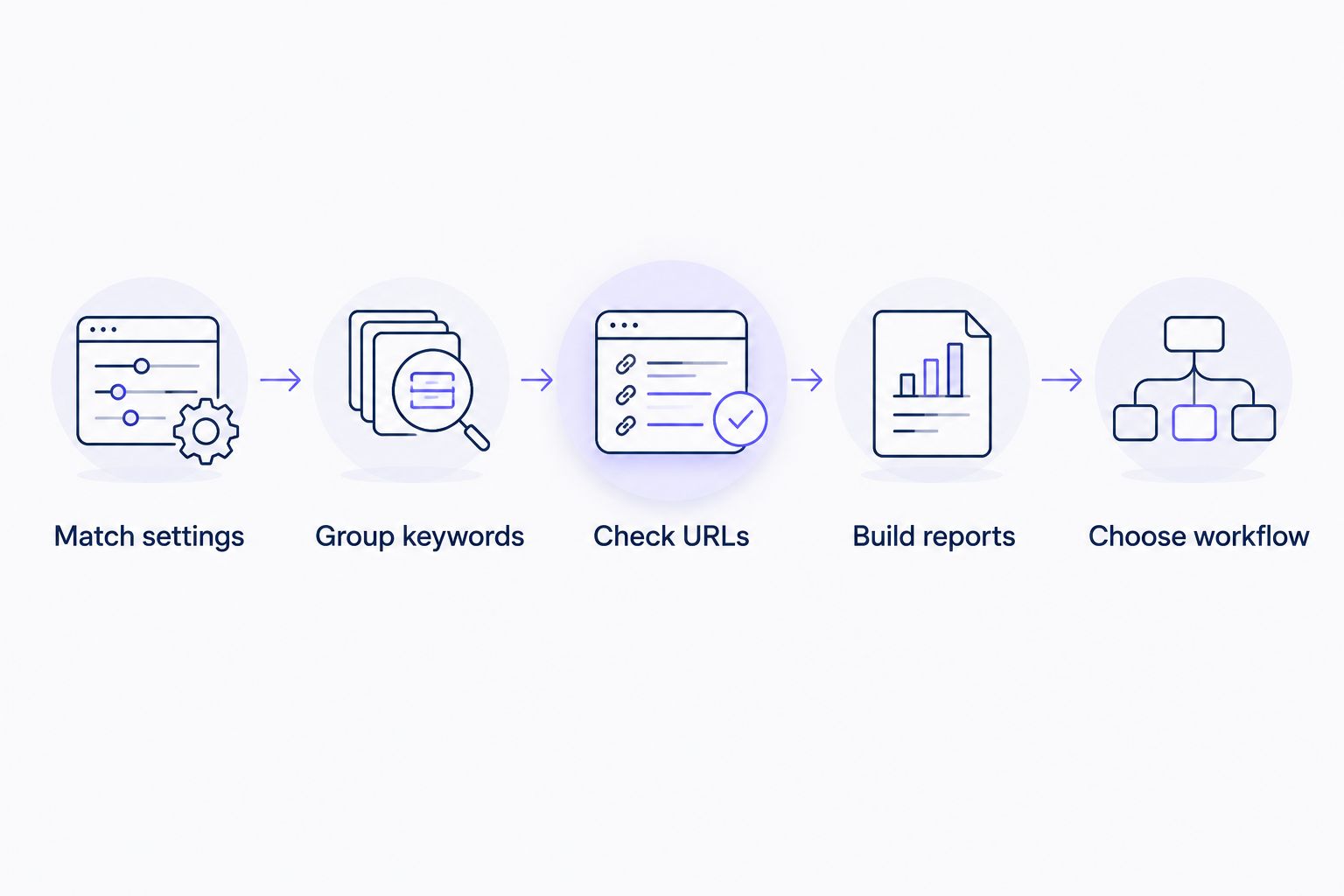
For a practical 2026 evaluation, use 3 client sites, 30 keywords per site, and a 14-day comparison window. These are suggested pilot settings, not vendor limits or performance benchmarks.
- Match settings: Use identical search engines, locations, languages, and devices across candidates.
- Group keywords: Split branded searches, commercial terms, and informational queries before comparing movement.
- Check URLs: Confirm whether the intended landing page ranks and flag unexpected substitutions.
- Build reports: Produce the client deliverable your team actually sends, including commentary.
- Choose workflow: Select the tool that supports diagnosis and reporting without unnecessary manual assembly.
Do not award a winner because its positions look more flattering. Inspect disagreements by checking the ranking URL, search context, and observation date first.
Keep ranking evidence separate from attribution. For link campaigns, record the destination page and publication date, then compare visibility with Search Console clicks and business outcomes. For reporting setup, use the guide to connecting Google Search Console to a niche edit campaign.
Which rank tracking tool should you choose?
Start with SE Ranking if you need an agency-wide default. Choose AccuRanker for dedicated ranking analysis, Semrush for research-led delivery, Ahrefs for backlink-led investigation, or BrightLocal for local search reporting.
Before switching, check whether the problem is your software or your setup. Unlabeled keyword lists, inconsistent locations, and missing landing-page targets produce confusing reports regardless of the tracker.
For a 2026 renewal decision, require a sample client report and a completed diagnostic task. A successful dashboard demonstration is not enough.
FAQ
What's the best rank tracking tool for an SEO agency?
SE Ranking is the default recommendation for agencies combining keyword tracking, site audits, and client reporting. Choose a specialist instead when dedicated ranking analysis or local Maps visibility defines your service.
Is AccuRanker better than SE Ranking?
AccuRanker is the better fit for a dedicated ranking-analysis workflow; SE Ranking fits broader agency SEO delivery. Decide whether you need a specialist tracker or tracking alongside audits and reporting.
Should an agency choose Semrush or Ahrefs for rank tracking?
Choose Semrush when keyword and competitor research drive your workflow; choose Ahrefs when backlink-led analysis is central. Both combine rank tracking with wider SEO research, so evaluate the tasks surrounding the ranking report.
What's the best option for tracking local SEO rankings?
BrightLocal is the local-search recommendation on this shortlist. Its local tracking and Local Search Grid address geographic visibility that a single national ranking does not describe.
Why do rank tracking tools show different positions?
Rank trackers can show different positions because their search settings, observation times, and measurement methods differ. Match location, device, search engine, language, and ranking URL before comparing reports.
Can Google Search Console replace a rank tracker?
Google Search Console does not replace controlled keyword tracking for a defined location and device. Its average position summarizes recorded search impressions, while a rank tracker monitors configured searches.
Can rank tracking prove that a backlink improved rankings?
Rank tracking alone cannot prove that a backlink caused an improvement. NO-BS Marketplace recommends comparing target-page movement with campaign dates, content changes, technical changes, and Search Console results.
One last thing
A better domain position can still hide the wrong ranking page. If an informational article displaces the service page you want to convert visitors, a green movement indicator is not the whole story.
Make the ranking URL part of every campaign review. Your next action depends on which page Google selected, not just the number beside the keyword.