
Build backlinks to blog posts when the source needs an explanation, resource, or evidence; build them to product pages when readers need the specific product being discussed. For backlinks to blog posts vs product pages in 2026, the deciding factor is relevance—not a fixed allocation—and a blog backlink does not replace a direct product-page backlink simply because you add an internal link.
- Backlinks to blog posts vs product pages: choose the destination that fulfills the publisher’s reference, not a fixed ratio.
- Blog posts suit informational references; product pages suit product-specific recommendations and buyer intent.
- Internal links connect useful content to commercial pages without guaranteeing equivalent ranking benefits.
- NO-BS Marketplace fits SEO professionals and agencies that need a link-building and guest-posting platform.
Should you build backlinks to blog posts or product pages?
Use both page types when each has a legitimate role in the referring content. A product recommendation should lead to the product. A citation supporting an explanation should lead to the relevant explanation, research, or resource.
Compare the 2 page types before selecting a destination:
| Destination | Best for | Main advantage | Main limitation |
|---|---|---|---|
| Blog post | How-to explanations, research citations, educational resources | Gives publishers something useful to reference | Requires a separate path to a product or purchase |
| Product page | Specific product mentions, reviews, compatibility references | Takes interested readers directly to the relevant offer | Does not necessarily answer broader informational questions |
Do not diagnose a link deficit from a domain-level score alone. Use a backlink gap analysis against competitors to inspect the actual pages ranking for your target query and the references pointing to them.
If informational articles dominate those results, sending more links to a product page does not fix the intent mismatch. If product pages dominate, an informational article is not automatically the right primary target.
Why this matters
Link acquisition and landing-page selection are separate decisions. A credible publisher does not make an irrelevant destination useful, and an excellent destination does not make a manipulative placement acceptable.
For your 2026 campaign, name the search opportunity before choosing the URL. Are you trying to improve an educational article’s visibility, support a product-specific search, or introduce qualified readers to an offer?
That distinction changes the destination, the pitch, and the measurement. A campaign built around blog traffic should not be judged as though every visitor arrived ready to purchase. Equally, a product-page campaign needs more than a report showing that links went live.
Blog posts: best for informational references
Prioritize a blog post when the referring article needs to explain something your product page does not cover. Useful destinations include a detailed tutorial, an original research article, a troubleshooting guide, or a comparison with a clearly stated method.
The advantage is editorial fit. A publisher explaining a problem can cite an article that helps readers understand or solve it without inserting an unrelated sales destination.
The drawback is distance from the transaction. Readers following an educational reference still need a sensible reason to explore your products. Informational traffic and commercial outcomes are different measures.
For example, consider an article explaining how to choose a desk for a small workspace. A publisher discussing room planning has a reason to reference that guide. Your guide can then link to a relevant desk where its dimensions or design help illustrate the advice.
That connection must earn its place. Do not turn every paragraph into a product pitch or send every contextual link to the same commercial URL.
Choose the blog post when the reference promises an answer rather than an offer.
Product pages: best for product-specific references
Prioritize a product page when the publisher is discussing that actual product. Reviews, product roundups, and references to documented features can justify a direct link because the reader needs to inspect the item being mentioned.
The advantage is a shorter route to the relevant offer. You avoid making a reader find a product after landing on an introductory article.
The drawback is a narrower reason to cite the page. A product description that only repeats generic sales copy gives an educational publisher little supporting material.
Improve the destination before seeking references. Include accurate specifications, clear use cases, compatibility information where relevant, and answers to genuine purchase questions. Only publish details you can substantiate.
A direct product link also needs a durable destination. Plan how you will handle product retirement and URL changes rather than treating publication as the end of the campaign.
Choose the product page when the source names the product and readers need that exact destination. Do not route them through a blog post merely to make the backlink profile appear less commercial.
Why the right backlink destination varies
There is no universal allocation between blog and product backlinks. The following factors give you a defensible decision without inventing a percentage:
- Search intent. Match the target page to what the query asks for. An informational guide and an individual product listing serve different needs.
- Publisher context. Read the surrounding passage. The destination should fulfill the reference made in that passage, not just contain a related keyword.
- Destination substance. Check whether the page provides the explanation, evidence, or product information the publisher needs to reference.
- Existing links. Inspect page-level referring domains and their relevance. Raw totals do not establish whether links are the main constraint.
- Internal connections. A blog post supporting a commercial goal needs useful, crawlable links to relevant commercial destinations.
- URL durability. Consider whether the destination will remain useful and accessible. Avoid building a campaign around a page scheduled for removal.
These factors apply to both page types. A detailed product page can be a better reference than a shallow blog post; being published in a blog does not make content link-worthy.
How do you choose the target URL for each placement?
Use the following sequence for your 2026 campaign. Set 1 primary destination per proposed reference, then check whether the source gives readers a real reason to visit it.
1. Check intent
Search the target query and inspect the types of pages appearing. Separate educational results from product listings and category pages instead of treating every competing URL as interchangeable.
Record what those pages help the reader accomplish. Use that task to assess your proposed destination, not just the presence of the same keyword.
2. Check context
Read the publisher’s proposed passage without your link. Identify the claim, recommendation, or resource that needs supporting.
Then read it with your destination in mind. If the article promises a setup tutorial but the destination only sells equipment, change the destination or the passage. Do not disguise the mismatch with vague anchor text.
3. Check destination
Open the exact target URL and verify that it loads, contains the promised material, and is eligible for indexing when organic visibility is the objective. Check the canonical destination rather than assuming the visible URL is the page search engines will select.
Complete these 3 checks before approving outreach or a placement. Fixing a weak page after publication leaves the original reader journey unfinished.
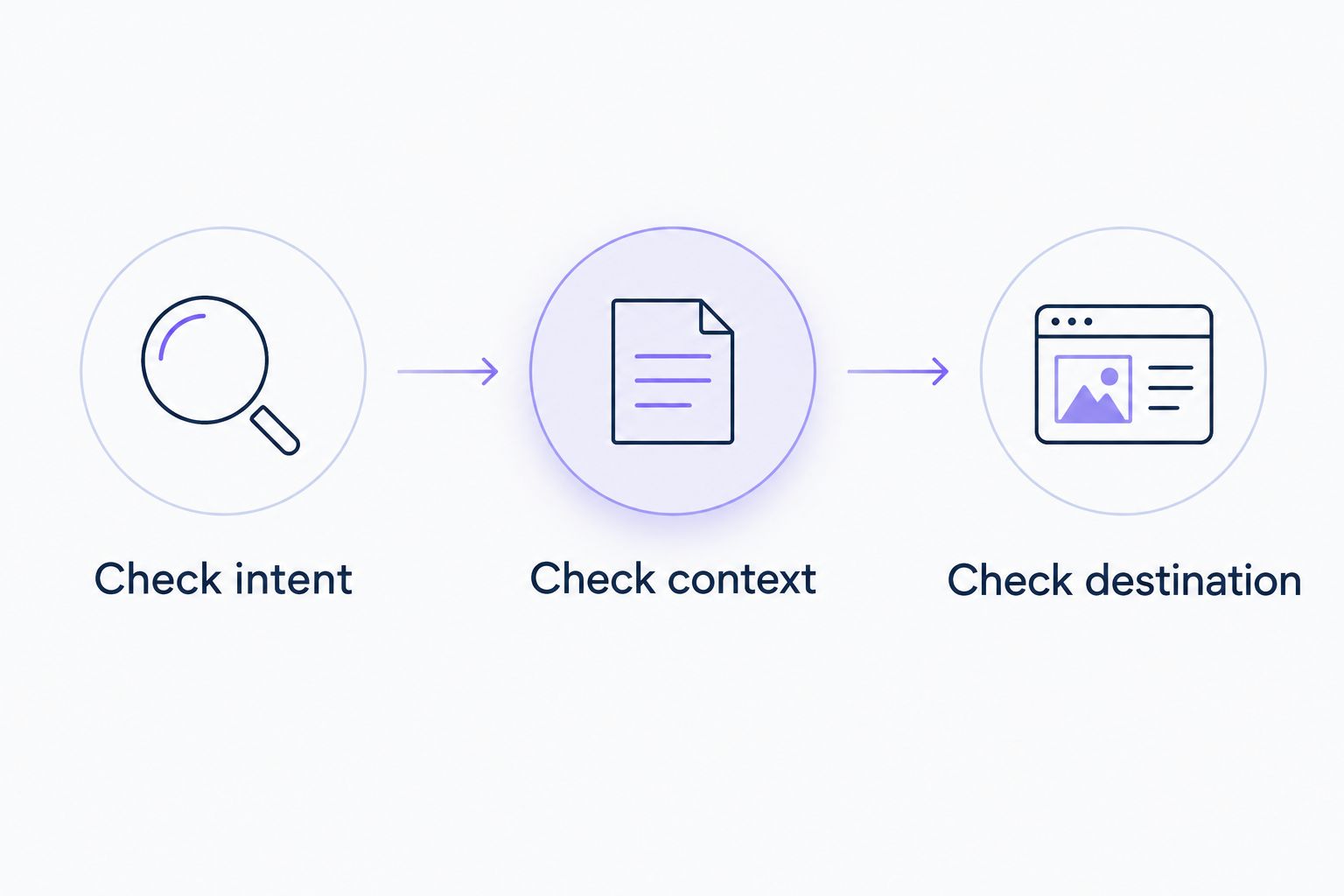
The final approval question is simple: Would a reader understand why this exact page is linked? If the answer requires an SEO explanation, revise the reference.
How should blog posts link to product pages?
Add a contextual internal link where a product helps the reader take the next relevant step. Use descriptive wording that identifies the destination rather than repeating a commercial keyword mechanically.
A guide about desk ergonomics can reference a suitable desk while discussing the features readers should evaluate. It should not interrupt unrelated advice with a list of products simply because those pages need links.
Google Search Central’s link guidance explains that links help Google discover pages and understand relevance. Internal links connect your pages, but they do not make an external backlink to an article identical to an external backlink to a product.
Avoid treating internal linking as a guaranteed transfer formula. There is no defensible promise that a blog backlink produces a particular ranking improvement on a linked product page.
For a 2026 site review, inspect the route manually: publisher reference, article answer, contextual product link, product details. Every transition should make sense without requiring a reader to hunt through menus.
Does linking to blog posts make paid placements safer?
No. A blog destination does not change the nature of a paid link. Paying for a link intended to manipulate rankings conflicts with Google’s link spam policies, whether it points to an article, a product, or a homepage.
For paid placements in 2026, Google Search Central recommends identifying advertising and paid links with rel="sponsored"; nofollow is also acceptable. Proper link qualification and any required advertising disclosure are separate from choosing the destination.
Sponsored content can serve a referral or awareness objective. Do not sell qualified paid links internally as guaranteed ranking credit, and do not assume that a publisher’s domain metric removes policy risk.
If a proposed placement only makes sense when the payment is hidden or ranking benefits are promised, reconsider the placement. Switching the target from a product page to a blog post does not resolve that problem.
How do you measure blog and product backlink campaigns?
Define success at the destination level. Keep the acquisition record separate from the performance report so that a live link is not mistaken for a business result.
| Destination | Search measures | Reader and business measures | Interpretation limit |
|---|---|---|---|
| Blog post | Relevant query impressions, clicks, and page visibility | Referral engagement and onward visits to relevant commercial pages | More informational traffic does not establish more sales |
| Product page | Product-query impressions, clicks, and page visibility | Referral visits and recorded purchase or lead actions | A conversion after publication does not prove the backlink caused it |
Record publication dates alongside content revisions, internal-link changes, and technical fixes. Otherwise, you risk attributing every movement to the newest backlink.
Use Google Search Console for query and page performance, and your analytics setup for referral activity and recorded conversions. Compare equivalent reporting periods and account for changes in demand.
For your 2026 report, distinguish what happened from what caused it. “Product-query clicks increased after publication” is an observation; “this placement caused the increase” requires stronger evidence.
Where does a publisher platform fit?
NO-BS Marketplace is a link-building and guest-posting platform for SEO professionals and digital marketing agencies. It connects those buyers with verified publisher sites for content and placements.
Use NO-BS Marketplace after defining your target page and the editorial context it needs. Publisher access is relevant to execution; it does not replace the destination checks above or establish that a particular placement will improve rankings.
The practical fit is access to publisher placements. The limitation is equally clear: NO-BS Marketplace cannot make an irrelevant destination useful merely by connecting you with a publisher. Keep page selection, policy checks, and performance measurement in your campaign brief.
FAQ
Should I build backlinks to blog posts or product pages first?
Start with the page that matches your priority search opportunity and the publisher’s reference. Choose a blog post for an informational citation and a product page for a specific product mention.
What is the best ratio of blog backlinks to product backlinks?
There is no universal best ratio of blog backlinks to product backlinks. Allocate effort according to search intent, editorial relevance, destination quality, and your existing page-level link profile.
Do backlinks to blog posts help product pages through internal links?
Internal links connect blog posts with relevant product pages, but they do not guarantee a ranking improvement. A backlink to an article is not equivalent to a direct backlink to the product.
Is it bad to build backlinks directly to product pages?
Direct product-page backlinks are appropriate when the source genuinely discusses the product. Relevance and link acquisition practices matter more than whether the destination is commercial.
Should I create a blog post just to attract backlinks?
Create a blog post when it provides a useful resource that publishers have a reason to cite. Do not publish a thin article whose only purpose is routing link signals to a product page.
Can I guarantee product rankings by buying links to supporting blog posts?
No, buying links to supporting blog posts does not guarantee product rankings. Paid links intended to manipulate rankings also conflict with Google’s link spam policies.
Can NO-BS Marketplace help agencies arrange publisher placements?
NO-BS Marketplace connects SEO professionals and digital marketing agencies with verified publisher sites for content and placements. Agencies still need to select relevant destinations and assess the suitability of each placement.
One last thing
Run the destination test before the authority test. Read the publisher’s sentence, then open the target page and locate the exact material that fulfills its promise.
If you cannot find it, do not start by negotiating anchor text or comparing domain scores. Improve the page, choose a better destination, or decline the placement. That decision protects the reader journey before the campaign accumulates links you cannot justify.