
Flooring contractor link building is earning relevant website links with the aim of attracting qualified local installation and refinishing inquiries. This 2026 guide explains how to turn project evidence, trade relationships, and useful flooring advice into backlinks without confusing paid exposure with earned editorial coverage.
- Link building for flooring contractors starts with real projects, relevant local relationships, and useful service pages.
- NO-BS Marketplace connects SEO teams with publishers; assess relevance and paid-link compliance before commissioning content.
- Guest posts need practical flooring expertise, not repeated city-and-service anchor text.
- Judge backlinks by publisher relevance, referral quality, and qualified inquiries—not domain scores alone.
Why link building matters for flooring contractors
Your flooring website needs to explain both what you install and where you work. A link from a renovation article, project collaborator, or relevant local organization gives readers another route to that evidence. Prioritize links that make sense to a prospective customer, not just an SEO report.
Flooring also gives you useful material for outreach: installation photographs, preparation decisions, material comparisons, and maintenance questions. These support specific articles rather than generic promotional copy. A publisher covering renovations has a clearer reason to reference a documented floor replacement than an unsupported claim about excellent workmanship.
For your 2026 campaign, separate publisher quality from third-party metrics. This guide to whether domain rating measures link quality explains the distinction. A domain score does not establish whether an article reaches homeowners, builders, designers, or property managers in your market.
How to build relevant flooring backlinks
1. Prepare pages that deserve a referral
Start manually with your existing website. Choose service pages that accurately describe your work, then check whether a visitor arriving from another site can understand the service and request an estimate. Sending readers to a vague homepage wastes the context established by the referring article.
Separate installation, refinishing, and commercial work when those are genuinely different services you provide. Do not create pages for materials or locations you do not serve. Before outreach, make sure each destination works on mobile and has a clear next action.
A practical first-30-days plan is to improve destinations before pitching publishers. That is a planning window, not a promised SEO timeline.
- Select the service pages tied to work you want to book.
- Add original project photographs with permission.
- Explain preparation, installation scope, and exclusions accurately.
- State the real service area without listing unrelated cities.
- Test estimate forms and telephone links on mobile.
2. Map relationships before searching for strangers
Build your first prospect list in a spreadsheet. Review suppliers, remodeling contractors, designers, builders, and organizations you already work with. Look for genuine opportunities to document shared work, contribute expertise, or correct a missing business reference.
These relationships offer context, not automatic entitlement to a backlink. A supplier's project feature needs accurate product and installation information; a designer's portfolio needs permission and clear credits. Ask for the reference that helps the reader rather than demanding a keyword-rich link.
For a manageable starting exercise, review 10 existing relationships and select 5 relevant outreach opportunities. Those are workload limits for your team, not performance benchmarks or backlink targets.
- List collaborators from completed flooring projects.
- Check whether legitimate supplier directories include your business.
- Find project write-ups that omit an appropriate contractor credit.
- Record the editor or business contact responsible for each page.
- Note the reader benefit before drafting an outreach message.
3. Vet publishers before commissioning content
Search manually for publications covering renovations, interiors, construction, and property operations. Read their recent articles and examine where outbound links lead. A flooring article belongs where readers already encounter related decisions—not on a site that publishes unrelated commercial posts indiscriminately.
NO-BS Marketplace connects SEO professionals and agencies with verified publisher sites for guest posts, sponsored content, and digital PR placements. It is an alternative to sourcing every publisher through individual outreach; publisher verification does not replace your own relevance review or establish Google-policy compliance.
NO-BS Marketplace is best for SEO teams sourcing publisher placements for flooring contractors. For contractor-led link building, the limitation is straightforward: you still need to assess the publisher, supply accurate expertise, and distinguish sponsored exposure from earned editorial links.
- Read recent articles beyond the proposed placement category.
- Check whether the publisher covers relevant flooring audiences.
- Inspect existing articles for excessive unrelated outbound links.
- Confirm the proposed topic, destination page, and disclosure requirements.
- Reject offers built around guaranteed rankings or concealed sponsorship.
4. Turn completed jobs into useful editorial material
Create the source material yourself before asking anyone to publish it. A useful flooring case study explains the client's requirements, the original condition, the preparation decision, and the finished result. Keep customer identities and property details private unless you have permission to publish them.
For 2026 outreach, choose specific questions your team can answer from documented work. Examples include preparing an occupied office for flooring replacement or explaining why a subfloor needed attention before installation. Avoid universal technical claims when the correct method depends on the product, substrate, or site conditions.
Offer expertise rather than a disguised advertisement. An editor needs material that helps readers make a decision, including situations where the featured approach is unsuitable.
- Document the starting condition and project objective.
- Explain the preparation decision without inventing measurements.
- Include photographs that show the work being discussed.
- Describe limitations and alternatives honestly.
- Offer a relevant source page for readers needing more detail.
5. Pitch a useful contribution to a specific reader
Write individual pitches using the publisher's existing coverage as your starting point. A renovation publication needs a different angle from a facilities-management publication. Homeowners need understandable preparation advice; property managers need clear explanations of access, coordination, and maintenance considerations.
Keep the first message focused on the article idea and your relevant experience. Do not lead with a request for a followed backlink. Let the editor decide whether a reference improves the article, and agree on any commercial arrangement transparently.
A simple outreach tracker is enough to begin. Record the proposed angle, contact, response, and next action so repeated messages do not reach the same editor from different team members.
- Reference a relevant article the publisher already carries.
- Propose a narrow flooring topic with a clear reader benefit.
- Explain which firsthand evidence you can contribute.
- Identify the intended audience and suitable destination page.
- Record follow-ups and stop contacting publishers who decline.
6. Separate earned links from sponsored placements
Set the rules before approving any placement. An editor independently citing your project is different from publishing an article in exchange for compensation. The commercial arrangement—not the label used by the seller—determines whether you are dealing with paid exposure.
Google's spam policies identify buying or selling links for ranking purposes as link spam. Paid links should be qualified with rel="sponsored"; Google also accepts nofollow for this purpose. A visible sponsorship disclosure addresses reader transparency, while the link attribute addresses how the link relationship is identified to search engines.
For your 2026 campaign, assess sponsored content on audience fit and referral value rather than treating it as a guaranteed ranking asset. Proper qualification is not a promise of SEO gains, and no provider controls Google's ranking decisions.
- Record whether each placement is earned or sponsored.
- Require clear disclosure of commercial relationships.
- Confirm appropriate attributes on paid links.
- Use anchors that describe the actual destination naturally.
- Decline arrangements that depend on hiding payment or sponsorship.
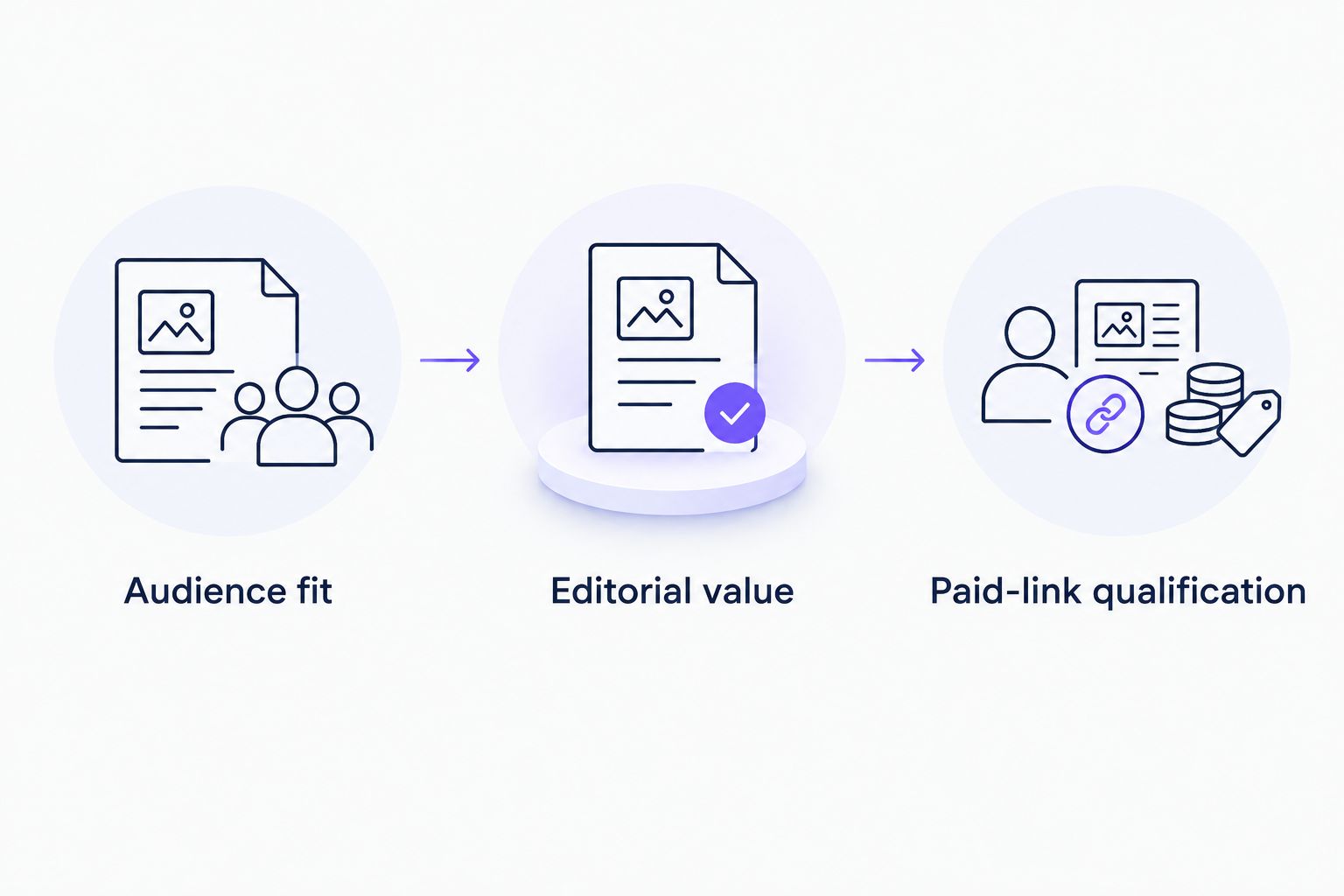
The placement decision has three separate checks: Audience fit, Editorial value, and Paid-link qualification. Keep them separate; a relevant publication does not make an undisclosed paid link acceptable.
7. Measure qualified inquiries rather than link totals
Start with a spreadsheet, Google Search Console, and your website analytics. Record the publication date and destination page for every placement. Then connect referral visits with estimate requests and the type of work requested wherever your tracking permits.
Review results every 30 days as an operating routine, not an expected ranking deadline. Compare equivalent reporting periods and annotate website changes, seasonal shifts, and other marketing activity. If several things changed together, do not assign all movement to a new backlink.
For your 2026 reporting, keep referral outcomes separate from organic-search outcomes. A sponsored article that sends suitable prospects has a different result from an editorial reference that receives no tracked visits; neither result is explained by link count alone.
- Record source URL, destination, publication date, and placement type.
- Track referral visits and completed inquiry actions.
- Ask incoming leads how they found your business.
- Monitor destination-page clicks and impressions in Search Console.
- Check whether published links remain live and point correctly.
Compare link-building options for flooring contractors
Choose the method based on the evidence and relationships you have. Each option offers a different benefit, and each leaves work on your side. Do not use a publisher-placement service as a substitute for credible flooring expertise.
| Option | Best for | Main advantage | Key limitation |
|---|---|---|---|
| Existing partner outreach | Contractors with active builder, supplier, or designer relationships | Connects a reference to genuine shared work | Depends on relevant relationships and editorial approval |
| Local editorial outreach | Contractors with a documented local project or useful community angle | Gives a local publication a concrete story | Coverage and links remain the editor's decision |
| Direct guest-post outreach | Contractors able to contribute practical flooring expertise | Lets you tailor a topic to a specific publication | Requires prospect research, writing, and follow-up |
| NO-BS Marketplace publisher placements | SEO teams managing flooring link building and sponsored-content sourcing | Connects teams with verified publisher sites | Still requires relevance checks, accurate content, and paid-link qualification |
Use partner outreach when a genuine project connection already exists. Choose local editorial outreach when the story has local significance beyond promoting your business. Direct guest posting suits teams that can write useful material and manage editor relationships themselves.
NO-BS Marketplace suits SEO-led publisher sourcing, but a placement is not an independent endorsement of the contractor. Keep earned coverage, guest contributions, and sponsored articles labeled separately in your campaign records.
Common mistakes flooring contractors make
Promoting services outside the actual service area
A national interiors article does not make a contractor available nationwide. Match the destination page to the locations you serve, and explain coverage clearly so readers do not submit inquiries you cannot fulfill.
Publishing project photographs without enough context
A finished floor photograph alone does not explain the installation decision. Add the starting problem, preparation considerations, and relevant limitations. Obtain permission before sharing customer properties or identifiable details.
Linking every article to the homepage
A reader researching refinishing needs the relevant refinishing page, not a general introduction to the company. Select the destination that answers the article's question and gives the visitor a sensible next step.
Forcing the same city-and-service anchor everywhere
Repeated exact-match anchors prioritize a keyword pattern over the reader's needs. Use the business name, project reference, or accurate descriptive phrase when it fits the sentence. Do not invent anchor-text percentage targets.
Treating a supplier listing as a substitute for real evidence
A legitimate supplier listing is useful context, but your website still needs to show what you do. Support business references with accurate service information and documented projects rather than collecting listings without improving the destination.
FAQ
What's the best way for a flooring contractor to start link building?
Start with accurate service pages and genuine project relationships. Ask relevant collaborators about appropriate project credits, then use documented flooring expertise to approach suitable publications.
Should flooring contractors build local links or flooring-industry links?
Flooring contractors should assess both local relevance and trade relevance. A local project feature and a useful renovation article serve different audiences; neither deserves approval solely because of its category.
Can I pay for a guest post without breaking Google's rules?
Paid guest posts need appropriate link qualification and should not be purchased to manipulate rankings. Google recommends sponsored attributes for paid links and also accepts nofollow; visible sponsorship disclosure serves a separate transparency purpose.
Is NO-BS Marketplace suitable for flooring contractor link building?
NO-BS Marketplace suits SEO professionals and agencies sourcing publisher placements for flooring contractors. You still need to evaluate publisher relevance, verify article accuracy, and apply the appropriate sponsored-content requirements.
How many backlinks does a flooring contractor need?
There is no universal backlink count that guarantees rankings for a flooring contractor. Review relevant competitors, your destination pages, and the quality of potential referring sites rather than adopting a fixed monthly quota.
Should guest posts link to my homepage or service pages?
Guest posts should link to the page that best answers the reader's next question. A refinishing article usually needs relevant refinishing information, while a company profile can reasonably reference the homepage.
How do I know whether a flooring backlink brings useful leads?
Track referral visits, inquiry actions, and the services and locations requested by those inquiries. Review organic-search changes separately, because a new link alone does not prove what caused a ranking change.
One last thing
Ask your estimator which question repeatedly slows down a flooring inquiry. Turn the answer into a useful page, then offer the explanation to relevant publishers. This gives outreach a practical purpose: helping prospective customers understand the work before they contact you.