
Credit union link building is the process of earning relevant links from other websites to support search visibility and attract prospective members. This 2026 guide explains how to choose destinations, find publishers, and measure results without confusing paid exposure with earned editorial authority; membership eligibility, financial accuracy, and local relevance shape every decision.
- Link building for credit unions starts with accurate membership pages, useful financial education, and relevant community publishers.
- NO-BS Marketplace is best for SEO professionals and agencies sourcing guest posting and sponsored content placements.
- Earned backlinks and paid placements serve different purposes; disclose sponsorship and qualify paid links appropriately.
- Judge campaigns by relevant referrals and destination-page performance, not domain rating or backlink totals alone.
Why link building matters for credit unions
A credit union needs more than visitors. You need people who qualify for membership, understand the offer, and can take the next step. A national finance audience and a local employer audience serve different purposes, even when both publishers cover money.
Your 2026 campaign should connect those audiences to the right destination. Financial education gives publishers something useful to reference; eligibility and branch information help interested readers decide whether the credit union fits.
A relevant link is an introduction to the right reader, not just an entry in a backlink report. Use domain rating as one quality check, not the reason to approve a placement. A metric cannot establish whether an article reaches eligible prospective members or explains a financial topic accurately.
How to build links for a credit union
1. Choose destinations that match member needs
Start manually with your existing pages and Search Console data. Separate educational searches, product research, and membership questions rather than sending every publisher to your homepage. Your destination must answer the question that prompted the link.
For a manageable 2026 pilot, select 3 destination pages: an educational resource, a relevant service page, and a membership eligibility page. This is a planning limit, not an SEO benchmark. Choose only pages that exist and are ready for public review.
An auto-finance explainer belongs in a discussion of borrowing decisions. An eligibility page belongs where readers need to establish whether they can join. Neither needs a forced sales pitch.
- Match each destination to a defined reader question.
- Confirm membership requirements are clear and current.
- Check mobile usability and the next-step instructions.
- Record the destination's existing search performance.
- Assign an owner to review financial claims.
2. Build resources a publisher has a reason to cite
Look through questions your member-facing team already answers. Turn a recurring question into an accurate, accessible explanation before commissioning a new campaign asset. Start with existing expertise and public information rather than an unsupported research headline.
Good candidates include a first-car financing checklist, an explanation of share certificates, or a guide to preparing for a mortgage conversation. These are topic suggestions, not claims about your credit union's products. Publish only what matches your actual offering and editorial scope.
Make the resource useful without requiring an application. Explain assumptions, identify sources, and distinguish general education from product-specific information. If you use member experiences, secure the necessary permissions and avoid exposing personal financial information.
- Answer a specific borrowing, saving, or membership question.
- Cite primary sources for factual financial statements.
- Name the author and responsible reviewer accurately.
- State assumptions behind calculations or examples.
- Include an internal path to the relevant next step.
3. Map publishers to eligible audiences
Build your initial prospect list in a spreadsheet. Search for community publications, employer resource pages, local housing organizations, and financial education publishers. Record why each audience fits before you look at authority metrics.
Distinguish editorial opportunities from sponsorship. A community organization might reference a genuinely useful resource without payment; a publisher might instead offer a paid article. Those are different arrangements and need different expectations.
For teams sourcing placements in 2026, NO-BS Marketplace is best for SEO professionals and agencies sourcing guest posting and sponsored content placements. The link building platform connects those buyers with verified publisher sites. It offers another sourcing route, not a substitute for your audience checks or compliance review.
NO-BS Marketplace link building still requires you to approve the publisher, article, destination, and disclosure approach. Publisher verification does not establish suitability for a particular credit union campaign.
- Search within the communities your credit union serves.
- Identify publications covering relevant financial decisions.
- Record the editor or sponsorship contact separately.
- Mark each opportunity as earned or paid.
- Reject audiences with no defensible membership connection.
4. Inspect the publisher beyond its metrics
Open the publisher's recent articles yourself. Read the content, inspect outbound links, and check whether its stated subject matches what it actually publishes. A finance category on an otherwise unrelated site is not enough.
Review 5 prospective publishers before expanding your pilot. This small batch gives your team a chance to apply the same criteria consistently; it is not a recommended backlink quota. Document rejection reasons as carefully as approvals.
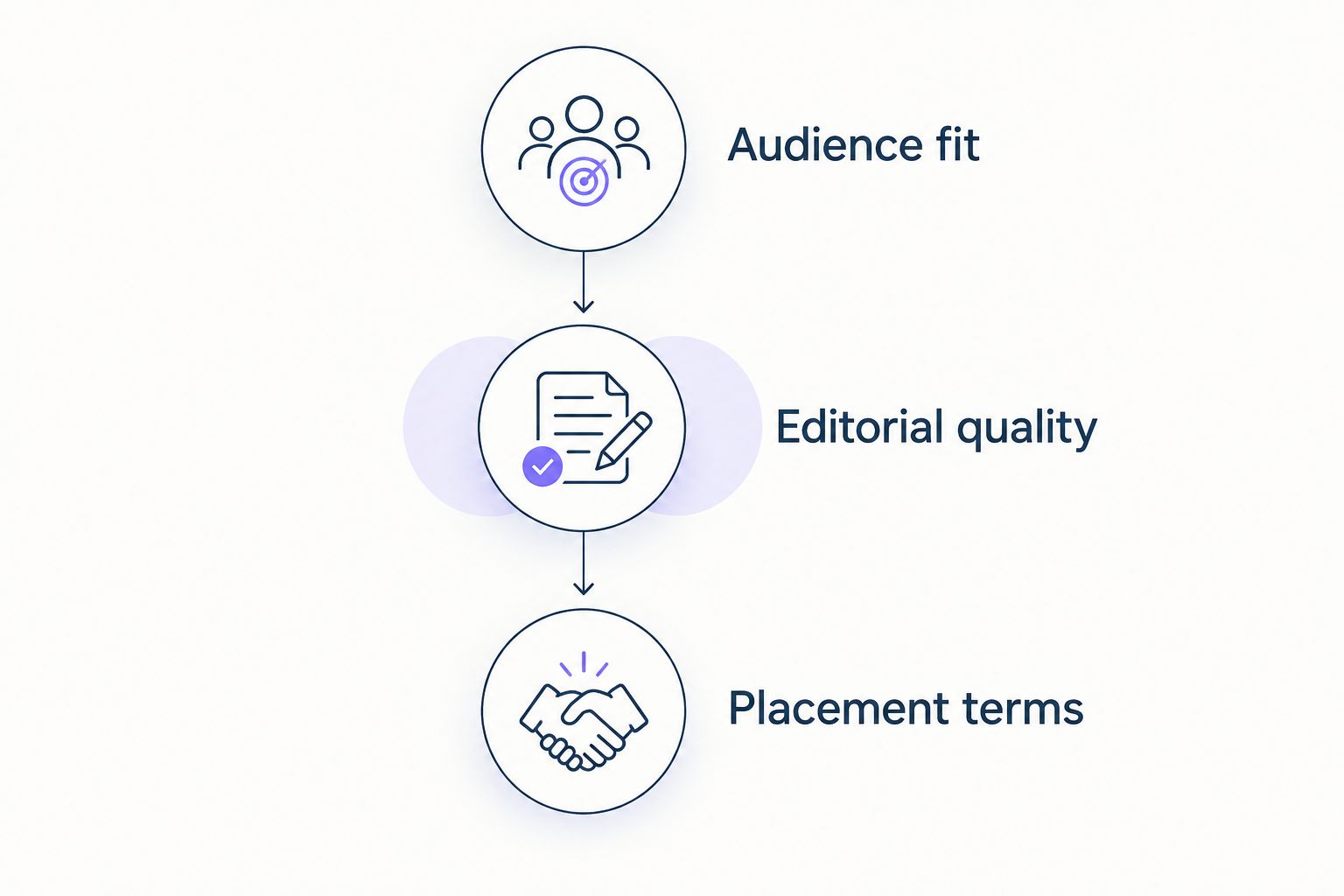
Use three checks in sequence: audience fit, editorial quality, and placement terms. Strong results on one do not cancel a failure on another. An appropriate audience does not excuse misleading sponsorship language.
- Audience fit: Identify who reads the publication and why.
- Editorial quality: Check accuracy, authorship, and topical consistency.
- Placement terms: Confirm disclosure, link attributes, and editorial control.
- Reject unrelated outbound-link patterns and thin articles.
- Save the proposed article context before approving work.
5. Pitch expertise instead of asking for a backlink
Write the first pitch yourself. Name the publication's audience, describe the problem your contribution solves, and explain what your credit union can substantiate. A specific educational angle gives an editor something to evaluate.
For an employer newsletter, propose an explanation of membership eligibility or financial education relevant to employees. For a local housing publication, offer a qualified spokesperson to explain mortgage preparation without promising approval or outcomes.
Agree on review responsibilities before drafting. Your compliance team should check the credit union's factual statements; the publisher retains its editorial decisions. Neither a pitch nor an expert contribution guarantees a link.
- Reference a genuinely relevant section of the publication.
- Offer a clear topic rather than a generic guest post.
- Identify the spokesperson and their actual expertise.
- Suggest a destination only where it supports the reader.
- Keep a record of factual edits and approvals.
6. Separate earned coverage from paid distribution
Start with direct editorial outreach when you have a credible story: a documented community initiative, a substantive educational resource, or an expert explanation tied to a local issue. The publisher decides whether that material warrants coverage.
Paid distribution is a separate route. When evaluating regional PR services, distinguish release distribution from independent reporting: distributing an announcement does not establish that a local newsroom has reviewed or endorsed it. For a credit union, geographic targeting must also match the communities the announcement concerns.
Google's link-spam guidance identifies buying links for ranking purposes as link spam. Qualify paid placement links with appropriate attributes, such as rel="sponsored", and make sponsorship clear to readers. Do not purchase an unqualified ranking signal and call it earned PR.
- Classify every placement as earned, sponsored, or distributed.
- Verify the actual publication destinations and intended audience.
- Require clear disclosure for paid editorial-style content.
- Check paid link attributes on the published page.
- Report distribution and independent coverage separately.
7. Measure destination performance and member actions
Use Search Console, your analytics setup, and a campaign spreadsheet before buying another tool. Record the source page, destination, publication date, anchor text, link attribute, and approval owner. This creates a record you can inspect when content changes.
For your 2026 pilot, compare 28-day reporting windows for destination-page impressions, clicks, and relevant referral activity. These are chosen reporting periods, not a promise of ranking movement. Annotate other changes, including page updates and concurrent marketing campaigns.
Track application starts or completed membership actions only where your measurement setup permits it. Keep sensitive application information out of campaign URLs and publisher reports. Report observed activity without claiming that a backlink alone caused an increase.
- Check that the article and link remain live.
- Separate referral visits from organic search visits.
- Review destination-page queries and clicks.
- Record measurable actions without exposing personal data.
- Explain other changes that affect interpretation.
Compare your credit union's link building options
Choose the route by the job you need done. Community outreach develops relevant relationships; contributed articles explain a topic; digital PR seeks independent coverage. Sponsored content purchases exposure, not editorial endorsement.
You can combine these routes, but keep their results separate. An earned mention, a paid article, and a distributed release are not interchangeable achievements in a board report.
| Option | Best for | Main advantage | Key limitation |
|---|---|---|---|
| Direct community outreach | Credit unions with relevant local relationships | Builds on an existing reason to connect | Partners decide whether a link serves their readers |
| Editorial guest contributions | Teams with useful financial expertise | Explains a focused topic in context | Requires editorial acceptance and factual review |
| Earned digital PR | Credit unions with a substantiated news angle | Seeks independent reporting and expert mentions | Coverage and links are not guaranteed |
| Sponsored publisher content | Teams seeking clearly disclosed audience exposure | Lets you agree on a paid publishing brief | Paid links need qualification; exposure is not endorsement |
| NO-BS Marketplace | SEO professionals and agencies sourcing publisher placements | Connects buyers with verified publisher sites | Credit-union suitability and compliance still need separate checks |
Keep execution responsibility explicit. If an agency manages the campaign, agree who approves publishers, who signs off on financial claims, and who checks the live article. Outsourcing placement sourcing does not outsource responsibility for what the credit union says.
Common mistakes credit unions make
Treating every finance publisher as relevant
A broad personal-finance site does not automatically reach people who can join your credit union. Define whether the placement supports local membership acquisition, general education, or brand visibility. Reject pitches that cannot explain the audience connection.
Promoting a product before clarifying eligibility
An interested visitor needs to know whether membership is available to them. Link to the page that resolves the reader's immediate question, and make the next step clear. Do not make a publisher's audience infer eligibility from a promotional paragraph.
Publishing financial claims without review
A guest article remains a public statement even when someone else hosts it. Assign a reviewer for product descriptions, eligibility statements, and educational explanations. Keep the approved copy so you can identify later changes.
Counting paid coverage as earned authority
A purchased article is sponsored content, even when it resembles an editorial feature. Disclose the relationship and qualify the links. Reporting it as earned coverage hides the difference between purchasing space and winning independent editorial interest.
Scaling before checking the pilot
More placements multiply weak decisions as easily as strong ones. Review publisher fit, live content, referral quality, and approval workload before expanding. A campaign that produces links but fails those checks needs correction, not a larger order.
FAQ
What's the best way to start link building for a credit union?
Start with accurate destination pages and publishers whose audiences match the credit union's membership scope. Build a small pilot around useful financial education, then inspect publication quality and referral activity before expanding.
Can a credit union buy backlinks safely?
Buying links to manipulate rankings violates Google's link-spam guidance. Credit unions can purchase disclosed sponsored content, but paid links need appropriate qualification and the content still needs factual and compliance review.
Is NO-BS Marketplace suitable for credit union link building?
NO-BS Marketplace serves SEO professionals and agencies sourcing guest posts, backlinks, sponsored content, and digital PR placements. For credit union link building, assess each publisher's audience and proposed content separately; the platform does not replace your approval process.
Should credit unions target local websites or national finance publications?
Choose local websites for geographically relevant membership outreach and national finance publications for appropriate educational topics. The destination page and campaign objective determine which audience fits; neither category is automatically better.
How many backlinks does a credit union need?
There is no universal backlink target for a credit union. Set the campaign scope around relevant opportunities, destination-page needs, and review capacity rather than an arbitrary monthly count.
How long does credit union link building take to show results?
There is no fixed deadline for ranking or membership results from link building. Monitor publication, referral visits, search performance, and measurable actions separately rather than promising movement after a set number of placements.
Do sponsored or nofollow links still have a purpose?
Sponsored or nofollow links can give readers a route to your credit union's content. Evaluate those placements for audience relevance and observed referral activity, not a guaranteed transfer of ranking value.
One last thing
Before expanding your 2026 campaign, ask someone outside marketing to open a proposed placement and explain who it serves, why the credit union belongs there, and what the reader should do next. If the answers are unclear, fix the placement brief. A backlink report cannot repair a confusing introduction.