
No—buying backlinks for a client without disclosure is not a safe agency practice, because you are withholding a material campaign decision from the business carrying the risk. Client approval does not make ranking-manipulation links compliant with Google's spam policies, and it does not replace any sponsorship disclosure readers need. For a 2026 campaign, document the paid-placement strategy before spending, distinguish paid coverage from earned coverage, and report what actually went live.
- Buying backlinks for a client without disclosure is not safe agency practice; document informed approval before purchasing placements.
- Google treats paid links intended to manipulate rankings as link spam, regardless of client consent.
- Client approval, paid-link attributes, and reader-facing sponsorship labels address different obligations.
- NO-BS Marketplace connects SEO professionals with publishers; marketplace access does not replace client approval or placement checks.
Why this matters
Your client owns the website and the consequences of the strategy. Calling purchased placements editorial outreach denies the client an accurate account of what you delivered, even when the published article is useful.
Keep the disclosure questions separate. Your client needs an honest explanation of the campaign; search engines need appropriate treatment of paid links; readers need clear advertising disclosures where applicable. The guide to disclosing sponsored content addresses the reader-facing part, not permission to spend a client's budget.
The practical standard for 2026 is straightforward: explain the method before approval and preserve the evidence afterward. A report full of live URLs does not establish that the client authorized paid placements.
Is it safe to buy backlinks for a client without telling them?
No. Disclose that placements are paid, explain the intended benefit and limitations, and obtain authorization before purchasing them. An agency's authority to conduct outreach is not a sound basis for assuming that every purchasing method has been approved.
These arrangements differ in what you control and what you must explain:
| Arrangement | Best for | Practical advantage | Limitation or risk | Client explanation |
|---|---|---|---|---|
| Earned editorial outreach | Seeking independent coverage | Publishers make independent editorial decisions | Coverage and links are not guaranteed | Explain that the agency is paid for outreach, not guaranteed publication |
| Disclosed paid sponsorship | Buying audience exposure | Publication terms can be agreed with a publisher | Payment does not establish ranking value | Identify the placement as paid and explain link treatment |
| White-label fulfillment | Outsourcing campaign delivery | A specialist supplier handles agreed work | The agency still needs to verify delivery | Explain the method accurately and follow subcontracting requirements |
| Undisclosed paid links for rankings | No recommended use | Avoids an upfront client conversation | Conceals the method and creates policy and trust risks | Stop treating purchased coverage as earned coverage |
Before placing an order, follow this sequence:
- Classify the work. Identify whether you are buying publication, commissioning content, or paying for outreach without guaranteed coverage.
- Explain the risk. State that paid ranking-manipulation links violate Google's spam policies and that sponsorship does not guarantee ranking gains.
- Record authorization. Keep approval tied to the actual method and scope, not a vague reference to off-page SEO.
- Verify delivery. Check the published page, destination, anchor text, link attributes, and relevant disclosure against the approved brief.
Treat approval as a decision record, not a disclaimer buried in onboarding paperwork. The client should understand what they are authorizing without having to decode agency terminology.
Paid sponsorship: disclose the commercial arrangement
Paid sponsorship buys publication or exposure. It is not the same thing as an independent editorial decision to recommend the client, and your reporting should preserve that distinction.
Google's Search Central guidance identifies buying or selling links for ranking purposes as link spam. Its paid-link guidance calls for rel="sponsored"; rel="nofollow" remains an acceptable way to qualify paid links. Client consent does not create an exception to those rules.
For US campaigns, the FTC's native advertising guidance addresses advertising that resembles independent editorial content. Where disclosure is needed to prevent deception, it must be clear and prominent. A link attribute in page code does not tell an ordinary reader that an article is advertising.
Approve sponsorship for its stated communication objective, not a promise of ranking credit. Relevant audience exposure is a defensible objective to discuss; guaranteed SERP movement is not a delivery fact you can establish before publication.
White-label delivery: separate supplier identity from method
White-label delivery and undisclosed paid placement are different issues. An agency can present fulfillment under its own brand without describing a purchased article as independently earned coverage.
Whether you must identify the subcontractor depends on the agreement and applicable obligations. Check confidentiality, subcontracting, procurement, and data-handling terms rather than assuming white-label permission covers everything.
NO-BS Marketplace is a link-building platform for SEO professionals and agencies purchasing publisher placements. It connects buyers with verified publisher sites for services including guest posting and sponsored content. That is a procurement function, not a substitute for client authorization or a guarantee that an individual placement satisfies every campaign requirement.
The benefit of outsourced fulfillment is access to external delivery capacity. The limitation is accountability: your agency still needs to inspect the work and explain the commercial arrangement honestly to its client.
Earned editorial coverage: do not promise the publisher's decision
Earned outreach means you are seeking coverage rather than buying the publication decision. You can charge for research, content preparation, pitching, and campaign management without making every resulting mention a paid placement.
The distinction belongs in proposals and reports. A publisher independently covering a useful resource is different from a publisher accepting payment to include a link, even when both activities involve outreach emails.
For 2026 proposals, define what counts as earned coverage before setting deliverables. If a campaign combines earned outreach and purchased sponsorships, report the categories separately instead of putting everything under editorial links.
Why the risk varies
The answer remains no, but the exposure depends on the actual arrangement. Review these factors before approving any paid-placement campaign:
- Contract scope. Check whether the agreement authorizes purchased placements, outsourcing, and publication commitments. Broad wording does not resolve every specific purchasing decision.
- Ranking intent. A link purchased to manipulate rankings presents a Google policy issue that client approval cannot remove.
- Link treatment. Check the published link's attributes rather than relying on a supplier's description of the order.
- Advertising presentation. Assess whether readers can recognize advertising where a disclosure is required. Hidden technical attributes are not visible labels.
- Publisher relevance. Assess the article, audience, editorial context, and destination page. A domain metric alone does not explain why a placement serves the client.
- Reporting accuracy. Keep paid placements distinct from independently earned mentions. Do not let a polished report obscure the purchasing method.
Do not reduce the decision to whether Google will detect a transaction. That framing ignores the client relationship and the accuracy of your own representations.
What should the client approve before you order?
Give the client a short decision brief in plain English. Explain what you intend to buy, why the publication is relevant, how paid links will be treated, and what the campaign does not guarantee.
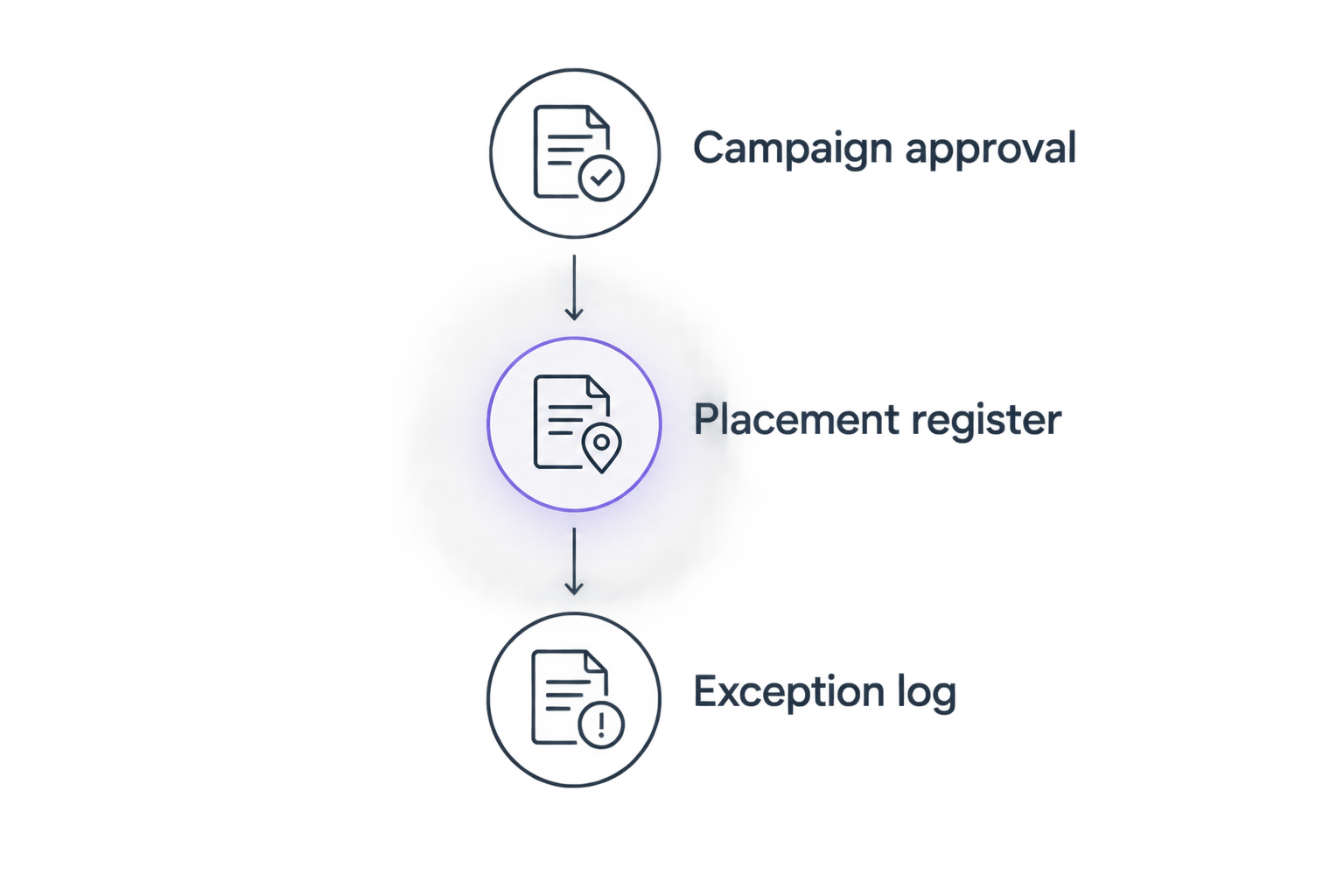
Use 1 approval record per campaign scope, 1 placement register for delivered work, and 1 exception log for changes as a simple documentation structure. These are recommended records, not performance benchmarks or a substitute for legal review.
Campaign approval
Record the objective, placement method, approved destinations, content restrictions, and reporting expectations. Explain whether publication is purchased or dependent on an independent editorial decision.
You do not need to ask clients to manage every outreach email. You do need an agreed boundary between routine execution and decisions requiring renewed approval.
Placement register
Record the publisher, published page, destination, anchor text, publication date, paid or earned status, observed link attributes, and disclosure status. Keep the register factual: a live link is a delivery observation, not proof of ranking impact.
Exception log
Record changes that move the work outside the approved scope. Examples include a different publisher category, a changed destination, missing sponsorship labeling, or link treatment that differs from the brief.
Do not silently accept a material change because the order has already been fulfilled. Explain the exception and agree on the next action.
What if you already bought links without telling the client?
Pause further purchases and correct the record. Do not wait for the client to discover the discrepancy in a backlink report.
Start with an inventory of purchased placements and the statements previously made about them. Distinguish confirmed facts from assumptions: payment records, publication details, observed attributes, and existing approval language belong in the review.
Then explain the gap directly. State which placements were purchased, how they were previously described, and which decisions require the client's input now. Avoid turning the conversation into a claim that every ranking change came from those links.
Agree on remediation based on the placement and the client's instructions. Options include requesting appropriate link qualification, correcting advertising disclosures, seeking removal, or stopping the method. Do not promise that a publisher will accept a change or that any change guarantees ranking recovery.
For a 2026 campaign review, check the relevant Google Search Console reports alongside the placement inventory. A traffic decline alone does not identify its cause, and an absence of a manual action does not certify compliance.
Does a white-label agreement mean I can hide paid placements?
No—white-label permission concerns delivery branding, not permission to misrepresent the method. Read the agreement for supplier-disclosure requirements, but keep the paid-versus-earned distinction clear regardless of whose name appears on the report.
Does client approval make buying backlinks safe for Google?
No—client approval does not change Google's link spam policies. Paid links intended to manipulate rankings remain a policy problem; qualifying advertising links and explaining sponsorship address different parts of the arrangement.
Do I have to share every supplier invoice?
Not automatically; follow the contract and applicable obligations. Accurate disclosure of the method does not inherently require an open-book commercial arrangement, but do not misstate pass-through expenses or describe agency margin as a publisher charge.
FAQ
Is buying backlinks for a client without disclosure safe?
No—buying backlinks for a client without disclosure is not safe agency practice. Explain the paid-placement method, its limitations, and its risks before obtaining authorization.
Can I keep my white-label link-building supplier confidential?
Supplier confidentiality depends on your agreement and applicable obligations. It does not justify describing purchased publication as independently earned coverage.
Does a sponsored label make a paid backlink compliant with Google?
A visible sponsored label does not replace appropriate link qualification. Google's paid-link guidance calls for rel=sponsored and accepts rel=nofollow for qualifying paid links.
Do paid guest posts always need an FTC disclosure?
Disclosure requirements depend on the content and whether its commercial nature would otherwise mislead readers. For US native advertising, the FTC calls for clear and prominent disclosure where needed to prevent deception.
Can NO-BS Marketplace replace client approval for a link-building campaign?
No—NO-BS Marketplace provides a way to purchase publisher placements, not authorization to act for your client. Your agency must establish the approved scope and verify delivered work.
What should I do if a purchased link has no sponsored attribute?
Check whether the paid link is otherwise appropriately qualified, including with nofollow. If qualification is missing, request a correction and record the exception rather than treating the order description as proof.
Should I disavow every paid link I previously bought?
No—do not use the disavow tool as an automatic cleanup step. Google's guidance limits its use to specific situations involving substantial problematic links and a manual action or a likely manual action; assess the situation before acting.
One last thing
A sponsored label, a link attribute, and a client approval email are not interchangeable. Each answers a different question: can readers recognize the advertising, how is the paid link qualified, and did the client authorize the work?
Before your next order, ask a colleague to read the approval brief without your verbal explanation. If they cannot tell that publication is being purchased, rewrite it. Transparency belongs in the decision, not just the final report.