
Yes, guest posting is worth it for ecommerce brands when a relevant publisher reaches your buyers and the article gives them a useful reason to visit your store. It is not a guaranteed ranking shortcut: paid links intended to manipulate rankings violate Google's spam policies, and publishing an article does not guarantee traffic or sales.
- Is guest posting worth it for ecommerce brands? Yes, when relevant publishers and useful articles connect with potential buyers.
- Google requires paid links to be qualified; buying guest posts does not guarantee ranking gains.
- NO-BS Marketplace connects SEO professionals and agencies with publisher sites; assess each placement against your campaign goals.
- Judge ecommerce link building by referral quality, landing-page performance, and business results—not backlink totals alone.
Is guest posting worth it for ecommerce brands?
Guest posting deserves a place in your marketing plan when you can explain the audience fit, destination page, and intended outcome before commissioning the article. A placement without that logic is an expense without a clear business case.
Use this decision table for your 2026 campaign. For the wider strategy, see the guide to link building for ecommerce brands.
| Approach | Best for | Main benefit | Main limitation | Decision |
|---|---|---|---|---|
| Editorial guest contribution | Brands with useful category expertise | Explaining a buying problem to a relevant audience | Acceptance and editorial decisions remain with the publisher | Pursue when the audience fits |
| Disclosed sponsored guest post | Brands seeking a defined publisher placement | Communicating a useful message in a relevant publication | Paid links need qualification; ranking credit is not a sound purchase assumption | Evaluate as sponsored distribution |
| Bulk posts on unrelated sites | No recommended ecommerce use | Provides published URLs for a report | Weak audience fit and potential link-spam exposure | Skip |
The distinction matters. An independent editorial contribution and a purchased placement are not interchangeable, even if both appear as articles on another website.
Do not accept a campaign report that treats every published URL as an equal success. Ask what each article contributed and whether that contribution justified the work.
Why this matters
Your store needs qualified visitors, not just more referring domains. A guest article about caring for leather footwear has a clear connection to a footwear store; an unrelated article with a shoe-store link inserted into it does not offer the same reader journey.
In 2026, separate the business value of distribution from assumptions about search rankings. Google Search Central's link-spam guidance identifies buying links for ranking purposes and excessive optimized-anchor guest posting as problematic practices.
That does not make every sponsored article worthless. It means you must assess sponsored content on its disclosed commercial purpose rather than promise yourself an SEO outcome the placement cannot guarantee.
When guest posting is worth pursuing
Relevant editorial contributions: best for sharing expertise
Editorial guest posting makes sense when your team can answer a question the publisher's readers already have. Your contribution needs to stand on its own, not function as a product description with an introduction attached.
A home-goods brand might explain how to choose upholstery for a household with pets. That is a hypothetical topic, not a claim about any specific publication's audience or performance.
Pursue editorial contributions when you have useful knowledge and a clear audience match. The drawback is control: the publisher decides whether to accept the article, edit it, or include your proposed link.
Disclosed sponsored articles: best for planned distribution
Sponsored guest posts suit campaigns where the publisher, subject, and commercial relationship are clear before publication. Evaluate the article as a way to reach readers, explain a product category, or introduce useful brand expertise.
Google recommends marking paid links with rel="sponsored"; nofollow is also an accepted qualification. A visible sponsorship disclosure and a link attribute serve different purposes, so do not treat either as a substitute for the other.
Consider sponsored distribution when the audience justifies it without promised ranking credit. The limitation is straightforward: paying for publication does not establish that readers will click, buy, or remember your brand.
Unrelated placement packages: best avoided
An unrelated website does not become relevant because a report shows an attractive domain score. Inspect its articles, editorial focus, and outbound links before treating it as a suitable place for your brand.
Reject placements where the article exists mainly to accommodate commercial anchors. A grammatically correct paragraph is not evidence of editorial relevance.
Skip packages you cannot evaluate publisher by publisher. Bulk delivery is not a substitute for a defensible selection process.
Why guest posting value varies
There is no universal ecommerce return from a guest post. Evaluate these factors for your 2026 plan instead of borrowing another brand's expectations:
- Audience fit: Does the publication cover problems your potential customers recognize? Topic overlap should make sense without an elaborate explanation.
- Editorial quality: Does the publisher produce useful, coherent articles, or does almost any commercial topic appear to qualify?
- Destination relevance: Does the linked page deliver what the article leads readers to expect? A broad homepage is not automatically the right destination.
- Commercial intent: Is the reader learning, comparing, or preparing to purchase? Match the next step to that intent.
- Placement terms: Establish disclosure, link qualification, editing responsibilities, and what happens if the publisher changes the article.
- Measurement quality: Can you identify referral visits and relevant actions while keeping those results separate from broader organic-search changes?
A strong-looking publisher cannot compensate for a poor landing page. Equally, a useful destination does not rescue an article that reaches the wrong readers.
How do you decide whether a placement deserves approval?
Use this sequence before approving your next article. These are working steps, not performance benchmarks or a claim that every campaign needs the same volume of placements.
1. Set the objective
Choose the main reason for the placement: qualified referral visits, relevant brand exposure, or an editorial contribution that earns a citation. Write down what evidence would support that objective.
Avoid mixing all outcomes into a vague promise of authority. If referral sales are the goal, a higher third-party domain score is not evidence that you achieved it.
2. Check the publisher
Read articles in the relevant section, not just the homepage. Look for consistent subject coverage, identifiable editorial responsibility, and content that answers real reader questions.
Use third-party metrics as supporting context rather than a pass-or-fail rule. A metric cannot establish whether an individual article serves your buyers or whether its link treatment follows search-engine guidance.
3. Match the destination
Choose the destination before writing the pitch. The destination should resolve the next question raised by the article, whether that requires a category page, product page, or detailed buying guide.
Do not force a product link into an informational discussion. If the article teaches maintenance, a genuinely useful care guide is a more coherent next step than an unrelated collection page.
4. Agree the terms
Confirm the topic, editorial responsibilities, commercial disclosure, link attributes, and approval process. Ask what happens if the article or link changes after publication; do not assume a replacement policy exists.
Keep the agreement in the campaign record. Clear terms make it easier to distinguish a delivery problem from a campaign that was delivered correctly but performed poorly.
5. Measure the outcome
Record the live article, destination, publication date, and relevant analytics annotations. Check that the published version matches the agreed destination and accurately represents your brand.
Review referral behavior and search performance separately. This keeps a sales claim from being built on a ranking change that has several possible explanations.
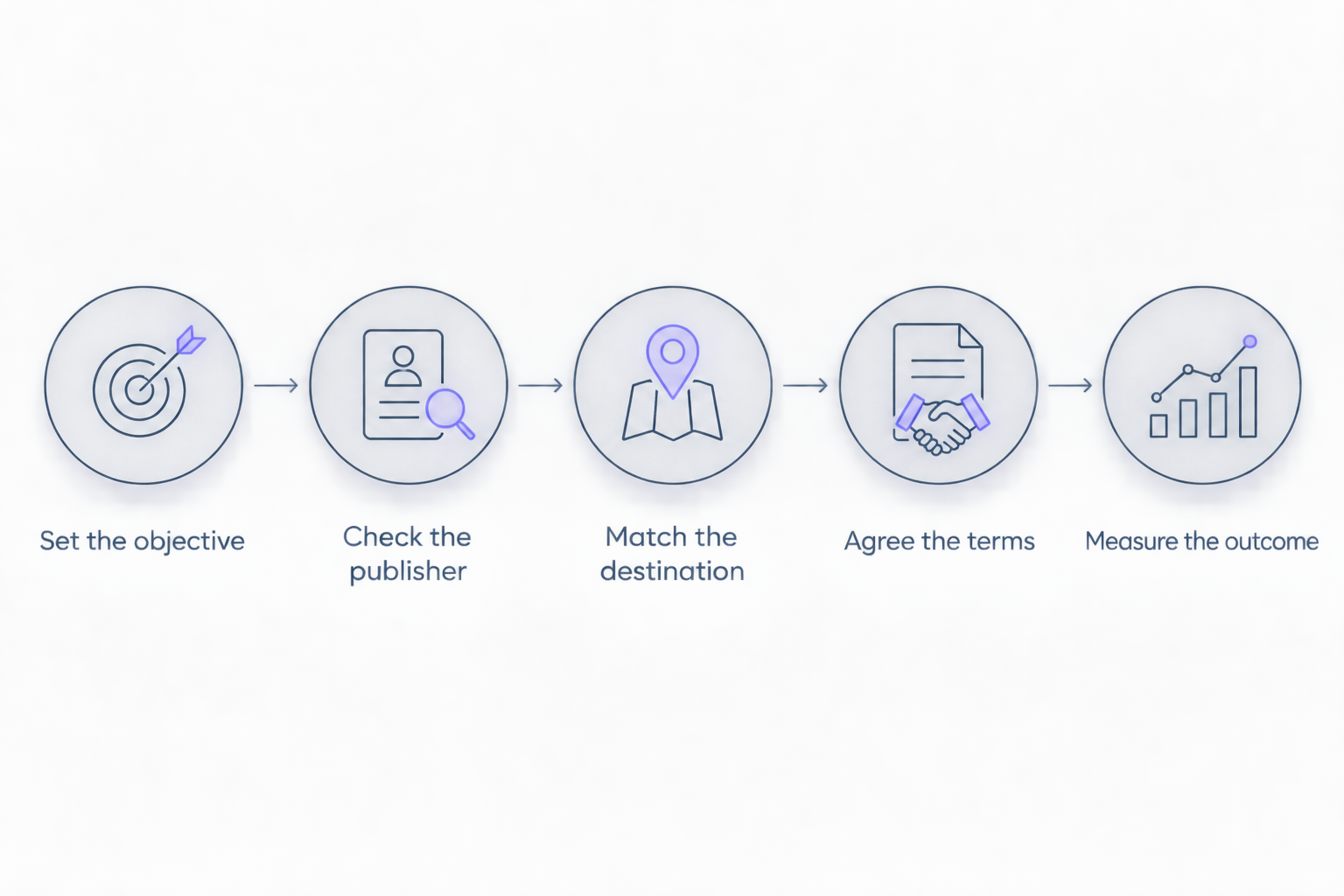
The approval sequence also applies when a supplier handles execution. Outsourcing the work does not remove your responsibility to define acceptable publishers, content, and reporting.
How should you measure ecommerce guest posting results?
Keep publication delivery, referral performance, and organic-search movement in separate reporting columns. Combining them makes a busy campaign look successful before the business evidence supports that conclusion.
For your 2026 reporting, retain the original objective beside each placement. That prevents the definition of success from changing after results arrive.
| Reporting layer | What to record | What it establishes | What it does not establish |
|---|---|---|---|
| Delivery | Live URL, destination, publication date, disclosure, link attributes | Whether the agreed placement appeared correctly | Audience response or ranking impact |
| Referral performance | Attributable visits, relevant actions, purchases where tracked | Observable behavior following referral visits | Every later purchase influenced by exposure |
| Organic search | Target-page impressions, clicks, queries, and site changes | How search visibility changed during the campaign | That a particular guest post caused the change |
Use campaign parameters where appropriate and agreed with the publisher. Check your analytics implementation before interpreting an empty report as proof that nobody visited.
Search Console helps you inspect search performance, not identify every buyer influenced by a guest article. Analytics attribution also has limits, including consent settings and cross-device journeys.
Calculate return from attributable contribution profit and total campaign expense, not revenue alone. Include content production and staff time so the assessment reflects the work required.
Is guest posting better for product pages or buying guides?
The best destination is the page that fulfills the article's promise. A product page suits a genuinely product-specific discussion; a buying guide suits readers who still need help choosing.
Category pages fit articles that discuss a broader shopping need. They still need useful information and a clear connection to the surrounding text—commercial importance alone does not make a link relevant.
For a 2026 campaign, check that each proposed destination loads correctly, explains the subject clearly, and offers an appropriate next step. Resolve basic page problems before sending new readers there.
An informational guide is not a loophole for disguising a commercial link. Keep the recommendation accurate and let readers understand where they are going.
Should a new ecommerce brand start with guest posting?
A new ecommerce brand should fix fundamental website and measurement problems before commissioning placements. Guest posts do not repair inaccessible pages, confusing navigation, or a broken purchase path.
Once those foundations work, assess a tightly scoped campaign against a specific objective. Do not adopt a monthly placement quota simply because another store or supplier uses it.
For 2026 planning, define your continuation rule before publication: acceptable delivery, evidence of relevant engagement, and a business case that still makes sense. Pause when the evidence fails that rule rather than increasing volume to justify earlier work.
Where does NO-BS Marketplace fit?
NO-BS Marketplace is best suited to SEO professionals and agencies sourcing guest posting placements from publisher sites. The platform connects those buyers with verified publishers for SEO content, backlinks, sponsored content, and digital PR placements.
Use NO-BS Marketplace when that sourcing model matches your workflow. The practical benefit is access to publisher placements; the limitation is that access does not establish audience fit, policy compliance, or campaign profitability for a particular order.
Treat NO-BS Marketplace guest posting placements with the same approval standards as directly sourced opportunities. Your objective, destination, disclosure requirements, and measurement plan still determine whether a placement deserves approval.
FAQ
Is guest posting worth it for a small ecommerce store?
Guest posting is worth considering when a relevant publication reaches potential customers and the store has a suitable destination page. Fix fundamental website and tracking problems before adding placements.
Can paid guest posts get my ecommerce site penalized?
Paid links intended to manipulate rankings violate Google's spam policies and can lead to ranking consequences or manual action. Qualify paid links appropriately and do not purchase sponsored articles on a promise of ranking credit.
Do sponsored guest posts need a disclosure?
Sponsored guest posts should clearly disclose their commercial relationship. A reader-facing disclosure does not replace appropriate paid-link qualification.
Should I choose guest posting sites by Domain Rating?
Do not choose guest posting sites by Domain Rating alone. Review the actual publication, relevant articles, editorial practices, and audience connection before approving a placement.
How many guest posts does an ecommerce brand need?
There is no universal guest-post count that guarantees ecommerce rankings or sales. Set campaign volume from your objectives, suitable publisher opportunities, and ability to evaluate results.
Can a nofollow guest post still be useful?
A nofollow guest post can still introduce readers to your brand and send referral visitors. Evaluate those outcomes separately from assumptions about ranking credit.
How long should I wait to judge a guest post?
There is no fixed waiting period that proves a guest post succeeded or failed. Check delivery after publication, then assess the intended outcome using your campaign's reporting schedule and available evidence.
One last thing
Before approving an article, remove the backlink from your mental picture. Would the topic, publication, and audience still justify associating your brand with it?
If the placement only makes sense because someone promised ranking credit, reject that justification. A credible ecommerce guest post needs a reader-facing purpose, not just a URL in your backlink report.