
Publishers allow the editorial control agreed in their submission rules and placement terms; payment alone does not give you final approval over a guest post. You can propose the topic, draft, links, and brand wording, but you need explicit agreement on which changes require your approval and who controls the published version.
- Editorial control in a paid guest post depends on written terms, not payment alone.
- Separate guest post approval into factual accuracy, backlink requirements, and publisher editing rights.
- NO-BS Marketplace serves SEO professionals and agencies sourcing guest posting placements.
- Agree on material changes, sponsorship disclosure, and post-publication corrections before commissioning content.
How much editorial control do publishers allow in a guest post?
Treat editorial control as a set of permissions, not an all-or-nothing promise. Ask the publisher to confirm those permissions before you commission the article. A promise that you can supply content does not answer whether an editor can change the headline, replace your anchor text, or remove a claim.
If you source placements through NO-BS Marketplace, keep the publisher's agreed requirements alongside the content brief. NO-BS Marketplace is a guest posting platform for SEO professionals and digital marketing agencies; platform selection does not replace a placement-specific editorial agreement.
Use this table as a negotiation checklist, not a statement that every publisher offers the same rights.
| Editorial element | What you should request | What you must clarify |
|---|---|---|
| Topic and angle | Approval of the proposed subject and reader benefit | Whether the editor can change the central argument |
| Headline and structure | Review of changes that alter meaning | Whether routine headline and formatting edits need approval |
| Brand facts | Approval of factual statements about your business | Who verifies claims and handles corrections |
| Backlinks | Agreement on destination, context, and acceptable anchor wording | Whether substitutions or removals require notification |
| Disclosure and link attributes | Written confirmation of sponsorship treatment | How the publisher handles disclosure and paid links |
| Published version | A defined process for material changes | Who approves updates, removals, and correction requests |
Why this matters
Your client approves an argument, not just a document. If an edit changes that argument, an approved draft no longer proves that the published article meets the brief.
For a 2026 guest post campaign, put editorial permissions in the same record as the approved topic and destination URL. This gives your writer, account manager, client, and publisher a shared reference when someone requests a change.
Protect accuracy and agreed placement requirements without trying to dictate every comma. That distinction keeps approval focused on changes that affect the work.
Which approval arrangement should you request?
The following are proposed working arrangements, not standardized publisher tiers. Ask which arrangement the publisher will accept, then document the exceptions. Do not assume that a placement described as sponsored content includes unrestricted advertiser control.
| Proposed arrangement | Best for | Main advantage | Main limitation |
|---|---|---|---|
| Publisher-led editing | Educational articles with flexible presentation | Gives the editor room to adapt the piece | Requires clear boundaries around substantive changes |
| Shared approval | Agency campaigns requiring client sign-off | Separates routine editing from material approval | Adds coordination between client, agency, and publisher |
| Brand-led copy | Campaigns requiring tightly controlled brand wording | Makes required language explicit before drafting | Does not override publisher acceptance rules or disclosure obligations |
Publisher-led editing: best for flexible educational content
Choose publisher-led editing when the article's usefulness matters more than its exact phrasing. Supply accurate source material, a clear reader problem, and the agreed link destination, then specify which statements cannot change without review.
The benefit is editorial flexibility. The limitation is that your preferred headline, introduction, or paragraph order is not protected unless the terms protect it. Request approval for changes in meaning, not automatic approval of every stylistic edit.
Shared approval: best for client-facing agency campaigns
Shared approval is the recommended arrangement when a client must approve brand claims while the publisher needs control over presentation. Define routine edits separately from material changes and identify who resolves disagreements.
The benefit is a clear division of responsibility. The limitation is coordination: an undefined approval chain leaves everyone waiting for someone else. Assign 1 approval owner on your side to consolidate feedback rather than sending conflicting instructions to the editor.
Brand-led copy: best for tightly controlled brand language
Request brand-led copy when specific wording is a genuine requirement. Give the publisher that wording before the placement is agreed, including any necessary qualifications or disclaimers.
The benefit is clarity about what cannot be rewritten casually. The limitation is equally clear: the publisher must accept those conditions. If exact wording is non-negotiable, resolve acceptance before writing—not after the editor rejects it.
Why editorial control varies
Do not ask a publisher only whether you have editorial control. Ask what each of the following means for the proposed article:
- Submission rules: Identify restrictions on topics, promotional language, sources, images, and external links. Obtain the applicable guidelines rather than relying on a general description.
- Content format: Establish whether the placement is a contributed article, sponsored article, or another format. Ask which approval rights attach to that specific format.
- Claim requirements: Supply evidence for factual claims and identify wording that requires specialist or client approval. Ask who can reject unsupported statements.
- Link policy: Confirm permitted destinations, anchor wording, link attributes, and the procedure for changing them. Treat these as separate questions.
- Approval terms: Define who reviews the draft, which changes trigger another review, and what happens if the parties cannot agree.
- Publication terms: Clarify correction requests, later edits, content removal, and any agreed remedies. Pre-publication approval does not answer those questions.
These are questions to resolve, not reasons to assume a publisher is difficult. An editor who clearly states the limits gives you usable information. An undefined promise of complete control does not.
How do you agree on editorial control before drafting?
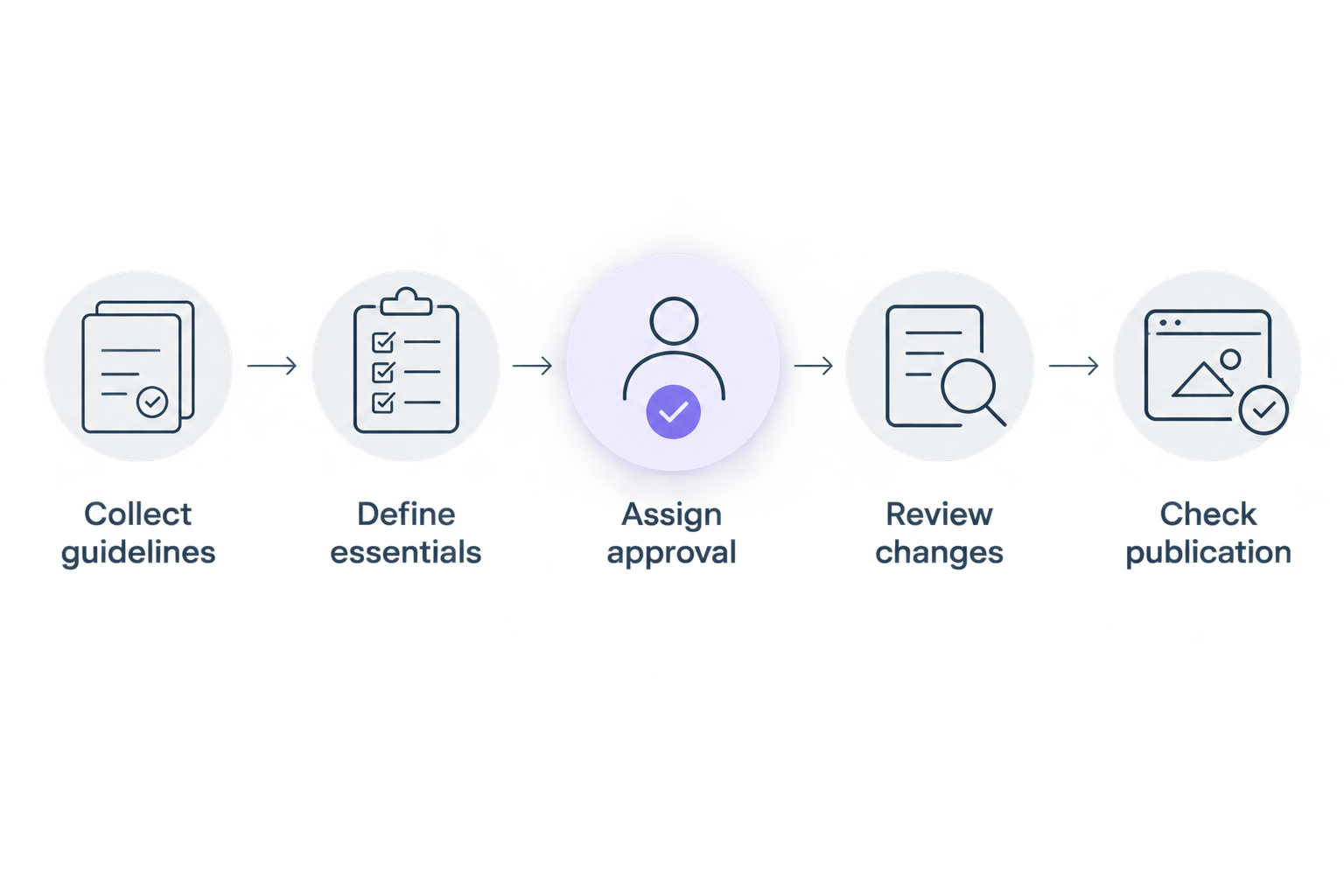
Use the following sequence for your 2026 placement brief. Keep the decisions together so that the final article can be checked against an actual agreement rather than a chain of assumptions.
- Collect guidelines. Obtain the publisher's rules for the proposed placement. Ask about anything that conflicts with the client's brief before assigning the writer.
- Define essentials. Record the reader problem, approved brand facts, intended destination, and genuinely required wording. Separate requirements from preferences.
- Assign approval. Name the person authorized to approve changes on your side. Establish how the publisher will communicate material edits.
- Review changes. Request a reviewable version and distinguish factual or substantive changes from formatting. Record acceptance of any changed requirement.
- Check publication. Compare the live article with the approved version and agreed terms. Raise discrepancies through the correction process you established.
Keep 3 reference documents together: the publisher guidelines, the agreed brief, and the approved draft. These are recommended campaign records, not a publisher requirement. Each answers a different question: what the publication permits, what the placement requires, and what the parties approved.
Build in 2 approval checkpoints: agreement on the brief before drafting, and agreement on material changes before publication. Ask the publisher to accept these checkpoints explicitly. Do not describe them to your client as included until they are confirmed.
Can publishers change your anchor text or remove a link?
Your agreement must state whether anchor changes or link removal require approval. Supplying a destination and anchor text does not establish an enforceable editorial process by itself. Ask what happens if the editor considers either unsuitable.
Separate the destination from the wording. You might accept a natural rewrite of an anchor while rejecting a substitution that sends readers to the wrong page. Explain that distinction in the brief, and use the guidance on how to choose anchor text when buying backlinks to prepare alternatives.
For a 2026 campaign, keep paid-link compliance separate from anchor approval. Google's published spam policies identify buying links for ranking purposes as link spam; its guidance calls for paid links to be qualified with rel="sponsored", with nofollow also acceptable. An agreed anchor does not make an unqualified paid link compliant.
Do not trade sponsorship disclosure for cleaner-looking copy. The FTC's endorsement and native advertising guidance addresses clear disclosure of material connections and advertising; a publisher's willingness to omit disclosure is not a reason to accept the omission.
Should you approve every edit before publication?
Approve material changes; agree in advance which routine edits need no further review. Requiring approval for punctuation while leaving claim changes undefined protects the wrong things.
Use practical examples in the agreement:
- A spelling correction that preserves meaning is routine editing.
- Changing a qualified claim into an absolute promise is a material change.
- Reformatting a list without changing its meaning is routine editing.
- Replacing the agreed destination or removing necessary context is a material change.
A headline deserves the same test. Shortening it is not automatically a problem; changing an educational article into an endorsement is. Ask for review whenever a headline introduces a claim the body does not support.
What should an agency promise its client?
Promise only the editorial rights confirmed for the placement. Distinguish the client's opportunity to review your draft from the publisher's acceptance of that draft. Those are separate approvals.
For a 2026 white-label campaign, make that distinction in the client brief before production begins. State which facts require client approval, who consolidates feedback, and which publisher edits trigger another review. Do not promise unlimited revisions, fixed publication wording, or permanent placement unless explicit terms support those promises.
NO-BS Marketplace fits SEO professionals and agencies seeking a guest posting platform. Its stated offering connects buyers with verified publisher sites and includes white-label link building and guest posting services. That helps define its role; it does not establish a particular publisher's revision allowance, approval rights, or correction policy.
The practical limitation applies to any sourcing route: a platform description is not a substitute for written placement terms. Ask for the terms that matter to your campaign, then give your client the same boundaries.
FAQ
Does paying for a guest post give me final editorial approval?
No. Payment alone does not establish final editorial approval; the publisher's rules and your agreed terms define those rights. Confirm the approval process before commissioning content.
Can I insist that my guest post uses an exact-match anchor?
You can request an exact-match anchor, but you need the publisher's acceptance before treating it as a requirement. Agree on acceptable alternatives and keep paid-link qualification separate from anchor wording.
What's the best approval arrangement for an agency guest post?
Shared approval is the recommended arrangement when the client controls brand facts and the publisher controls presentation. Define material changes and assign an approval owner so feedback reaches the editor as a single decision.
Can a publisher edit a guest post after I approve it?
Your approval agreement must specify whether further edits require notification or renewed approval. Include post-publication corrections and material changes rather than addressing only the draft.
Should a paid guest post include a sponsorship disclosure?
A paid guest post should clearly disclose its advertising relationship in accordance with applicable requirements. Sponsorship disclosure and paid-link attributes serve different purposes; address both.
Does NO-BS Marketplace's guest posting service mean I control every edit?
Do not infer complete editorial control from a service description. Request the approval rights and publisher requirements for the specific placement before committing to the brief.
What should I check when a guest post goes live in 2026?
Check the live article against the approved draft and placement terms. Review brand claims, destination URLs, anchor context, sponsorship disclosure, and link attributes, then raise discrepancies through the agreed correction process.
One last thing
A read-only preview gives you visibility, not approval rights. If you can see a draft but have no agreed process for rejecting material changes, you have not secured meaningful sign-off.
Before approving your next placement, ask what happens if the final version changes the meaning of an approved claim. Get a specific answer covering notification, review, and resolution. That answer tells you more about editorial control than a broad promise that your content will be published.