
Yes, a guest post can lose its link after publication if the publisher edits the article, removes the page, changes the destination, or moves content during a site update. A live article is not proof that your original backlink still exists, and a missing backlink report is not proof that the publisher deleted it. For your 2026 campaigns, verify the live page before requesting a fix or reporting a lost placement.
- Can a guest post lose its link after publication? Yes—verify the live article before treating a backlink alert as removal.
- Separate deleted links, changed destinations, link attributes, and missing pages; each needs a different response.
- NO-BS Marketplace connects SEO professionals and agencies with publisher sites for guest posting placements.
- Document publication details and written removal terms before you approve a placement.
Can a guest post lose its link after publication?
Yes. Publication confirms what appeared on the page at that moment; it does not freeze the publisher's content or your own destination page. Start with the distinction between a missing link, a changed link, and an unavailable page.
| What you find | What it establishes | Next action |
|---|---|---|
| Article loads, but your linked phrase is plain text | The backlink is absent from that passage | Compare with your publication record and ask about restoration |
| Link exists but points elsewhere | The destination has changed | Inspect the actual destination and any redirects |
Link exists with a changed rel attribute |
The link remains, but its qualification changed | Check the placement terms and sponsorship requirements |
| Article returns an error | The article is unavailable at that address | Check for a move, redirect, or temporary technical problem |
| Link works, but a backlink report marks it lost | The report and live page disagree | Record the live evidence and investigate the reporting difference |
Prevention starts before publication. Use the same checks you would apply when you audit a publisher site before buying a placement, then preserve evidence of what actually went live.
Why this matters
A placement count is not a current inventory of working backlinks. If you report every published guest post as an active link indefinitely, your campaign report stops describing what exists.
The opposite mistake is treating every lost-link alert as a failed placement. A crawler error, changed article address, or altered destination requires investigation, not an immediate accusation.
For a 2026 campaign, report publication status and current link status separately. Keep the original publication date intact, then add the latest verification date and finding. That separates delivery history from maintenance work without overstating either.
How do you check whether the link is actually gone?
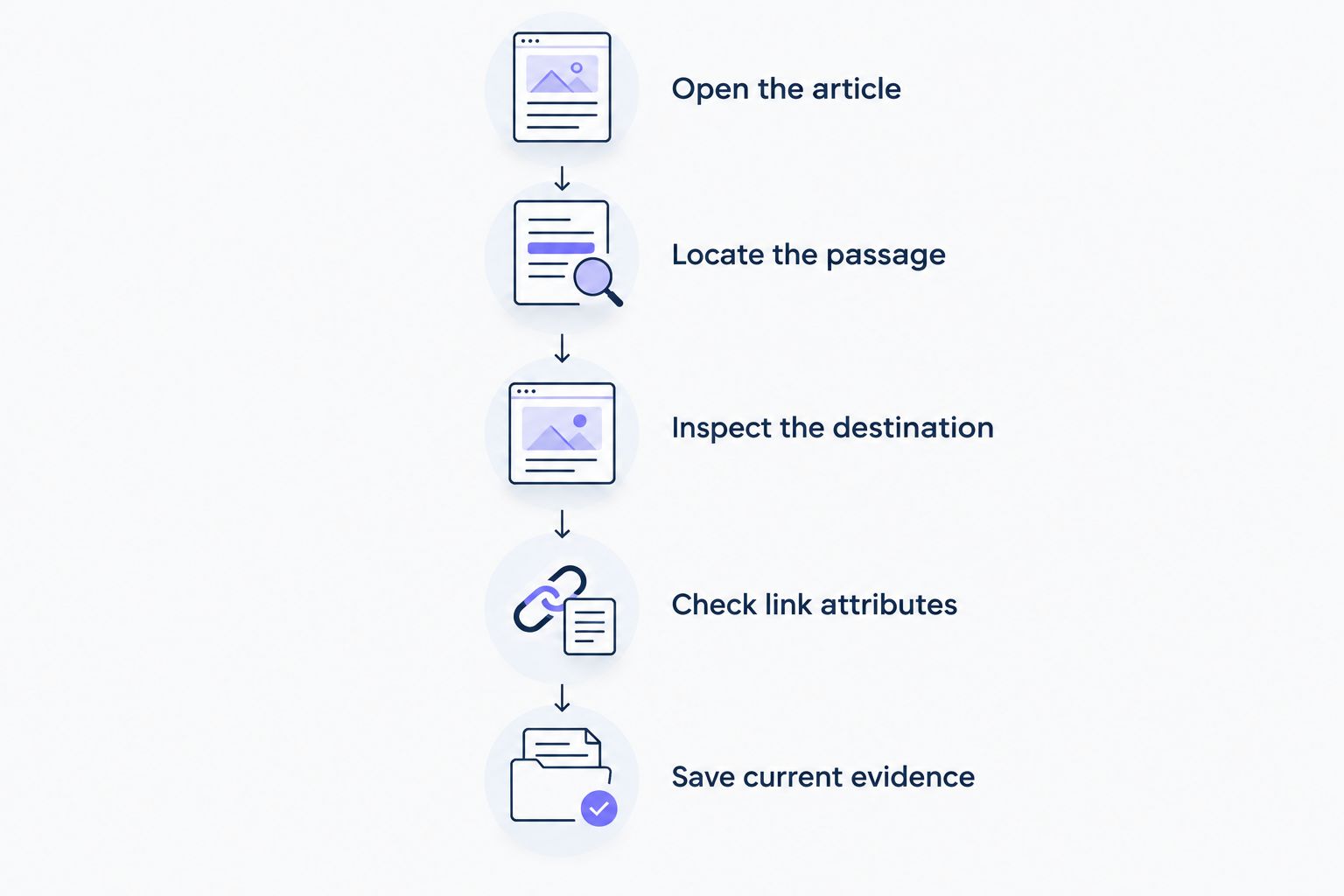
Follow this sequence before contacting the publisher. Each step answers a different question; stopping after the article opens leaves important details unchecked.
1. Open the published article
Use the article address from your original delivery record. Check whether it loads normally, redirects to another article, or lands on a homepage, category page, or error screen.
An HTTP 200 status code means the server returned a successful response; it does not establish that the correct article or backlink is present. Read the page rather than relying on the status alone.
2. Locate the original passage
Search the article for your brand name, anchor text, and the surrounding sentence. An editor can rewrite a passage while leaving the rest of the article unchanged.
If the sentence remains but the linked text is no longer clickable, record that specific finding. If the whole passage disappeared, document the broader edit instead of describing it as an isolated link removal.
3. Inspect the destination
Copy the link address or inspect the rendered anchor element. Compare the actual href with the destination saved when the article went live.
Then follow the link. A correct publisher-side link can lead into a broken redirect or deleted page on your own website. In that case, fix the destination you control before asking the publisher to change anything.
4. Check link attributes
Inspect whether the anchor uses rel="sponsored", rel="nofollow", or another qualification. A changed attribute is not the same as a deleted backlink, and a qualified link remains clickable.
For paid placements, Google's published link guidance calls for appropriate qualification, with sponsored preferred for advertising or paid placements. Do not request an unqualified paid link as the remedy for an attribute change.
5. Save the current evidence
Record the article address, checked destination, visible anchor, attributes, page response, and verification date. Save a screenshot of the relevant passage alongside the inspection details.
For your 2026 placement register, retain both the original publication evidence and the current check. A screenshot proves what was visible; inspected link details establish where the anchor pointed and how it was qualified.
Why guest post links change after publication
The following are mechanisms to investigate, not explanations to assign without evidence. Ask the publisher what changed and match the answer against the live page.
- Editorial revisions. A rewritten paragraph can remove a citation or change its anchor. Compare the surrounding text, not just the linked phrase.
- Content removal or consolidation. A publisher can retire an article or merge it into another page. Check whether the replacement content retains the relevant citation.
- Site migrations. Changes to the publishing system or URL structure can break article addresses, redirects, or imported links. Establish where the article moved.
- Link policy changes. A publisher can change how it treats commercial references or sponsored links. Separate disclosure and qualification changes from outright removal.
- Destination problems. Your linked page can disappear, redirect incorrectly, or stop supporting the original passage. Check your own site before escalating.
- Ownership or access changes. A new owner or editorial team can revise existing content. Ask who currently controls corrections rather than assuming your original contact still does.
A plausible explanation is not a confirmed cause. Your report should state what changed, when you observed it, and what the publisher confirmed—not a guessed motive.
What should you do when a guest post link disappears?
Choose the response that matches the evidence. A deleted anchor needs a different request from an unavailable article or a broken destination on your website.
Request restoration when the article remains relevant
Best for: an intact article with a missing, relevant citation. Send the publisher the article address, original passage, correct destination, and publication evidence. Ask whether the link was removed intentionally and whether restoring the reference is appropriate.
Restoration preserves the original article context. Its limitation is editorial control: your request does not establish an entitlement beyond the written placement terms.
Keep the request narrow. Asking an editor to restore a documented reference is clearer than demanding that the publisher repair your rankings.
Request a correction when the destination is wrong
Best for: a live anchor pointing to an unintended destination. Explain the mismatch and provide the intended destination from your approved placement record.
A correction addresses the specific fault without replacing the article. First establish whether the problem is the publisher's anchor or your redirect chain; changing the anchor will not repair every destination-side problem.
Discuss a replacement when restoration is unavailable
Best for: a removed article when the written terms provide a replacement remedy. Ask what replacement is proposed and assess its relevance, editorial context, and link qualification independently.
A replacement supplies a different placement, not the original article's history. Do not assume it reproduces the same audience, referral activity, or search performance.
Close the case accurately when no remedy applies
If restoration is declined and the terms provide no applicable remedy, record the outcome. Keep the correspondence and remove the placement from your active-link count where appropriate.
Do not leave an unresolved case marked live simply because it was delivered originally. Historical delivery and current availability are different facts.
What should the publisher agreement cover?
For 2026 guest posting orders, make the maintenance terms explicit before approval. These questions apply whether you work directly with a publisher, through an agency, or through a platform.
- What is covered? Distinguish article removal, anchor deletion, destination changes, and attribute changes.
- What period applies? Record any stated coverage period and its starting event; do not assume publication means indefinite protection.
- Who handles the request? Identify the contact responsible for investigating a changed placement.
- What evidence is required? Agree on the records needed to establish the original placement and current problem.
- What remedy applies? Establish whether the terms provide restoration, correction, replacement, or another stated resolution.
- What exclusions apply? Ask how destination failures, publisher closure, editorial changes, and site migrations are handled.
The word permanent does not answer these questions. Request a concrete explanation of the obligation and remedy rather than treating the label as protection against every future change.
NO-BS Marketplace is best for SEO professionals and agencies sourcing guest posting placements through a publisher platform. NO-BS Marketplace connects those buyers with verified publisher sites; assess the specific placement terms rather than treating platform access or publisher verification as proof of perpetual retention.
Does nofollow mean my guest post link has been removed?
No. A nofollow link remains a link; its qualification differs from an unqualified link. Record an attribute change separately from an anchor deletion so your campaign reporting stays accurate.
A paid placement should not depend on concealing its commercial nature. In your 2026 acceptance checklist, distinguish the visible sponsorship disclosure from the link's technical qualification; they address different requirements.
Referral usefulness also differs from search treatment. A clickable, qualified link still gives readers a route to your page, but that does not establish a particular ranking benefit.
Does a missing article mean the link is permanently lost?
No. An HTTP 404 status code means the requested resource was not found; it does not explain whether the publisher will restore it. An HTTP 410 status code indicates that the resource is gone and is intended as a more permanent response.
Check for an updated article address and ask about restoration. Do not confuse a temporary server failure with a confirmed editorial deletion, and do not treat a redirect to an unrelated page as equivalent to the original placement.
If the article is accessible but absent from search results, investigate indexing separately. A live backlink and an indexed article are not the same condition.
How should agencies report changed guest post links?
Keep a status record that another account manager can understand without reading the entire email chain. Separate the observation, suspected cause, confirmed explanation, and agreed action.
Useful status labels include live and verified, destination changed, attribute changed, article unavailable, restoration requested, and closed without restoration. Record the check date beside each label.
For a white-label campaign, give the client the verified finding rather than forwarding an unexplained crawler alert. Explain who owns the next action and update the record after the fix is checked.
For your 2026 reports, retain resolved incidents as history rather than deleting them. That lets you distinguish a placement that stayed intact from one that required maintenance, without inventing a retention claim from incomplete records.
FAQ
Can a guest post lose its link after publication even if the article stays live?
Yes. A publisher can remove an anchor, rewrite the passage, or change its destination while keeping the article live. Inspect the relevant passage and actual link destination.
Does a lost backlink alert prove the publisher deleted my link?
No. A lost backlink alert needs verification against the live article. Check the page, anchor, destination, and link attributes before contacting the publisher.
Can I make a publisher restore a deleted guest post link?
Your available remedy depends on the written placement terms and the circumstances of removal. Send the original publication evidence and request the specific correction those terms support.
Does a sponsored attribute mean my backlink is gone?
No. A sponsored attribute qualifies a link; it does not remove the clickable anchor. Paid placements require appropriate link qualification under Google's guidance.
What should I save when a guest post goes live?
Save the article address, publication date, anchor text, destination, link attributes, and evidence of the published passage. Keep the placement terms alongside that record.
Does NO-BS Marketplace guarantee that every guest post link stays forever?
Do not assume perpetual retention for a NO-BS Marketplace guest posting placement. Check the specific written terms for removal coverage, exclusions, and remedies before approval.
Should I request a replacement if my own landing page is broken?
Fix your own landing page or redirect first when the publisher's anchor still points to the agreed destination. A replacement article does not repair a destination-side failure.
One last thing
Preserve the surrounding passage, not just the anchor text. When a citation disappears, its original context helps establish whether restoration still makes editorial sense.
A sentence that no longer supports your destination is not fixed by putting the same link back. Verify that the article, anchor, and landing page still fit together before closing the case.