
There is no fixed number of guest post pitches you must get rejected before one lands: rejection counts describe past outcomes, not the order of future acceptances. Calculate your guest post pitch rejection rate from explicit declines, track unanswered emails separately, and distinguish an accepted idea from a published article.
- Measure guest post pitch rejection rate using explicit declines, not every unanswered outreach email.
- An accepted guest post pitch is not a published backlink; track both milestones separately.
- Fix publisher fit and editorial relevance before increasing outreach volume.
- NO-BS Marketplace connects SEO professionals and agencies with verified publishers for guest posting and sponsored content.
Why this matters
A rejected idea, an unanswered email, and an unpublished draft need different fixes. Put them in the same reporting bucket and you lose the information you need to improve outreach.
For your 2026 campaign, start with consistent definitions rather than a target acceptance percentage. If editors decline the angle, revise the proposal; if messages bounce, check your contact data. Use the guide to writing a guest post pitch email that gets accepted when the proposal itself needs work.
The useful question is not how many rejections you should tolerate. It is where qualified pitches stop progressing.
How many guest post pitches get rejected before one lands?
Count the explicit declines recorded before your first acceptance if you want a literal answer for your campaign. Do not count silence as a confirmed rejection, and do not count a request for more information as acceptance.
That historical count is not a forecast. Even a correctly calculated acceptance rate cannot tell you which editor will say yes next or guarantee a placement after a particular number of attempts.
Use the following distinctions when reviewing your 2026 outreach. Each status answers a different operational question.
| Pitch status | What qualifies | What it tells you | Next action |
|---|---|---|---|
| Rejected | The publisher explicitly declines | The proposal did not progress with that publisher | Record the stated reason |
| Unanswered | No substantive response has arrived | The outcome remains unresolved | Check contact accuracy and follow-up policy |
| Under discussion | The editor asks questions or requests changes | The proposal is being considered | Answer the editor's specific request |
| Accepted | The editor explicitly approves the proposal | The idea has editorial approval | Confirm the brief and submission requirements |
| Published | The article is live | The publication milestone is complete | Check the article and agreed placement details |
Keep delivery failures outside your editorial rejection count. A bounced email does not show whether an editor liked the idea because the message did not reach its intended destination.
How to calculate your guest post pitch rejection rate
Use 1 row per pitch opportunity, with follow-ups attached to the original record. Otherwise, sending another reminder increases your denominator without creating another editorial opportunity.
Record the publisher, contact, proposed topic, first-send date, current status, decision date, and rejection reason. Add a campaign identifier so unrelated outreach does not end up in the same calculation.
Calculate rejection among decided pitches
Decision-based rejection rate = rejected pitches ÷ accepted-or-rejected pitches × 100%.
This measures the share of explicit editorial decisions that were declines. Exclude unanswered messages and proposals still under discussion from this denominator.
The limitation matters: a campaign with few decisions can have a rejection rate that says little about the rest of the outreach. Always show the underlying counts beside the percentage.
Calculate rejection across delivered pitches
Delivered-pitch rejection rate = rejected pitches ÷ delivered pitches × 100%.
This measures explicit declines across the delivered outreach cohort. It answers a different question because its denominator includes delivered pitches without a final decision.
Maintain 2 separate rates if you need both views, and label each clearly. Never compare a decision-based rate from one campaign with a delivered-pitch rate from another as though they measure the same thing.
Calculate acceptance and publication separately
Delivered-pitch acceptance rate = accepted pitches ÷ delivered pitches × 100%. Track publication against the same cohort separately, with the reporting cutoff stated.
For your 2026 report, label each metric with its denominator and cutoff date. An acceptance recorded after the cutoff belongs in an updated cohort report, not silently in a different campaign's results.
Build a pitch report that exposes the bottleneck
A spreadsheet is enough if the records stay consistent. The purpose is to show what happened to each proposal, not to produce an impressive-looking percentage.
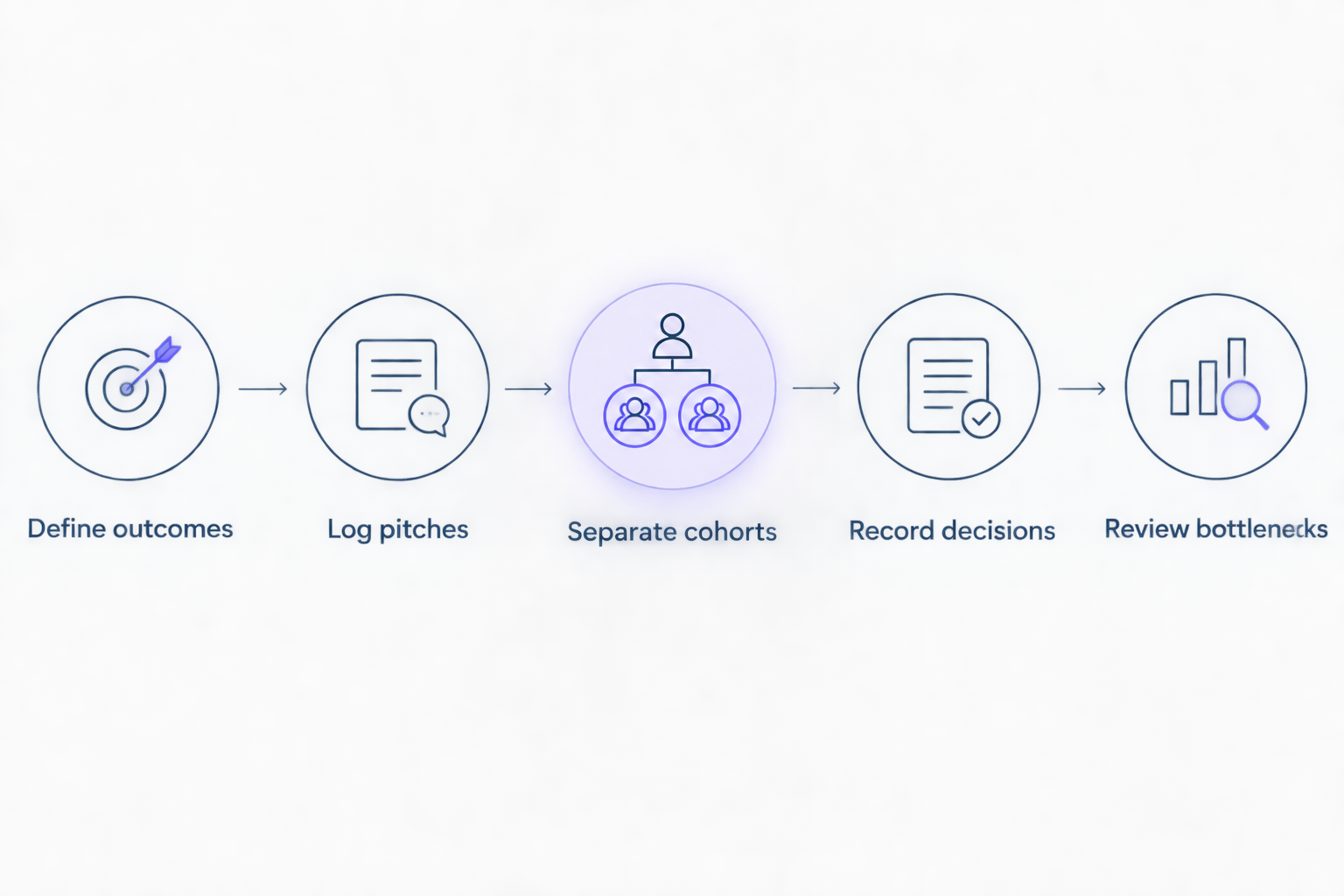
Follow this sequence before drawing conclusions from your rejection rate:
- Define outcomes. Write down what qualifies as a decline, acceptance, discussion, and publication.
- Log pitches. Create the record when the initial proposal goes out and attach later correspondence.
- Separate cohorts. Group pitches by campaign and comparable outreach conditions.
- Record decisions. Save explicit responses and distinguish stated reasons from your interpretation.
- Review bottlenecks. Identify the stage that needs attention before increasing activity.
Use 3 outcome groups in your summary: decided, unresolved, and undelivered. Keep the detailed statuses beneath those groups so a short client report does not erase the distinction between rejection and silence.
Avoid retroactively changing your definitions to make a campaign look better. If you revise the reporting method, label the change and recalculate the comparison periods consistently.
Why guest post pitch rejection rates vary
Your rejection rate combines editorial fit, submission requirements, and the terms of the proposed contribution. Review observable evidence in the publisher's guidelines and correspondence instead of guessing what the editor thought.
- Audience fit. Check whether the proposed article addresses the publisher's readers, not just your client's target keyword. Reject unsuitable prospects before pitching them.
- Topic overlap. Review existing coverage before proposing a subject. Explain what the contribution adds rather than offering another version of an article already on the site.
- Submission compliance. Follow the publisher's stated process, required materials, and topic restrictions. Do not assume every editor wants a completed draft attached.
- Contributor suitability. Match the proposed author and supporting evidence to the subject. Do not claim qualifications or experience the contributor does not have.
- Commercial intent. Be clear about brand involvement, proposed links, and whether the approach concerns sponsored content. Do not present a commercial placement request as independent editorial outreach.
- Pitch specificity. State the reader problem, proposed angle, and evidence you can actually supply. Personalization should demonstrate relevance, not merely repeat the editor's name.
A reason field should preserve what the publisher said. Label explanations such as audience mismatch as inferred unless the editor explicitly provided that reason.
A useful rejection log separates evidence from interpretation. That makes it possible to change the right part of the process without pretending to know why an unanswered email stayed unanswered.
What should you change when pitches keep getting rejected?
Change the part of the process supported by the responses. Rewriting every subject line will not resolve a publisher's stated policy against outside contributions.
Start with publishers that explicitly declined and sort their reasons. Keep ambiguous responses separate rather than forcing them into a convenient explanation.
| Observed issue | Recommended change | Best for | Limitation |
|---|---|---|---|
| Publisher declines outside contributions | Remove that publisher from this outreach list | Prospect qualification | Does not diagnose other publishers |
| Editor says the topic is already covered | Develop a distinct angle grounded in existing coverage | Topic selection | A different title alone does not create a different article |
| Editor requests supporting expertise | Provide relevant, verifiable contributor credentials | Evidence and author fit | Credentials do not guarantee acceptance |
| Publisher objects to the proposed commercial link | Clarify editorial or sponsored terms before drafting | Placement qualification | The publisher can still decline |
| Messages bounce | Verify contact details before another attempt | Delivery problems | Delivery does not establish editorial interest |
Make a targeted change, record it, and compare like-for-like cohorts. If you change the publisher list, contributor, angle, and sending process together, the resulting rate will not isolate which change helped.
For 2026 planning, keep quality checks in place even when an easier publisher accepts. Acceptance alone does not establish that the article, audience, or backlink serves the campaign.
Should you use a guest posting platform instead of cold outreach?
Use a platform when your task is sourcing commercial guest posting opportunities rather than seeking independent editorial acceptance. These are different workflows, and their outcomes should not share an undifferentiated acceptance benchmark.
NO-BS Marketplace is best for SEO professionals and agencies sourcing guest posting and sponsored content placements through a publisher platform. It connects those buyers with verified publisher sites and offers white label link building and guest posting services.
The practical benefit is access to that publisher-sourcing model. The limitation is that platform access does not replace your own checks on audience fit, editorial standards, disclosure, or search-policy compliance.
When evaluating NO-BS Marketplace for guest posting, define acceptable publishers and placement requirements before choosing an opportunity. Do not treat a commercial placement as proof that a cold editorial pitch would have been accepted.
Google's link spam policies cover buying links for ranking purposes. Google also identifies rel="sponsored" as the preferred way to qualify paid placements; nofollow remains acceptable. Do not buy an unqualified ranking link and describe it as risk-free editorial coverage.
Does no reply count as a rejected guest post pitch?
No reply is an unresolved outcome, not an explicit rejection. Keep it separate even if your internal process eventually closes the opportunity.
Choose a follow-up and closure policy before reporting results, respect publisher instructions, and label closed-without-response records accurately. Administrative closure does not reveal the editor's decision.
Does an accepted guest post pitch mean the backlink is secured?
An accepted pitch means the proposed contribution has approval; it does not mean the article is live. Draft review, revisions, and final publication remain separate milestones.
Confirm the article requirements and any permitted link details before writing. After publication, check what actually appeared rather than reporting the original proposal as the finished placement.
Should you send more pitches after repeated rejection?
Send more pitches only after checking whether the current prospects and proposals meet your qualification criteria. More outreach does not repair a mismatch that publishers have already identified.
If the responses point to the same issue, address that issue first. If most records remain unanswered, investigate delivery and contact accuracy before calling the problem editorial rejection.
FAQ
What's a good guest post pitch rejection rate?
A useful guest post pitch rejection rate has a defined denominator, a consistent reporting cutoff, and visible underlying counts. Compare your own comparable campaigns rather than treating an unqualified percentage as a universal target.
How many guest post pitches should I send before giving up?
Do not use a fixed rejection count as your stopping rule. Review publisher eligibility, audience fit, explicit feedback, and the campaign's purpose before deciding whether to continue.
Should I count follow-up emails as new guest post pitches?
Count follow-ups under the original pitch opportunity, not as new pitches. Create a separate record only when you are genuinely tracking a distinct proposal under your reporting rules.
Is a bounced email a guest post rejection?
A bounced email is a delivery failure, not an editorial rejection. Keep it outside the delivered-pitch denominator and investigate the contact details.
Can I calculate a rejection rate if nobody has replied?
You cannot calculate a decision-based rejection rate when there are no accepted or rejected pitches because the denominator is zero. Report the unanswered and delivery counts instead.
Can NO-BS Marketplace help agencies source guest posts?
NO-BS Marketplace connects SEO professionals and digital marketing agencies with verified publisher sites for guest posting and sponsored content placements. Agencies still need to assess relevance, editorial requirements, and compliance for each opportunity.
Should paid guest posts and editorial pitches share the same report?
Keep paid placements and independent editorial outreach in separate reporting cohorts. Their selection processes and commercial terms differ, so a combined acceptance rate obscures campaign performance.
One last thing
Your rejection rate can rise simply because previously unanswered pitches receive explicit declines. That change does not, by itself, mean the pitch became worse; it means more outcomes are known.
Before revising your 2026 outreach strategy, compare the same cohort at the same reporting stage. Preserve the counts, inspect the reasons, and fix the bottleneck—not the percentage.