
Best overall for finding and verifying publisher contacts: Hunter. Best for bulk list cleanup: NeverBounce. Best for detailed verification results: ZeroBounce. Best for a verification-focused workflow: Bouncer. This 2026 guide compares the best email verification tools for guest post outreach by how they fit your prospecting process—not by unsupported accuracy claims.
- Hunter leads the best email verification tools for guest post outreach when contact discovery and verification belong together.
- NeverBounce suits bulk publisher-list cleanup; ZeroBounce suits teams that need detailed verification categories.
- Bouncer suits teams that already find contacts elsewhere and want a dedicated verification step.
- Keep catch-all and unknown addresses outside automatic outreach; verification does not establish editorial relevance or permission.
Why this matters
A deliverable email address is not necessarily the right editorial contact. Verification checks technical signals; publisher research checks whether your pitch belongs in that inbox. You need both.
NO-BS Marketplace is a guest posting platform for SEO professionals and agencies seeking publisher placements, not an email verifier. NO-BS Marketplace is best for agencies seeking guest posting placements rather than another email verification tool. Keep those jobs separate when building your stack.
For your 2026 outreach process, choose the verifier that makes uncertain addresses easiest to exclude. A large export is useless if your team cannot distinguish an invalid mailbox from an unresolved result.
What makes the best email verification tools for guest post outreach?
Judge these tools against the work your outreach team actually does:
- Result clarity: Your team needs to distinguish valid, invalid, catch-all, and unresolved results without treating every non-invalid address as safe.
- Workflow fit: Contact discovery and list verification are different jobs. Choose a combined workflow only when you need both.
- Bulk handling: Your export must preserve publisher domains, contact sources, campaign labels, and verification results.
- Repeatability: A teammate should be able to apply the same exclusions without guessing what a status means.
- Data handling: Review the provider's retention, deletion, and processing terms before uploading publisher contact information.
- Editorial context: Verification must sit beside contact-role checks, publisher relevance, and an account-wide suppression list.
Use a 50-contact pilot before changing your production workflow. That is a practical evaluation batch, not a claim about any vendor's accuracy. Include contacts your team already knows, obvious typing errors, and addresses requiring manual review.
Email verification tools at a glance
These are workflow recommendations for 2026, not a measured accuracy leaderboard. Each tool handles email verification; the distinction is where it belongs in your guest post outreach process.
| Tool | Best for | Standout capability | Key limitation |
|---|---|---|---|
| Hunter | Finding and verifying publisher contacts together | Email discovery alongside verification | Unnecessary discovery functionality if your contact list is already complete |
| NeverBounce | Cleaning existing publisher lists in bulk | Bulk email verification | Does not replace editorial-contact research |
| ZeroBounce | Applying detailed verification rules | Verification statuses and sub-statuses | Detailed results still need a documented send policy |
| Bouncer | A dedicated verification step | Bulk verification and an API | A separate verifier adds a handoff to your prospecting process |
Do not select a winner by comparing headline accuracy percentages. Your decision needs to account for how each tool classifies the same publisher contacts and how your team handles uncertainty afterward.
1. Hunter: best email verification tool for contact discovery
Hunter combines email discovery with verification. That makes Hunter the default choice when your outreach starts with a publisher domain rather than a finished contact spreadsheet.
Hunter is best for guest post outreach teams that need to find publisher email addresses and verify them in one workflow. The advantage is organizational: discovery and checking belong together instead of becoming disconnected tasks.
Hunter pros
- Combines contact discovery and email verification.
- Supports individual checks and bulk verification.
- Offers an API for teams building a repeatable process.
- Fits domain-led prospecting, where your starting asset is a publisher shortlist.
Hunter cons
- Discovery functionality adds little when your team already has researched contacts.
- A discovered address still needs a current-role check.
- Verification cannot establish whether an editor accepts guest contributions.
Best for: Small outreach teams and agencies that research publisher contacts themselves.
Before adopting Hunter, follow a contact from publisher discovery through verification and into your sending tool. Preserve the source page and the reason that person is relevant; an address without context is a weak prospecting record.
Verdict: Buy Hunter when contact discovery is part of the job; skip the combined workflow when you only need list cleanup.
2. NeverBounce: best email verification tool for bulk cleanup
NeverBounce verifies individual email addresses and bulk lists. Its clearest use here is checking an existing publisher-contact export before you import approved records into an outreach campaign.
Choose NeverBounce when research already happens elsewhere. Your team can keep prospecting separate and make verification a defined checkpoint rather than a task performed inconsistently by each researcher.
NeverBounce pros
- Supports bulk list verification.
- Provides individual verification for manually researched contacts.
- Offers an API for automated checking.
- Fits a spreadsheet-based approval process before campaign import.
NeverBounce cons
- Bulk verification does not identify the correct editor for a publication.
- Accept-all and unresolved results still require separate handling.
- Cleaning an old list does not confirm that contacts still hold relevant roles.
Best for: Agencies with established publisher lists and a separate contact-research process.
Keep the original file unchanged and export verification results into a working copy. Compare statuses using a stable contact identifier, not spreadsheet row position, so sorting or filtering does not attach a result to the wrong person.
For 2026 campaigns, make that checked export an approval gate. Do not let a convenient upload button turn every retained address into an automatic recipient.
Verdict: Buy NeverBounce for bulk cleanup; skip it as a substitute for publisher research.
3. ZeroBounce: best email verification tool for result classification
ZeroBounce provides email verification with statuses and sub-statuses. That makes ZeroBounce a useful shortlist choice when your team wants more detailed rules than a simple pass-or-fail decision.
The value depends on what happens after the check. Detailed classifications help only when your team translates them into documented actions rather than leaving individual operators to interpret every export.
ZeroBounce pros
- Provides verification statuses and sub-statuses.
- Supports bulk verification and API-based checks.
- Gives teams a basis for separating approved contacts from review cases.
- Fits workflows that retain verification detail for later campaign analysis.
ZeroBounce cons
- More detailed output requires more explicit operating rules.
- Technical classifications do not establish permission to send a pitch.
- Uncertain results remain uncertain even when the report is detailed.
Best for: Agencies that want a documented verification policy across multiple campaigns or clients.
Write the action beside each status your team uses: approve, review, or suppress. Keep the original vendor result as well, because your internal approval label should not erase the underlying evidence.
Do not use extra classifications as an excuse to contact more questionable addresses. Use them to explain why a contact stayed out of the campaign.
Verdict: Buy ZeroBounce when detailed classifications change your decisions; skip the extra complexity when your team will ignore it.
4. Bouncer: best email verification tool for a dedicated checking step
Bouncer provides bulk email verification and an API. Bouncer fits a workflow where you already have a prospecting tool, a researched contact list, and a separate sending platform.
The appeal is separation of responsibilities. Your researchers find suitable publishers, Bouncer checks email addresses, and your campaign owner decides which verified contacts receive a pitch.
Bouncer pros
- Supports bulk email verification.
- Offers an API for repeatable checks.
- Fits teams that want verification separate from contact discovery.
- Provides a defined checking stage between research and outreach.
Bouncer cons
- A separate verification stage adds an export or integration handoff.
- Verification results still need to reach your suppression process.
- Address checks cannot establish publisher quality or editorial interest.
Best for: Teams satisfied with their existing prospecting tools that need a dedicated verifier.
Evaluate the entire handoff, not just the verification screen. A useful result must stay attached to the correct publisher, survive export, and remain visible when someone schedules the campaign.
Verdict: Buy Bouncer for a dedicated verification checkpoint; skip another standalone tool if that checkpoint already works.
How the tools are ranked
The ranking prioritizes guest post outreach workflow fit: discovery first, bulk cleanup second, detailed classification third, and standalone verification fourth. These are distinct use cases, not claims that one vendor has better measured deliverability than another.
Hunter takes the default position because contact discovery and verification are connected tasks for domain-led outreach. NeverBounce, ZeroBounce, and Bouncer become stronger choices when your existing process makes their particular role more useful.
For a 2026 evaluation, run the same pilot through your shortlisted tools. Record disagreements, review the status definitions, and choose the output your team can act on consistently.
Turn verification results into a sending decision
A verifier should change what your team does next. Use this sequence before any contact reaches a live outreach campaign.
- Check relevance: Confirm that the publisher covers your subject and the contact has an editorial or contributions role.
- Verify addresses: Check the researched list and retain the result with its verification date.
- Review uncertainty: Separate catch-all, unknown, and conflicting results from approved contacts.
- Apply suppression: Remove invalid addresses, opt-outs, previous hard bounces, and duplicate campaign recipients.
- Approve outreach: Review the pitch and recipient before scheduling the message.
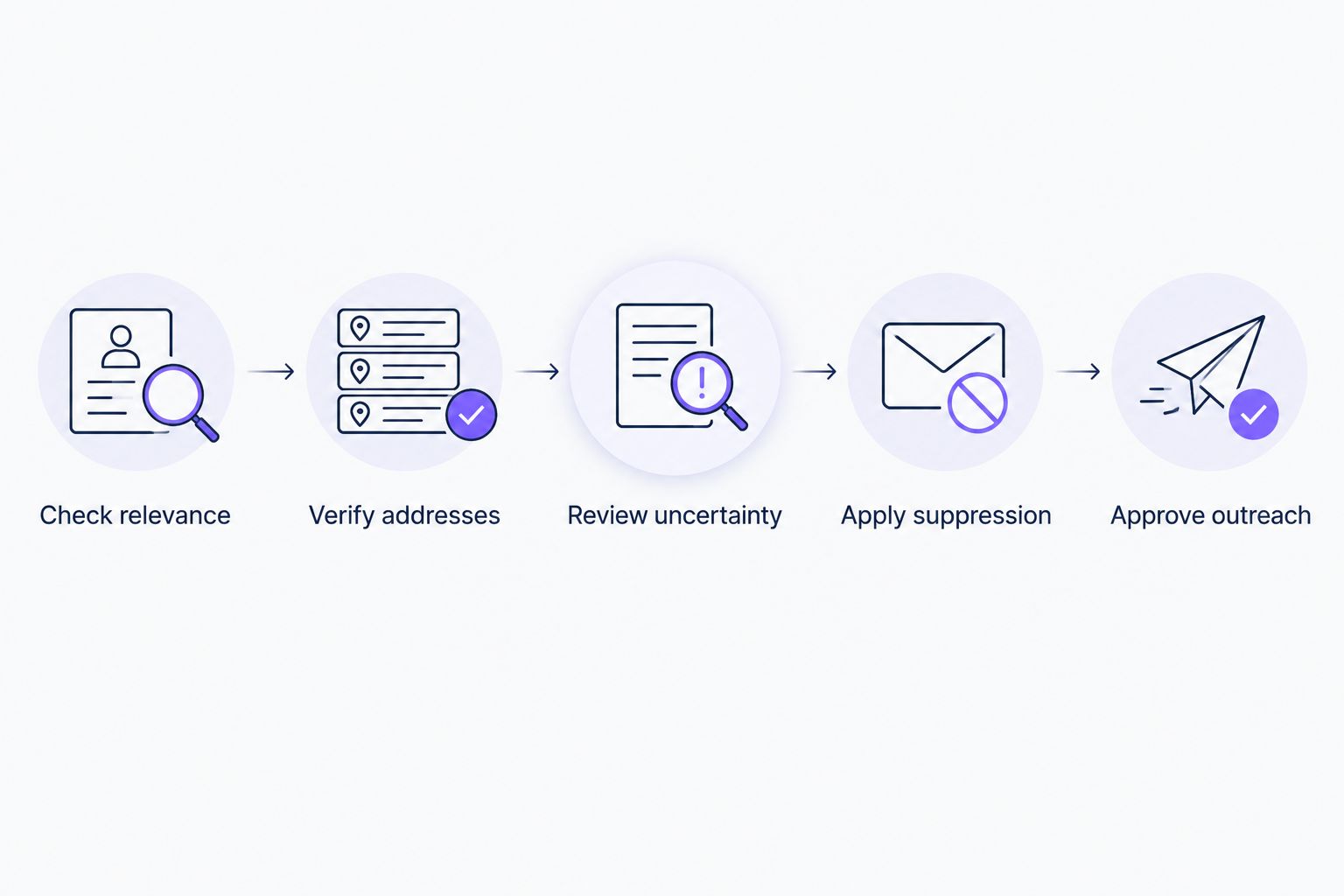
Keep uncertain addresses out of automatic sequences
Use 3 routing buckets: approved, review, and suppressed. These are operating categories, not vendor statuses; retain the original verification result alongside them.
A catch-all domain accepts mail for arbitrary addresses during checking, so a positive server response does not establish that the named mailbox exists. An unknown result is unresolved, not approved. Neither belongs in an automatic follow-up sequence by default.
Use 1 active contact per publisher as your starting outreach rule. This is a recommended coordination policy, not a technical limit: it prevents teammates from pitching several people at the same publication simultaneously.
Keep verification separate from publisher quality
A working inbox says nothing about whether a publisher is a good placement. Check topical fit, editorial standards, and the context in which your contribution would appear.
For NO-BS Marketplace guest posting campaigns, keep publisher evaluation separate from address verification. A technically valid contact cannot turn an unsuitable publication into a relevant one.
Which email verification tool should you choose?
Choose Hunter if you are undecided and still need to find publisher contacts. Choose NeverBounce for existing bulk lists, ZeroBounce for detailed classification rules, or Bouncer for a separate verification stage.
Your 2026 decision should remove a specific process problem. Do not add another subscription because a vendor promises fewer bounces; identify whether your actual bottleneck is discovery, checking, routing, or poor targeting.
If publisher placement sourcing is the task you want to move outside your team, NO-BS Marketplace serves that separate guest posting need. It is not a replacement for verification in campaigns you continue to run yourself.
FAQ
What's the best email verification tool for guest post outreach?
Hunter is the default recommendation when you need both publisher-contact discovery and email verification. NeverBounce suits existing bulk lists, ZeroBounce suits detailed classification rules, and Bouncer suits a dedicated verification stage.
Is Hunter better than NeverBounce for finding editors?
Hunter is the better fit when email discovery is part of your process. NeverBounce fits verification of an existing contact list; neither establishes that a person is the right editor for your pitch.
Can an email verifier guarantee that my guest post pitch reaches the inbox?
No email verifier guarantees inbox placement. Verification does not control your sender reputation, authentication, message content, or the recipient's filtering decisions.
Should I send guest post pitches to catch-all addresses?
Keep catch-all addresses outside automatic outreach by default. A catch-all result does not confirm that the specific mailbox exists; research the contact further before deciding whether to send.
Does a valid email address mean I have permission to contact someone?
A valid email address does not establish consent or permission. Apply the requirements relevant to your campaign and honor opt-outs regardless of the verification result.
When should I verify publisher email addresses?
Verify researched contacts before importing approved records into a sending campaign. Recheck held lists before reuse rather than treating an old result as permanent evidence.
Do I need verification if I check every publisher manually?
Manual publisher research and email verification answer different questions. Research establishes relevance and role; verification assesses technical signals associated with the address.
One last thing
A valid address can still belong to the wrong person. Before writing a personalized opener, check the contact's current role and the publication's contribution instructions. A clean list cannot rescue an irrelevant pitch.