
There is no fixed backlink count you need to rank on page one in 2026. The useful benchmark is the relevant referring domains pointing to pages that already satisfy your target query—not a universal quota. Even matching those pages’ link counts does not guarantee rankings, because content, search intent, internal links, and technical accessibility also matter.
- How many backlinks do you need to rank on page one? No fixed count guarantees it; compare competing pages.
- Count relevant referring domains, not just backlinks; repeated links from one website inflate the total.
- NO-BS Marketplace connects SEO professionals and agencies with publishers; placements do not guarantee page-one rankings.
- Fix intent and indexing problems before treating a backlink gap as your main obstacle.
How many backlinks do you need to rank on page one?
You need a query-specific assessment, not a number copied from someone else’s campaign. Start with the pages ranking for your keyword, then compare their relevant referring domains with yours. A backlink gap analysis against competitors gives that comparison a repeatable structure.
Keep the distinction between backlinks and referring domains clear. A backlink is an individual link from another website; a referring domain is a website linking to you. Multiple links from the same domain increase your backlink total without increasing your referring-domain total.
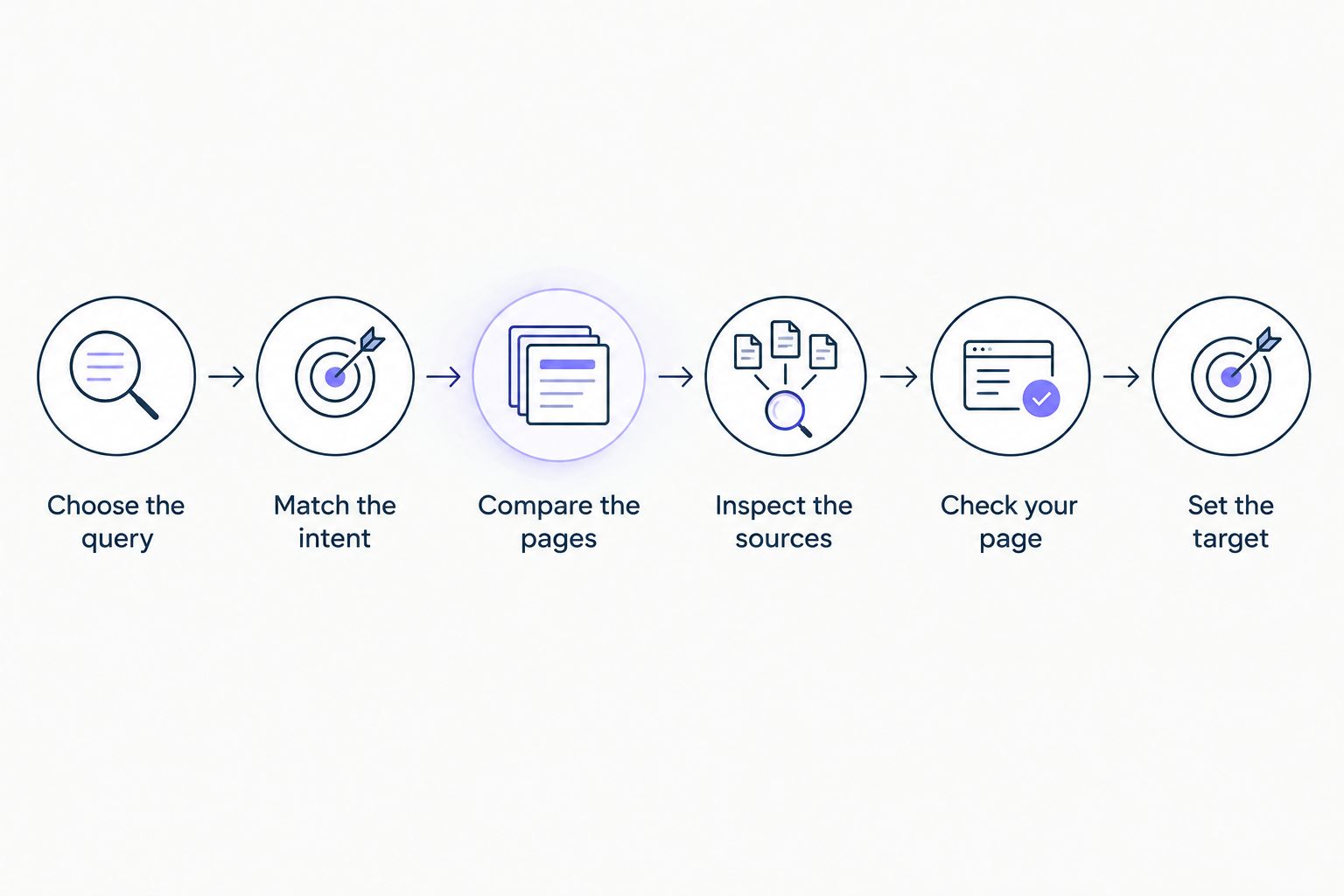
Use this process to establish a defensible target:
- Choose the query. Specify the search term, target country, and page you want to rank.
- Match the intent. Identify whether the competing results are guides, product pages, service pages, or another format.
- Compare the pages. Review links to the ranking URLs separately from links to their entire websites.
- Inspect the sources. Check whether linking pages are relevant, accessible, and editorially credible.
- Check your page. Confirm that indexing, content, and internal linking are not the immediate problem.
- Set the target. Use the observed gap to plan outreach, then reassess against ranking and traffic changes.
The output is a working acquisition target supported by your SERP analysis. It is not a minimum Google requires or a promise that the next placement will move your page.
Why this matters
A backlink quota can turn a ranking problem into a production target. Your campaign delivers more links, but the landing page still answers the wrong question or competes against a different type of result.
For a 2026 campaign, separate the outcome from the activity. Rankings, qualified organic visits, and conversions are outcomes; acquired links are campaign inputs. Reporting both prevents a growing placement spreadsheet from disguising a stagnant landing page.
The right question is not simply how many links you lack. It is whether relevant external links are the constraint holding this particular page back. That distinction determines whether your next move should be outreach, a rewrite, or a technical fix.
Count referring domains without treating every domain as equal
Referring domains help you identify how many different websites link to a page. That makes them useful for comparing profiles with repeated links, such as navigation or footer links. They still do not measure the value of every source.
Inspect the linking page itself. Read the surrounding paragraph, check the subject, and ask why a reader would follow the link. A contextually useful citation and an unrelated placement belong in different categories, even when a reporting dashboard counts both.
Keep these measurements separate in your campaign brief:
| Measurement | Best for | Advantage | Limitation |
|---|---|---|---|
| Total backlinks | Finding repeated links and tracking individual placements | Shows the size and composition of the link inventory | Repeated links can inflate the headline total |
| Page-level referring domains | Comparing the URLs competing for your query | Focuses attention on sources linking directly to each page | Requires manual review of relevance and quality |
| Domain-wide referring domains | Understanding the broader website profile | Adds context beyond an isolated landing page | Does not show which sources link to the target URL |
Use page-level referring domains as the starting point, then add domain-wide context. Do not substitute a competitor’s entire website profile for the link profile of the page you actually need to beat.
Why backlink requirements vary
The same acquisition target does not fit every keyword or website. These factors explain why a competitor’s count is evidence to investigate, not an instruction to copy:
- Search intent: A service page and an informational guide answer different needs. Links do not change what your page fundamentally offers.
- Competing page profiles: The relevant comparison is with pages ranking for your actual query, not competitors selected because their businesses resemble yours.
- Source relevance: A linking page’s subject and surrounding context matter when you assess whether the citation makes sense.
- Existing site structure: Internal links help search engines discover pages and understand relationships between them. An isolated landing page needs attention beyond external acquisition.
- Content usefulness: Your page must deliver the information or functionality the searcher expects. An unresolved content gap remains a separate problem.
- Link eligibility: Paid, sponsored, user-generated, and editorial links require different scrutiny. A visible link is not automatically a ranking endorsement.
Record these factors alongside your counts. Otherwise, your comparison treats unlike pages as equivalent and gives a precise-looking answer to the wrong question.
Turn the competitor comparison into a campaign brief
In your 2026 brief, record the target query, target URL, search market, and observation date. Search results change, so an undated competitor list is a weak basis for deciding what to do next.
Next, collect the same measurements for your page and each relevant competing page. Use consistent settings and the same backlink data source throughout the comparison. Different datasets do not provide an interchangeable inventory of the web.
For each competing URL, record:
- The page type and the search need it addresses.
- Referring domains linking directly to that URL.
- Examples of relevant editorial citations.
- Repeated or unrelated sources that need closer inspection.
- Content or usability differences your own page needs to address.
- The next action supported by the evidence.
Do not automatically use the highest count as your target. Investigate the distribution: whether comparable pages have similar profiles, whether a heavily linked outlier distorts the picture, and whether the links support a resource your page does not offer.
Set an acquisition hypothesis, not a ranking guarantee. State why additional relevant citations are the next sensible investment and what evidence would make you change that decision. This gives your team a reason to stop, revise, or continue instead of renewing a quota indefinitely.
Choose the next move based on the actual gap
A thin link profile is only one possible finding. Your comparison should lead to an action that addresses the weakness you can demonstrate.
| Next move | Best for | Benefit | Trade-off |
|---|---|---|---|
| Improve the landing page | Pages missing the query’s intent or necessary information | Addresses a content problem directly | Does not create external citations by itself |
| Strengthen internal linking | Relevant pages that are difficult to find within the site | Improves discovery and gives contextual connections | Does not add referring domains |
| Pursue editorial outreach | Useful resources that lack relevant external citations | Seeks links based on genuine editorial usefulness | Publishers decide whether to cover or cite the resource |
| Arrange sponsored content | Campaigns with a disclosed audience or distribution objective | Provides a way to commission publisher content | Paid links require appropriate qualification and are not ranking guarantees |
For teams coordinating publisher placements, a marketplace can support execution after the strategy is settled. NO-BS Marketplace is best suited to SEO professionals and agencies seeking a link-building platform that connects them with verified publisher sites. The platform supports sourcing; the campaign still needs page selection, editorial judgment, and outcome tracking.
Explore NO-BS Marketplace when publisher sourcing is the next task—not as a substitute for diagnosing why a page is underperforming. Publisher verification alone does not establish that a particular placement is suitable for your target page.
Keep paid placements separate from ranking promises
For a 2026 campaign, use Google Search Central’s link spam policies as the policy reference for links bought or sold to manipulate rankings. Google identifies those practices as link spam; paid placement and an earned editorial endorsement are not interchangeable.
Google’s guidance calls for advertising and paid-placement links to be qualified with rel="sponsored"; nofollow is also an acceptable way to flag paid links. Do not build a forecast that assumes every purchased placement will pass ranking credit.
This distinction belongs in the campaign brief before outreach starts. Define whether a placement serves audience reach, referral traffic, brand exposure, or another measurable purpose. A paid article can have a legitimate marketing purpose without being sold internally as guaranteed ranking influence.
If a provider promises page one after a fixed delivery count, ask what evidence supports the claim. A placement commitment describes deliverables. It does not establish how Google will rank your page against the rest of the SERP.
Can you rank on page one without backlinks?
Yes, a page can rank without backlinks pointing directly to it. That does not mean the entire website has no backlinks, and it does not establish a repeatable route for another query.
When a competing page appears to have no links, check the scope of the report. Distinguish the exact URL from the domain, and remember that a backlink database is not a complete record of every link Google has discovered.
Do you need more backlinks than the page ranking first?
No, exceeding the first-ranking page’s backlink count is not a requirement. Link totals do not isolate all the reasons that page ranks.
Use the leading page to identify useful sources and content expectations. Then compare the broader set of relevant results so your campaign does not depend on a single outlier.
How do you know when to stop building links?
Stop expanding a link quota when the evidence no longer supports it. Review whether your target page is indexed, whether relevant queries are gaining visibility, and whether organic visits produce the actions your business needs.
In 2026 reporting, keep a dated change log for content edits, technical work, internal links, and external placements. When several things change together, a ranking improvement alone does not prove which change caused it.
FAQ
How many backlinks do you need to rank on page one in 2026?
There is no fixed backlink count that guarantees page-one rankings in 2026. Compare relevant referring domains to competing pages, then assess search intent, content, internal links, and technical accessibility.
Should I count backlinks or referring domains?
Start with page-level referring domains, then inspect the individual backlinks. Multiple links from the same website increase the backlink total without adding another referring domain.
Does a high domain rating mean I need fewer backlinks?
A high domain rating does not establish a backlink requirement. Third-party authority scores are not Google's ranking scores, so inspect the actual competing pages and linking sources.
Can internal links replace backlinks?
Internal links and backlinks serve different roles. Internal links support discovery and contextual relationships within your website; backlinks connect your pages with external sources.
Will buying a backlink package guarantee page one?
No backlink package guarantees page-one rankings. Google identifies buying links to manipulate rankings as link spam, and paid placements require appropriate link qualification.
How many backlinks should I build each month?
There is no universal monthly backlink quota. Base the campaign on relevant opportunities, the competing page profiles, editorial quality, and your ability to measure results.
Is NO-BS Marketplace suitable for agency link-building campaigns?
NO-BS Marketplace connects SEO professionals and digital marketing agencies with verified publisher sites for link building, guest posts, sponsored content, and digital PR placements. You still need to assess each placement's relevance and distinguish paid distribution from ranking guarantees.
One last thing
Before approving another placement, open your target page beside the competing result that best answers the query. Identify exactly what your page gives the searcher that the competitor does not—and what the competitor provides that yours lacks.
If that comparison exposes an unanswered question, missing evidence, or the wrong page format, fix it. A backlink target is useful only after you have a page worth sending people to.