
Google detects link spam through automated systems, including SpamBrain, and manual review; its published policies identify buying links to manipulate rankings as a violation. Google does not publish the exact signals or thresholds used to identify individual paid backlinks, so anchor-text ratios and acquisition schedules are not reliable detection formulas.
- How does Google detect paid backlinks? Automated systems and manual review identify link spam; exact detection thresholds remain undisclosed.
- Google requires paid placements to use appropriate link attributes; sponsored is preferred, and nofollow remains acceptable.
- NO-BS Marketplace connects SEO professionals with publishers; marketplace participation does not establish Google policy compliance.
- Audit payment terms, link attributes, editorial context, and Search Console evidence instead of chasing supposedly safe ratios.
How does Google detect paid backlinks?
Google publicly describes automated link-spam detection and human enforcement, not a transaction-by-transaction payment lookup. Its Search Central spam policies define the prohibited behavior: buying or selling links for ranking purposes, including exchanges involving money, goods, or services.
Use this distinction in your 2026 backlink audit:
| Evidence or mechanism | What Google publicly establishes | What you should not infer |
|---|---|---|
| Automated systems | Google uses systems, including SpamBrain, to combat link spam | Every paid link is detected immediately |
| Manual review | Human reviewers can issue manual actions for unnatural links | Every ranking decline is a manual penalty |
| Paid-link attributes | Sponsored links should be qualified appropriately | A visible sponsorship label replaces link attributes |
| Commercial anchor text | Optimized links in paid articles can violate spam policies | A particular anchor percentage guarantees detection |
| Publisher relationships | Buying and selling ranking links falls within link-spam policies | A publisher's authority score proves compliance |
NO-BS Marketplace connects SEO professionals and agencies with verified publisher sites for link building, guest posting, sponsored content, and digital PR placements. That describes the service, not an exemption from Google's rules.
Why this matters
Payment is not the entire distinction; the purpose and treatment of the link matter. Google permits advertising and sponsorship links when publishers qualify them appropriately.
For a 2026 campaign, separate advertising exposure from ranking promises before approving a placement. A useful article can still contain a noncompliant paid link, and a properly qualified sponsored article can still introduce your business to relevant readers.
Automated detection: what Google confirms
Google's published material on SpamBrain describes its ability to identify sites buying links and sites used to pass outgoing links. Google also describes neutralizing unnatural links so they do not provide the ranking benefit intended by the scheme.
That is the confirmed mechanism at a useful level. Google does not publish a checklist showing exactly how topic mismatch, repeated anchors, publisher networks, or other observations are weighted in a specific case.
Treat suspicious patterns as reasons to investigate, not as reverse-engineered access to Google's systems. Your audit should distinguish an observable fact, such as an unqualified paid link, from a hypothesis about why Google changed a ranking.
A backlink can stop contributing without a manual action appearing in Search Console. A clean manual-actions report therefore does not certify every link in your profile.
Manual review: what a confirmed action looks like
Google's Manual Actions report identifies actions issued by human reviewers. An unnatural-links action is different from an unexplained change in impressions, clicks, or positions.
In Google Search Console, check the Manual Actions report for the affected property. Read the stated issue and scope before deciding what to fix; a generic traffic decline is not equivalent evidence.
Use these 2 reports for different purposes:
- Manual Actions report: Check whether Google has reported a human-issued action.
- Links report: Review Google's reported linking sites, pages, and anchor text as audit inputs.
The Links report is not a complete backlink inventory or a list of links Google trusts. Reconcile it with your campaign records rather than treating the presence of a link as Google's approval.
For source checking in 2026, use Google Search Central's spam policies, Manual Actions report documentation, and guidance on qualifying outbound links. These sources explain policy and enforcement; they do not reveal a paid-link detection score.
Why paid-backlink risk varies
The following factors explain why placements need different treatment. They are policy considerations and audit evidence, not a disclosed list of Google's algorithmic inputs.
- Purpose: Paying for links to influence rankings falls within Google's definition of link spam. Paying for advertising does not automatically create the same policy issue when links are qualified appropriately.
- Compensation: The exchange can involve money, goods, or services. Calling a placement a collaboration does not change the underlying arrangement.
- Link attributes: Paid links should use
rel="sponsored"; Google also acceptsrel="nofollow". An ordinary unqualified link does not disclose its paid relationship through these attributes. - Anchor requirements: Google's spam examples include optimized anchor-text links in paid articles and guest posts. A contract demanding commercial anchor text deserves scrutiny.
- Placement model: Advertorials, paid guest posts, and inserted links are not exempt formats. Review the actual agreement and published link, not the name on the invoice.
- Documented enforcement: A reported manual action gives you a specific issue to address. A ranking decline alone leaves the cause unproven.
Do not turn these factors into an invented risk score. A weighted spreadsheet is your internal prioritization method, not a replica of Google's detection system.
Which link arrangement fits your goal?
Choose the arrangement before choosing the publisher. If the business goal is advertising, evaluate audience fit and referral outcomes; if the goal is independent editorial coverage, the publisher must retain the decision to cite your material.
| Arrangement | Best for | Benefit | Limitation or risk |
|---|---|---|---|
| Qualified sponsored placement | Brands seeking paid exposure | Makes the commercial arrangement explicit to Google through link attributes | Does not promise ranking credit |
| Independent editorial coverage | Brands with information worth citing | Leaves the citation decision with the publisher | Publication and linking are not guaranteed |
| Unqualified paid ranking link | No policy-compliant ranking objective | Provides a controllable placement | Violates Google's link-spam policies when purchased to manipulate rankings |
Paying an agency for outreach is not the same transaction as paying a publisher for an unqualified ranking link. Inspect what the agency actually secures: independent editorial consideration, a qualified sponsorship, or a purchased link intended to pass ranking credit.
NO-BS Marketplace is best suited to SEO professionals and agencies seeking a platform that connects them with publisher placements. Its stated service fits placement sourcing, but using a marketplace does not establish that every campaign meets Google's policies or that a link will improve rankings.
How should you audit a paid-backlink campaign?
Use these 5 checks for a 2026 campaign review. Start with facts your team can verify rather than guesses about what Google has detected.
1. Check the agreement
Record what changed hands and what the publisher promised. Include cash payments, supplied products, required anchors, destination pages, and any commitment concerning link attributes.
Keep outreach fees separate from publisher compensation. Without that distinction, your campaign records cannot explain whether you paid for work, advertising, or a ranking link.
2. Inspect the attributes
Inspect the published link in the page's HTML or browser developer tools. Check the actual anchor element, not just the order confirmation or the article's sponsorship label.
Google prefers rel="sponsored" for paid placements and accepts rel="nofollow". A reader-facing disclosure and a link attribute serve different purposes; neither should be assumed from the other.
3. Read the context
Read the article and the paragraph surrounding your link. Ask whether the destination supports the reader's task and whether the publisher would reasonably cover that subject.
Relevance is an editorial quality check, not permission to buy ranking credit. Use the publisher-site audit guide to structure that review without reducing it to an authority metric.
4. Review Search Console
Check for a manual action, then inspect relevant search-performance changes separately. Record the dates of placement changes and ranking changes without assuming that proximity establishes causation.
A decline after publication does not prove paid-link detection. Likewise, stable rankings do not establish compliance.
5. Document the decision
For paid placements you control, request appropriate qualification or removal when necessary. If Google has issued a manual action, follow the documented cleanup and reconsideration process for that action.
Keep correspondence and completed changes. For NO-BS Marketplace link-building campaigns, the same rule applies: placement records should support your decisions rather than substitute for checking the published page.
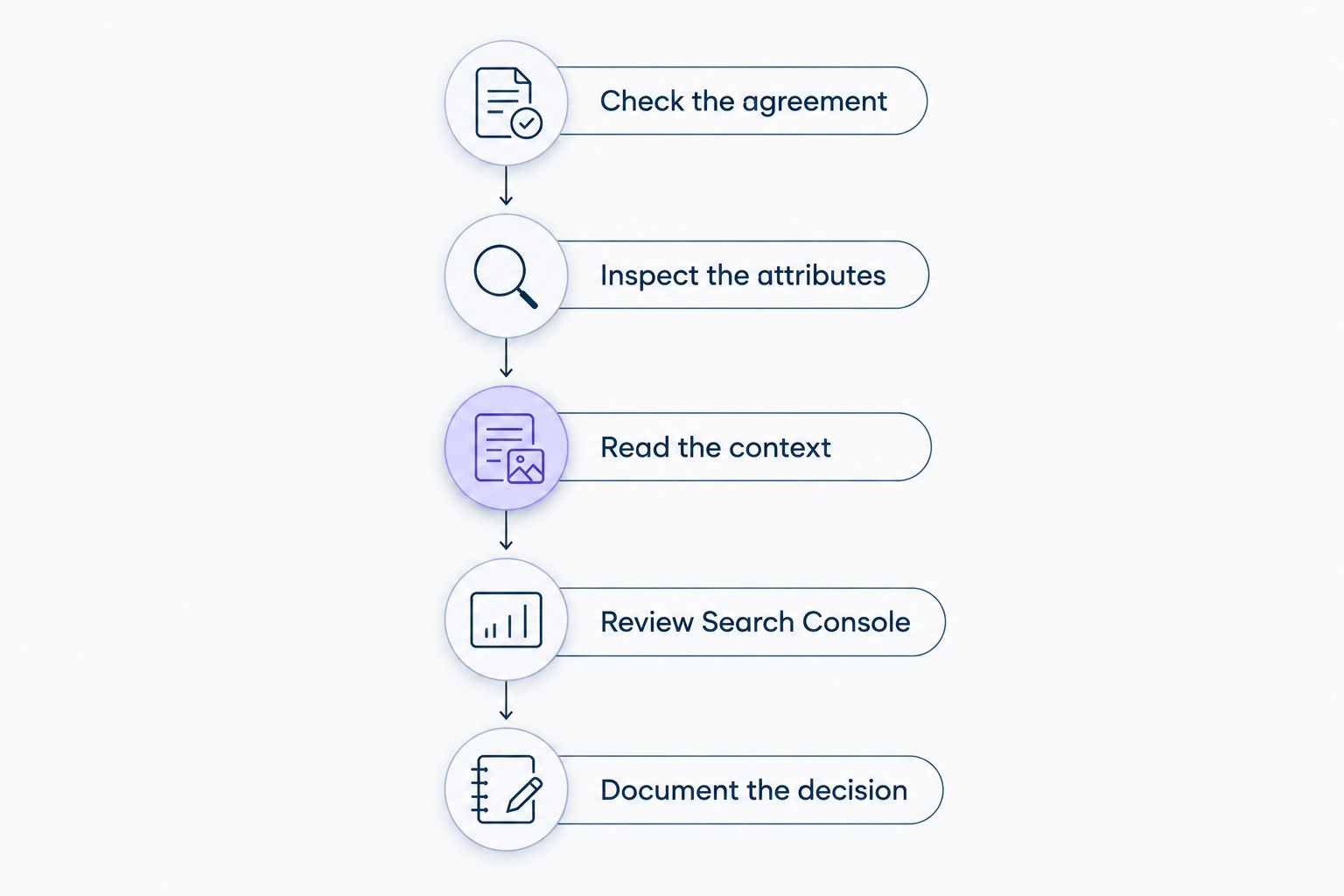
The audit ends with an action, not a prediction about Google's next update. Assign responsibility for publisher requests and preserve evidence of the result.
Can Google detect paid links with branded anchors?
A branded anchor does not exempt a paid ranking link from Google's spam policies. The commercial arrangement and purpose remain relevant even when the anchor contains only your company name.
Do not replace a commercial keyword with a brand name and mark the issue resolved. Anchor wording is one part of a link; it does not change whether the publisher was paid to supply ranking credit.
Does a sudden increase in backlinks prove you bought them?
A sudden increase in backlinks does not prove payment. News coverage, useful resources, and other legitimate attention can produce bursts of links.
Google does not publish a universally safe monthly acquisition quota. Set campaign activity around legitimate opportunities and editorial work, not an invented schedule intended to look undetectable.
Should you disavow every suspicious backlink?
Do not disavow every suspicious backlink. Google's guidance reserves the disavow tool for specific circumstances involving substantial artificial or low-quality links and a manual action, or a likelihood of one.
Start with evidence, removal efforts where appropriate, and Google's current instructions. The tool is not routine maintenance for every unfamiliar referring domain, and incorrect use can harm search performance.
FAQ
Can Google see the payment for a backlink?
Google does not publish a payment-record lookup as its method for detecting paid backlinks. Its public documentation describes automated link-spam systems, manual review, and policies covering compensated ranking links.
Does Google penalize every paid backlink?
Google does not describe every paid backlink as a violation. Advertising and sponsorship links are permitted when appropriately qualified; buying links to manipulate rankings violates its spam policies.
Is sponsored better than nofollow for a paid link?
Google prefers rel="sponsored" for advertising and paid placements, while rel="nofollow" remains acceptable. Check the actual published anchor element rather than relying on a publisher's promise.
Will a high Domain Rating make a paid backlink safe?
A high Domain Rating does not establish Google policy compliance. Domain Rating is a third-party metric, not Google's approval of a publisher or an individual paid link.
Can Google detect a paid link inserted into an old article?
An old article does not exempt an inserted paid link from Google's link-spam policies. Google does not publish a separate detection threshold that makes older placements safe.
How do I know whether Google issued a backlink penalty?
Check the Manual Actions report in Google Search Console for a reported unnatural-links action. A ranking decline without that report does not establish a manual penalty or prove paid-link detection.
Do sponsored links still have marketing value?
Sponsored links can send readers to your site and support paid exposure. Evaluate relevant referral visits and business outcomes rather than promising ranking credit.
Can a marketplace guarantee that Google will not detect a paid link?
A marketplace cannot substantiate an undetectable-link guarantee from Google's public documentation. Google does not disclose its full detection methods, and marketplace participation does not override its spam policies.
One last thing
Ask whether you would still want the placement if it carried a sponsored attribute. If the answer is no, your business case depends on ranking credit that the publisher cannot guarantee.
Make that question part of every 2026 placement brief. It separates a defensible audience decision from a promise about Google's systems.