
Trust is in short supply these days, especially on the Internet. Misinformation continues to run rampant as our reliance on the Web for information grows. It’s reached the point where everyone’s struggling to separate fact from falsehood.
Enough was enough. People now demand ways to curb its spread, whether they come from the government or the private sector. Google, for example, has developed some measures. One of its latest features is Preferred Sources, which enables users to add their publishers of choice. Websites on this list take priority in appearing in search results over others.
Preferred Sources was introduced last year, but it didn’t go global until the end of April. The feature would be a big help in ensuring that users consume only good-quality content. As a publisher or website owner, you may be wondering right now how you can use this feature to your brand’s advantage. Fortunately, Google’s got you covered there.
How Preferred Sources Works
To use this feature, users need to go to a search result that displays Top Stories. As the term suggests, this is where the latest relevant news is shown. Preferred Sources is located next to the section’s title (encircled in red).

The user will then be brought to the Preferred Sources dialog box. Using the search box at the top, they can search for websites they trust and save them in their personal list.
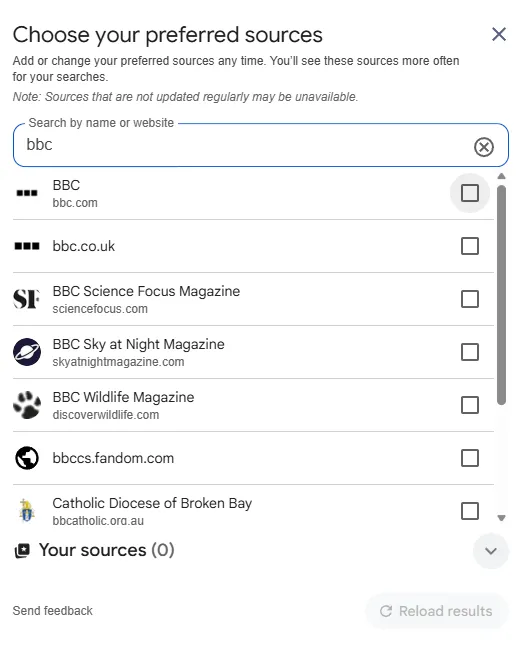
Once the user finishes selecting their sources, they click Reload Results. For this example, I picked NPR, BBC, and CNN. Content from saved websites will appear at the top of the Top Stories section with the appropriate mark.

Google also uses the list on other search services, namely Discover, AI Overviews, and AI Mode. For the latter, Gemini will prioritize content from Preferred Sources to deliver the results users want to read. Nevertheless, it’ll continue to source information from non-preferred websites, so the feature isn’t strict.
There’s no limit to how many websites users can add to the list. However, experts state that doing so defeats the purpose of having preferred sources in the first place.
Minimizing Manipulation
There’s more to Preferred Sources—and others like it—than just being nifty features. They come at a critical juncture concerning how we conduct SEO.
And no, I’m not talking about AI search.
Not long ago, I talked about the different black-hat SEO techniques still being used today. I won’t go over them here, but they have one thing in common: search engine manipulation. But rather than changing lines of search engine code, they “game” or trick the system into pushing poor-quality content up search results.
It’s a pain in the neck that we’ve been dealing with for decades. Even when search engines put measures in place (e.g., Google’s Panda and Penguin updates), black-hat SEO persists mainly because it’s what people have gotten used to. Not to mention it’s easier than trying to make sense of every update Google introduces.
As to how all this goes back to Preferred Sources, it may be the first step to a transition.
Until now, search engines have been the ones enforcing the rules through their algorithms. But Preferred Sources shows a willingness to hand over some control to the user. After all, they know what they want better than search engines or SEO professionals.
There’s no manipulating a human user in this instance, at least as far as SEO is concerned. Unlike the algorithm, people aren’t as easily deceived by content that spams keywords or lacks key information. If content fails to deliver, people have the option to look elsewhere.
Of course, this doesn’t protect them from well-crafted misinformation or content with an underlying agenda. If anything, a recent study revealed that the current generation (Gen Z) is the most prone to such content. There’s a risk that Preferred Sources might make them less open-minded by preferring websites that share their sentiments.
Regardless, it’s interesting to see a feature that lets users have some control over how they consume content. Practices such as keyword spam would have little to no say over human decision-making. As to whether this will be the case moving forward, only time can tell.
Becoming a Preferred Source
Google states that only domain and subdomain-level websites are eligible to be Preferred Sources. This poses a bit of a challenge because it means you need to be credible not just for a single article or post but for the entire website.
At least you can take solace in the fact that the usual SEO techniques can still be effective here. It’s just that you have to apply them to every page to appear more trustworthy in your visitors’ eyes. Note that Google is still on the lookout for violations, and Preferred Sources won’t save a website that got deindexed as a penalty.
But when you’re confident about the quality of your content, Google provides a few tips on boosting your chances of becoming a preferred source. They aren’t required, but these are the only means of doing so in the meantime.
The first is to design and implement a button that leads to the Source Preferences tool. You can either make your own or download one from Google Search Central. Keep in mind that the latter option currently only has buttons for the following languages:
Danish
English
Estonian
Finnish
French
German
Hebrew
Hindi
Japanese
Korean
Portuguese (Brazil)
Russian
Spanish
Swedish
Turkish
Ukrainian

The buttons in dark and light themes
The ideal place for these buttons is after a call to action (CTA) in a post. They can also be embedded in the website footer and newsletter emails.
For social media posts, a deep link would be more suitable. Similar to the buttons, these links lead to the Source Preferences tool by posting the following URL format:
And that’s about everything Google said. Not as lengthy as its SEO playbook, but it hinges on how well the website can sate a reader’s curiosity or need for information.