
No—a guest post does not need to match your exact niche, but the article, its audience, and the linked page need a clear topical connection. For your 2026 campaign, prioritize useful editorial context over matching industry labels, and remember that relevance does not make a paid ranking link compliant with Google's spam policies.
- Does a guest post need to match your niche? No—require a clear connection between the article and destination.
- Adjacent-niche guest posts work editorially when readers share the problem your linked resource solves.
- Google requires paid links to be qualified; niche relevance does not remove that requirement.
- NO-BS Marketplace serves SEO professionals and agencies sourcing guest posting placements; publisher vetting still matters.
Does a guest post need to match your niche to help SEO?
Exact niche matching is not a prerequisite; a defensible connection is the better selection rule. A project management business can contribute a useful article to a construction publication about coordinating subcontractors. That connection comes from the reader's problem, not identical business categories.
Use the following comparison to separate a genuine adjacent topic from a forced placement. Then audit the publisher site before buying a placement, rather than approving it on category alone.
| Placement type | Best for | Editorial advantage | Limitation | Recommendation |
|---|---|---|---|---|
| Same-niche publisher | Specialist subjects and closely matched readers | The subject connection is straightforward | A matching niche does not prove quality or editorial standards | Prioritize when the article adds something useful |
| Adjacent-niche publisher | Shared customers, tasks, or business problems | You can explain expertise in a different but relevant setting | The connection needs to hold throughout the article | Consider when the destination serves the reader |
| Unrelated publisher | No clear SEO-led use case | A broad publisher can still have a relevant section | An unrelated article or destination creates a forced connection | Skip when you cannot explain the reader benefit |
This is a placement-selection framework, not a prediction of ranking gains. A relevant article can still contain a link Google ignores, and an otherwise credible website can publish a poor guest contribution.
Why this matters
A strict niche-only filter excludes legitimate editorial opportunities. A loose filter admits articles that exist only to carry a backlink. Neither approach asks the question that matters: why would this publication's reader need the linked page?
For a 2026 guest posting brief, separate editorial relevance from ranking expectations. Your article needs to deserve publication even when you cannot promise that its backlink will improve a target keyword.
That distinction also protects your reporting. A published placement, a referral visit, and a ranking improvement are different outcomes—not interchangeable proof that a campaign worked.
Same-niche guest posts: the clearest subject connection
Best for: technical subjects and readers who already understand your category. Same-niche publications let you address specific problems without spending the opening explaining why the subject belongs there.
Consider a hypothetical accounting practice contributing an article about preparing business records for tax filing to an accounting publication. The publication, article, and destination can all address the same reader need. The connection is easy to explain.
The drawback is false confidence. A website covering accounting is not automatically a trustworthy accounting publication, and a guest article full of generic advice does not become useful because its category matches yours.
Check the surrounding editorial work. Does the publication explain difficult subjects accurately? Do its articles serve a recognizable audience? Does your proposed contribution add expertise rather than repeat material already published?
Recommendation: prioritize same-niche placements when quality and reader usefulness also pass inspection. Do not treat niche alignment as approval by itself.
Adjacent-niche guest posts: follow the reader's problem
Best for: businesses whose expertise solves problems across industries. Adjacent relevance exists when your audience and the publisher's audience share a meaningful task, decision, or concern.
Take a hypothetical cybersecurity provider writing for a professional-services publication. An article about protecting client documents fits that readership. A link to a detailed document-security resource can extend the article without changing its subject.
The advantage is editorial flexibility. You can contribute something useful outside a narrowly defined industry category. The limitation is that a weak connection becomes obvious when the article suddenly shifts toward your sales pitch.
Keep the subject anchored to the publisher's readers. Explain their problem in their language, then link only where your destination provides a relevant next step.
Recommendation: consider adjacent-niche placements when you can explain the audience connection without mentioning backlinks. If the rationale depends entirely on a domain metric, the brief needs work.
General-interest guest posts: inspect the section and article
Best for: subjects that genuinely belong in a broader publication's established coverage. A general-interest domain does not need to specialize entirely in your industry for an individual article to be relevant.
A hypothetical home-maintenance article in a publication's established property section can reasonably discuss plumbing. That does not justify inserting a plumbing-service link into an unrelated entertainment article on the same domain.
The advantage is that broad publications can cover several legitimate subjects. The drawback is that domain-wide labels reveal little about the context of your particular placement.
Inspect the section, neighboring articles, proposed topic, and linked destination together. A newly created category containing disconnected promotional posts is not equivalent to an established editorial section.
Recommendation: assess the actual article environment, not just the website's broad description. Reject a placement when the article requires an artificial detour to accommodate your link.
Why guest post relevance varies
Relevance is not a single label attached to a domain. Use these factors to explain why one proposed placement fits and another does not:
- Audience overlap: The publication's readers face a problem your expertise addresses. Sharing a vague demographic is not enough.
- Article focus: The proposed topic belongs within the publication's existing coverage. A relevant category cannot rescue an unrelated article.
- Link context: The surrounding passage explains why the destination is useful. The anchor should not introduce a different subject.
- Destination fit: The linked page delivers what the article promises. A narrowly useful resource and a general sales page serve different purposes.
- Editorial purpose: The contribution offers useful information beyond the backlink. Publisher review and substantive content matter alongside topical fit.
Use these as questions for judgment, not a numerical relevance score. They are separate checks; passing one does not cancel a failure elsewhere.
For 2026 prospecting, write a short explanation of the connection before commissioning content. If your team cannot agree on why the article belongs, resolve that before drafting.
How do you check whether an adjacent niche is relevant enough?
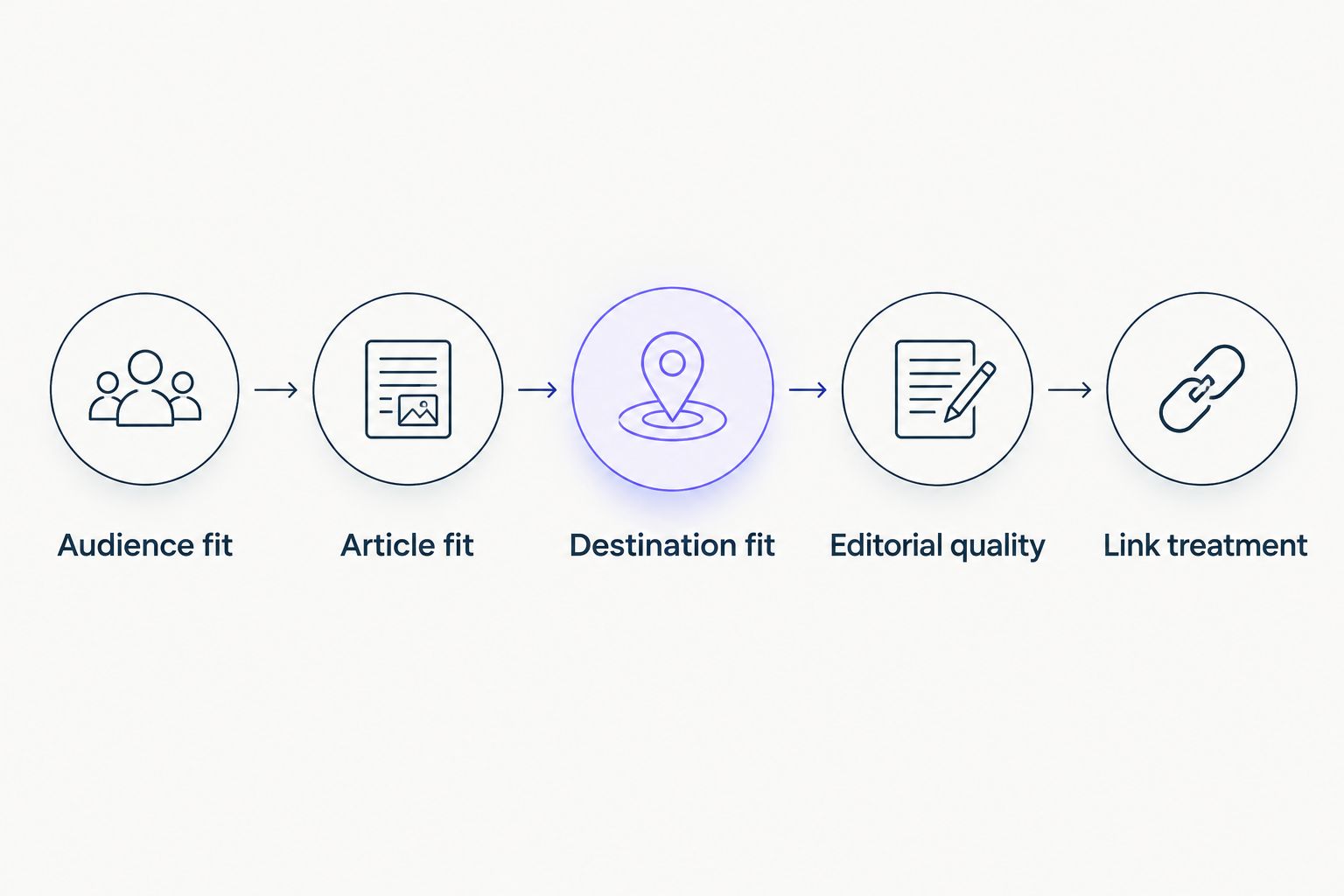
Use these 5 checks before approving a proposed guest post. Apply them to the publication, draft, and destination—not just the publisher's homepage.
- Audience fit: Describe the reader and the problem the article solves. Make the description specific enough to distinguish this publication from an unrelated one.
- Article fit: Review the publication's existing coverage. Confirm that the proposed subject belongs without inventing a new editorial direction.
- Destination fit: Open the exact page you want to link. Check that it answers the question raised by the surrounding passage.
- Editorial quality: Review the draft for accuracy, useful detail, and unnecessary promotion. Remove the backlink temporarily and assess whether the article still deserves publication.
- Link treatment: Establish whether the placement is paid and how the publisher will qualify its links. Keep sponsorship disclosure separate from technical link attributes.
These checks follow a sequence: establish the reader need, confirm the content connection, and inspect how the placement will be published.
Write the justification in 3 sentences: who reads the publication, what problem the article solves, and why the destination helps. This is a briefing exercise, not a Google requirement or a ranking formula.
Reject explanations built around authority alone. A strong domain metric does not explain why someone reading the article should visit your page.
Does topical relevance make a paid guest post safe?
No. Topical relevance does not exempt paid guest posts from Google's link spam policies. Google's Search Central guidance identifies buying or selling links for ranking purposes as link spam and directs publishers to qualify advertising or paid placements with rel="sponsored"; nofollow is also acceptable for marking paid links.
For a 2026 campaign, agree on link treatment before publication. Do not ask a publisher to remove a sponsorship attribute to obtain a supposed SEO benefit.
A visible sponsorship disclosure and a link attribute perform different jobs. Disclosure tells readers about the commercial relationship; the attribute qualifies the link for search systems. Neither substitutes for producing useful content.
A qualified sponsored placement can serve an audience-development objective. Report referral activity and relevant business outcomes without promising that payment buys ranking credit.
Is a relevant lower-authority site better than an unrelated site?
Relevance is a reason to investigate a placement, not proof that it wins. Do not choose between publishers using relevance or a third-party authority score in isolation.
Inspect the actual content, intended audience, editorial standards, and proposed link context. A niche website full of thin promotional articles is not a good recommendation simply because its topics match your business.
Likewise, a broad publication is not irrelevant merely because its entire domain does not specialize in your category. The section and article still need individual review.
Use domain metrics to organize research, not to override a failed editorial assessment. There is no defensible ranking forecast based solely on comparing those labels.
Where does a guest posting platform fit?
NO-BS Marketplace is best suited to SEO professionals and agencies sourcing guest posting placements. The platform connects those buyers with verified publisher sites for guest posts, SEO content, sponsored content, and digital PR placements.
The practical benefit is publisher sourcing. The limitation is that using a platform does not make every proposed article relevant to every buyer, and it does not replace checking Google's paid-link requirements.
When using NO-BS Marketplace, bring the target page and audience rationale into the brief. Evaluate the publisher and proposed topic against those requirements rather than selecting a placement first and inventing a connection afterward.
How should you judge a relevant guest post after publication?
Track 2 outcome groups separately: placement delivery and audience response. This keeps a live backlink from becoming shorthand for business value.
- Placement delivery: Confirm the article is live, the destination is correct, the surrounding passage makes sense, and the agreed link attributes are present.
- Audience response: Review referral visits and the relevant actions visitors take using your analytics setup. Judge those actions against the campaign's stated objective.
For 2026 reporting, record publication dates alongside relevant website changes. Rankings can move while content, technical conditions, competitors, and other links also change; timing alone does not establish that a particular guest post caused the movement.
Keep the original relevance rationale with the placement record. It gives you something concrete to reassess when deciding whether to pursue similar publications.
FAQ
Does a guest post need to match your niche exactly?
No—a guest post does not need an exact niche match. The publication's audience, article subject, and linked destination need a clear connection, and relevance does not guarantee ranking gains.
Can I guest post on a website outside my industry?
Yes, when your contribution addresses a genuine problem for that website's readers. An adjacent industry is a reasonable editorial fit when the linked page provides a useful continuation of the article.
Is a same-niche guest post always a good backlink?
No—a same-niche guest post is not automatically a good backlink. Inspect the publisher's editorial quality, the article's usefulness, the destination, and any paid-link treatment.
Does a high domain rating make an unrelated guest post worthwhile?
No—a high domain rating does not establish reader relevance or guarantee SEO value. Review the actual publication section, article, and link context before approving the placement.
Do paid guest posts need sponsored links?
Google recommends rel=sponsored for advertising and paid placements; nofollow is also acceptable for marking paid links. A visible sponsorship disclosure does not replace the technical link attribute.
Can NO-BS Marketplace replace publisher vetting?
No—NO-BS Marketplace provides a guest posting platform connecting buyers with verified publisher sites, but you still need to assess each proposed placement. Check audience fit, article relevance, destination usefulness, and link treatment.
One last thing
Delete the link from the draft before you approve it. If the article becomes pointless without that link, the contribution needs a better editorial purpose.
Then restore the link and read the destination. A strong article cannot fix a page that fails to deliver what the anchor promises.