
Yes. Undisclosed sponsored content can trigger FTC action when it misleads consumers about an advertisement or hides a material connection behind an endorsement. Advertisers and participating agencies, publishers, or endorsers can face scrutiny; a monetary penalty is not automatic, and the legal basis for relief matters.
- Can undisclosed sponsored content trigger FTC action? Yes. Hidden advertising and undisclosed material connections create enforcement risk.
- FTC disclosure guidance requires clarity consumers can notice and understand, not a label buried beneath sponsored content.
- Guest posts need separate checks for consumer-facing disclosures and paid-link attributes; neither replaces the other.
- Advertisers and agencies should document instructions, inspect live placements, and correct disclosure failures.
Why this matters
Buying a placement does not make it independent editorial coverage. When readers would assess a recommendation differently if they knew about payment, that connection matters.
For your 2026 campaigns, treat disclosure as a publishing requirement, not a cleanup task. Start with how to disclose sponsored content without breaking FTC rules, then build the requirements into your publisher brief and approval process.
The practical rule: readers should recognize the commercial relationship before hidden sponsorship changes how they interpret the message. A strong backlink does not excuse a misleading presentation.
Can undisclosed sponsored content trigger FTC action?
Yes. Section 5 of the FTC Act prohibits unfair or deceptive acts or practices. An advertisement presented as independent reporting, or an endorsement that conceals an unexpected material connection, can fall within that prohibition.
The FTC's Endorsement Guides, at 16 CFR Part 255, explain how the agency applies deception principles to endorsements. The guides are interpretive guidance, not a standalone rule imposing an automatic fine whenever a disclosure is missing.
For a 2026 disclosure review, distinguish these situations:
| Placement | What creates the disclosure issue | Practical response |
|---|---|---|
| Paid publisher article | The article appears to be independent editorial coverage | Identify the advertising clearly where readers encounter it |
| Gifted-product endorsement | Readers do not know the reviewer received something of value | Disclose the material connection clearly alongside the endorsement |
| Affiliate recommendation | The recommendation conceals a commission relationship | Explain the commission relationship near the recommendation |
| Unpaid independent coverage | No sponsor relationship or other material connection exists | Do not invent a sponsorship; assess the actual circumstances |
Payment alone is not the entire test. The FTC considers the overall impression, what consumers reasonably understand, and whether the omitted information matters to their evaluation.
What FTC action actually means
FTC action can include an investigation, an administrative proceeding, or a court case seeking relief authorized by the applicable statute. A settlement or order can impose conduct requirements, including disclosure, monitoring, and recordkeeping obligations.
Do not confuse an enforcement risk with an automatic fine. Civil penalties and other monetary remedies require an applicable legal basis; an initial Section 5 deception allegation does not itself create a universal per-post penalty.
Paid articles: make the advertising recognizable
A sponsored article needs more than an accurate byline. If its presentation suggests independent reporting, readers need a clear indication that they are viewing advertising.
The FTC's native advertising guidance addresses both the promotional entry point and the destination content. When a headline card itself resembles editorial content, a disclosure only on the article page does not necessarily resolve the misleading impression created before the click.
Best for paid editorial-style placements: explicit advertising language placed prominently near the headline or other relevant entry point. Its advantage is clarity; its limitation is that wording alone cannot fix poor placement, unreadable styling, or a misleading overall presentation.
Do not assume that a logo, author biography, or publisher category communicates sponsorship. Review what a reader actually sees, not what the commercial team knows.
Gifted and affiliate endorsements: explain the connection
Money is not the only material connection. Free products, commissions, employment, and personal or family relationships can affect the credibility readers assign to an endorsement.
Whether disclosure is necessary depends on the circumstances, including whether the audience would reasonably expect the connection. Calling content a review does not remove that question.
Best for affiliate recommendations: a plain explanation that the publisher earns a commission from qualifying purchases through the relevant links. The benefit is specificity; the limitation is that a distant sitewide statement does not necessarily explain the connection where the recommendation appears.
For gifted products, state the relevant benefit rather than relying on an ambiguous thank-you. A disclosure does not make an unsupported product claim acceptable, either.
Why FTC disclosure risk varies
The assessment depends on the relationship and the presentation, not a publisher's authority score. These factors come directly from the FTC's endorsement and native advertising principles:
- Material connection: Payment, gifts, commissions, or another relationship can affect how consumers evaluate an endorsement.
- Audience expectations: An unexpected connection requires different treatment from a relationship the audience already understands.
- Overall impression: Editorial styling and surrounding language can make advertising look independent.
- Disclosure prominence: Placement, contrast, size, and competing content affect whether readers notice the disclosure.
- Disclosure meaning: A visible label still fails its purpose if readers do not understand what relationship it describes.
- Distribution format: An article, teaser, video, and repost can expose readers to different messages and disclosure placements.
A publisher's preferred label is not a compliance guarantee. Assess the finished presentation and the audience receiving it.
Who is responsible when an agency buys the placement?
An agency arrangement does not automatically transfer the advertiser's responsibility to the publisher. Advertisers should provide appropriate instructions and oversight for endorsements arranged on their behalf.
Agencies and other intermediaries can also face liability depending on their participation and knowledge. Publishers and endorsers have their own exposure when they participate in deceptive advertising or endorsements; responsibility is not identical for every participant.
For white-label campaigns, identify who approves wording, who controls publication, and who fixes a live error. A contract can allocate those jobs, but it does not determine whether the audience was deceived.
NO-BS Marketplace is a sponsored-content sourcing option for SEO professionals and agencies buying publisher placements. It connects those buyers with verified publisher sites; the limitation is that sourcing a placement does not replace reviewing its disclosure or claims.
When using NO-BS Marketplace for sponsored content, keep the approval decision in your campaign workflow. Verification of a publisher and approval of a specific advertisement are different checks.
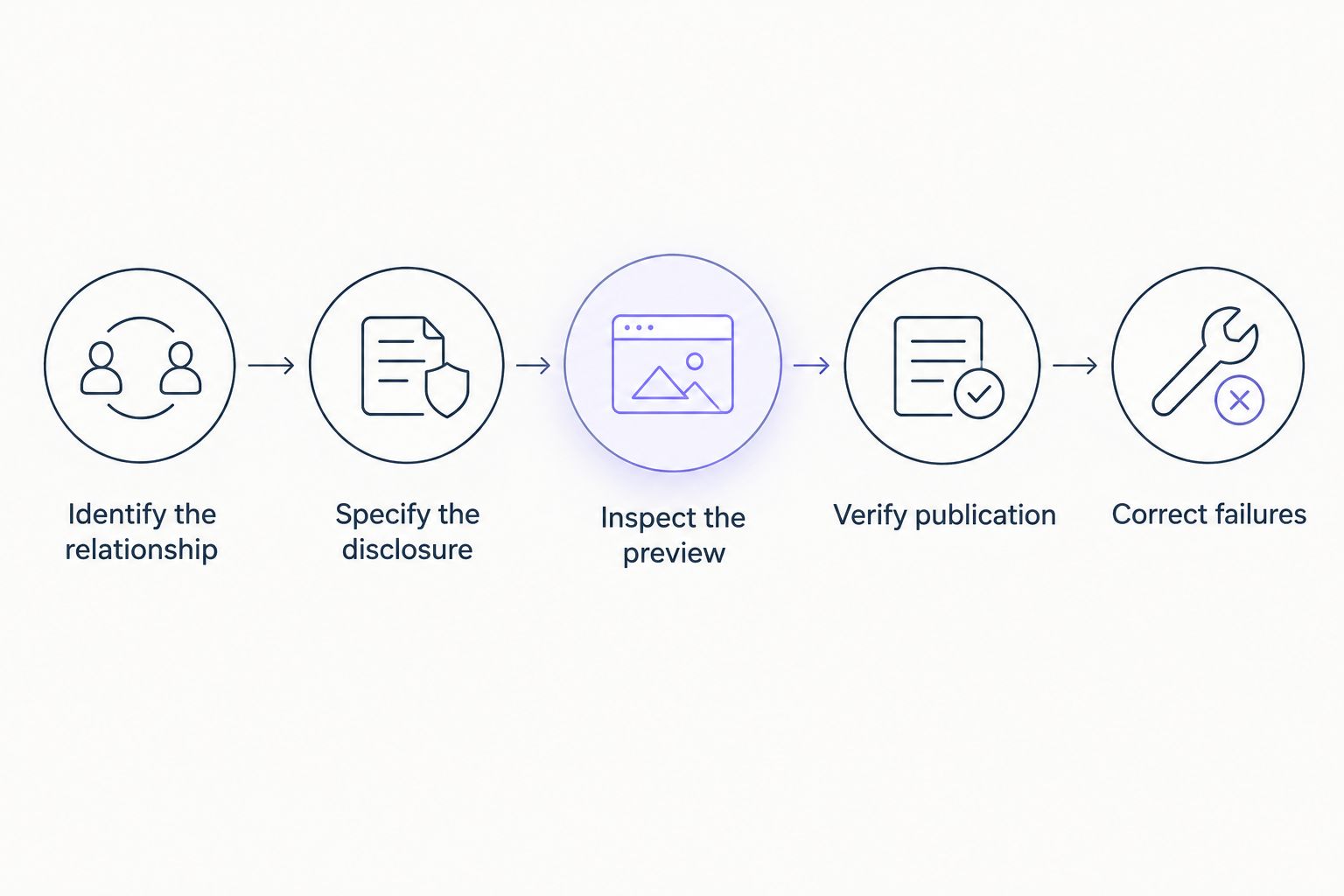
A 5-step disclosure workflow for 2026 campaigns
Use these 5 steps before approving a paid article, affiliate recommendation, or other sponsored placement. This is an operational checklist, not a legal safe harbor.
1. Identify the relationship
Record who provides value, who receives it, and what publication or endorsement the arrangement covers. Include noncash benefits and commission arrangements, not just the invoice.
For an existing article, identify exactly what changes. Adding a paid recommendation creates a different disclosure question from correcting an unrelated factual error.
2. Specify the disclosure
Write the required disclosure into the brief rather than asking the publisher to add an unspecified label. Match the explanation to the actual relationship and use language the intended audience understands.
Reject vague wording that leaves readers guessing who sponsored what. No phrase works automatically across every context, so review wording and placement together.
3. Inspect the preview
Check the headline area, article body, promotional card, and any other agreed distribution format. Inspect the mobile presentation as well as the desktop view.
Confirm that readers do not need to expand a hidden section, visit a separate policy page, or reach the footer to discover the sponsorship. Do not approve a disclosure solely because it exists somewhere in the draft.
4. Verify publication
Open the published page and compare it with the approved version. Check the disclosure, substantive claims, and paid-link attributes separately.
Save the live URL and a screenshot showing the disclosure in context. A draft proves what you requested; a live capture records what the audience encountered.
5. Correct failures
Request a correction when a disclosure disappears, becomes unclear, or moves away from the relevant content. Escalate unresolved failures to the person authorized to pause promotion or request removal.
Keep the correction request and confirmation with the placement record. Documentation supports oversight, but it does not turn a misleading placement into a compliant one.
The sequence matters: define the relationship before choosing the wording, then inspect what actually publishes. A technically correct brief is not the finished advertisement.
Does a sponsored link attribute satisfy the FTC?
No. A sponsored link attribute does not provide the consumer-facing disclosure needed to explain advertising or an endorsement relationship. An HTML attribute communicates information to search systems; readers ordinarily do not see it.
Keep 2 separate checks in your 2026 approval process: disclosure for people and appropriate link qualification for search engines. Passing either check does not establish that the other is complete.
The reverse matters too. A visible advertising label does not automatically satisfy Google's requirements for qualifying paid links, and FTC compliance does not guarantee ranking benefits.
Can a disclosure fix misleading product claims?
No. A disclosure explains the commercial relationship; it does not substantiate the advertising claim. A sponsored article still needs support for its express and implied claims.
Review headlines, comparisons, testimonials, and performance statements rather than checking the sponsorship label alone. Where a claim requires evidence, removing the evidence problem requires changing or supporting the claim—not enlarging the disclosure.
Is fixing an undisclosed post enough to avoid FTC action?
No. Correcting a post does not guarantee that the FTC will take no action. A correction addresses the live problem, but it does not erase how the content previously appeared.
Fix the placement promptly and investigate how the failure happened. If your 2026 campaign contains similar placements, review those too rather than assuming the error is isolated.
FAQ
Can undisclosed sponsored content trigger FTC action if the article is accurate?
Yes. Accurate product information does not cure a misleading impression that paid advertising is independent editorial content. Disclosure and claim accuracy address different problems.
Does every missing sponsorship disclosure result in a fine?
No. A missing disclosure does not trigger an automatic fine. Monetary penalties require an applicable legal basis, and enforcement depends on the facts and available authority.
Do free products count as a material connection?
Yes. A free product can be a material connection that requires disclosure when readers would not expect it and it could affect their assessment of the endorsement.
Can I put the disclosure at the bottom of a sponsored article?
A bottom-only disclosure is inadequate when readers encounter misleading advertising or endorsements before noticing it. Place the disclosure where it clearly explains the relevant content.
Is a sponsored link attribute the same as an FTC disclosure?
No. A sponsored link attribute is not a consumer-facing explanation of the commercial relationship. Review visible disclosures and search-engine link qualification separately.
Can my agency leave all disclosure decisions to the publisher?
Delegating publication does not automatically remove advertiser or agency responsibility. Give clear instructions, review the presentation, and address failures within your control.
Is a platform's paid partnership label always enough?
No. A platform label is not an automatic compliance guarantee. Assess whether the audience can notice and understand the disclosure in the actual presentation.
One last thing
Approve the entry point, not just the destination. A clearly labeled article can still sit behind a promotional card that misleadingly looks like independent editorial coverage.
For your next NO-BS Marketplace sponsored-content brief, require a preview of the article and any agreed promotional teaser. That specific check catches a disclosure problem an article-only review misses.
Legal references for this 2026 checklist are Section 5 of the FTC Act, the FTC Endorsement Guides at 16 CFR Part 255, the FTC's Enforcement Policy Statement on Deceptively Formatted Advertisements, and its Native Advertising: A Guide for Businesses. This article provides general information, not legal advice for a particular placement.