
Yes—undisclosed sponsored content can hurt your SEO when paid links violate Google’s link-spam policies, but a missing disclosure label does not automatically trigger a ranking penalty. In 2026, you need both a clear disclosure for readers and appropriate link attributes for search engines; neither replaces the other. Advertising-disclosure obligations also sit separately from Google’s ranking rules.
- Can sponsored content hurt your SEO if not disclosed? Yes, when paid links violate Google’s link-spam policies.
- Google recommends rel=sponsored for paid links; nofollow remains acceptable.
- A visible sponsorship label does not qualify backlinks, and link attributes do not disclose advertising to readers.
- NO-BS Marketplace connects SEO professionals and agencies with publishers; assess each sponsored content placement separately.
Can sponsored content hurt your SEO if not disclosed properly?
Yes, but separate advertising disclosure from paid-link qualification before diagnosing the problem. A sponsorship statement tells readers about a commercial relationship. An HTML link attribute tells Google how to treat the relationship behind a link.
Google Search Central’s guidance on qualifying outbound links recommends rel="sponsored" for advertisements and paid placements. Google also accepts rel="nofollow" for these links. Its spam policies identify buying or selling links for ranking purposes as link spam unless those links are appropriately qualified.
For reader-facing requirements, use the guide to disclosing sponsored content without breaking FTC rules. Do not assume that adding a technical attribute satisfies advertising-disclosure requirements.
| Placement condition | Reader-facing issue | Search-facing issue | Next move |
|---|---|---|---|
| Clear disclosure and qualified paid links | Commercial relationship is identified | Paid links are appropriately marked | Check the content and surrounding publisher practices |
| Clear disclosure but unqualified paid links | Relationship is identified | Disclosure does not resolve link-spam exposure | Add appropriate attributes to paid links |
| Qualified paid links but hidden sponsorship | Readers lack a clear explanation | Link qualification does not disclose the advertisement | Correct the visible disclosure |
| Hidden sponsorship and unqualified paid links | Both checks fail | Paid links remain unqualified | Correct both before approving the placement |
These are 2 separate checks, not interchangeable ways to complete the same task. Passing either check does not establish that the article is useful, accurate, or otherwise compliant.
Why this matters
A sponsored article can look like an ordinary editorial while serving a commercial purpose. If your campaign report counts that placement as an independently earned recommendation, your reporting misrepresents what you bought.
The practical issue in 2026 is not whether sponsorship is inherently bad. Google explicitly provides a way to qualify paid links. The problem starts when a campaign depends on concealing payment so that a purchased link appears to be an editorial ranking signal.
Keep the business case separate from the ranking promise. You can evaluate sponsored content for relevant exposure, referral visits, and reader engagement without presenting a paid backlink as guaranteed ranking credit.
What does proper disclosure actually require?
For US campaigns, FTC guidance on native advertising focuses on whether people recognize commercial content as advertising. Disclosures should be clear, prominent, and understandable in the context where people encounter the content.
Use direct language that identifies advertising or sponsorship. Do not make readers decode a vague partnership description, search a footer, or open a separate policy page to understand the relationship.
Disclosure placement matters as well as wording. Review the article itself and any promotional presentation that could make the advertisement appear to be independent editorial content. A clear statement on the article does not automatically fix a misleading promotional card elsewhere.
Best for reader transparency: a prominent, plain-language disclosure that accurately explains the commercial relationship. Its limitation is technical: it does not tell Google how to treat the article’s paid links.
The FTC’s native advertising guidance and endorsement guidance address related but distinct situations. Apply the guidance relevant to the actual placement rather than treating every paid article, endorsement, and affiliate recommendation as identical.
What link attributes should sponsored content use?
Best for identifying paid links to Google: rel="sponsored". Google Search Central specifically recommends this attribute for advertisements and paid placements. Its purpose is to qualify the link relationship, not to display a sponsorship notice.
rel="nofollow" remains acceptable for paid links under Google’s guidance. A publisher does not need to replace an existing, appropriately applied nofollow attribute solely because sponsored is more specific. Multiple relationship values can also appear on the same link.
| Attribute approach | Best for | Advantage | Limitation |
|---|---|---|---|
rel="sponsored" |
Explicitly identifying a paid relationship | Matches Google’s recommendation for paid placements | Does not provide a visible advertising disclosure |
rel="nofollow" |
Qualifying paid links using an accepted alternative | Google accepts it for paid links | Does not describe sponsorship as specifically |
| No qualifying attribute | Links that do not require paid-link qualification | Appropriate for ordinary editorial links where applicable | Not an appropriate way to qualify a purchased link |
Inspect the actual hyperlink, not just a publisher’s description of it. A label above the article and an attribute on the link are different parts of the page.
Also distinguish nofollow from noindex. A link relationship attribute is not a directive to remove the whole sponsored article from search results. Do not request page removal when the problem is an unqualified paid link.
Why the SEO risk varies
No single disclosure label determines the outcome of a whole campaign. Assess the placement against Google’s link-spam policies and review what the campaign is actually buying.
- Link qualification: Paid links without appropriate attributes create a different policy issue from properly qualified advertising links.
- Campaign purpose: Buying links to manipulate rankings is the conduct Google’s link-spam policies address. Calling the transaction editorial does not change its purpose.
- Publisher conduct: Review whether the publisher participates in link schemes or other spam practices. A disclosure alone does not resolve unrelated violations.
- Placement pattern: Assess the campaign rather than approving isolated pages while ignoring a coordinated paid-link arrangement.
- Content purpose: A useful sponsored article and a page created mainly to carry manipulative links require different editorial judgments. Neither usefulness nor disclosure excuses a link-spam violation.
Domain Rating is not a Google compliance certificate. A third-party authority metric cannot establish that a paid link is appropriately qualified or that an advertisement is clearly disclosed.
Likewise, a publisher’s promise that a placement is safe is not evidence. Ask for the proposed disclosure and inspect the published link.
How do you audit a sponsored article before signing it off?
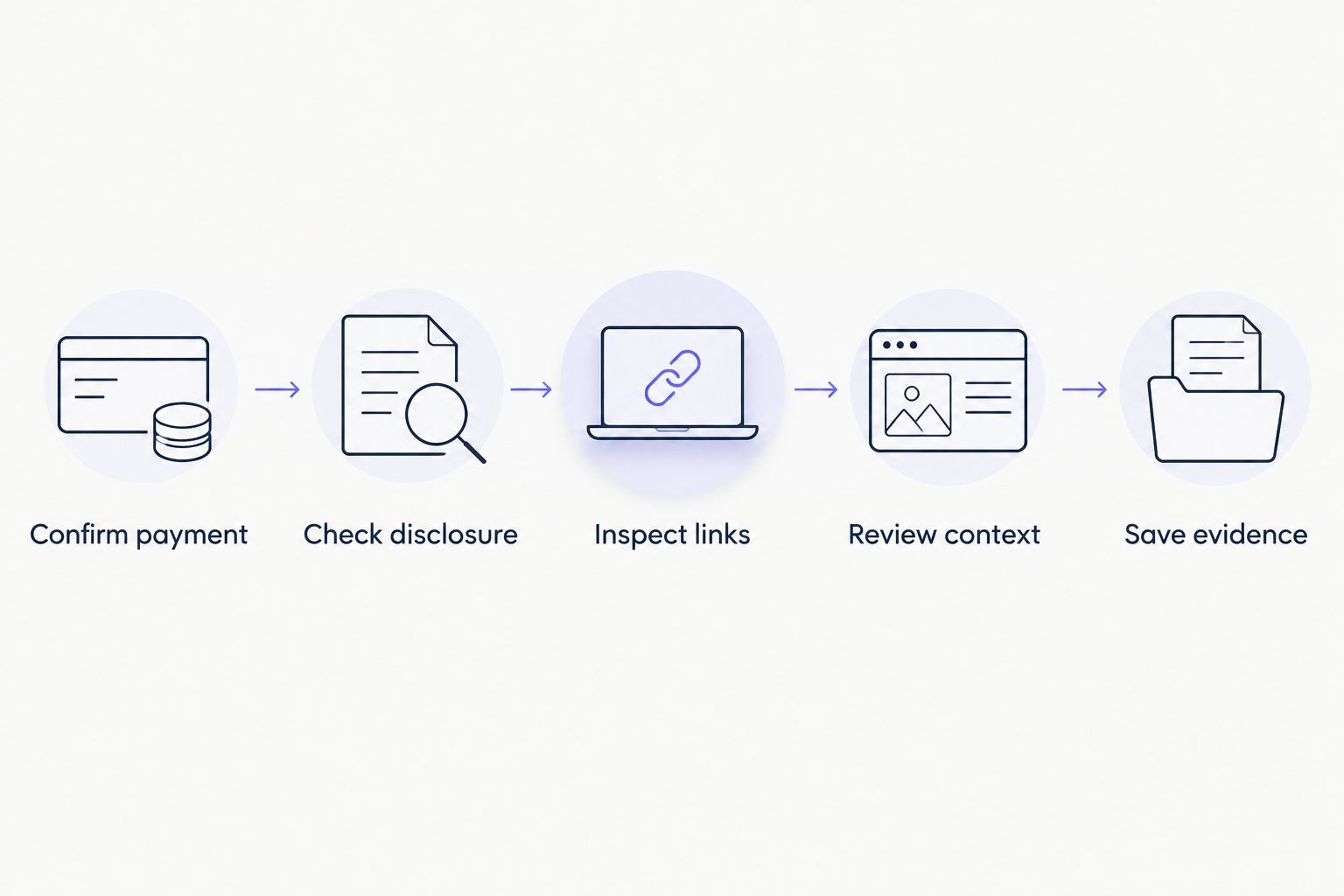
Use this 5-step review for your 2026 placements. Apply it to the published article, not only to a draft, because the live page is what readers and search engines encounter.
1. Confirm payment
Record whether money, products, services, or another material benefit formed part of the arrangement. Identify what was purchased: article production, publication, a link insertion, an endorsement, or a combination.
Do not classify a placement as earned editorial simply because a journalist or editor wrote it. Establish the commercial relationship first, then assess the disclosure and link treatment.
2. Check disclosure
Open the article as a reader would. Confirm that the disclosure is understandable, visible, and accurately describes the relationship without requiring a search through unrelated site policies.
Review the mobile presentation too. A disclosure that disappears into a collapsed element or becomes difficult to notice needs attention, regardless of how clear it looked in the desktop draft.
3. Inspect links
Inspect each paid destination link in the published HTML or browser developer tools. Check the actual rel value rather than relying on visible anchor text or an order confirmation.
Record the destination and attribute together. If the article contains several links, do not assume that qualification applied to one link also applies to the others.
4. Review context
Read the surrounding paragraph and the article’s claims. Confirm that the link helps readers understand the subject and that the article does not present unsupported endorsements as independent findings.
Check publisher quality separately from disclosure. A correctly marked link does not turn a low-value page into a worthwhile placement, and a relevant article does not excuse hidden advertising.
5. Save evidence
Save the live placement URL, publication date, disclosure wording, and observed link attributes. Keep the evidence with the campaign record so the client can distinguish paid distribution from earned coverage.
Record any correction request and its outcome. Your approval should reflect the published page, not a promise that the publisher will fix it later.
What should an agency require from a placement provider?
Require clarity about the publisher, the commercial arrangement, the disclosure, and the expected link treatment before approving the placement. Reject a campaign brief that promises editorial credibility while requiring the publisher to conceal sponsorship.
NO-BS Marketplace is best for SEO professionals and agencies seeking a platform for purchasing publisher placements. The platform connects those buyers with verified publisher sites for SEO content, backlinks, sponsored content, and digital PR placements.
The practical advantage of the NO-BS Marketplace sponsored content offering is access to publisher placements. That access does not replace your review of the disclosure, link attributes, content claims, or campaign purpose.
For NO-BS Marketplace sponsored content campaigns, apply the same acceptance checks you would apply to any paid placement. Publisher access and search-policy compliance are different questions; verify the latter on the live page.
What should you do if an existing placement fails the checks?
Correct the specific failure rather than deleting everything by default. Ask the publisher to add a clear disclosure if the commercial relationship is hidden, and to qualify paid links if the attributes are missing.
If the publisher refuses appropriate qualification, request removal of the paid link. Preserve the correspondence and update the campaign record so an unresolved placement does not remain marked as approved.
If Search Console reports a manual action, follow the instructions for that action and document the cleanup. A reconsideration request belongs to the manual-action process; it is not a general response to every ranking decline.
For your 2026 remediation record, distinguish 3 outcomes: corrected, removed, and unresolved. Those statuses describe observable work without claiming that a correction guarantees a ranking recovery.
Does adding a sponsorship label fix the backlink?
No—a sponsorship label does not qualify a paid backlink. The publisher still needs an appropriate link attribute, such as rel="sponsored" or the accepted rel="nofollow" alternative.
The reverse is also true. An attribute hidden in HTML does not explain the commercial relationship to readers, so it cannot substitute for a clear advertising disclosure.
Will Google automatically penalize your site for an undisclosed article?
No—an undisclosed article does not establish an automatic Google penalty. Google’s link-spam policies concern manipulative linking practices, while advertising-disclosure requirements address how commercial relationships are communicated.
Google can neutralize spam links, and policy violations can lead to manual actions. Do not describe every ignored link or ranking movement as a penalty; check Search Console and the placement evidence before making that diagnosis.
Is sponsored content still useful without ranking credit?
Yes—sponsored content can serve an audience and referral objective without a promise of ranking credit. Judge the placement by whether the right readers encounter useful content and take relevant actions.
For 2026 reporting, separate the paid placement’s referral performance from organic search performance. Attribution does not become reliable merely because publication and a ranking change happened near each other.
FAQ
Can sponsored content hurt your SEO if not disclosed?
Yes, sponsored content can hurt your SEO when paid links violate Google’s link-spam policies. A missing visible disclosure is a separate advertising-transparency issue, not proof of an automatic ranking penalty.
Do I need both a disclosure and a sponsored link attribute?
Yes, reader-facing disclosure and paid-link qualification serve different purposes. A clear advertising label informs readers, while an appropriate rel attribute qualifies the paid link for Google.
Is nofollow acceptable for sponsored links?
Yes, Google accepts nofollow for paid links, although sponsored is its recommended attribute for advertisements and paid placements. Neither attribute replaces visible advertising disclosure.
Does a sponsored attribute stop an article from ranking?
No, the sponsored link attribute is not a noindex directive for the article. It qualifies a link relationship rather than directing Google to exclude the entire page.
Can a publisher call a paid article an editorial instead?
Calling a paid article an editorial does not change the commercial arrangement. Assess the payment, reader-facing presentation, and link attributes rather than relying on the publisher’s label.
Should I disavow every sponsored backlink?
No, do not disavow sponsored backlinks simply because they are sponsored. Google reserves the disavow tool for specific circumstances involving substantial problematic links and a manual action or likely manual action; start by seeking correction or removal.
What should I check after a publisher fixes a sponsored post?
Check the live disclosure and the actual attributes on each paid link. Save the corrected page details and keep unresolved issues separate from completed fixes.
One last thing
A corrected campaign can report fewer ranking-oriented links and still be a better campaign. If your old report counted unqualified paid links as earned endorsements, fixing the classification removes a misleading success measure.
Before approving your next 2026 placement, ask a simple question: would this article still justify the spend if its paid link delivered no ranking credit? If the answer is no, reconsider the objective before requesting a less transparent link.