
No, niche edits cannot be added to any article on a site: the publisher must authorize the change, and the link must fit the article’s subject and help its readers. An editable page is not automatically a suitable placement, and a paid insertion must also meet Google’s rules for qualifying sponsored links.
- Can niche edits be added to any article? No: publisher permission and paragraph-level relevance determine suitability.
- NO-BS Marketplace connects SEO professionals and agencies with publishers; evaluate each proposed article separately.
- Google requires paid placements to use appropriate link attributes; publisher approval alone does not establish compliance.
- Choose a guest post when an existing article cannot support your link without changing its purpose.
Why this matters
A publisher can approve your campaign while rejecting the article you picked. Treat site acceptance and article approval as separate decisions. Otherwise, you risk approving a domain before knowing where your link will actually appear.
For your 2026 placement checklist, inspect the specific page rather than relying on a domain-level score. Start with the checks in this guide to auditing a publisher site before buying a placement, then examine the paragraph proposed for the insertion.
The deciding question is not whether someone can add the link. It is whether the publisher should add it. That distinction keeps technical access, editorial permission, and search-policy compliance from getting mixed together.
Can niche edits be added to any article on a site?
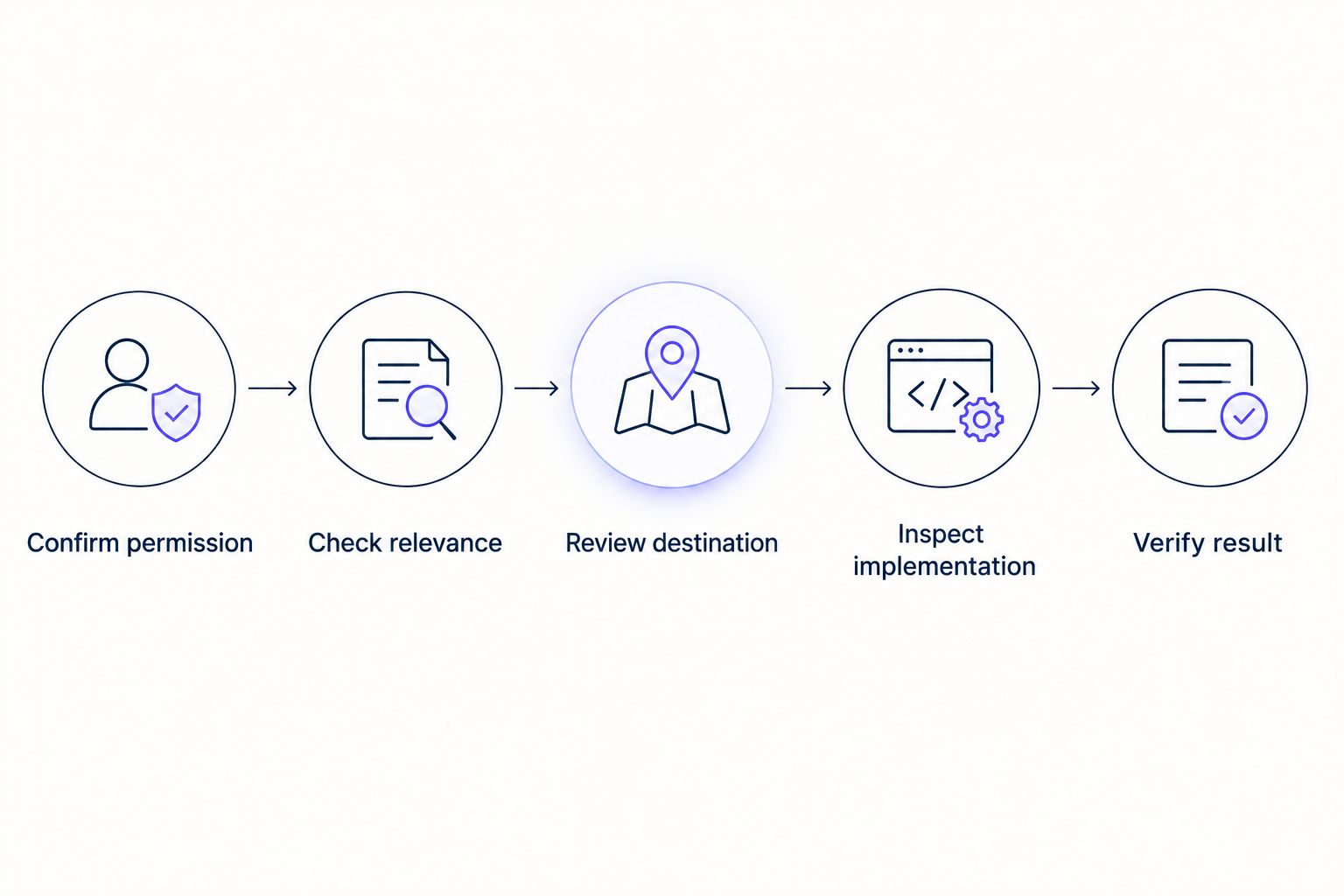
No. A suitable niche edit needs an authorized publisher, a relevant article, a useful destination, and an acceptable implementation. Use the following review sequence before approving an insertion.
1. Confirm permission
Ask the publisher or authorized representative whether the specific article accepts editorial updates or sponsored insertions. Do not assume that acceptance of guest posts also covers changes to existing content.
Record 1 candidate URL per proposed placement in your brief. This is a workflow recommendation, not a publisher requirement: it makes approval specific enough to verify later. Reject any proposal that depends on unauthorized access or changes concealed from the site owner.
2. Check relevance
Read the full article before selecting an anchor. Identify the question the article answers and whether your destination helps answer that same question.
Then inspect the intended paragraph. A broad connection between industries is not enough if the destination interrupts the discussion. An article about employee onboarding, for example, does not automatically support a link to every business software category.
3. Review the destination
Open the exact destination page, not just its homepage. Confirm that the page delivers what the proposed anchor promises and that a reader arriving from the publisher’s article would understand why the link belongs there.
Match the destination to the reader’s task. A technical explanation needs supporting technical material; a buying discussion needs information relevant to that buying decision. Do not use an informational anchor to disguise an unrelated sales destination.
4. Inspect the implementation
Request the proposed sentence, anchor, destination, link attribute, and any applicable sponsorship disclosure before publication. For a straightforward edit, prepare 2 draft sentences: the existing sentence and its proposed replacement. More substantial revisions need a fuller excerpt.
For your 2026 review, apply Google Search Central’s link-spam guidance: paid links should be qualified with rel="sponsored"; Google also accepts rel="nofollow" for marking paid links. A paid link intended to pass ranking credit is not made compliant by placing it inside an otherwise relevant article.
5. Verify the result
Inspect the live article after publication. Confirm that the approved paragraph, destination, anchor, attributes, and disclosure match the agreement.
Keep the review in 3 stages: before approval, at publication, and during monitoring. These are recommended checkpoints, not a promised timetable. Publication confirms that an edit happened; it does not prove that Google indexed the change or that the link improved rankings.
Which articles are suitable for niche edits?
Choose an existing article only when the insertion improves that article without changing its purpose. Use this table to separate a useful update from a forced placement. These are screening recommendations, not claims about any particular publisher’s inventory.
| Article situation | Best for | Benefit | Limitation | Recommendation |
|---|---|---|---|---|
| Relevant guide with a missing supporting resource | Adding a useful explanation or reference | The link supports an existing reader question | The destination still needs editorial review | Consider the edit |
| Relevant article with an outdated reference | Updating supporting material | The revision can improve accuracy | Replacing a reference requires checking its original purpose | Propose a documented update |
| Broadly related article with no suitable paragraph | Further prospect research | The site’s audience offers a starting point | Site-level relevance does not establish paragraph-level fit | Find another article |
| Unrelated article offered only for its domain metrics | No recommended use | Domain metrics are available for screening | The insertion lacks a reader-focused reason | Reject the placement |
| Article requiring an entirely new argument to fit the link | A separate content brief | The topic can be addressed directly elsewhere | The original article is the wrong vehicle | Consider a guest post |
Consider a hypothetical payroll guide discussing onboarding documents. A link explaining required paperwork fits that discussion more naturally than a link to unrelated office furniture. Both destinations concern workplaces, but only one answers the question in the paragraph.
Apply the same test to your own landing pages. If you need a long explanation to justify the connection, return to prospecting rather than rewriting the article around your target URL.
Why niche edit eligibility varies
A publisher’s ability to edit its site does not establish a blanket policy for every article. Your review should cover these factors:
- Publisher authorization: Confirm who has permission to approve and publish the change. Access credentials alone do not establish authorization.
- Article purpose: Check whether the proposed edit supports the article’s original question, audience, and scope.
- Destination usefulness: Assess the exact resource being linked, including whether it supports the surrounding claim.
- Editorial restrictions: Ask whether the article has author, contractual, or publication restrictions. Do not assume restrictions exist; obtain an answer.
- Commercial treatment: Confirm the required link attributes and applicable disclosure before approval.
- Page condition: Check whether the article is accessible, current enough for the proposed reference, and technically eligible for your campaign’s objectives.
In 2026, use these as approval criteria rather than treating any single metric as a substitute. A strong domain-level score cannot tell you whether an author permits changes or whether the target paragraph makes sense.
Keep the outcome explicit: approved, revision requested, or rejected. A vague status such as “publisher looks good” leaves the article-level decision unfinished.
Are niche edits better than guest posts when an article does not fit?
No: a guest post is the better format when you need a separate article to explain the topic honestly. A niche edit uses an existing discussion; a guest post creates a new discussion, subject to the publisher’s editorial approval.
| Format | Best for | Main advantage | Main limitation |
|---|---|---|---|
| Niche edit | A resource that fills a gap in an existing article | No separate article is needed when the fit already exists | You depend on the existing article’s scope and permission to update it |
| Guest post | A topic that needs its own explanation | You can propose a coherent article around the reader’s question | You need an approved brief and an original contribution |
Neither format guarantees rankings. Both require relevant content, authorized publication, and appropriate treatment of any commercial relationship.
Do not commission a guest post merely to wrap an unrelated link in more words. The new article still needs a clear audience and a reason to exist without your backlink.
Does an old article automatically make a niche edit valuable?
No: article age alone does not establish relevance, readership, indexing, or link value. Inspect the page as it exists now, including its content, accessibility, and technical signals.
Separate the article’s original publication date from the date of your insertion. An older timestamp does not mean your new link has been present for the article’s lifetime, and it does not guarantee immediate discovery of the update.
For a 2026 campaign, document the insertion date separately in your placement record. That gives you a clear starting point for checking the edit without making unsupported claims about when search engines processed it.
Does publisher approval make a paid niche edit safe for SEO?
No: publisher approval establishes permission, not compliance with Google’s link-spam policies. Google identifies buying or selling links for ranking purposes as link spam unless the links are appropriately qualified.
Separate paid exposure from ranking expectations. A sponsored link can serve a reader, but that does not justify promising ranking credit from the placement. Sponsorship disclosure and link attributes also serve different purposes; one is not a substitute for the other.
Reject assurances that relevance alone makes a paid, unqualified link compliant. Equally, do not treat a sponsored attribute as proof that an article is useful or a publisher is suitable. You still need the editorial review.
What should you send the publisher before approving an edit?
Send a brief that lets the publisher make a specific decision. Include:
- The exact article URL and proposed paragraph.
- The destination URL and the reader question it answers.
- The existing wording and proposed replacement.
- The requested anchor, with permission to revise it for clarity.
- The agreed link attribute and applicable disclosure.
- The approval contact and a record of the final decision.
NO-BS Marketplace is best for SEO professionals and agencies sourcing publisher placements. The NO-BS Marketplace link building platform connects those buyers with verified publisher sites; that sourcing function does not replace review of each proposed article.
The advantage is access to publisher placements through a platform. The limitation is the same as with direct outreach: an available publisher does not establish that every article is appropriate for your destination. Keep the article-level approval gate in your own process.
FAQ
Can niche edits be added to any article if the publisher agrees?
No. Publisher agreement establishes permission, but the article, paragraph, destination, and implementation still need to fit. Paid placements also need appropriate link attributes.
Can I choose the exact article for a niche edit?
You can request an exact article, but the publisher must approve that specific page and change. Confirm the article URL before treating the placement as approved.
Does an article need existing traffic before I request an insertion?
Existing traffic is not a technical requirement for adding a link. Assess readership separately from relevance, permission, and indexing rather than treating traffic as a guarantee of SEO results.
Will a niche edit get indexed immediately?
Publication does not guarantee immediate indexing of an edit. Record the insertion date and distinguish a live link from evidence that Google has processed the change.
Should a paid niche edit use a sponsored attribute?
Yes. Google recommends rel="sponsored" for paid links and also accepts rel="nofollow" for qualifying them. Publisher approval does not remove that requirement.
Can I add an exact-match keyword anchor to any paragraph?
No. The anchor must accurately describe the destination and make sense within the paragraph. Do not distort the article to accommodate a keyword.
Does NO-BS Marketplace replace publisher-level due diligence?
No. NO-BS Marketplace connects buyers with verified publisher sites, but you should still review the proposed article, destination, wording, and commercial treatment before approval.
One last thing
Remove the link from your proposed sentence and read it again. Does the sentence still contribute something useful to the article, or does it exist only to carry an anchor?
Reject edits that need filler to justify the backlink. For your 2026 campaign, that is a practical final check before approval: the edit should improve the explanation, not interrupt it.