
Yes, link insertions can be traced to the destination website, but the backlink alone does not prove who bought the placement. Identifying the actual buyer requires additional evidence, such as an invoice, an order record, or correspondence connecting the placement to a person or business.
- Can link insertions be traced back to the buyer? Yes, with evidence beyond the backlink itself.
- A visible backlink identifies its destination, not necessarily the person or agency that purchased it.
- Google’s link spam rules concern manipulative links; a public payment receipt is not required to assess a link pattern.
- NO-BS Marketplace connects SEO professionals and agencies with publishers; marketplace involvement does not make a placement anonymous.
Why this matters
For your 2026 link-building campaign, separate confidentiality from search compliance. A placement can keep commercial records private while leaving the destination URL, anchor text, and surrounding copy visible to readers and crawlers. Those are different questions.
NO-BS Marketplace is best suited to SEO professionals and agencies seeking a platform for publisher placements. NO-BS Marketplace connects those buyers with verified publisher sites, but that business model does not establish anonymity, a particular records policy, or protection from search enforcement.
Ask what someone can observe, what they can reasonably infer, and what they can prove. Treating those as the same thing creates bad client advice.
Can link insertions be traced back to the buyer?
Yes, when evidence connects the placement to its purchaser. The public link usually establishes the beneficiary of the backlink, while commercial records establish the transaction. Neither should be substituted for the other.
Use these 3 evidence categories when reviewing a placement:
| Evidence category | What it establishes | What it does not establish alone |
|---|---|---|
| Public page evidence | The destination URL, anchor text, surrounding context, and visible disclosures | Who commissioned or paid for the edit |
| Transaction evidence | A purchase or instruction when an authentic record identifies the parties and placement | Whether every related backlink was purchased |
| Pattern evidence | Similarities across placements that support further investigation | A confirmed purchaser or a documented transaction |
A competitor reviewing a published article starts with public evidence. A publisher reviewing its own correspondence has a different evidence base. Your conclusions must reflect that difference.
Public page evidence identifies the destination
An ordinary hyperlink exposes its destination through its link address. A reader can inspect that address even when the anchor text contains only a generic phrase.
The surrounding sentence also matters. A brand mention, product reference, or service description connects the recommendation to the linked business. That establishes context, not payment.
Visible sponsorship disclosures provide additional information about a commercial relationship. Their wording determines what they actually identify; a general sponsorship label does not automatically name the agency that arranged the placement.
Transaction evidence identifies the purchaser
An invoice naming a purchaser and placement is stronger buyer evidence than an anchor-text pattern. An order record or email approving a particular edit can also connect the transaction to its participants.
Access is the limiting factor. An outside observer cannot inspect private commercial records merely because the resulting backlink is public.
Keep the roles straight: the invoice recipient, agency, advertiser, publisher, and linked website owner are not necessarily the same entity. A defensible attribution explains which role the evidence establishes.
Pattern evidence supports investigation, not certainty
Repeated anchors, similar commercial language, or clusters of links to the same destination are observable patterns. They justify closer inspection, but they do not independently identify a purchaser.
For a 2026 backlink audit, record those observations without turning them into accusations. Write that several placements share wording if that is what you found; do not write that a named business bought them without supporting evidence.
Why buyer traceability varies
Buyer traceability depends on the evidence attached to the placement, not whether the seller calls it a niche edit or link insertion.
- Destination ownership: A link identifies a destination. Establishing who controls that destination is a separate task, especially when agencies, affiliates, or third parties are involved.
- Disclosure wording: A disclosure that names an advertiser establishes more about that relationship than an unlabeled commercial reference does.
- Record specificity: A document naming the publisher page and purchaser connects the parties more clearly than an invoice with an unspecified service description.
- Evidence access: Public readers, publishers, agencies, and clients have different access to correspondence and transaction records.
- Historical coverage: Available page snapshots can establish that a link appeared between captures. Without adequate coverage, the precise insertion date remains unproven.
- Intermediary involvement: An agency or reseller adds another commercial relationship. That separates roles; it does not erase the destination link or establish anonymity.
These factors affect attribution. They do not change the need to assess the placement against search policies and advertising disclosure requirements.
Can Google identify paid links without knowing the buyer?
Google does not need a publicly available invoice to assess whether links violate its spam policies. Google's link spam guidance addresses links created primarily to manipulate search rankings, including buying or selling links for ranking purposes.
Buyer anonymity is not a search-policy defense. A private transaction does not make a manipulative link compliant, and a visible backlink does not prove that a violation occurred.
For paid placements in 2026, Google's guidance calls for qualifying paid links with rel="sponsored"; rel="nofollow" remains acceptable for marking them. These attributes communicate the link relationship to search engines. They do not remove the hyperlink from the page or conceal its destination.
Keep potential outcomes separate, too. Google's systems can disregard spam links, and a site can receive a manual action for unnatural links. Do not promise either an inevitable penalty or guaranteed safety based on one placement.
The practical question is whether the arrangement is defensible, not whether you expect someone to discover the payment. See the guide to whether buying backlinks can get you penalized by Google for that separate risk assessment.
Does white-label link building hide the buyer?
White-label delivery is a service arrangement, not proof of anonymity. An agency can manage a placement for a client without appearing in the published article, while the backlink still points to the client's website.
That creates separate identities to assess:
- The beneficiary receives the link to its website.
- The purchaser commissions or pays for the placement.
- The publisher controls the page carrying the link.
A single business can occupy more than one role. Do not assume it does.
NO-BS Marketplace offers white-label link building and guest posting services. That establishes the service category, not a confidentiality agreement, a retention schedule, or a promise about what publishers know.
Before assigning work, ask the provider which parties receive client details and which records document the placement. Require specific answers rather than treating the phrase white label as a privacy policy.
How should you assess a link insertion before approving it?
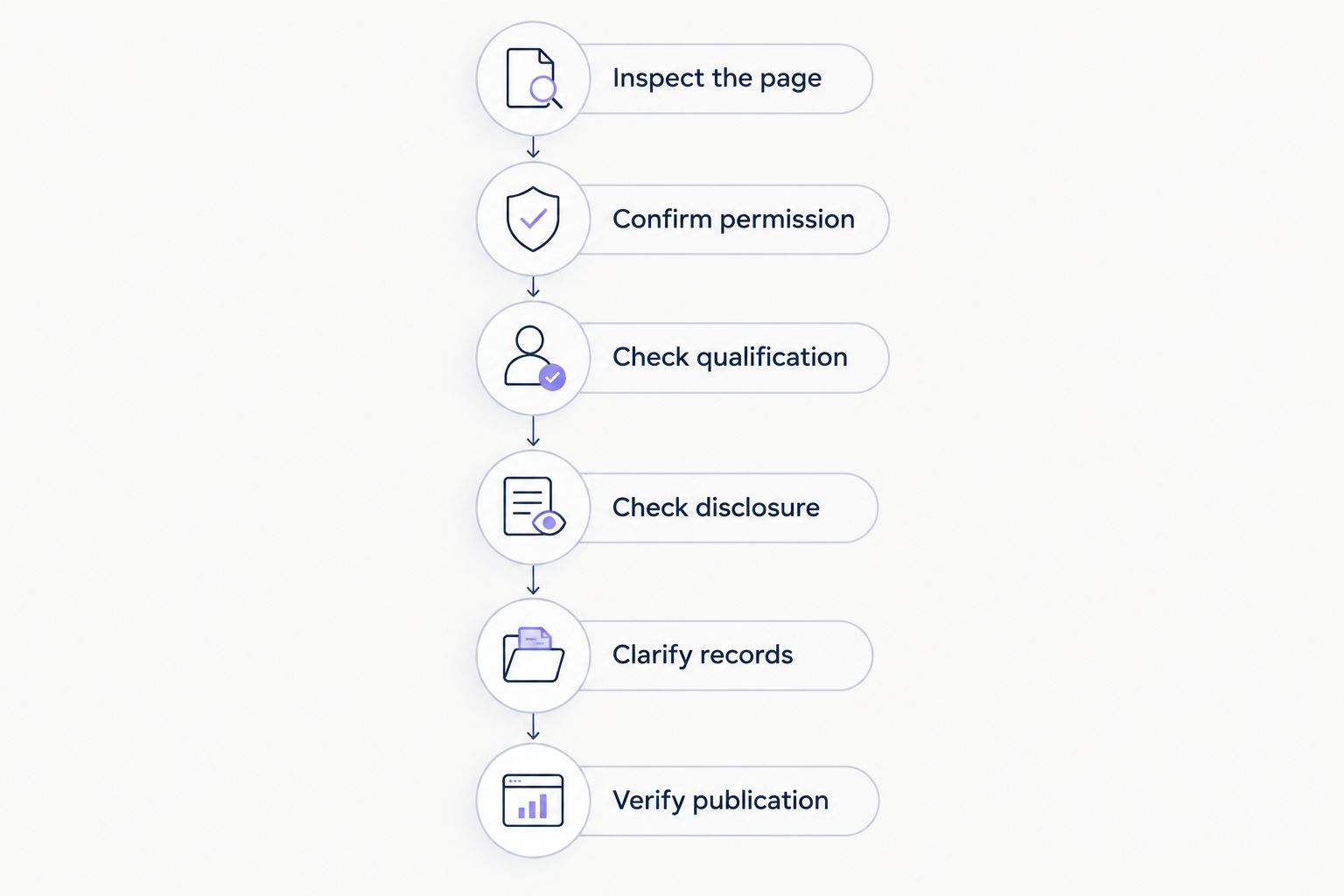
Use these 6 review steps for a 2026 campaign. The sequence keeps evidence, compliance, and client expectations separate rather than reducing approval to a domain metric.
1. Inspect the page
Read the article and the proposed surrounding paragraph. Confirm that the destination genuinely helps a reader understand the subject.
An established article is not automatically a suitable placement. Its age does not establish editorial relevance or authorize a commercial edit.
2. Confirm permission
Require confirmation that the publisher or an authorized representative approves the edit. Do not accept unauthorized changes to someone else's content.
Publisher permission addresses control of the page. It does not, by itself, settle whether the link arrangement complies with search policies.
3. Check qualification
Establish whether the placement is paid and how the publisher will qualify the link. Record the intended link attribute before approval, then inspect the published result.
Reject a promise that a paid link is safe simply because it appears inside existing editorial copy. Placement format does not override the commercial relationship.
4. Check disclosure
Review whether the content creates an endorsement or advertising relationship requiring disclosure. For US campaigns, the FTC's endorsement guidance calls for clear and conspicuous disclosure of material connections where applicable.
A link attribute is not a substitute for a reader-facing disclosure. Readers and search engines receive different signals.
5. Clarify records
Ask who receives the buyer's details, what the order documents, and how access is controlled. Get the answer in writing.
Limit collection and sharing to information needed for the work. Do not request false identities or the destruction of records to create an appearance of anonymity.
6. Verify publication
Check the live destination, anchor text, surrounding paragraph, qualification, and disclosure against the approved arrangement. Save an accurate record of what was published.
A delivery report is useful documentation, but it is not a substitute for inspecting the actual page. Resolve discrepancies with the publisher or provider.
What should an agency tell a client about traceability?
Tell the client that the destination backlink is public, while identifying the purchasing party requires additional evidence. Do not sell confidentiality as invisibility or describe a link as undetectable.
Make 2 separate checks part of your approval process: whether the placement is acceptable, and whether client information is handled appropriately. Passing the privacy check does not settle the search-policy question.
For your 2026 client reporting, distinguish the order date, observed publication date, and any known article update date. They describe different events. If you only know when your team first saw the link, label that observation accurately.
Report outcomes with the same discipline. A ranking change after publication does not, by itself, prove that the placement caused it. Neither does a competitor noticing the backlink prove that the competitor identified the buyer.
What are the benefits and limits of using a marketplace?
A marketplace provides a channel for arranging publisher placements. NO-BS Marketplace connects SEO professionals and digital marketing agencies with verified publisher sites for content and placement purchases.
The benefit is access to that publisher-placement channel. The limitation is equally important: the platform description does not establish the editorial suitability, disclosure treatment, or privacy terms of every individual order.
Assess the placement, not just the intermediary. Ask for the proposed page, the commercial terms relevant to disclosure, and the intended link qualification. Keep your client's approval tied to those details.
Reject anonymity claims that replace those checks. A provider's willingness to describe its process clearly is more useful than a promise that nobody will ever connect a link to your client.
FAQ
Can a competitor prove I bought a link insertion?
A backlink alone does not prove that you purchased the placement. A competitor needs additional evidence connecting you to the transaction; repeated anchors or commercial wording are not a payment record.
Can Google see who paid for a link insertion?
A public backlink does not automatically reveal who paid for it. Google's link spam policies address manipulative linking practices, so the absence of a publicly identified buyer does not establish compliance.
Does a sponsored link attribute reveal the buyer?
A sponsored link attribute identifies the link as part of a paid or sponsored relationship, not necessarily the purchaser. The destination remains visible, and a separate disclosure can provide further context.
Does using an agency make link insertions anonymous?
Using an agency does not make link insertions anonymous. It adds an intermediary, while the destination link remains public and transaction records can connect the parties involved.
Does NO-BS Marketplace guarantee anonymous link building?
NO-BS Marketplace's stated services do not establish an anonymity guarantee. Ask for the applicable privacy and confidentiality terms before sharing client information or approving a placement.
Can someone find out when a link was inserted?
Historical page snapshots can show that a link appeared between captures when suitable snapshots exist. An article's original publication date does not establish when a later backlink was added.
Is a nofollow link invisible to backlink tools?
A nofollow link is still a hyperlink that can be observed on an accessible page. The attribute is not a privacy control, and inclusion in a particular backlink tool depends on that tool's coverage.
One last thing
An old article is not evidence of an old backlink. If someone cites an article's original publication date as proof that your link has existed since then, ask for a historical copy that actually contains it.
Apply the same standard to your own reports. Accurate evidence protects your client's decisions better than an anonymity claim you cannot substantiate.