
Yes—buying backlinks for a seasonal ecommerce campaign can work as paid exposure and referral acquisition, but it is not a dependable shortcut to higher organic rankings before a deadline. Paid placements need appropriate link attributes and advertising disclosures; buying links that pass ranking credit violates Google’s link spam policies, regardless of the season.
- Backlinks for a seasonal ecommerce campaign should support relevant exposure, not promise deadline-driven rankings.
- Google requires paid links to be qualified; sponsored placements are not guaranteed ranking signals.
- NO-BS Marketplace connects SEO professionals and agencies with publishers; evaluate each seasonal placement individually.
- Keep campaign destinations useful after the season and measure referral results separately from organic search.
Can buying backlinks work for a seasonal ecommerce campaign?
Yes for reaching relevant readers; no as a guaranteed seasonal ranking tactic. A publisher placement has a defensible purpose when its audience needs your products or advice and the linked destination delivers on the article’s promise.
Start with the publisher, not the backlink count. Use the criteria in How to Audit a Publisher Site Before Buying a Placement before approving an order.
| Approach | Best for | Main benefit | Main limitation |
|---|---|---|---|
| Sponsored guest post | Explaining a seasonal buying decision | Gives you space for useful context and a relevant destination | Requires disclosure and qualified paid links; publication does not guarantee readership |
| Sponsored link insertion | Adding a genuinely useful reference to an existing article | Reaches readers within an established topic | Existing publication does not guarantee current traffic or search benefit |
| Earned editorial coverage | An original seasonal story or useful resource | Gives publishers an independent reason to cite your store | Coverage, timing, wording, and links remain outside your control |
For your 2026 campaign, choose the approach according to the reader journey. A holiday buying guide needs a different destination from a product announcement, even when both support the same store.
Why this matters
Seasonal demand gives you a deadline. Search engines do not owe you one. Publication, discovery, indexing, and ranking are different events, and a live placement proves only publication.
That distinction changes the brief. If the business needs visits during a specific shopping window, assess whether the publisher can put the content in front of relevant readers. Do not substitute a domain metric for an audience distribution plan.
Treat paid coverage as paid coverage, and assess organic search separately. Otherwise, a campaign can look successful because links appeared while the store received no measurable visits or orders from them.
Build the campaign around a durable destination
Choose the destination before approaching publishers. The right page matches the article’s promise, helps shoppers make a decision, and has a useful role after the seasonal peak.
A recurring seasonal collection is a sensible destination when you intend to maintain that collection. A buying guide fits educational coverage, provided it gives readers a clear route to relevant shopping pages. A product page fits an article about that specific product, but it becomes a poor destination when its content no longer matches the recommendation.
Do not send every placement to the homepage by default. Make the reader’s next step obvious. Someone reading about choosing outdoor gifts should not have to search your entire catalog to find the category discussed.
For 2026 planning, document what happens to the destination after the campaign. Keep a useful recurring page current; where a page genuinely moves, use an appropriate redirect to its replacement rather than sending unrelated traffic elsewhere.
Run the campaign through a clear approval sequence
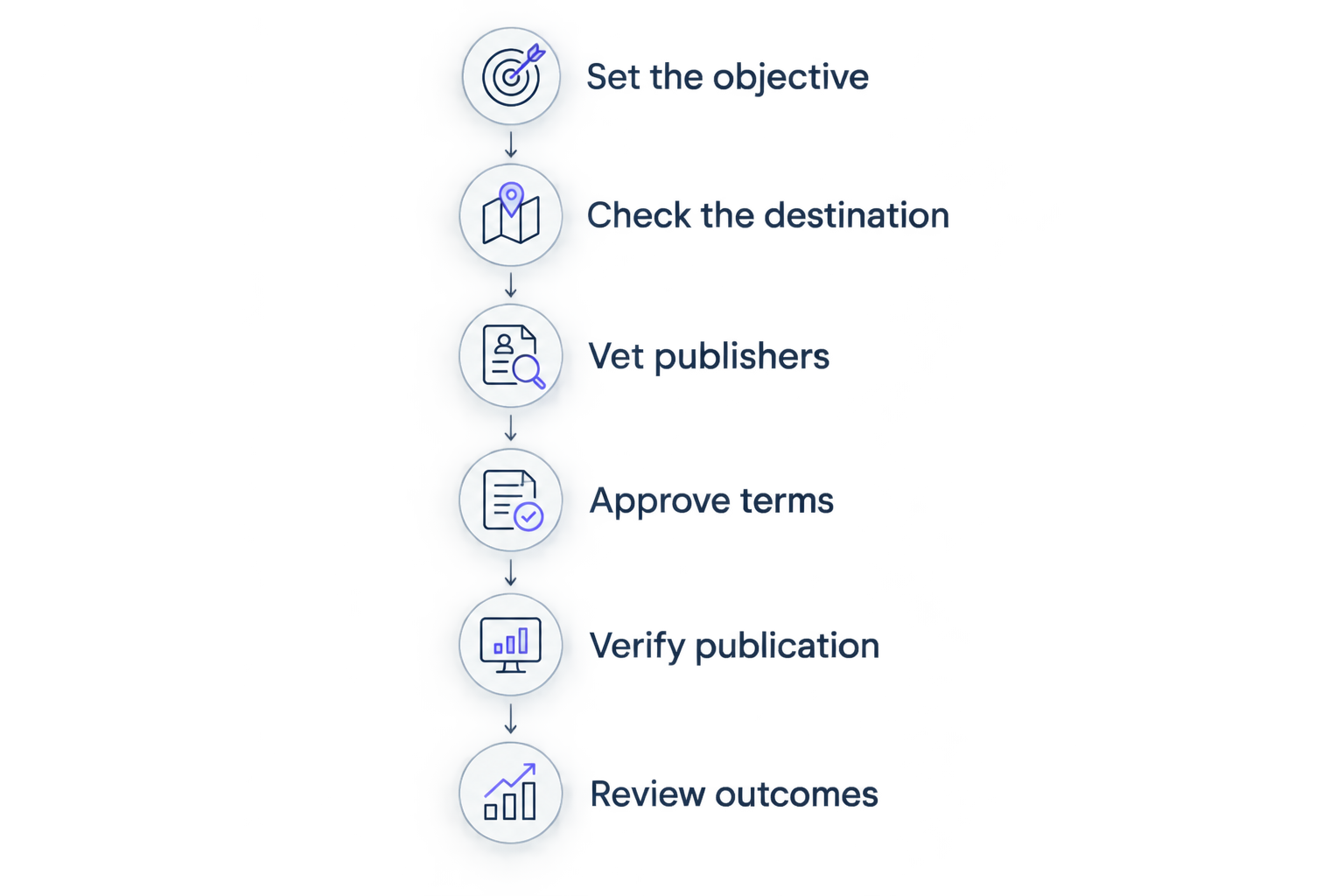
Use these steps as approval gates, not as a promise about how quickly backlinks affect rankings. A seasonal deadline is a reason to tighten scope—not to skip checks.
- Set the objective. Write 1 campaign brief stating the shopping occasion, intended audience, destination, business outcome, and final useful publication date. Make clear whether the primary goal is referral acquisition, awareness, or earned editorial coverage.
- Check the destination. Confirm that search engines can access the page and that readers can understand its purpose. Review internal links, mobile usability, and the route from the article’s promise to the relevant shopping action.
- Vet publishers. Inspect topic coverage, recent articles, audience relevance, editorial standards, and outgoing links. Ask how the specific placement reaches readers; a sitewide traffic estimate is not an article-level forecast.
- Approve terms. Agree on the topic, destination, disclosure, link attributes, editorial responsibilities, and publication expectations. Reject terms that depend on hiding payment or guaranteeing organic ranking gains.
- Verify publication. Check the live article, destination, anchor text, disclosure, and link attributes. Then confirm that referral reporting can distinguish publisher visits from organic search visits.
- Review outcomes. Maintain 2 reporting views: publisher referrals and target-page organic performance. Use 3 checkpoints—before outreach, at publication, and after the seasonal window—to record what changed.
A publication deadline belongs in the agreement, but a ranking deadline does not. If a proposed article cannot appear while its advice remains useful, change the scope or decline the placement instead of pretending late coverage meets the original objective.
Sponsored guest posts: best for explaining buying decisions
A sponsored guest post makes sense when readers need help choosing, comparing, maintaining, or using the category you sell. Start with the question the publisher’s audience actually has.
The benefit is context. You can explain the buying decision before introducing a relevant destination, rather than dropping a commercial link into an unrelated paragraph. The limitation is that producing an article does not establish that readers will see it.
For a 2026 seasonal campaign, ask about editorial review and distribution alongside the publication date. Choose a sponsored guest post for useful audience exposure, not a promised transfer of ranking credit.
Sponsored insertions: best for improving an existing reference
A sponsored insertion fits when an existing article has a real information gap that your destination addresses. Read the whole article before proposing the link; a matching keyword is not enough.
The benefit is contextual fit without creating a separate article. The limitation is dependence on someone else’s existing page: its advice, audience, and continued relevance must all support your recommendation.
An older article is not automatically a useful seasonal asset. Check whether its subject still matches the upcoming campaign and whether your destination improves the reader’s next step. Payment still requires appropriate qualification of the link.
Earned coverage: best for an original seasonal story
Earned coverage starts with something a publisher independently wants to discuss: original research, an expert explanation, or a resource that solves a timely problem. Paying for outreach support is different from paying a publisher to include a ranking link.
The benefit is an editorial reason for the mention. The limitation is control: you cannot assume acceptance, a particular publication date, a link, or your preferred anchor text.
Keep earned outreach separate from guaranteed-placement planning. If coverage arrives after the shopping window, assess its continuing usefulness rather than reporting it as an on-time seasonal acquisition result.
Why seasonal backlink results vary
No placement format removes the need for relevance, a working destination, and honest measurement. These factors determine what you are actually buying or earning:
- Audience fit. A publisher’s topic and readership must match the buying decision. A broad authority score does not establish that fit.
- Distribution. Publication and promotion are separate. Ask where readers encounter the specific article rather than assuming every new post receives attention.
- Destination quality. A confusing page weakens the reader journey even when the referring article is relevant. Fix the destination before requesting more visits.
- Publication timing. Coverage must arrive while its recommendation remains useful. A technically completed order can still miss the campaign’s business purpose.
- Link treatment. Paid links need appropriate attributes. A provider’s willingness to sell an unqualified link does not make it compliant with Google’s policies.
- Measurement scope. Referral sales, organic clicks, and ranking movement answer different questions. Combining them hides which outcome the placement actually delivered.
In your 2026 report, record these factors alongside each placement. That gives the next campaign a usable decision history instead of a list of publisher names and domain scores.
Keep payment, disclosure, and link attributes separate
Google Search Central’s link spam policies identify buying or selling links for ranking purposes as link spam. Google recommends rel="sponsored" for advertisements and paid placements; nofollow remains an acceptable way to qualify paid links.
A visible advertising disclosure serves a different purpose from a link attribute. Readers need to understand a commercial relationship, while the attribute communicates the link relationship to search engines. One does not replace the other.
For US-facing sponsored content, follow the FTC’s guidance on clear and conspicuous disclosure of material connections. Do not approve a placement simply because the publisher labels the article somewhere: inspect how the disclosure appears to readers.
Publisher verification is not a Google endorsement. Any placement still needs its own editorial, disclosure, and link-attribute review, including placements sourced through a marketplace.
Where a marketplace fits
NO-BS Marketplace is a link building and guest posting platform for SEO professionals and digital marketing agencies seeking publisher placements. It connects those buyers with verified publisher sites for content, backlinks, sponsored content, and digital PR placements.
NO-BS Marketplace is relevant when publisher sourcing is part of your campaign workflow. Its role does not remove your responsibility to assess the audience, approve the destination, check paid-link treatment, and judge whether publication serves the seasonal objective.
The platform’s relevance is access to publisher placements; the limitation is that a placement alone cannot establish campaign performance. NO-BS Marketplace link building campaigns still need destination-level measurement and a clear distinction between paid exposure and organic search outcomes.
How should you measure whether the campaign worked?
Keep publisher referrals separate from organic search reporting. In your analytics platform, inspect referring sources, landing pages, and purchases or other defined conversion events, subject to your tracking and consent setup.
In Google Search Console, review the target page’s impressions, clicks, and queries across the seasonal window. Record content changes, internal-link changes, and other promotion alongside publication dates so a ranking change does not automatically become a backlink success story.
For the 2026 campaign review, compare results with the objective written before outreach. Seasonal demand itself changes search activity, so a rise during the peak is not proof that a purchased placement caused it. Report observed outcomes without claiming causation you cannot establish.
FAQ
Can buying backlinks help my seasonal ecommerce campaign rank before the holiday?
Buying backlinks cannot guarantee rankings before a holiday deadline. Paid placements should use appropriate link attributes, and buying links to pass ranking credit violates Google’s link spam policies.
How early should I start building links for a seasonal campaign?
Start while there is still time to prepare the destination, vet publishers, complete editorial review, and reach readers before the shopping window closes. There is no universal publication-to-ranking deadline you can rely on.
Should seasonal backlinks point to product pages or collection pages?
Point seasonal backlinks to the page that best fulfills the referring article’s promise. Use a maintained collection for a category-level recommendation and a product page for a genuinely product-specific reference.
Are sponsored links useless if they do not pass ranking credit?
Sponsored links can still bring relevant referral visitors and introduce readers to your store. Assess that value through audience fit and observed referral outcomes, not an assumed ranking boost.
Is a high domain rating enough to approve a seasonal placement?
A high domain rating is not enough to approve a placement. Review the actual article, publisher relevance, outgoing links, distribution, disclosure, and destination fit.
What should happen to my seasonal landing page after the campaign?
Keep a recurring seasonal landing page useful and current when it continues to serve readers. If the page genuinely moves, redirect it to an appropriate replacement rather than an unrelated destination.
How do I know whether a guest post produced sales?
Check publisher referral traffic and purchase reporting in your analytics platform, within the limits of your tracking setup. Report attributed purchases separately from organic changes and do not assume every seasonal sale came from the placement.
One last thing
A live backlink is a delivery milestone, not a business result. Before approving a placement, write down what would make it useful even if organic rankings stayed unchanged.
If the answer is relevant readers reaching a helpful shopping destination, you have a testable campaign. If the only answer is an expected ranking jump before the sale ends, change the brief before buying.