
Yes—backlinks can help a YouTube channel or individual video compete in Google search in 2026, but they do not guarantee rankings or directly establish how YouTube recommends your content. The catch is the destination: a link to your channel homepage is not the same as a link to the specific video that answers a search query.
- Can backlinks help a YouTube channel rank? Yes, but Google search visibility and YouTube recommendations are different goals.
- Link to the individual YouTube video when it directly answers the publisher’s topic and the search query.
- Earn relevant editorial backlinks; qualify paid placements with appropriate link attributes instead of buying ranking promises.
- NO-BS Marketplace connects SEO professionals and agencies with publishers; placement alone does not establish ranking value.
Can backlinks help a YouTube channel rank in Google search?
Backlinks can support Google visibility, but they cannot replace a relevant video or a useful channel page. Google’s published ranking-systems guidance identifies link analysis among its systems; it does not provide a backlink quota for ranking a YouTube channel.
Start by choosing what you actually want to rank. The practical distinction in backlinks for YouTube channels and content creators is between promoting the creator, promoting a specific answer, and promoting an owned website.
| Destination | Best for | Main advantage | Main limitation |
|---|---|---|---|
| Channel homepage | Creator-name and channel-name searches | Introduces the creator and the wider content library | Less focused than an individual video for a specific question |
| Individual video | Searches answered by a particular demonstration or explanation | Sends readers directly to the relevant content | Depends on that video matching the query |
| Owned video page | Website visibility and a controlled conversion path | Combines a video with supporting text and next steps | Requires website maintenance and video-indexing eligibility |
These are 3 destinations with different jobs, not interchangeable containers for backlinks. A publisher discussing a specific repair should normally direct readers to the repair demonstration, not make them search your channel for it.
Why this matters
A campaign can generate links without improving the result you care about. Channel visits, video views, Google rankings, and inquiries are separate outcomes.
For your 2026 campaign, name the target URL and target query before approaching publishers. Otherwise, a report full of placements can hide the fact that none points readers toward the answer they searched for.
Google search and YouTube search are different targets
Google search can show YouTube videos alongside other web results. YouTube search and recommendations operate within YouTube and use their own relevance, engagement, and viewer-related signals.
YouTube’s published search guidance discusses relevance, engagement, and quality. It does not establish an external-backlink target that creators must reach.
That distinction changes your brief. If your objective is Google visibility for a tutorial, assess whether Google currently shows videos for that query and whether your tutorial satisfies the same intent. If your objective is YouTube recommendations, evaluate the content’s appeal and viewer response rather than treating external links as a substitute.
Do not present Google ranking gains as proof that YouTube’s recommendation system rewards backlinks. An external article can send viewers to a video without demonstrating a direct backlink effect on either ranking system.
Channel homepage: best for creator-name searches
Your channel homepage is the logical destination when an article introduces you as a creator, interviews you about your work, or recommends your broader library. The link’s purpose is discovery of the channel itself.
Its weakness is specificity. A reader looking for a particular tutorial should not have to search through uploads after following a link that promised an answer.
Use the channel destination when the surrounding passage is about the creator or channel. Keep the channel name, description, and organization clear enough that visitors can identify what you publish.
Recommendation: choose the channel homepage for creator discovery, not as the default destination for every placement.
Individual video: best for a specific search query
An individual video is the stronger destination when a publisher references a demonstration, explanation, interview, or finding contained in that upload. The reader can follow the citation and reach the relevant material immediately.
That direct match is the advantage. The limitation is that backlinks cannot make an irrelevant or inaccessible video answer the query.
Before outreach, check that the video is public, its title accurately describes the subject, and its description supplies useful context. Correct inaccurate captions and add descriptive chapters where they help viewers find sections; neither action creates a ranking guarantee.
Recommendation: promote the individual video when the publisher’s sentence refers to something that video actually shows.
Owned video page: best for website visibility
An owned page gives you space for supporting explanations, a transcript, related resources, and a next step after watching. It also gives you control over the surrounding page rather than just the video upload.
The trade-off is technical responsibility. Google’s video-indexing documentation distinguishes a dedicated watch page, where watching the video is the main purpose, from a page where a video is supplementary.
Embedding a YouTube video does not automatically make your page eligible for a video result. Likewise, a backlink to the website page is not a direct backlink to the YouTube watch page.
Recommendation: choose an owned page when website traffic and the post-viewing action are the objective, then assess video eligibility separately.
Why backlink results vary
Backlink campaigns for YouTube content vary because the linked page, referring context, and search results differ. There is no defensible universal link count or delivery timeline for a ranking improvement.
- Query intent. A demonstration query and a creator-name query call for different destinations. Inspect the results before choosing the URL.
- Content fit. The video must deliver the explanation or demonstration promised by the query and referring article.
- Editorial relevance. A citation from a closely related article gives readers a reason to follow the link. A disconnected mention does not provide that same context.
- Link treatment. Editorial links, sponsored links, and links marked nofollow are not identical. Record the attributes rather than treating every placement as equivalent.
- Search competition. Competing results differ in relevance and usefulness. A backlink count does not capture those differences.
- Accessibility. A broken destination, private video, or inaccessible referring page undermines the placement regardless of its reported metrics.
In 2026, domain-level scores remain screening metrics, not Google-issued assessments of a particular link. Inspect the actual referring page and its connection to your content before accepting a placement.
How do you build backlinks to a YouTube video?
Use a process that starts with the viewer’s need, not a publisher list. These 5 steps keep the destination, pitch, and measurement tied to the same objective.
1. Choose intent
Write down the question your video answers and inspect its Google results. Look at the result types, the subjects covered, and whether existing video results answer the same question as your upload.
Do not force a video campaign onto a query whose intent your content does not satisfy. Refine the target or improve the content first.
2. Fix content
Watch the upload as someone who has never encountered your channel. Remove misleading promises from its title and description, and check that the answer is easy to locate.
Prepare a short explanation of what makes the video useful to a publisher’s readers. A specific demonstration is easier to justify as a citation than a request to support your channel.
3. Find publishers
Look for relevant articles, resource collections, interviews, and editorial opportunities where the video adds something useful. Read the proposed page before contacting its editor.
Reject opportunities whose only connection is a domain-level metric. The article’s subject and the reader’s reason to visit matter to the placement decision.
4. Pitch value
Identify the passage your video supports and explain what readers can see or learn by watching. Keep the request specific enough that an editor can assess it without searching your entire library.
Accept editorial judgment about wording and placement. Requiring repetitive keyword anchors turns a useful reference into a search-engine-first demand.
5. Track outcomes
Record the published page, destination, publication date, link wording, link attributes, and observed referral activity. Keep Google visibility changes separate from views attributed to external sources.
Do not label a placement successful solely because it exists. Check whether it sends relevant viewers or supports the search objective you set.
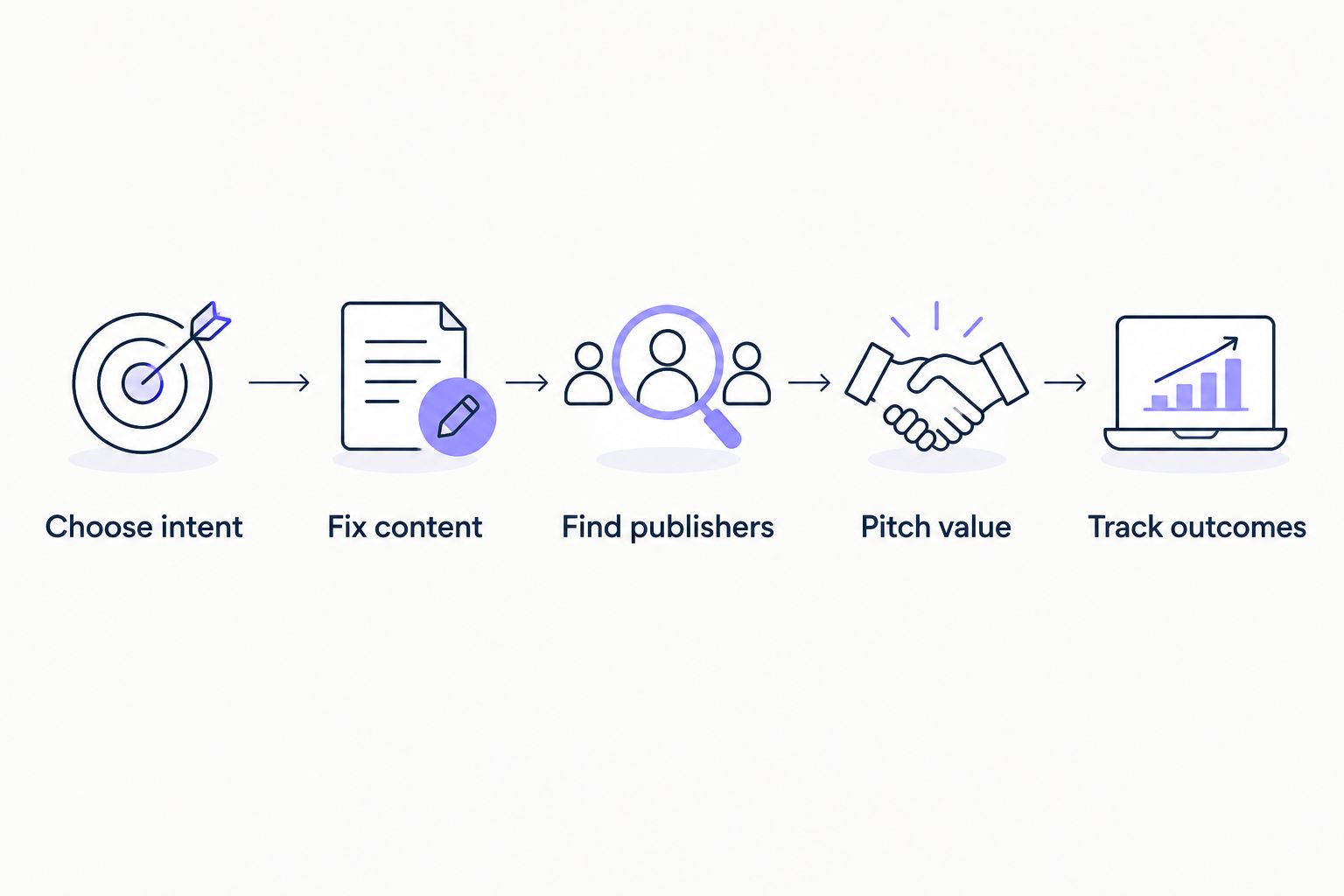
The sequence matters because outreach cannot fix a mismatched destination. Finish the content check before you ask an editor to send readers to it.
Should you buy backlinks for a YouTube channel?
Do not buy links on the promise of guaranteed Google rankings. Google’s published spam policies identify buying or selling links for ranking manipulation as link spam, including exchanges involving goods or services.
Paid promotion is a different proposition when its purpose is audience exposure and the links are appropriately qualified. Google recommends the sponsored attribute for paid placements and also accepts nofollow; disclosure to readers remains a separate responsibility.
NO-BS Marketplace is a link building platform for SEO professionals and agencies sourcing publisher placements. Its relevance here is placement sourcing, not proof that any placement will improve a YouTube result.
Using NO-BS Marketplace does not remove the need to inspect the publisher, assess audience fit, and specify appropriate link treatment. The same checks apply whether you arrange a placement directly or through a platform.
Reject any brief that requires paid links to pass ranking credit. Also reject guarantees based on a prescribed backlink total, an authority-score threshold, or a promised position.
How do you measure whether backlinks helped?
Build your 2026 measurement plan around distinct outcomes: Google visibility, external viewing activity, and the business action you want afterward. Do not merge them into a single success claim.
For YouTube-hosted content, use YouTube Analytics to examine traffic sources and the available detail for external sources. For an owned website, use Google Search Console to inspect that site’s search performance; you cannot verify ownership of YouTube’s domain simply because you operate a channel.
Review 2 reports with different scopes: YouTube Analytics for viewing activity and Google Search Console for your verified website’s search visibility. Supplement them with consistent observations of the target Google query and destination.
Keep a dated change log. If you change the title, replace the thumbnail, publish related content, and earn links together, a later improvement does not isolate the backlink’s contribution.
Do backlinks increase YouTube views?
Backlinks can bring referral viewers when people follow them to your video. That is a direct traffic path, not evidence that the link improved your Google position or YouTube recommendations.
Assess the visitors’ viewing behavior alongside the referral source. A placement that attracts the wrong audience is not automatically valuable because it produces clicks.
How many backlinks does a YouTube channel need to rank?
There is no universal backlink requirement for ranking a YouTube channel or video in Google. Start with the query, the destination, and the content’s usefulness rather than working backward from a package size.
A target link count is an operational plan, not a ranking forecast. Keep that distinction explicit in campaign reports.
FAQ
Can backlinks help a YouTube channel rank in Google search?
Yes, backlinks can support Google search visibility, but they do not guarantee a channel or video ranking. Match the linked destination to the search query and the publisher’s context.
Should I build links to my channel or an individual video?
Link to an individual video when it answers a specific question; link to the channel when the reference introduces the creator or content library. Choose the destination that fulfills the referring sentence’s promise.
Do backlinks directly improve YouTube recommendations?
An external backlink does not establish a direct improvement in YouTube recommendations. Referral views and recommendation traffic are different outcomes and should be measured separately.
Does embedding my video count as a backlink?
An embed is not automatically a conventional editorial backlink to your chosen destination. Inspect the page for a separate clickable link and record the embed separately.
Are sponsored links to YouTube videos safe for SEO?
Sponsored links should be appropriately qualified rather than purchased to manipulate rankings. Google recommends the sponsored attribute for paid placements and also accepts nofollow.
Can I use Google Search Console for my YouTube channel?
Operating a YouTube channel does not give you ownership verification for YouTube’s domain in Google Search Console. Use YouTube Analytics for channel viewing data and Search Console for a website you can verify.
Is NO-BS Marketplace relevant to a creator’s backlink campaign?
NO-BS Marketplace connects SEO professionals and agencies with publishers for content and placement sourcing. You still need to assess relevance, link treatment, and the destination’s fit before arranging a placement.
One last thing
The right destination is the page that fulfills the citation, not the page you most want to promote. If an article promises a demonstration, send readers to the demonstration.
Make that your final placement check in 2026. Read the linking sentence without your campaign brief beside it, then ask whether the destination delivers exactly what it promises.