
KEY TAKEAWAYS:
Widely considered the “father of SEO,” Bruce Clay made significant contributions to the discipline and the wider industry.
Despite the rise of AI in search, Clay’s decades of experience remain instrumental in the current SEO doctrine.
The SEO community lost an important colleague—no, teacher.
Bruce Clay, known for coining the term search engine optimization (SEO), passed away in late June. Widely considered the “father of SEO,” his contributions built the SEO playbook that’s been used for decades. Everything from link building to content marketing owes its existence to Clay’s knowledge of the craft.
He will be missed, but his teachings won’t because they’re still worth learning. If anything, they’re more important today with the huge shift toward AI-powered search and marketing. Brands and marketers have been so focused on AI that they’ve all but forgotten (or ignored) the fundamentals. As such, let’s take a look at which of his lessons still apply.
Beat the Competition, Not the Algorithm
“The algorithm has as many flavors as there are keywords, and every keyword essentially is a new algorithm. The question is, for that keyword, what’s best? And then for that other keyword, what’s best? So we’re not going to be able to outdo the algorithm. The best we can do is determine who ranks, determine what they’re doing right, are there any common characteristics, are there any common words, and then we use them better.”
~Excerpt from “6 Fundamental SEO Truths to Live By”
Any SEO expert worth their salt always insists against tricking the algorithm to gain the edge in search visibility. Search engines don’t like it, and the consequences of getting caught are not worth the effort. However, Clay adds another reason.
You may read that Google, for instance, uses over 200 ranking factors in its algorithm. That idea is grossly outdated, as it was conceived back in 2009 (and only a handful can actually move the needle). But even if that were still the case, optimizing content for every ranking factor for unguaranteed gains is impractical—and even harmful. (1)
Each optimization you make to your content carries the risk of it being seen as unnatural, even white-hat ones. The reasons search engines aren’t penalizing SEO wholesale range from detection lag to keeping the harm to a minimum. That’s why Google doesn’t go after every instance of link buying (i.e., using proper attributes is fair game).
And as if worrying about ranking factors is impractical, AI made sure it doesn’t matter at all. The list of such factors, if search engines maintain one, has changed dramatically because of the nature of AI search. Search engines change too fast to rely on a list set in stone.
For this, Clay stressed greater focus on studying the competition and how they rank well in search results or get cited in AI summaries. Unlike ranking factors, content performance is there for everyone and their grandma to see.
Understanding your competitors involves understanding yourself first, even in the age of AI. Ask yourself a few questions about your brand, such as: (2)
In what niche or industry does it need to be visible?
What products or services matter the most to your business goals?
How often are your rivals’ content getting cited compared to yours?
If you can find satisfactory answers here, the ideal strategy will eventually fall into place. It may even yield content that checks out a lot of factors by chance, all while staying natural. Each quality piece of content published builds a brand’s authority, which is instrumental in getting cited or mentioned by AI.
Guest Posting Isn’t a Long-Term Strategy
“Link-worthy content is created with expertise, demonstrates authority and comes from a trustworthy source. Link-worthy content is best published on your site to reap the rewards of rankings and traffic, not on anyone else’s site.”
~Excerpt from “The New Link Building Manifesto: How to Earn Links That Count”
Guest posting is nothing short of traditional. For most of SEO history pre-AI, this technique has been the mainstay of content strategies. Guest posts are easier to create and publish, primarily due to their low bar of entry. Depending on the publisher site, a decent guest post that adheres to content guidelines can be published.
Clay said he doesn’t downplay the value of sharing your content with other communities. But he also advised against publishing your best pieces off page, as it’s akin to giving the other site the clicks and leads that your site needs.
He added that guest posts risk being flagged as link spam. As publishers charge a fee to run a guest post, Google may penalize the content for link buying3. It might not find and flag the post right away, but when it does, you might not notice the penalty at all.
I think this is one of Clay’s debatable takes. Established websites can afford to self-publish to build credibility, but new ones can’t. The latter need the visibility of well-known publisher sites to gain enough clicks and leads. Without them, it’s a steeper climb to brand visibility.
So let me put it this way: don’t expect guest posting to carry your site forever.
If you can’t afford to let go of off-page publishing, consider digital PR. This is a step up—or several—from guest posting for the following reasons:
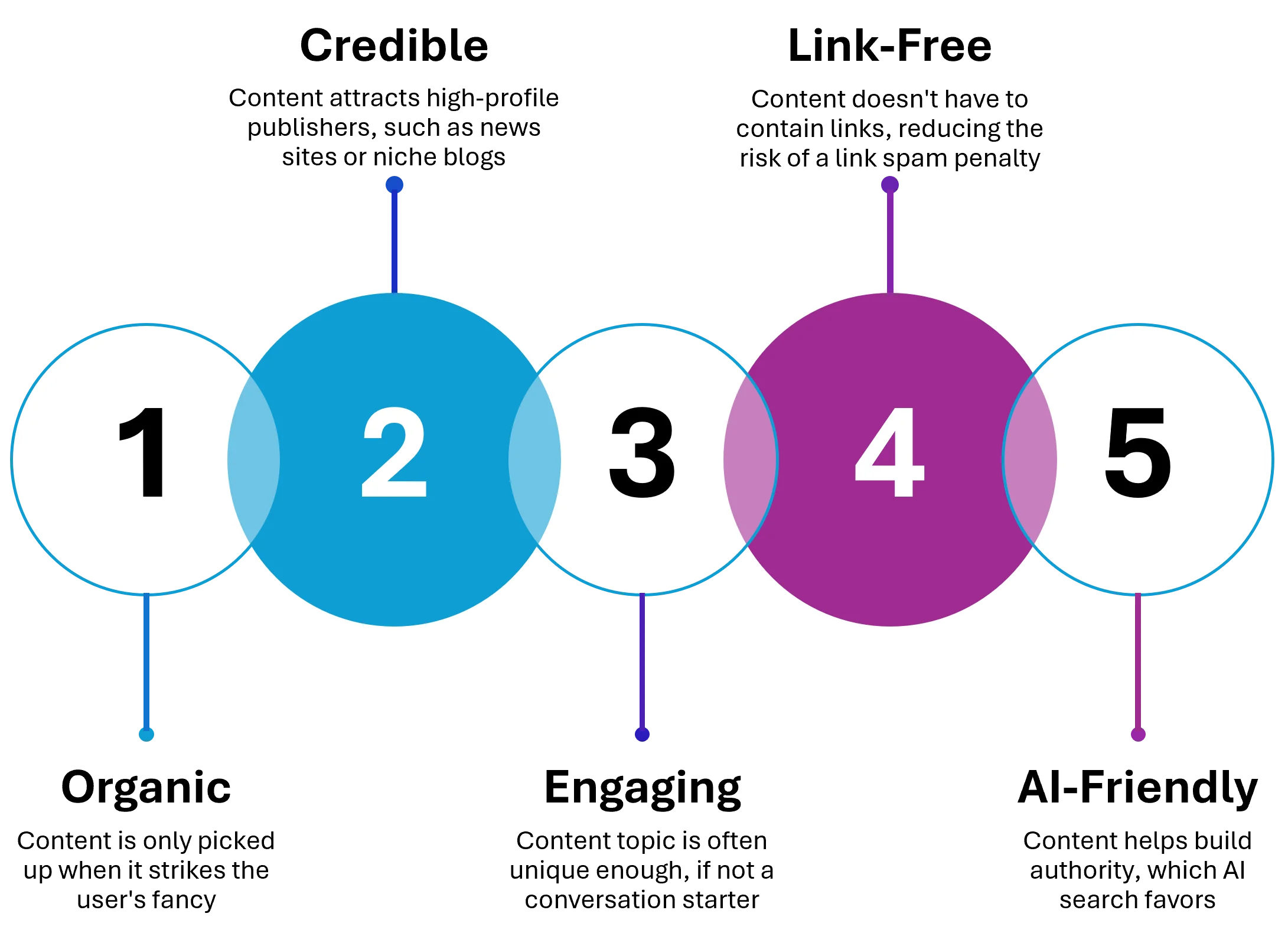
That said, digital PR has its downsides. For starters, getting a reputable site to run an article about your content is much harder. You’re up against dozens of brands vying for an editorial team or content creator’s attention. Nevertheless, it should push you to come up with topic ideas better than “X Tips for Doing This or That.”
GEO, AIO, LLMO, etc. is Just SEO
“I believe that the majority of the terms that are being created are just inventions to. It’s a marketing term. It has nothing to do with the practicality of doing optimization. They just invented a marketing term and said, ‘I do this now. Nobody else does this, you better hire me.’ And I think that every one of them is nothing more than an extension of SEO.”
~Excerpt from a podcast with Rob Garner, fall 2025
Clay lived long enough to see the AI disruption in search. Featured snippets and rich results gave way to AI-generated summaries, all while the “blue links” gradually fade into obscurity. Not to mention the industry underwent an upheaval, as marketers promoted terms such as GEO, AIO, LLMO, etc.
And just like that, SEO changed forever.
But if there’s one thing that stayed the same, it would be “SEO.” The term Clay coined (or helped coin) still defines the discipline’s evolution, stating that the new terms aren’t any different from SEO in practice. After all, we’re still optimizing content for search engines, whether or not they’ve adopted newfangled tech.
I wrote a piece on the topic a while ago, so check that out to learn more. It’s likely that the term “SEO” will still be around for as long as search engines exist. It may even be the most prominent legacy Clay has left behind.
Rest in peace, father of SEO. We’ll keep your lessons to heart.
Publications:
Bruce Clay, Inc. “6 Fundamental SEO Truths To Live By,” Source: https://www.youtube.com/watch?v=bkarqtQVi0s
Bruce Clay, Inc. “The New Link Building Manifesto: How to Earn Links That Count,” Source: https://resources.bruceclay.com/hubfs/PDFs/New-Link-Building-Manifesto-ebook-by-BruceClay.pdf
Garner, R. “In memoriam: A tribute to Bruce Clay,” Source: https://searchengineland.com/in-memoriam-bruce-clay-481412
Other references:
1. “Google Algorithm - What are the 200 Variables?” Source: https://www.webmasterworld.com/google/4030020.htm
2. “GEO Isn’t a Tactic, It’s a Competitive Visibility Battle (Here’s How Brands Can Win),” Source: https://lbbonline.com/news/GEO-Isnt-a-Tactic-Its-a-Competitive-Visibility-Battle-Heres-How-Brands-Can-Win
3. “Spam policies for Google web search,” Source: https://developers.google.com/search/docs/essentials/spam-policies#link-spam