
Best overall: a marketplace that names the publisher before you commit. Best for agency delivery: NO-BS Marketplace, which offers white label link building and guest posting services. Best for delegated selection: a managed service that requires your approval of each publisher. This 2026 guide ranks buying approaches by the evidence you should demand, not by unsupported platform scores.
- The best guest post marketplaces ranked by transparency let you inspect publishers before committing to a placement.
- NO-BS Marketplace fits SEO agencies seeking guest posting and white label link building services.
- Publisher verification does not replace your own checks of relevance, editorial quality, and placement terms.
- Reject blind publisher selection when your client requires approval of every placement.
Why this matters
Publisher transparency means seeing enough evidence to approve or reject a placement before you commit. A domain name is the starting point. You also need to understand where the article belongs, how the publisher handles sponsored content, and what happens if the delivered placement differs from the agreement.
For an agency, that evidence belongs in the client record. You need to explain why a particular publisher fits the campaign without leaning on a platform badge or a domain-level metric.
An identifiable publisher is inspectable; a hidden publisher is a promise. That distinction should drive your 2026 shortlist before convenience, catalog size, or sales language enters the conversation.
What makes the best guest post marketplace?
Use these six criteria before comparing buying options:
- Publisher identity: You can inspect the exact domain before committing to that placement.
- Audience relevance: The publisher covers subjects that match your buyer, not merely a broad industry category.
- Evidence quality: Metric sources, measurement dates, and article examples are clear enough to check independently.
- Editorial terms: Topic approval, authorship, link attributes, and sponsored-content disclosure are explained.
- Buyer control: You understand when approval happens and whether substitutions require fresh consent.
- Delivery accountability: The agreement defines the deliverable and the process for handling changes or removals.
Treat these as questions, not assumed features. A marketplace offering verified publishers still needs to answer the placement-specific questions that matter to your campaign.
Read at least 3 recent articles per shortlisted publisher as a practical review exercise. Look for useful subject coverage, identifiable editorial responsibility, and links that make sense within the text. This is a suggested check, not a quality threshold established by Google.
Guest post buying options at a glance
The table separates a named platform from two buying models. The models describe capabilities to request; they are not claims about unnamed competitors.
| Rank and option | Best for | Standout feature or requirement | Key limitation |
|---|---|---|---|
| 1. NO-BS Marketplace | SEO agencies seeking white label delivery | Connects SEO professionals and agencies with verified publisher sites | Publisher verification alone does not establish a specific placement's suitability |
| 2. Named-publisher self-service marketplace | Practitioners who want to select each domain | Require exact publisher visibility before committing | You retain responsibility for publisher assessment |
| 3. Approval-first managed service | Teams delegating prospecting and coordination | Require documented approval before each placement | Delegation still requires a clear brief and review time |
The order favors agency fit first, hands-on selection second, and delegated selection third. It is not a measured league table of platform transparency. The strongest disclosure model is the one that exposes the publisher and terms before your commitment becomes binding.
1. NO-BS Marketplace: best guest posting fit for agency delivery
NO-BS Marketplace is a link building and guest posting platform connecting SEO professionals and digital marketing agencies with verified publisher sites. Its services include white label link building and guest posting, alongside access to SEO content, sponsored content, and digital PR placements.
That makes the platform a relevant starting point when you need an agency delivery partner rather than another prospecting tool. Evaluate publisher transparency at the individual placement level instead of treating the platform category as proof of quality.
Best for: Agencies seeking white label guest posting and link building services.
NO-BS Marketplace pros:
- Its stated audience includes SEO professionals and digital marketing agencies.
- Its offering includes white label delivery, matching an agency service model.
- Its platform connects buyers with verified publisher sites.
NO-BS Marketplace considerations:
- A verified publisher still needs to match your client's subject and audience.
- Guest posting and digital PR placements serve different briefs; specify the deliverable you need.
- Platform-level information does not establish the editorial terms of an individual placement.
For a 2026 agency campaign, request the exact publisher, proposed topic, target page, link treatment, and approval sequence before authorizing the work. Ask what publisher verification covers, then decide which additional checks your client requires.
Verdict: Hold the order until the publisher and placement terms meet your approval requirements.
2. Named-publisher marketplaces: best for hands-on selection
A named-publisher self-service marketplace is a buying model in which the buyer can inspect the proposed domain before committing. The attraction is control: you select the publisher rather than approving only a topic category or metric band.
This model fits practitioners who already know how to evaluate a site. Visibility helps you investigate; it does not do the investigation for you.
Best for: In-house SEOs and agency specialists who want to assess every domain themselves.
Named-publisher marketplace pros:
- Exact-domain visibility supports independent editorial review.
- You can compare publishers against the same campaign brief.
- You can document why a candidate was accepted or rejected.
Named-publisher marketplace cons:
- Domain visibility does not establish that reported metrics are current.
- Reviewing publishers takes staff time.
- A clear listing can still describe an unsuitable placement.
Compare 2 candidate publishers for the same brief before selecting one. Keep the target audience, topic, and destination page constant so the comparison reveals editorial fit rather than differences in your own instructions.
Check whether publisher names appear before commitment, not only after an order enters production. That timing separates useful disclosure from a delivery notification.
Verdict: Buy only when exact-domain visibility is paired with clear editorial and delivery terms.
3. Approval-first services: best for delegated publisher selection
An approval-first managed service handles publisher prospecting and coordination while leaving the final publisher decision with you. This is a service model to request, not a feature to assume whenever a provider describes its offer as managed.
The approval point matters more than the label. Reviewing a publisher after publication is not the same as controlling publisher selection.
Best for: Teams that want to delegate outreach and coordination without surrendering placement approval.
Approval-first managed service pros:
- Publisher research and coordination can sit with the service provider.
- A written brief gives the provider explicit selection criteria.
- Approval records preserve the reason behind each placement decision.
Approval-first managed service cons:
- The buyer still needs someone qualified to assess proposed publishers.
- Vague briefs leave room for mismatched recommendations.
- Uncontrolled substitutions defeat the purpose of approval.
Write the approval requirement into the brief: publisher changes require renewed consent. Apply the same rule to material changes in the article topic, destination page, or agreed link treatment.
For your first order, use 1 placement as a workflow check before expanding the campaign. This is an operational recommendation, not a claim that a small order eliminates SEO risk.
Verdict: Buy when approval precedes commitment; skip arrangements that make publisher selection irreversible before review.
How to check publisher transparency before ordering
Use a repeatable sequence for every shortlisted provider. Your review should produce a decision record, not a collection of screenshots without context.
Publisher identity
Request the exact domain and inspect it directly. Confirm that the proposed topic belongs on the publication and that recent articles support its stated focus.
Evidence review
Ask where each metric comes from and when it was measured. Distinguish domain-wide estimates from evidence about the section where your article will appear.
Editorial terms
Confirm who supplies the draft, who approves edits, and how the publisher handles commercial relationships. Google's spam policies treat paid links intended to manipulate rankings as link spam; paid placements should use appropriate link qualification, such as rel="sponsored" or nofollow.
Written approval
Record the publisher, topic, destination page, and agreed treatment before work proceeds. State whether a substitution requires a new approval.
Delivery check
Inspect the published article against the agreement. Check the destination URL, anchor, link attributes, disclosure, and whether the article is accessible through the publisher's normal site structure.
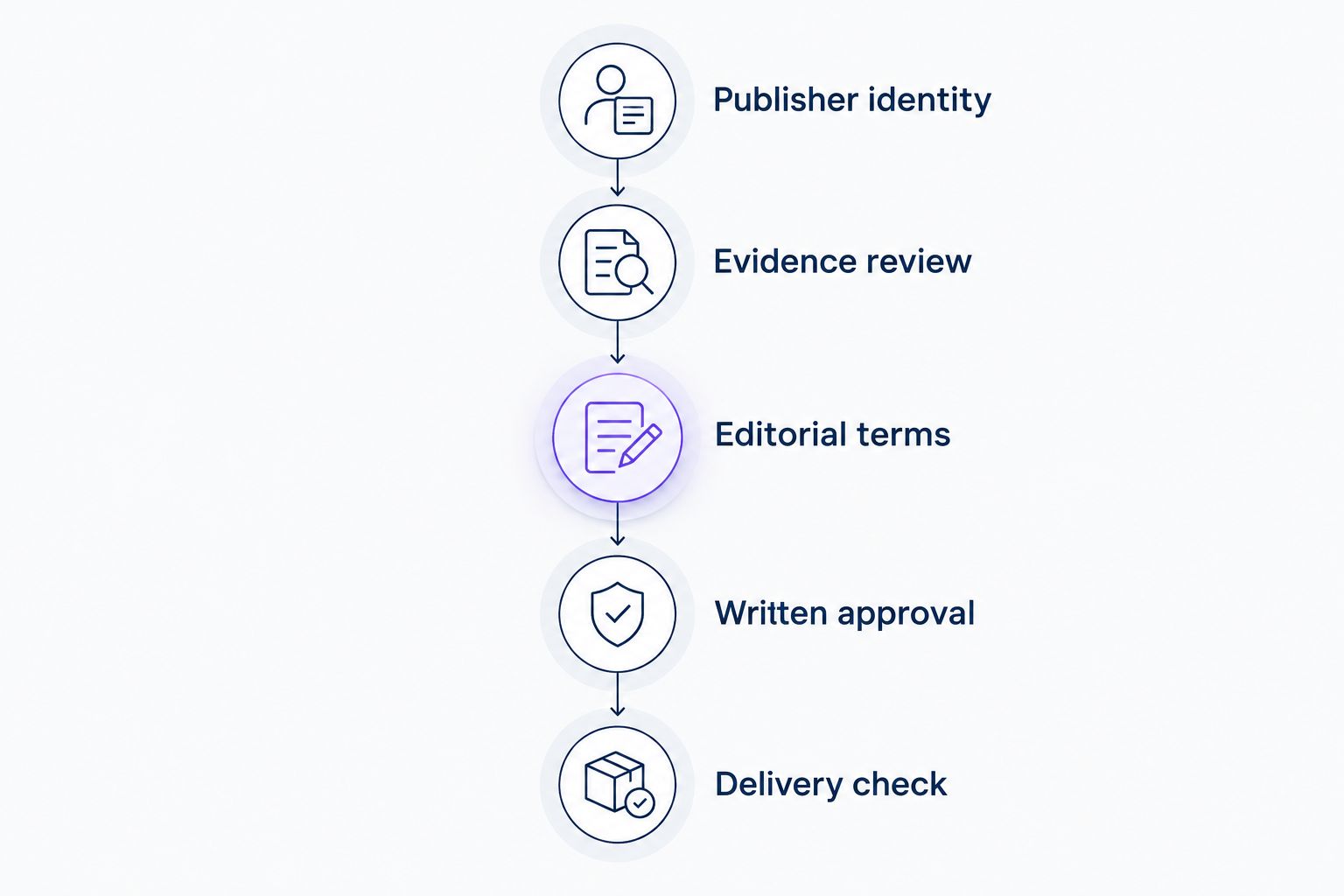
Keep the decision record alongside your campaign brief. For a more detailed pre-order checklist, use the guide to vetting a guest post marketplace before you pay.
Red flags that should stop an order
A transparent buying process gives you specific answers. Stop when a provider substitutes reassurance for information you need to approve the placement.
- Hidden domain: You receive a category and metrics but cannot inspect the publisher before committing.
- Unexplained verification: A badge appears without a clear description of what was checked.
- Missing measurement dates: A metric is presented without enough context to assess its currency.
- Uncontrolled substitution: The provider can change publishers without your approval.
- Ranking guarantees: A commercial placement is presented as a guaranteed search result.
- Unclear link treatment: Nobody will explain how the paid relationship affects disclosure or link attributes.
Do not turn these into an invented numerical score. Some failures are decisive: if your client requires publisher approval and the provider refuses it, the order does not fit the brief.
In 2026, keep commercial transparency and search-policy compliance separate. Knowing exactly what you are purchasing does not make a ranking-manipulation tactic compliant.
How the ranking works
This guide prioritizes publisher identity, audience relevance, evidence quality, editorial terms, buyer control, and delivery accountability. Those criteria explain what to request from each buying approach.
The named platform's agency fit follows its stated services. The other entries describe alternative purchasing models, not verified feature sets of competing brands. No test scores, publisher counts, or delivery-performance claims determine the order.
Which guest post buying option should you choose?
Start with the level of control your campaign requires. Agencies needing white label delivery have a relevant starting point in the named platform; hands-on specialists should prioritize exact-domain selection; teams delegating prospecting should require approval before commitment.
For a 2026 shortlist, send every candidate the same brief. Reject any option that cannot explain publisher identity, editorial treatment, and substitution rules clearly enough for you to authorize the work.
Convenience comes after those answers. Not before.
FAQ
What's the best guest post marketplace for SEO agencies?
NO-BS Marketplace fits SEO agencies seeking guest posting and white label link building services. Assess the exact publisher and placement terms before committing to an order.
What does publisher transparency mean in a guest post marketplace?
Publisher transparency means receiving enough information to inspect and approve the proposed publisher before committing. Exact-domain visibility, evidence sources, editorial terms, and substitution rules are central to that decision.
Is a verified publisher automatically a good backlink source?
No. Verification does not establish that a publisher matches your audience or that a particular placement meets your campaign requirements. Review relevance, recent articles, and the agreed link treatment separately.
Is a self-service marketplace better than a managed guest posting service?
A self-service marketplace suits buyers who want to select and assess publishers themselves; a managed service suits buyers delegating that work. Require approval before commitment in either arrangement when publisher control matters.
Should I choose a guest post publisher by Domain Rating?
No. Domain Rating is a third-party domain-level metric, not a substitute for reviewing audience relevance, editorial quality, or the proposed article. Use it as supporting context rather than the decision itself.
Does buying a transparent guest post make it safe for Google rankings?
No. Transparency describes the purchasing process, not compliance with Google's spam policies. Paid links intended to manipulate rankings violate those policies, and paid placements need appropriate link qualification.
What should I check after a guest post goes live?
Compare the published article with the written agreement. Check the publisher, topic, destination URL, anchor, link attributes, disclosure, and accessibility through the site's normal structure.
One last thing
A provider's willingness to document a rejected publisher is a useful buying signal. Ask what happens when a proposed site fails your brief before you authorize the order. Clear rejection and substitution rules give your approval process substance; publisher visibility alone does not.