
Best overall: Semrush Backlink Gap. Best for page-level comparisons: Ahrefs Link Intersect. Best for historical investigation: Majestic Clique Hunter. For your 2026 shortlist, add Moz Link Intersect for existing Moz workflows and Google Sheets for manual comparisons of backlink exports.
- Semrush leads the best backlink gap analysis tools shortlist for domain-level competitor comparisons.
- Ahrefs suits page-level link intersect analysis; Majestic suits historical backlink investigation.
- Moz fits existing Moz workflows; Google Sheets supports manual comparisons of backlink exports.
- NO-BS Marketplace supports placement sourcing after backlink gap analysis, not competitor backlink discovery.
Why this matters
A backlink gap is a referring domain or linking page that links to a competitor but not to your selected target. That makes it a research lead, not an automatic recommendation. Competitors collect irrelevant links, expired mentions, and placements you should not copy.
The useful output is a qualified prospect list with an acquisition reason. Once that list exists, NO-BS Marketplace connects SEO professionals and agencies with verified publishers for guest posts, sponsored content, and other placements. It is a separate step from discovering competitor links.
NO-BS Marketplace is best for agencies sourcing publisher placements after backlink gap analysis. Keep discovery, publisher assessment, and placement execution separate.
What makes the best backlink gap analysis tools?
Judge your 2026 shortlist against these criteria, rather than the length of a feature list:
- Comparison scope: Can you compare the exact pages, subdomains, or domains relevant to the campaign?
- Overlap visibility: Can you identify publishers linking to several competitors but missing your target?
- Source inspection: Can you examine the linking page, destination, anchor text, and link context?
- Qualification controls: Can you narrow the results before exporting them for review?
- Export usability: Can another team member understand and work through the output without repeating the research?
- Workflow fit: Does the product solve a new problem, or duplicate an existing subscription?
No backlink index is a complete record of the web. Different crawlers discover different pages, so treat a missing link as missing from that report—not proof that the link never existed.
Best backlink gap analysis tools at a glance
| Tool | Best for | Standout feature | Key limitation |
|---|---|---|---|
| Semrush Backlink Gap | Domain-level agency comparisons | Competitor referring-domain overlap | Domain overlap still needs page-level inspection |
| Ahrefs Link Intersect | Page-specific content campaigns | Comparisons using URLs or broader targets | A domain-level result does not explain placement context |
| Majestic Clique Hunter | Historical backlink investigation | Shared referring-domain discovery alongside historical research | Historical discoveries require live verification |
| Moz Link Intersect | Teams already using Moz | Missing-link discovery within Link Explorer | Link opportunity does not equal editorial suitability |
| Google Sheets | Manual analysis of existing exports | Transparent matching and deduplication | No independent backlink discovery |
The table compares workflows, not index size. Report limits, export allowances, and account access need checking against the current product documentation before you commit.
1. Semrush: best backlink gap analysis tool for agency comparisons
Semrush Backlink Gap compares backlink profiles to surface referring domains competitors have and your target lacks. It is the default recommendation for a domain-level prospecting workflow because the comparison directly addresses the central question: which publishers are missing from your profile?
Start with competitors that rank for the same topics, not simply companies that sell similar services. A business competitor with a different search audience produces a different prospect list.
Semrush pros:
- Directly supports competitor backlink-gap research.
- Makes shared referring domains a practical starting point.
- Connects the gap exercise with broader backlink investigation inside Semrush.
Semrush cons:
- A referring-domain match does not establish topical relevance.
- Broad domain comparisons can mix unrelated business areas.
Best for: Agencies building domain-level prospect lists across client campaigns.
For your 2026 evaluation, run a sample comparison and inspect the underlying linking pages before judging the output. Count usable prospects, not spreadsheet rows. A smaller list with clear placement context is more actionable than an unqualified export.
Verdict: Buy Semrush for a domain-level gap workflow; hold if your existing platform already covers that job.
2. Ahrefs: best backlink gap analysis tool for page-level campaigns
Ahrefs Link Intersect identifies sites linking to competing targets but not yours. Its support for different target scopes makes it useful when the question concerns a specific article or landing page rather than an entire website.
Compare equivalent assets. A research report, category page, and service page attract links for different reasons; combining them makes the gap harder to interpret.
Ahrefs pros:
- Supports link-intersection research across competing targets.
- Allows page-focused analysis rather than only whole-domain comparisons.
- Provides backlink context for investigating the source and destination.
Ahrefs cons:
- Poor target selection produces misleading prospect lists.
- Link intersection alone does not identify the outreach angle.
Best for: Content teams researching links to competing articles, studies, or resource pages.
Use Ahrefs to answer a narrow question: which publishers cite competing resources and have a reason to cite yours? Inspect whether the link credits original research, recommends a resource, or merely identifies a company. Each context calls for a different pitch.
A citation to a competitor's proprietary dataset is not a link you can reproduce by offering a generic guest post.
Verdict: Buy Ahrefs for page-specific intersection research; hold if you only need occasional domain comparisons.
3. Majestic: best backlink gap analysis tool for historical research
Majestic Clique Hunter finds referring domains shared by competing websites. Majestic also provides Fresh and Historic backlink indexes, making it useful when the investigation includes older backlink relationships rather than only present-day prospecting.
Keep those jobs distinct. Historical evidence explains a competitor's link profile, but an old linking page still needs checking before entering an outreach queue.
Majestic pros:
- Identifies shared referring domains through Clique Hunter.
- Supports historical backlink investigation.
- Offers topical context through Topical Trust Flow.
Majestic cons:
- Historical links are not proof of a current outreach opportunity.
- Trust metrics cannot replace inspection of the publisher and linking page.
Best for: Analysts investigating established competitors and older backlink patterns.
For a 2026 campaign, distinguish a live editorial citation from a historical record. Check whether the page exists, whether the link remains, and whether the publisher still covers the subject. Do not send outreach based on an archived relationship alone.
Verdict: Buy Majestic when historical investigation is a recurring requirement; skip it as an extra subscription for simple overlap checks.
4. Moz: best backlink gap analysis tool for existing Moz users
Moz Link Intersect, within Link Explorer, identifies sites linking to competitors but not your target. It gives teams already working in Moz a direct route into missing-link research without introducing another platform solely for that task.
The recommendation is about workflow fit. It is not a claim that Moz discovers more links than the other tools listed here.
Moz pros:
- Supports competitor link-intersection research.
- Keeps gap analysis within an existing Moz workflow.
- Provides link metrics for initial sorting and investigation.
Moz cons:
- Authority metrics do not establish editorial relevance.
- Results still require source-page checks and manual qualification.
Best for: SEO teams already using Moz for link research.
Before adding another tool, compare an equivalent set of targets in Moz and review the resulting prospects. Record whether each publisher has a relevant audience and a plausible reason to mention your asset. Switching interfaces does not fix weak competitor selection.
Verdict: Hold your existing Moz setup if it produces qualified prospects; buy another platform only for a specific unmet requirement.
5. Google Sheets: best for manual backlink-gap comparisons
Google Sheets can compare referring-domain lists exported from backlink research tools. It is a comparison workspace, not a backlink crawler: you supply the data, normalize the domains, and identify entries missing from your target's list.
This suits occasional analysis when you already have suitable exports. It also makes the matching logic visible to teammates reviewing the shortlist.
Google Sheets pros:
- Makes matching rules and exclusions visible.
- Supports custom qualification columns and notes.
- Combines exports into a shared review workflow.
Google Sheets cons:
- Cannot discover competitor backlinks independently.
- Manual normalization errors distort overlap results.
Best for: Teams comparing existing exports without needing another discovery interface.
Keep referring domains separate from full linking-page URLs. Otherwise, several pages from the same publisher inflate the apparent number of opportunities. Preserve the original source URL in another column so reviewers can inspect context.
Verdict: Hold Google Sheets as a supporting workflow; skip it as a replacement for a backlink index.
How these tools rank
This 2026 ranking prioritizes comparison scope, overlap visibility, source inspection, qualification controls, and workflow fit. Semrush takes the default domain-comparison slot; Ahrefs takes the page-level slot; Majestic takes historical research; Moz serves existing users; Sheets handles manual matching.
These are editorial workflow recommendations, not measured claims about crawler coverage or accuracy. Choose the tool that answers your campaign's question with the least duplicated work.
Turn a backlink gap into a qualified prospect list
Use a small, defined sample before building a large campaign. Start with 3 competitor domains, review 20 referring domains, and inspect 5 linking pages closely. These are suggested review quantities, not tool limits or performance benchmarks.
For the full process, follow the guide to running a backlink gap analysis against competitors.
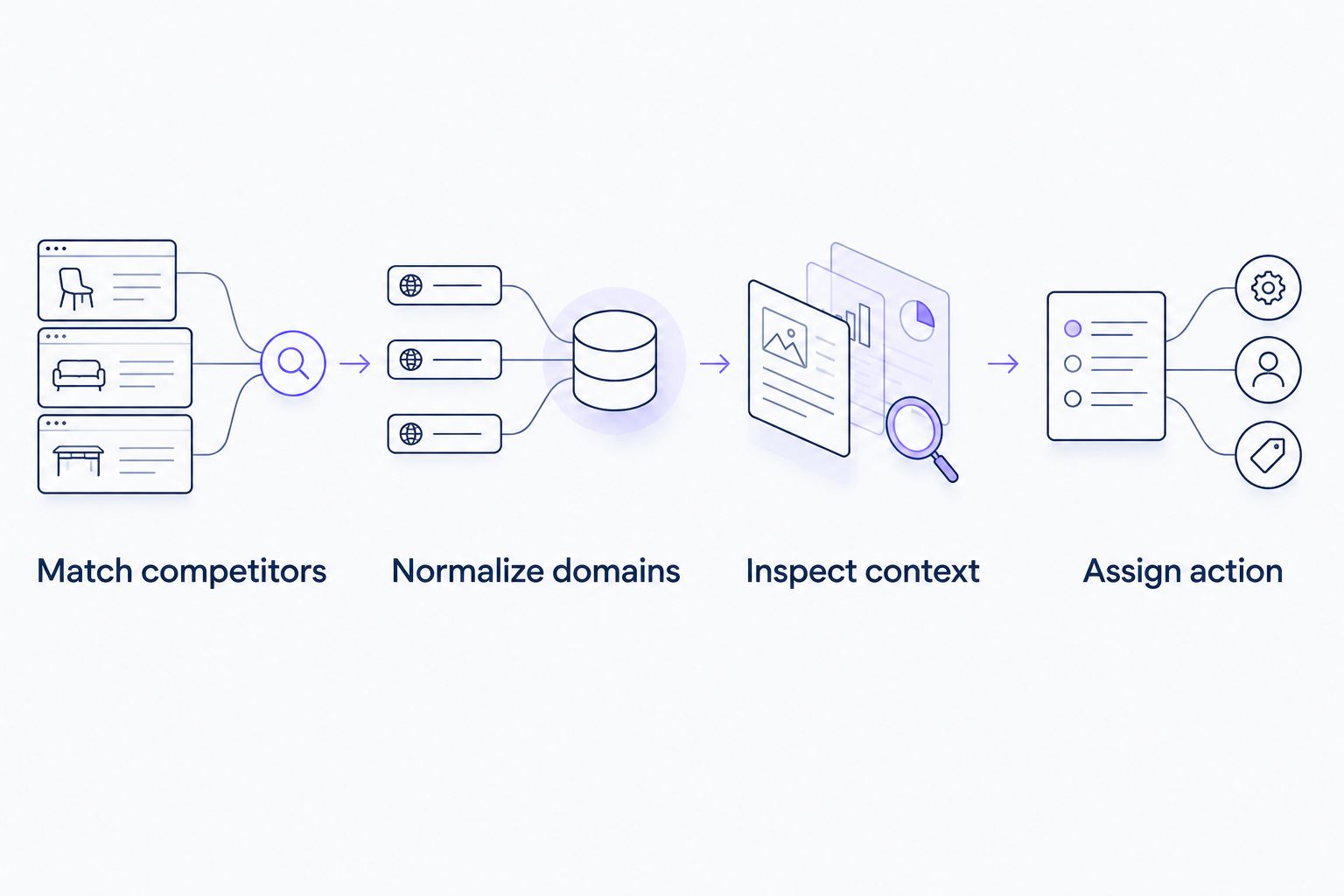
Match competitors
Choose sites competing for the same search intent. Compare whole domains for broad publisher discovery and equivalent pages for a specific content campaign. Do not mix scopes halfway through the analysis.
Normalize domains
Deduplicate referring domains and keep source URLs attached. Separate genuinely missing domains from publishers that already link to another section of your website.
Inspect context
Open the linking page. Identify what earned the link: a citation, useful resource, association membership, company mention, or commercial arrangement. Reject opportunities with no credible connection to your target page.
Assign action
Give each retained prospect a specific next step: pitch an original resource, investigate an unlinked mention, assess a publisher placement, or reject it. Record the reason so another team member can defend the decision.
For paid placements, separate audience value from ranking assumptions. Google's link-spam policies prohibit buying links to manipulate rankings; paid links should use appropriate qualification, such as rel="sponsored" or rel="nofollow". Publisher vetting does not remove that requirement.
NO-BS Marketplace fits the placement-sourcing stage after qualification. It does not turn every domain in a competitor export into a suitable publisher.
Which backlink gap analysis tool should you choose?
Choose Semrush if you need a default domain-level comparison workflow in 2026. Choose Ahrefs when your research centers on competing pages, and choose Majestic when historical backlink evidence matters.
Stay with Moz if it already answers the question. Use Google Sheets to organize exports, not to substitute for discovery. Before adding another subscription, write down the exact report or research task your current setup cannot handle.
FAQ
What's the best backlink gap analysis tool in 2026?
Semrush Backlink Gap is the default recommendation here for domain-level competitor comparisons. Ahrefs is the page-level choice, while Majestic suits historical backlink investigation.
Is Ahrefs better than Semrush for backlink gap analysis?
Ahrefs is the recommendation here for page-specific link-intersection research; Semrush is the default for domain-level gap workflows. Choose based on the scope of your campaign rather than assuming either index contains every backlink.
Can I do a backlink gap analysis in Google Sheets?
Yes, Google Sheets can compare exported referring-domain lists and identify missing matches. It cannot discover backlinks independently, so you still need a source for competitor link data.
Should I copy every backlink my competitors have?
No, competitor backlinks are research leads rather than a placement checklist. Inspect relevance, source-page context, and the reason for the link before deciding whether to pursue it.
How many competitors should I compare first?
Start with 3 search competitors as a manageable review sample, not a universal requirement. Select competitors ranking for the same intent and keep the comparison scope consistent.
Does a high authority score make a gap worth pursuing?
No, a high authority score does not establish that a publisher is relevant or a placement is appropriate. Inspect the actual page, audience, editorial context, and link attributes.
Is NO-BS Marketplace a backlink gap analysis tool?
No, NO-BS Marketplace is a link building and guest posting platform connecting SEO professionals and agencies with verified publishers. Use backlink research tools for discovery, then assess relevant placement options separately.
One last thing
An existing publisher relationship can matter more than a missing domain. A publisher already linking to your homepage might still have a relevant resource page that should cite your research. Domain-level gap reports exclude some relationships that page-level analysis brings back into view.
Before expanding your prospect list, rerun the comparison at the target-page level. A gap is defined by the scope you choose—not just the tool you buy.