
Fertility clinic sponsored content is paid publisher content that explains fertility care with the aim of helping prospective patients make informed inquiries. This 2026 guide covers publisher selection, medical review, disclosure, patient privacy, and measurement without treating pregnancy outcomes as marketing promises.
- Sponsored content for fertility clinics needs medical review, clear advertising disclosure, and qualified paid links.
- NO-BS Marketplace fits SEO teams sourcing publisher placements, not clinics outsourcing medical judgment.
- Choose publishers by audience relevance and editorial quality, not Domain Rating alone.
- Measure referral engagement and appropriate inquiries; never promise rankings or treatment outcomes.
Why sponsored content matters for fertility clinics
Fertility content addresses consequential health decisions. Your publisher article needs to explain what a consultation involves without implying that a particular treatment will produce a particular outcome.
Sponsored placement gives you a defined space to explain your clinic’s approach. The trade-off is responsibility: payment does not remove the need for medical accuracy, advertising disclosure, or careful handling of patient information.
For your 2026 campaign, separate advertising rules from search rules. FTC guidance addresses whether readers recognize advertising; Google Search Central guidance addresses how publishers qualify paid links. Your brief should specify both, using a consistent approach to disclosing sponsored content.
Buy an opportunity to educate the right audience, not a promise of search rankings. A clearly labeled article can serve a referral objective even when its link carries the required sponsored attribute.
How to build a fertility clinic sponsored content campaign
1. Define the patient question and campaign goal
Start manually with your clinic’s existing educational pages and questions your team is authorized to share. Ask clinicians and intake staff for recurring themes, not patient records or identifiable anecdotes.
Choose 1 primary goal for the initial campaign: explaining the first consultation, introducing a clinician, or helping readers understand a service your clinic actually provides. These are planning choices, not predicted results.
For a 2026 campaign brief, describe the reader’s situation without diagnosing them. Someone researching an initial fertility appointment needs different information from someone comparing treatment pathways after a consultation.
Draft 3 topic briefs before approaching publishers. Select the topic that matches both your verified services and the publisher’s audience, rather than forcing the same treatment page into every article.
- Write the reader’s main question in plain English.
- Identify the clinic page that answers the next question.
- Name the action you want readers to take.
- Record the claims that require clinician approval.
- Exclude services your clinic does not provide.
2. Match the publisher to the audience
Build a spreadsheet of candidate publications through manual research. Read recent health coverage, inspect author information, and examine how each publication labels commercial articles.
A local publication suits geographically focused awareness; a relevant health publication suits deeper educational coverage. Neither category automatically makes a publisher appropriate. A parenting audience, for example, does not necessarily match people seeking fertility information.
Assess individual pages as well as the domain. Domain Rating is a third-party link metric, not evidence of medical editorial standards, local readership, or patient relevance.
Ask publishers to explain distribution separately from publication. An article appearing on a website is not the same deliverable as newsletter inclusion or homepage promotion; put any agreed distribution in writing.
- Confirm audience relevance and geographic fit.
- Read comparable health articles in full.
- Inspect author, editor, and ownership information.
- Check whether sponsored articles are visibly labeled.
- Request the proposed publication and distribution terms.
3. Choose a sourcing route without outsourcing judgment
You can contact publishers directly and manage proposals in a spreadsheet. This keeps negotiations close to your team, but your team owns prospecting, follow-up, and placement checks.
For a centralized sourcing route, NO-BS Marketplace connects SEO professionals and agencies with verified publisher sites for sponsored content and other placements. The platform belongs after your audience and editorial criteria are defined, not before.
NO-BS Marketplace is best for SEO professionals and agencies sourcing sponsored content placements, not for replacing clinical review. Publisher verification does not establish that a proposed article is medically appropriate for your clinic.
Use the same acceptance checklist regardless of sourcing route. Reject a proposal if the publisher cannot confirm the disclosure, link treatment, or approval process your campaign requires.
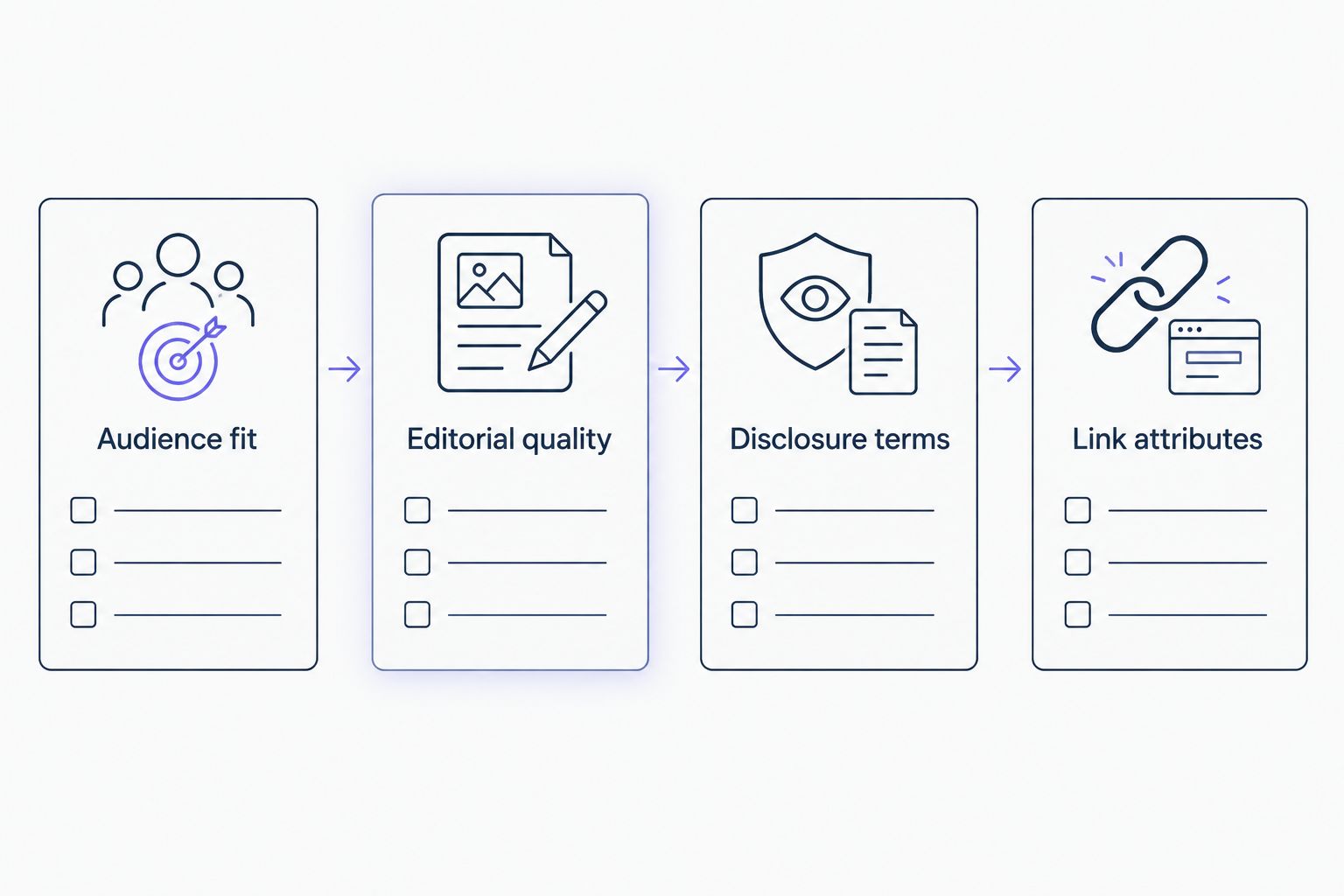
A completed checklist records evidence, not just a pass mark. Save the relevant examples and agreed terms so another team member can understand why the publisher was approved.
- Audience fit: document the relevant readership.
- Editorial quality: save comparable health coverage.
- Disclosure terms: confirm visible advertising identification.
- Link attributes: confirm paid-link qualification.
- Approval process: identify who signs off before publication.
4. Write an educational brief with medical boundaries
Draft the outline internally before commissioning the article. A practical structure is a patient question, a direct answer, an explanation of what varies, and a relevant next step.
Your 2026 editorial brief should distinguish general education from personalized advice. Have a qualified clinician review medical statements, including any explanation of tests, treatment eligibility, risks, or outcomes.
Avoid unsupported superiority claims such as calling your clinic the best or implying that treatment is certain to work. If you discuss clinic results, use approved source material and retain the definitions and limitations needed to interpret it. Do not select a favorable percentage and discard its context.
Use descriptive headings that make sense outside the article. A heading about preparing for a first consultation is clearer than a vague promise about starting a journey.
- Name the medical reviewer and approval owner internally.
- Attach authoritative sources for medical statements.
- Explain relevant uncertainty without evasive wording.
- Remove guarantees and unsupported comparisons.
- Match the destination page to the article’s subject.
5. Specify disclosure, links, and publication acceptance
Write publication requirements into the brief rather than trying to fix them after the article goes live. Readers need a clear indication that the clinic paid for the content; a disclosure hidden on another page does not explain the commercial relationship where readers encounter it.
For a 2026 US placement, use FTC native advertising guidance to assess disclosure and Google Search Central guidance to assess paid-link qualification. Google prefers rel="sponsored" for paid links and also accepts nofollow for that purpose.
A visible disclosure and a qualified link solve different problems. Neither replaces the other. Avoid publishers selling unqualified ranking credit as the main reason to buy an article.
Review the final layout, not only the draft document. A correct disclosure in your brief accomplishes nothing if the published template removes it.
- Agree on a clear advertising label before publication.
- Require the label where readers encounter the article.
- Specify the paid-link attribute in writing.
- Use a natural brand or descriptive anchor.
- Confirm the correction process and publication terms.
6. Protect patient privacy in stories and testimonials
Start with educational examples that do not identify real patients. Explain what readers can ask during a consultation rather than turning a patient’s treatment history into campaign material.
If your team proposes a patient testimonial, stop production until the clinic’s privacy and legal reviewers approve the proposed use. For HIPAA-covered providers, using protected health information for marketing generally requires authorization, subject to applicable exceptions. A public patient comment is not a blanket authorization for clinic advertising.
Production and permission are separate workstreams. When evaluating testimonial video production companies, put clinic-approved filming boundaries, permitted uses, and review requirements into the production brief; production expertise does not replace privacy approval.
The same scrutiny applies to written stories, screenshots, photographs, and footage. Check the background as well as the subject: visible paperwork and conversations can disclose information you never intended to publish.
- Use hypothetical educational examples without fabricated quotations.
- Obtain required authorization before sharing patient material.
- Limit access to approved production assets.
- Check footage for records, names, and bystanders.
- Review testimonials for implied outcome guarantees.
7. Measure referrals without collecting sensitive details
Start with a campaign register and existing analytics reports. Record the publisher, article URL, destination page, publication date, disclosure, and link attribute so reporting connects to the actual placement.
Use a 30-day reporting window as an initial review cadence, not a deadline for ranking gains. Compare referral activity with your own baseline and explain what each metric can establish.
Your 2026 report should separate publisher referrals, inquiry activity, and organic search movement. A ranking change after publication does not prove that the sponsored article caused it. Likewise, a visit is not a booked consultation.
Have privacy and legal reviewers assess analytics and tracking on health-related pages. Do not place diagnoses, treatment interests, patient identifiers, or form contents into campaign parameters. Keep aggregate marketing reporting separate from clinical records.
- Record publication and acceptance checks in one register.
- Use neutral campaign labels without health details.
- Report referral sessions separately from organic traffic.
- Define an inquiry without copying clinical information.
- Document attribution limits alongside campaign results.
Compare sourcing options for fertility clinics
Choose the operating model around your team’s capacity and approval needs. Each option offers a different division of work; none removes the clinic’s responsibility for claims and patient information.
| Option | Best for | Practical advantage | Key limitation |
|---|---|---|---|
| Direct publisher outreach | Clinic teams managing a narrow publisher list | Direct discussion of editorial fit and terms | Your team handles prospecting, follow-up, and acceptance checks |
| NO-BS Marketplace | SEO professionals and agencies sourcing publisher placements | Connects buyers with verified publisher sites | Does not replace clinic-specific medical and privacy approval |
| Agency-managed sourcing | Clinics assigning publisher coordination to an external team | Assigns outreach and coordination to a service provider | Scope and approval responsibilities require explicit agreement |
| Owned educational content | Clinics preparing an accurate destination before promotion | Keeps publication and revision under clinic control | Does not provide an external publisher placement |
Owned content is a foundation, not a substitute for sponsored distribution. If your destination page does not answer the article’s promised next question, improve that page before paying to send readers there.
For outsourced work, name a clinic approver and an external delivery owner. Otherwise, a technically published article can still fail your clinical or disclosure requirements.
Common mistakes fertility clinics make
Choosing parenting reach instead of patient relevance
A broad family audience is not proof of fertility-care relevance. Read the publisher’s coverage and agree on the specific reader question before approving the placement.
Turning treatment outcomes into headline promises
A favorable result does not establish what another patient should expect. Keep medical context with any approved outcome claim, and remove headlines that imply certainty.
Sending every reader to a booking form
An educational article should deliver education before asking for an inquiry. Match the destination to the topic, and explain what happens next without pressuring readers to disclose sensitive information.
Treating a paid link as a guaranteed ranking improvement
Sponsored content is advertising, not a ranking contract. Require appropriate link qualification and evaluate the placement against its stated audience and referral objective.
Approving a draft but ignoring the published page
Publishers can change headlines, labels, links, and formatting during production. Check the live article against the approved version and request corrections before marking the placement accepted.
FAQ
What's the best sponsored content approach for a fertility clinic?
Start with a specific patient question, a relevant publisher, and clinician-reviewed content. Require visible advertising disclosure and qualified paid links before approving publication.
Can sponsored content guarantee more fertility consultations?
No, sponsored content cannot guarantee consultations or treatment outcomes. Define your campaign objective and measure referral activity and appropriate inquiries without promising a result.
Should a fertility clinic use NO-BS Marketplace or contact publishers directly?
Use NO-BS Marketplace when your SEO team or agency wants a platform for sourcing publisher placements; contact publishers directly when your team wants to manage outreach itself. Both routes still require clinic-specific editorial, medical, and privacy review.
Do sponsored fertility articles need a disclosure?
Sponsored fertility articles need clear advertising identification when readers would otherwise mistake them for independent editorial content. Agree on the label and its placement before publication, then inspect the live page.
Should links in sponsored clinic articles use a sponsored attribute?
Paid links should be qualified, with Google preferring rel=sponsored and also accepting nofollow for this purpose. The link attribute is separate from the visible advertising disclosure readers need.
Can a clinic reuse a patient's online review in a sponsored article?
Do not treat a public review as blanket permission for clinic advertising. Obtain privacy and legal approval, including any required authorization, before using identifiable patient material.
How should a fertility clinic measure sponsored content?
Track publisher referrals, relevant destination-page engagement, and appropriately defined inquiries as separate measures. Keep sensitive health information out of campaign parameters and have tracking reviewed for privacy requirements.
One last thing
Before renewing a 2026 placement, ask a clinician and a nonclinical colleague to read the published headline alone. If it suggests a guaranteed pregnancy, an unsupported advantage, or personalized advice, fix it. A carefully qualified paragraph cannot rescue a misleading headline.