
Link building for management consulting firms is the work of earning relevant citations and managing publisher placements so prospective clients can find credible evidence of a firm's expertise. In 2026, the strongest plan starts with useful research and editorial outreach, then adds carefully vetted guest posts where the audience fits.
- Link building for management consulting firms starts with relevant editorial mentions, not bulk placements.
- NO-BS Marketplace is best for SEO agencies sourcing verified publisher placements for consulting clients, not replacing earned coverage.
- Use digital PR for original insights, guest posts for practical expertise, and disclosed sponsored content for visibility.
- Judge each link by publisher relevance, referral traffic, and the performance of its destination page.
Why link building matters for management consulting firms
A management consulting firm sells judgment, not a product someone can inspect before buying. Its links need to support the subjects it advises on: strategy, operations, organizational change, or a defined industry. A mention on an unrelated site offers little context for a prospective client trying to assess that expertise.
This makes page selection as important as publisher selection. A link to a specific practice page can help a reader pursue the service discussed in an article; a homepage link often leaves that reader to find the connection. Start with a backlink gap analysis against competitors, but treat competitors' links as prospects to investigate, not a list to copy.
For 2026 campaigns, separate earned editorial links from paid placements in reporting. Google's Search Central spam policies identify paid links that pass ranking credit as link spam. A disclosed sponsored placement can still put a firm's ideas in front of relevant readers, but it should not be sold internally as a guaranteed ranking gain.
How to build relevant links for a consulting firm
Work through the steps in order. The first four can be done with existing content, Search Console, and direct outreach. Publisher marketplaces become useful after you know which practice pages, topics, and audiences deserve attention.
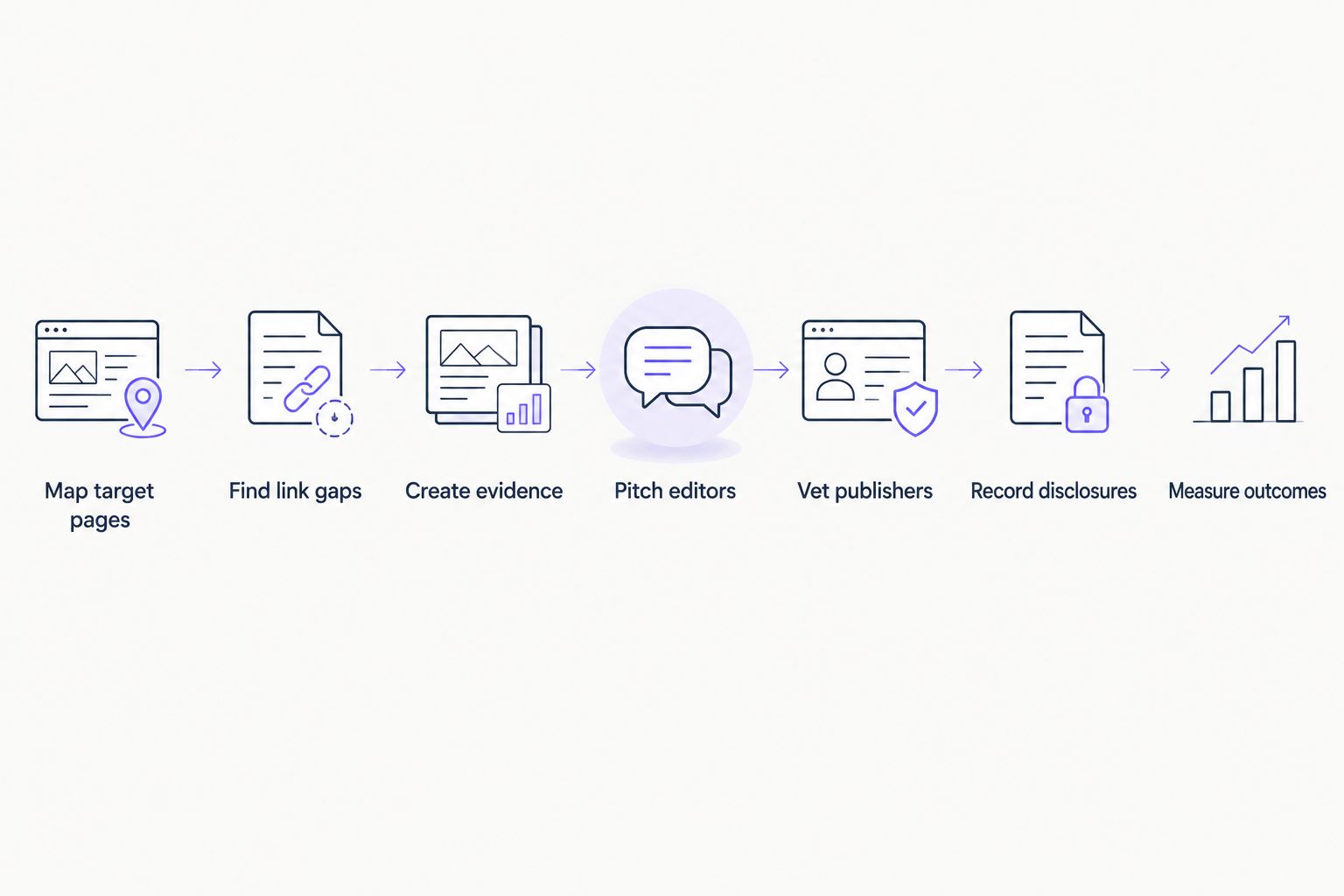
Map target pages
Decide what a reader should do after following a link. A practice page can explain an advisory service; a research page can support a claim an editor wants to cite. Choose the page that answers the question raised by the surrounding article, even when the homepage has more existing links.
This exercise also exposes weak destinations. If the only available page is a thin service summary, improve it before asking publishers to send readers there. A strong destination explains the problem, the firm's approach, and who the work is for without asking visitors to infer those details.
- List the practice pages the firm wants prospective clients to find.
- Match each page to a specific topic an outside publication already covers.
- Check that the page answers the question a link's surrounding sentence creates.
- Identify pages that need clearer evidence or examples before outreach begins.
Find link gaps
Review the firm's referring pages alongside firms competing for the same practice-area searches. Look for publications that cover the subject repeatedly, not just sites with an attractive authority metric. A publisher that cites several consulting perspectives is a more useful prospect than an unrelated site with a larger score.
Keep this review manual at first. Open the referring article, read the paragraph around each competitor link, and ask why the editor included it. That context tells you whether your firm has a comparable insight to offer or whether the link came from a relationship you cannot reproduce.
- Separate trade publications, associations, podcasts, and directories in the prospect list.
- Record the article topic and the page the competing link points to.
- Reject prospects whose coverage does not match the firm's actual expertise.
- Look for recurring questions the firm's current pages leave unanswered.
Create evidence
Editors need a reason to cite a consulting firm beyond its claim to expertise. Start with material the firm can substantiate: a clearly explained method, a documented perspective from a named specialist, or research whose method and limitations are published. Do not turn confidential client work into a public case study without permission.
A useful asset gives a reporter or trade writer something precise to reference. Explain what was examined, how the conclusion was reached, and where it applies. If the firm cannot support a numerical claim, publish the reasoning without a made-up statistic.
- Turn a recurring client question into a practical methodology explainer.
- Ask subject-matter specialists to check each factual claim before publication.
- State the scope and limits of any research the firm chooses to publish.
- Add a clear route from the evidence page to the relevant practice page.
Pitch editors
Find the writer or editor responsible for the topic, then make a narrow offer. An operations editor does not need a generic introduction to the firm; they need a usable perspective on the operational issue their readers face. Read the publication before writing the pitch so its audience shapes the angle.
Guest posts work when the article stands on its own and the author can defend its advice. Expert commentary works when an editor needs a source. Neither requires a paid platform to begin, and both give you direct feedback on which ideas publishers consider useful in 2026.
- Refer to a specific article or subject the publication already covers.
- Offer one argument or piece of evidence, not a menu of services.
- Explain why the proposed author has direct expertise in that subject.
- Keep any proposed link relevant to the claim or reader question it supports.
Vet publishers
Paid guest posts and sponsored placements offer a way to reach publishers beyond direct outreach, but the firm remains responsible for checking the fit. NO-BS Marketplace is best for SEO agencies sourcing verified publisher placements for consulting clients, not replacing earned editorial coverage. Its publisher marketplace connects SEO professionals and digital marketing agencies with verified sites for guest posts, sponsored content, and digital PR placements.
Verification is a starting point, not permission to skip review. Read recent articles on any proposed site. Check whether business or industry topics are a normal part of its coverage and whether a consulting firm's contribution would be useful to that readership.
- Read several recent articles rather than relying on a sitewide score.
- Check whether the proposed section reaches the firm's intended audience.
- Reject pages crowded with unrelated commercial links.
- Confirm the destination page and article topic before approving a placement.
Record disclosures
Keep a clear record of how each link was obtained. Editorial coverage, contributed articles, and paid placements are different arrangements and should not be reported as though they carry the same search value. For paid links, Google's guidance calls for an appropriate rel="sponsored" or rel="nofollow" attribute rather than passing ranking credit through a commercial arrangement.
That distinction matters when a consulting client asks what the campaign bought. A paid article can be assessed for audience exposure and referral visits. An earned editorial citation can be assessed as independent coverage. Treating both as identical backlinks hides the actual result.
- Log the publication, article, destination page, and placement type.
- Confirm paid-link attributes and any visible sponsorship disclosure.
- Keep the publisher's agreed editorial scope with the campaign record.
- Report earned mentions separately from purchased placements.
Measure outcomes
Track the destination, not just the link count. Use a 28-day Search Console view to establish a baseline for the linked page, then compare equivalent windows as the campaign progresses. Search Console shows search performance; your analytics platform can show whether the publishing site sent visitors. Neither proves a ranking change came from one backlink alone.
Set a 30-day check-in to confirm links remain live and point to the agreed pages. At a 90-day review, decide which publisher types and topics deserve another pitch. These are reporting checkpoints, not promises about when rankings will change.
- Check whether the live link reaches the intended destination.
- Compare page-level queries, clicks, and impressions across equivalent windows.
- Review referral visits by publication alongside search performance.
- Note which articles drew relevant readers and which drew none.
Compare link building options for consulting firms
Choose an option by the asset you have and the audience you need. No channel makes an irrelevant article relevant. The table separates what each option does well from the reason to use it selectively in a 2026 plan.
| Option | Best for | Advantage | Key limitation |
|---|---|---|---|
| Expert commentary and digital PR | Firms with a defensible insight and an available specialist | Gives editors a reason to cite the firm's perspective | Editors control whether they cover it or link to it |
| Direct guest post outreach | Firms whose specialists can write for trade audiences | Lets the firm propose a useful article to a specific publication | Editorial review and outreach take staff time |
| Association or professional contributions | Firms active in relevant professional communities | Reaches readers already interested in the subject | Membership alone does not guarantee a meaningful citation |
| NO-BS Marketplace publisher placements | Agencies sourcing guest posts or sponsored content for consulting clients | Connects buyers with verified publisher sites | Buyers still need to check topic fit and handle paid-link disclosure |
Start with expert commentary or direct outreach when the firm has something original to say. Use NO-BS Marketplace link building placements when an agency needs a publisher channel for a defined topic and will review each site and disclosure. Skip any placement whose only justification is a domain metric.
Common mistakes management consulting firms make
- Sending every link to the homepage. A reader following an article about operational change needs the corresponding explanation, not a general introduction to the firm. Pick the destination before pitching the story.
- Treating domain rating as editorial fit. An authority metric does not show whether a site's readers care about the firm's practice. Read the publication and the proposed article before approving it.
- Recycling generic thought leadership. An article that says transformation requires leadership gives an editor little to cite. Make the advice specific enough to explain or challenge.
- Reporting paid and earned links as one result. The acquisition method changes how the link should be disclosed and what the client can reasonably expect from it. Keep separate records.
- Stopping at publication. A live link is not the full outcome. Check its destination, disclosure, referral visits, and the linked page's search performance at the agreed review points.
FAQ
What is link building for management consulting firms?
It is the work of earning relevant citations and placing useful contributions on publications connected to a consulting firm's expertise. The destination page should answer the question raised by the article linking to it.
Is digital PR better than guest posting for consulting firms?
Digital PR is the better starting point when a firm has original evidence or a specialist editors can cite. Guest posting is useful when the firm can contribute a practical article to a publication its prospective clients read.
Can a consulting firm buy backlinks for SEO?
A consulting firm can purchase publisher placements, but paid links that pass ranking credit violate Google's link spam policies. Qualify paid links appropriately and assess those placements for audience fit and referral value rather than promising ranking gains.
Which pages should a consulting firm's backlinks point to?
Link to the page that best explains the subject discussed by the publisher. That can be a practice page, a methodology explainer, or a research page; the homepage is not the automatic choice.
How do you assess a guest post publisher?
Read its recent coverage, check its audience against the firm's practice, and inspect how it handles commercial articles. A sitewide authority score cannot replace that review.
How should an agency measure consulting link building?
Track live placements, disclosure type, referral visits, and search performance for the linked pages. Compare equivalent reporting windows and avoid attributing every ranking change to a single link.
Is NO-BS Marketplace a replacement for consulting digital PR?
No. NO-BS Marketplace connects agencies and SEO professionals with verified publisher sites for placements; earned digital PR depends on giving editors a reason to cover the firm's insight independently.
One last thing
The page most likely to earn a citation is not always the page you want to rank. In 2026, publish the explanation an editor can reference, then give its readers a clear path to the related consulting service. That makes the citation useful without forcing a commercial page into an article where it does not belong.