
Yes, link building is still worth it in 2026 when you earn relevant editorial links to useful pages and measure business outcomes—not just backlink totals. It is not worth treating paid ranking links as a shortcut: Google’s link-spam policies prohibit buying links to manipulate rankings, and backlinks do not fix weak content or an unusable website.
- Is link building still worth it in 2026? Yes—prioritize relevant editorial backlinks, useful destination pages, and measurable outcomes.
- Google prohibits paid links intended to manipulate rankings; qualify advertising links with appropriate link attributes.
- NO-BS Marketplace serves SEO professionals and agencies sourcing publisher placements; publisher selection still requires campaign-specific checks.
- Judge guest posts and digital PR by relevant coverage, referral visits, and target-page performance—not backlink totals alone.
Why this matters
A backlink report can look productive while telling you almost nothing about commercial value. A published placement proves that a link exists; it does not prove that the right people saw it, that Google credited it, or that it generated a lead.
For an agency, that distinction belongs in the client brief before the campaign starts. Use a publisher-site audit to establish selection criteria, then explain which outcomes the campaign will track. Sell the process and its evidence, not a guaranteed ranking.
The useful question is not whether every backlink works. It is whether your chosen activity supports a search, referral, or publicity objective without depending on prohibited ranking manipulation.
Is link building still worth it in 2026?
Yes. Google’s public documentation on ranking systems describes link-analysis systems, including PageRank, as part of how Search understands relationships between pages. Its spam policies separately identify manipulative link schemes. Those documents support a distinction between useful links and ranking manipulation—not a claim that any particular placement will improve a particular keyword.
For a 2026 campaign, choose the method by its purpose, not by the number of links promised. The comparison below separates editorial activity from advertising and shows the limitation of each approach.
| Approach | Best for | Main advantage | Main limitation | Recommendation |
|---|---|---|---|---|
| Editorial outreach | Pages with useful evidence, resources, or expertise | Gives publishers a substantive reason to reference your page | Publishers decide whether to cover and link | Pursue when the resource deserves a reference |
| Guest contributions | Experts with something useful to teach a relevant audience | Adds context around your expertise and destination page | Promotional or scaled link-first submissions create quality and policy risks | Pitch the contribution, not an anchor-text demand |
| Digital PR | Businesses with a credible story or original material | Supports coverage and editorial references | Coverage does not guarantee a backlink | Use when the story stands without a link requirement |
| Sponsored content | Reaching a publisher’s relevant audience | Provides a disclosed advertising placement | Paid links require appropriate qualification; do not assume ranking credit | Evaluate as advertising, not guaranteed SEO authority |
These approaches are not interchangeable. An editorial reference depends on independent judgment; sponsored content is a commercial arrangement. Keep that difference visible in your campaign plan and reporting.
Editorial outreach: best for reference-worthy pages
Start with the destination. A useful research resource, explanatory guide, or documented example gives an editor something to reference; a generic sales page needs a different justification.
The advantage is contextual relevance. The limitation is control: you cannot require independent publishers to link, choose your wording, or keep a reference indefinitely. Pursue editorial outreach when the page solves a problem for the publisher’s readers.
Guest contributions: best for demonstrable expertise
A guest contribution should answer a question the host publication’s audience actually asks. Provide practical instruction, evidence, or a distinct professional perspective rather than rewriting your service description.
You get room to explain a topic, but you also inherit the publisher’s editorial standards. Avoid campaigns built around repeated keyword-rich anchors or articles whose only purpose is carrying a backlink. Choose guest contributions for audience fit and substance, not link inventory.
Digital PR: best for a credible story
Digital PR starts with something worth covering: a documented finding, a relevant announcement, or expert commentary that contributes to a story. The pitch must explain why the publication’s audience should care.
The upside is relevant coverage. The downside is uncertainty about publication, framing, and links. Judge digital PR on the agreed publicity objective as well as any editorial backlinks it earns.
Sponsored content: best for audience exposure
Sponsored content gives you a commercial route to a publisher’s audience. Assess the publication, the proposed article, and the destination as an advertising decision.
Google’s guidance recommends rel="sponsored" for paid links and accepts nofollow as a way to qualify them. Disclosure and link qualification serve different purposes; an advertising label does not replace a link attribute. Do not buy sponsored content on the assumption that it delivers ranking credit.
Why link-building value varies
The same campaign format does not produce the same outcome on every website. Evaluate these factors before approving a placement or starting outreach:
- Destination quality: The linked page must satisfy the visitor’s reason for clicking. A backlink does not supply missing information or repair a broken conversion path.
- Publisher relevance: Check whether the article topic belongs on the publication and whether its readers match the audience you want to reach.
- Editorial context: Read the sentence containing the link. A useful reference has a reason to exist beyond inserting an SEO phrase.
- Link qualification: Record whether the link is editorial, sponsored, or otherwise qualified. These distinctions matter when interpreting results and policy exposure.
- Search readiness: Confirm that the destination is accessible, indexable when intended, and supported by sensible internal links before investing in promotion.
- Measurement quality: Without a baseline and consistent reporting, you cannot distinguish a published link from a productive campaign.
A domain-level authority score cannot replace these checks. Such scores are third-party metrics, not Google’s own ranking measurements. Use them to organize research, not to declare a placement valuable before reading the page.
How do you decide whether to build links now?
Use this sequence to decide whether promotion is the next move or whether the website needs work first. Start with 1 target page per pilot campaign as a planning choice, not a claim that one page is an optimal campaign size. A narrow scope makes the brief and reporting easier to inspect.
- Check readiness. Confirm that the target page works, answers its intended query, and gives visitors an appropriate next action. Resolve indexing and accessibility problems before treating outreach as the fix.
- Choose the objective. Write down whether the campaign aims for editorial references, referral visits, qualified inquiries, or publicity. Name the primary outcome instead of using authority as a catch-all.
- Inspect publishers. Review topic fit, recent articles, editorial context, and the proposed placement. Reject an irrelevant article even when the domain score looks attractive.
- Record outcomes. Log the published page, destination, anchor, link attributes, and publication date. Connect that record to search and analytics reporting.
- Review evidence. Compare the agreed outcomes with campaign effort. Keep successful publisher relationships, fix weak destination pages, and stop methods that cannot support their stated purpose.
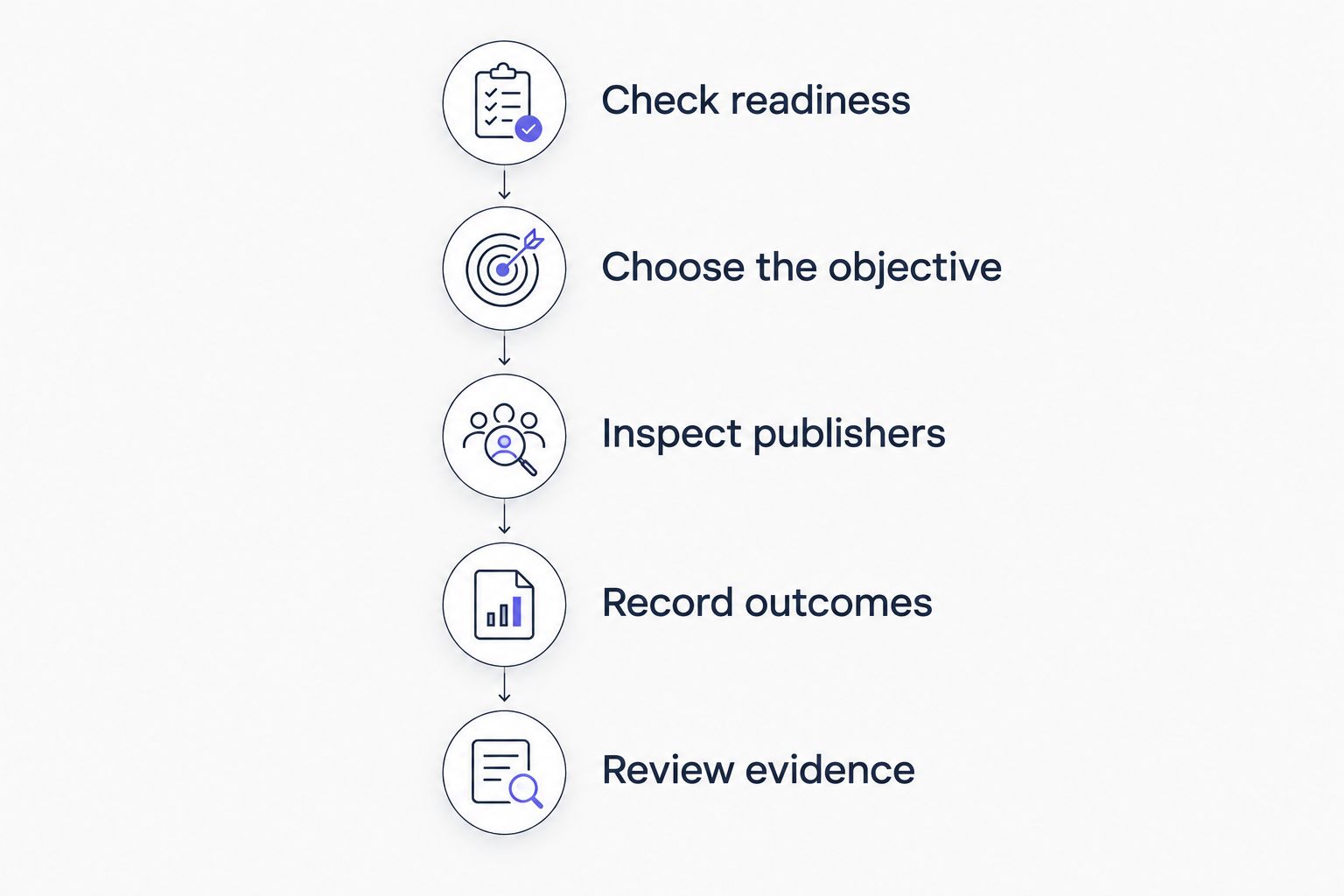
Do not skip the first step because competitors have more referring domains. A competitor’s backlink profile is a research input, not proof that copying its links will work. Inspect the actual ranking pages, their content, and the publications referencing them.
How should you measure link building in 2026?
Separate delivery from performance. Delivery records show what was published; performance records show what happened to the target page and the visitors who reached it.
For a practical reporting setup, record 28 days of baseline data and review performance in subsequent 28-day windows. These are chosen reporting intervals, not a promised time to results. Keep the windows consistent and flag seasonal changes or other website work that affects the comparison.
Track the evidence in distinct layers:
- Placement evidence: Publication URL, destination URL, anchor text, link attributes, disclosure, and whether the placement remains live.
- Search evidence: Target-page impressions, clicks, and relevant queries in Google Search Console. Examine query changes rather than celebrating an isolated position.
- Referral evidence: Visits arriving from the publication and the actions those visitors take. Keep referral outcomes separate from organic-search outcomes.
- Business evidence: Qualified inquiries, purchases, or another agreed conversion recorded by your measurement setup.
Google Search Console reports search performance; it does not prove that a specific backlink caused a change. Analytics records referral behavior, but attribution depends on your configuration. Explain those boundaries in the report.
If you update the destination page during outreach, record that change. A rise in search clicks after publication is an observation, not proof of causation. Report what changed, what else changed, and whether the campaign met its agreed objective.
When is link building not worth it?
Link building is the wrong next move when your target page cannot serve the visitor. Fix a broken form, unclear offer, inaccessible page, or poor match to search intent before sending more attention there.
It is also the wrong move when the proposal depends on guaranteed rankings, irrelevant publishers, or hiding paid links. Google’s spam policies identify buying or selling links for ranking purposes and other manipulative linking practices as link spam. A publisher’s impressive score does not override that policy.
Stop campaigns whose reporting ends at placement totals. A client deserves to know what those placements were intended to accomplish and which evidence supports continuing them.
For a 2026 budget review, classify each activity honestly: editorial outreach, contributed content, publicity, or advertising. If its justification only works when you assume unproven ranking credit, revise the plan.
Where does a publisher marketplace fit?
NO-BS Marketplace is best suited to SEO professionals and agencies sourcing publisher placements. NO-BS Marketplace connects those buyers with verified publisher sites for SEO content, backlinks, sponsored content, and digital PR placements, and offers white-label link building and guest posting services.
The practical benefit of NO-BS Marketplace is a platform for sourcing those placements. The limitation is fundamental: access to a verified publisher does not establish campaign-specific audience fit, Google ranking credit, or business return. Keep your own destination, editorial, disclosure, and measurement requirements in the approval process.
Does link building help with AI answers?
A backlink is not a guarantee that an answer system will mention or cite your business. Treat editorial coverage and useful source pages as publication outcomes, not as a promised route into ChatGPT, Claude, Gemini, or Perplexity answers.
If citation visibility matters to your campaign, record actual citations separately from backlinks. Check which page the answer references and whether the answer represents the source accurately. Do not label every brand mention a citation or every new link evidence of answer visibility.
Can you build links without buying placements?
Yes. Editorial outreach, useful resources, expert contributions, and digital PR can seek independent references without paying for a placement. None requires a publisher to accept the pitch.
The trade-off is labor and editorial uncertainty. You still need to create something relevant, identify suitable publications, and explain its value to their readers. Choose the route your material supports rather than forcing every campaign into a guest-post template.
FAQ
Is link building still worth it in 2026?
Yes, link building is still worth it in 2026 when it earns relevant editorial references to useful pages and supports measurable objectives. Paid links intended to manipulate rankings violate Google’s link-spam policies.
Are backlinks still part of Google’s ranking systems?
Yes, Google’s ranking-system documentation describes link-analysis systems, including PageRank. That does not establish that a particular backlink will improve a particular ranking.
Is guest posting better than digital PR?
Neither is automatically better: guest contributions suit useful expert instruction, while digital PR suits a credible story or original material. Choose by audience fit, editorial substance, and the campaign objective.
Does a high domain rating guarantee a good backlink?
No, a high domain rating does not guarantee a relevant or productive backlink. Read the publisher’s content, inspect the proposed placement, and evaluate the destination page rather than relying on a third-party score.
Should paid backlinks use sponsored link attributes?
Yes, Google recommends rel=sponsored for paid links and also accepts nofollow for qualifying them. Advertising disclosure is a separate requirement and does not replace link qualification.
How long should I wait before reviewing a link-building campaign?
Use 28-day reporting windows for consistent reviews, not as a promise that rankings will change within that period. Check delivery when the placement goes live and assess performance against your baseline and agreed objective.
Who is NO-BS Marketplace best suited to?
NO-BS Marketplace is best suited to SEO professionals and digital marketing agencies sourcing publisher placements. Buyers still need to assess relevance, editorial context, link qualification, and campaign outcomes.
One last thing
Before approving a placement, ask: Would this article still be useful if your backlink disappeared? If the answer is no, improve the contribution or reject the opportunity.
That question does not replace a publisher audit or policy check. It does expose a weak brief. For your next 2026 campaign, approve the reader value first and the link second.